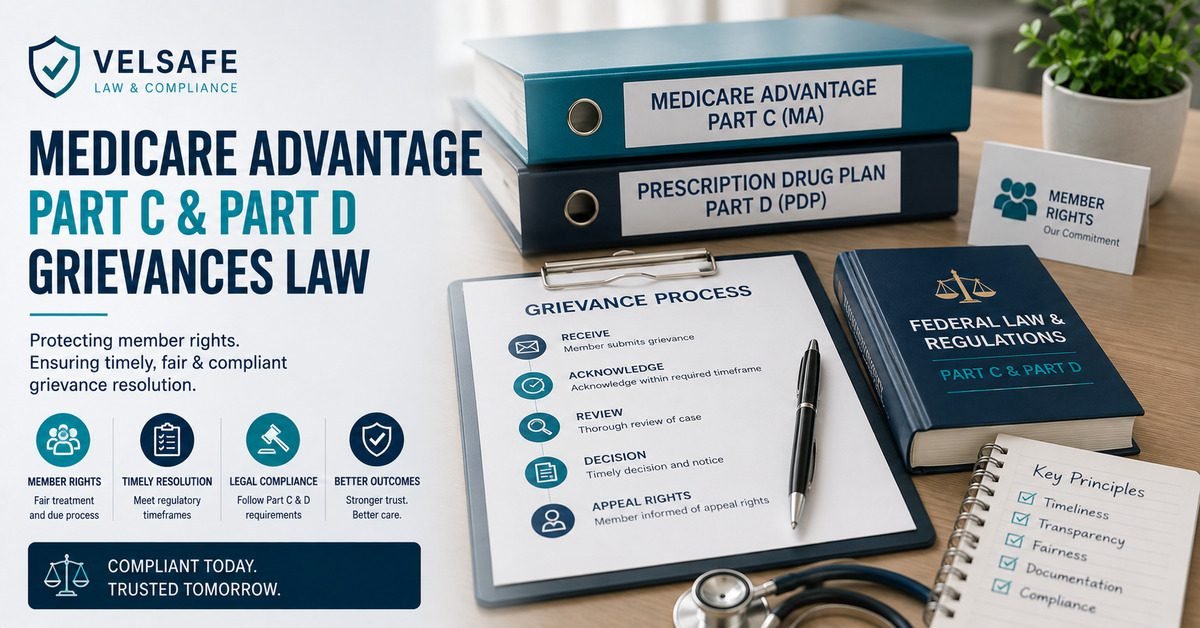
LAW: Medicare Advantage and Part D
Medicare Advantage Grievances: What Part C
and Part D Plans Are Legally Required to Do
Medicare Advantage (Part C) and Part D plan sponsors are legally required to maintain meaningful grievance procedures under 42 CFR Part 422 Subpart M and 42 CFR Part 423 Subpart M. These regulations define who may file a grievance, what counts as a grievance versus an appeal, when a plan must respond, and what the plan must do when a grievance involves an urgent matter. CMS conducts annual programme audits, and grievance procedure failures are among the most consistently cited systemic deficiencies, directly triggering civil money penalties against major health plans. This article explains what the law requires, who must comply, what penalties apply, and what compliance failures look like in practice.
$100K+
CMS Civil Money Penalties for Grievance Failures
CMS has imposed civil money penalties exceeding $100,000 on single MA-PD plan sponsors for systemic grievance and appeals failures, including $106,325 on EmblemHealth for failures related to non-contracted provider determinations and denial notice deficiencies under 42 CFR 422.568(e).
CMS CMP Notice: EmblemHealth (March 2022)
30 / 24
Day / Hour Response Deadlines
Part C and Part D plans must respond to standard grievances within 30 calendar days of receipt. For urgent grievances, those where the standard timeframe would seriously jeopardise the enrollee’s health, plans must respond within 24 hours. Both deadlines apply from the date the grievance is received, not the date it is reviewed.
42 CFR 422.564; 42 CFR 423.564
60 days
Enrollee Filing Window for Grievances
Enrollees must file a grievance within 60 calendar days of the event or incident that prompted the complaint. Plans must accept grievances filed orally or in writing. A plan that has a written-only grievance intake process is non-compliant with the requirement to accept oral grievances under 42 CFR 422.564.
Medicare Interactive: Grievances Explained
Law Summary: The Legal Framework for Medicare Advantage Grievances
Medicare Advantage grievance requirements are established by the Social Security Act (42 USC 1395w-22) and implemented through 42 CFR Part 422, Subpart M for Part C plans and 42 CFR Part 423, Subpart M for Part D plan sponsors. CMS issues detailed implementing guidance through the “Parts C and D Enrollee Grievances, Organization/Coverage Determinations, and Appeals Guidance” document, which was most recently updated in November 2024 with an effective date of January 1, 2025.
A grievance is a complaint or dispute filed with a Medicare Advantage or Part D plan about any aspect of the plan’s operations, behaviour, or activities, other than an organisation determination or coverage determination. The critical distinction is between a grievance and an appeal: an appeal is a request for coverage of a denied item or service; a grievance is a complaint about how the plan treated the enrollee. When a complaint is received, the plan must promptly determine and inform the enrollee whether the complaint is subject to its grievance procedures or its appeals procedures, this triage step is itself a regulatory obligation under 42 CFR 422.564(b) and 423.564(b).
2025 Update: Part C guidance revised effective January 1, 2025
The November 2024 update to the Parts C and D guidance modified the timeframe for enrollees to submit an appeal from 60 calendar days to 65 calendar days from the date of the coverage denial notice. Separate grievance procedures, the 30-day response standard and the 24-hour urgent standard, were not changed. Integrated plans (D-SNPs with affiliated Medicaid MCOs) must also follow the unified appeals and grievances requirements at 42 CFR 422.629 through 422.634. Source: CMS: Medicare Managed Care Appeals and Grievances (Updated Nov 2024)
Compliance Table: Who Must Comply and What Is Required
| Entity Type |
Governing Regulation |
Core Obligation |
Response Deadline |
| Medicare Advantage Organisation (MAO) |
42 CFR Part 422, Subpart M (422.564) |
Provide meaningful procedures for timely hearing and resolution of grievances between enrollees and the plan or any entity through which the plan provides benefits |
Standard: 30 calendar days; Expedited (urgent): 24 hours |
| Part D Plan Sponsor (PDP / MA-PD) |
42 CFR Part 423, Subpart M (423.564) |
Provide meaningful procedures for timely hearing and resolution of grievances; promptly determine whether complaint is subject to grievance or appeals procedures |
Standard: 30 calendar days; Expedited (urgent): 24 hours |
| Applicable Integrated Plan (D-SNP + affiliated MCO) |
42 CFR 422.629-422.634; CMS D-SNP Addendum (effective Jan 2025) |
Unified grievances and appeals procedures covering both Medicare and Medicaid benefits; additional integrated-plan-specific requirements per CMS addendum |
Standard: 30 days; Expedited: 24 hours; Unified process requirements per 422.629 |
| Cost Plan / HCPP |
42 CFR Part 422, Subpart M (applicable provisions) |
Must meet grievance, organisation determination, and appeals processing requirements under MA regulations; web-based training available via CMS MMCAG |
Standard: 30 calendar days; Expedited: 24 hours |
What the Law Actually Requires: Medicare Advantage Grievances Step by Step
The grievance obligations in 42 CFR 422.564 and 423.564 break into five distinct operational requirements that plans must implement and document. CMS programme auditors assess all five during annual audits, and a systemic failure in any of them can trigger a civil money penalty.
Step 1: Accept oral and written grievances, no written-only intake
What the regulation requires
Plans must accept grievances submitted orally or in writing. An enrollee may call the plan’s member services line and file a grievance verbally, the plan must have a process to receive, record, and process oral grievances. A plan that directs enrollees to submit grievances only in writing, through a form, a portal, or a letter, is non-compliant with this requirement. The plan must acknowledge receipt and inform the enrollee of the process and their rights. Source: 42 CFR 422.564(c); 423.564(c)
Distinguish grievances from appeals at intake
When a complaint is received, the plan must promptly determine whether it is a grievance (a complaint about plan operations or treatment) or an appeal (a challenge to a coverage or organisation determination). The plan must inform the enrollee of this determination and route the complaint to the correct process. A plan that treats all complaints as grievances when some should be appeals, or vice versa, violates the triage requirement. This determination must be prompt, not held pending review. Source: 42 CFR 422.564(b); 423.564(b)
Step 2: Process the grievance within the applicable timeframe
Standard grievances: 30 calendar days from receipt
Plans must investigate and respond to a standard grievance within 30 calendar days of receiving the grievance. The clock starts on the date of receipt, not the date the plan begins its investigation, not the date the plan assigns a case manager, and not the date the plan determines the grievance is valid. The 30-day window is an absolute deadline, not a target. Source: 42 CFR 422.564(e)(1); 423.564(e)(1)
Expedited grievances: 24 hours when standard timeframe jeopardises health
When a grievance involves a matter where applying the standard 30-day response timeline would seriously jeopardise the enrollee’s life, health, or ability to regain maximum function, or in the case of a Part D plan, when the standard timeframe would seriously jeopardise the enrollee’s life, health, or ability to regain maximum function and the enrollee has not yet purchased the drug, the plan must respond within 24 hours. The 24-hour requirement also applies when a grievance involves a plan’s failure to grant an expedited appeal. Source: 42 CFR 422.564(e)(2); 423.564(e)(2)
Step 3: Provide written notice of disposition to the enrollee
After investigating a grievance, the plan must provide the enrollee with a written notice of the disposition. The notice must describe the results of the grievance review, the decision reached, and, where relevant, information about any further rights the enrollee may have. For grievances that are not resolved in the enrollee’s favour, the notice must not leave the enrollee without a path to further action. Plans that resolve grievances verbally without written confirmation of the disposition are non-compliant with the written notice requirement. Source: 42 CFR 422.564(e)(3); 423.564(e)(3)
Step 4: Maintain records and report grievance data to CMS
Plans must maintain records of all grievances received, the nature of each grievance, the date received, the date resolved, and the outcome. This data must be reported to CMS through the Part C and Part D reporting requirements on an annual basis. CMS uses this data to identify systemic problems in plan operations and to target programme audits. Plans that do not maintain complete grievance records, or that cannot produce grievance records during a CMS audit, face a presumption of non-compliance that is difficult to rebut without contemporaneous documentation. Source: CMS Part C Reporting Requirements; 42 CFR 422.516
Step 5: Notify enrollees of their right to file a quality improvement organisation complaint
The grievance process under 42 CFR 422.564 is separate and distinct from the quality improvement organisation (QIO) complaint process. Plans must distinguish their internal grievance procedures from the QIO complaint process in their member communications, and must inform enrollees of the existence of the QIO complaint pathway where applicable. Conflating the two processes, or failing to inform enrollees that a QIO complaint option exists for quality of care concerns, is a regulatory deficiency under 42 CFR 422.564(c). Source: 42 CFR 422.564(c); CMS Parts C and D Guidance
Penalties: Civil Money Penalties and Enforcement Actions
| Violation Type |
Authority |
Maximum Penalty |
Real-World Example |
| Systemic grievance procedure failure adversely affecting enrollees |
42 CFR 422.752(c)(1); 422.760(c) |
Up to $100,000 per violation per day |
BCBS of Michigan: $7,424 CMP for Part C grievance and appeals failures (CMS audit, March 2024); CDPHP: $17,864 CMP for Part C organisation determination and grievance failures (March 2024) |
| Failure to provide required denial notices or appeal rights information |
42 CFR 422.568(e); 422.2267(e)(27) |
CMP plus potential contract termination |
EmblemHealth: $106,325 CMP for failure to provide denial notices with appeal rights for non-contracted provider services (March 2022) |
| Repeated or uncorrected Part D grievance and appeals failures |
42 CFR 423.752(c)(1); 423.760(c) |
CMP and mandatory independent validation audit at plan’s expense |
UCare Minnesota: $13,224 CMP following a failed independent validation audit after initial Part D grievance findings; the plan was required to hire an independent auditor at its own cost (December 2023) |
| Failure to meet 24-hour expedited grievance response |
42 CFR 422.564(e)(2); 423.564(e)(2) |
CMP; elevated to systemic finding if pattern demonstrated |
CMS programme auditors assess expedited grievance compliance in every annual Part C and D audit cycle; failures are among the most consistently cited grievance deficiencies |
Common Failures: What Triggers Citations and CMPs
Failing to triage complaints as grievances vs. appeals at intake, Systemic finding
CMS auditors consistently find that plans fail to promptly identify whether an incoming complaint is a grievance or a coverage determination request. When enrollees call about a denied service, the call is often logged as a grievance and processed under the 30-day standard without escalating the coverage determination for appeals processing. This misrouting denies enrollees their appeal rights, a systemic deficiency that CMS treats as adversely affecting enrollees and triggering CMP consideration.
Missing the 30-day response deadline, Most frequently cited grievance deficiency
Late grievance responses are the most frequently cited grievance deficiency in CMS programme audits. Plans that cannot demonstrate, with records, that responses were provided within 30 calendar days of receipt fail this requirement. Common causes include incomplete grievance logging (where the intake date is not recorded at intake), routing delays that restart the clock incorrectly, and case management backlogs that allow cases to age past the deadline. The 30-day requirement is measured from date of receipt, not date of assignment to a case manager.
Failing to provide written notice of disposition, Documentation failure
Plans that resolve grievances verbally, through a follow-up phone call that satisfies the enrollee, without issuing a written notice of disposition violate the written notice requirement. Verbal resolution of a grievance does not satisfy 42 CFR 422.564(e)(3). The written notice must be sent regardless of the outcome, and it must describe the result of the investigation and the plan’s decision. Plans audited without written notice records for resolved grievances face a presumption that those grievances were not properly resolved.
No process for expedited grievances, 24-hour requirement not operationalised
Many plans have documented the 30-day standard grievance process but do not have a separately identified, operationalised process for expedited grievances. Member services staff who receive an urgent complaint may not know to flag it for expedited processing. Case management systems that do not support a 24-hour escalation pathway cannot operationally meet the requirement. CMS auditors test this by submitting test grievances that qualify for expedited processing and measuring the actual response time against the 24-hour standard.
Denial notices missing required appeal rights language, CMP trigger
When a plan denies an organisation determination, the denial notice must include specific language describing the enrollee’s appeal rights, the timeframes for filing an appeal, and the process for requesting an expedited review. Plans that issue denial notices without this required language, or with incomplete or inaccurate appeal rights language, face both a grievance-related deficiency (enrollees cannot file effective grievances about denied appeal rights they were not informed of) and a direct violation of 42 CFR 422.568(e). This category of failure generated the largest single CMP in recent programme audit history.
Plan Sponsor Responsibilities Under 42 CFR 422 and 423
Maintain a written grievance procedure covering all regulatory requirements
The written grievance procedure must address: intake methods (oral and written), triage of grievances versus appeals, the 30-day standard response process, the 24-hour expedited process with criteria for when it applies, written notice of disposition requirements, record-keeping obligations, and CMS reporting obligations. A procedure that omits any of these elements is incomplete, and an incomplete procedure is itself an audit finding.
Train member services staff on the grievance versus appeals distinction
The most common source of systemic grievance failures is front-line staff who do not correctly distinguish between a grievance (complaint about plan operations) and a coverage determination request (request to cover a denied item or service). Training must be specific, tested, and documented. Staff must know when to escalate a complaint to appeals processing rather than processing it as a grievance, and when to escalate a grievance to the 24-hour expedited track.
Implement a case management system that tracks intake dates and deadlines
The 30-day and 24-hour response requirements cannot be reliably met without a case management system that records the date a grievance is received, automatically calculates the response deadline, and flags cases approaching the deadline. Plans that manage grievances through spreadsheets, email inboxes, or paper files cannot demonstrate systematic compliance with response timeframes during a CMS audit. The system must produce records showing intake date and response date for every grievance.
Update procedures for the January 1, 2025 guidance changes
The November 2024 CMS guidance update changed the appeal filing timeframe from 60 to 65 calendar days and updated NOMNC instructions. Plans must update their written procedures, denial notices, member communications, and staff training to reflect the 65-day appeal window effective January 1, 2025. Plans that continue to use 60-day language in their notices after January 1, 2025 are providing inaccurate information about enrollee rights, a compliance deficiency. Source: CMS MMCAG Guidance Update, November 2024
Legal Disclaimer
This article provides educational information about regulations and legal requirements. It does not constitute legal advice. Requirements vary by plan type, contract, and specific operational conditions. Consult a qualified healthcare compliance attorney or CMS-certified consultant for guidance specific to your organisation’s Medicare Advantage or Part D contract obligations.
Key Takeaways
Grievance triage at intake is the highest-risk compliance step in the process
The requirement to promptly distinguish a grievance from a coverage determination is the point where most systemic failures begin. When a complaint about a denied service is logged as a grievance rather than escalated as an appeals determination request, the enrollee loses their appeal rights without knowing it. CMS treats this as a systemic deficiency that adversely affects enrollees and that meets the threshold for civil money penalty consideration.
The 30-day clock starts at receipt, not at review, assignment, or investigation
Plans that interpret the 30-day response window as starting when a clinical reviewer opens the case, rather than when the grievance was received, systematically miss the deadline without knowing it. The intake date must be recorded at the time the grievance is received, and the 30-day clock must run from that date. A case management system that starts the clock at assignment rather than at intake is a compliance liability in every grievance the plan receives.
CMS programme audits test grievance compliance with live test cases, not just procedure reviews
CMS auditors do not limit their assessment to reviewing written procedures. They submit test grievances, review the plan’s response times and processes against the actual records, and assess whether the plan’s operational performance matches its documented procedures. A plan with a fully compliant written grievance policy but an operations team that cannot execute it within the required timeframes will fail the audit. The audit tests operations, not policies. Compliance requires both a correct procedure and a verified operational capability to execute it.
Frequently Asked Questions
What is a Medicare Advantage grievance and how is it different from an appeal?
A Medicare Advantage grievance is a complaint or dispute filed with a Part C or Part D plan about any aspect of the plan’s operations, behaviour, or activities, other than a coverage determination. Examples include complaints about poor customer service, administrative errors, long wait times, facility conditions, or the plan’s failure to follow required processes. An appeal is a formal request for coverage of an item or service the plan has denied. The two processes are legally distinct, and plans must promptly identify which process applies to each incoming complaint. Source: 42 CFR 422.564; 423.564
How long does a Medicare Advantage plan have to respond to a grievance?
A Part C or Part D plan must respond to a standard grievance within 30 calendar days of receiving it. For urgent grievances, where applying the 30-day timeframe would seriously jeopardise the enrollee’s life, health, or ability to regain maximum function, the plan must respond within 24 hours. Both deadlines run from the date the grievance is received, not from the date the plan begins its investigation or assigns the case. Source: 42 CFR 422.564(e); 423.564(e)
Can a Medicare Advantage plan require grievances to be filed in writing?
No. Under 42 CFR 422.564(c) and 423.564(c), plans must accept grievances filed orally or in writing. A plan that directs enrollees to submit grievances only through a written form, a portal, or a letter is non-compliant with the oral grievance intake requirement. Plans must have a process to receive, record, and process grievances filed by phone, and they must acknowledge receipt and inform the enrollee of the process and their rights regardless of how the grievance was submitted.
What changed in the January 2025 CMS grievances and appeals guidance update?
The November 2024 update to the Parts C and D Enrollee Grievances, Organization/Coverage Determinations and Appeals Guidance changed the timeframe for enrollees to submit a Part C appeal from 60 calendar days to 65 calendar days from the date of the coverage denial notice, effective January 1, 2025. The Notice of Medicare Non-Coverage (NOMNC) was modified to reflect new fast-track appeal rights in specific circumstances. Separate grievance procedures, the 30-day response standard and the 24-hour expedited standard, were not changed. Plans must update denial notices, member communications, and staff training to reflect the 65-day appeal window. Source: CMS MMCAG: Updated Parts C and D Appeals Guidance (Nov 2024)
What civil money penalties can CMS impose for Medicare Advantage grievance failures?
Under 42 CFR 422.752(c)(1) and 422.760(c), CMS may impose a civil money penalty for any determination that a plan has failed substantially to follow Medicare requirements. For systemic grievance failures that adversely affect or have the substantial likelihood of adversely affecting enrollees, CMS may impose penalties up to $100,000 per violation per day. In practice, penalties in recent programme audit cycles have ranged from approximately $7,000 to over $100,000 depending on the scope and severity of the failure. Plans with repeated or uncorrected failures may also be required to retain an independent auditor at their own expense. Source: CMS CMP Notice: BCBS Michigan (March 2024)
Do Part D-only plans have the same grievance requirements as Medicare Advantage plans?
Yes. Standalone Part D prescription drug plans (PDPs) are subject to the same grievance requirements under 42 CFR 423.564 as Medicare Advantage-Prescription Drug (MA-PD) plans. The obligations, to accept oral and written grievances, triage complaints as grievances versus coverage determinations, respond within 30 days for standard grievances and 24 hours for urgent grievances, and provide written notice of disposition, apply to all Part D plan sponsors. The 24-hour expedited grievance requirement for Part D also applies when the plan has denied an expedited appeal request and the enrollee has not yet purchased the prescription drug. Source: 42 CFR 423.564
How does CMS audit Medicare Advantage grievance compliance?
CMS conducts annual programme audits of Part C and Part D plan sponsors that review grievance, organisation determination, and appeals compliance. Auditors review written procedures, case records for a sample of grievances received during the audit period, and staff training documentation. Auditors also submit test cases, including test grievances that qualify for expedited processing, to assess whether the plan’s operations actually meet the required timeframes. Plans that fail to demonstrate compliance during the audit receive programme audit findings that CMS reviews individually to determine whether a civil money penalty or other enforcement action is warranted. Plans with systemic failures, defined as failures that adversely affect or have the substantial likelihood of adversely affecting enrollees, face the highest enforcement risk. Source: CMS Part C and D Compliance and Audits
Sources
Government and Regulatory Sources
- 42 CFR 422.564, Grievance Procedures (Part C): the primary grievance regulation for Medicare Advantage organisations, covering the oral and written intake requirement, the grievance-versus-appeals triage requirement, the 30-day standard and 24-hour expedited response deadlines, written notice of disposition, and the distinction from the QIO complaint process.
- 42 CFR 423.564, Grievance Procedures (Part D): the parallel grievance regulation for Part D plan sponsors, with the same core obligations as 422.564 and an additional 24-hour expedited requirement when the plan denies an expedited appeal and the enrollee has not yet purchased the prescription drug.
- CMS: Medicare Managed Care Appeals and Grievances (MMCAG), Updated November 2024: the authoritative CMS guidance page for Part C and Part D grievances, organisation determinations, and appeals. Source for the November 2024 update changing the appeal timeframe from 60 to 65 calendar days, effective January 1, 2025, and NOMNC modifications for fast-track appeal rights.
- CMS CMP Notice: Blue Cross Blue Shield of Michigan (March 21, 2024): civil money penalty notice imposing $7,424 on BCBS Michigan for Part C organisation determination, appeals, and grievance failures found during a 2023 programme audit, a systemic failure with the substantial likelihood of adversely affecting enrollees under 42 CFR 422.752(c)(1).
- CMS CMP Notice: Capital District Physicians’ Health Plan (March 21, 2024): civil money penalty notice imposing $17,864 on CDPHP for Part C organisation determination, appeals, and grievance failures, systemic failure where enrollees experienced or likely experienced increased out-of-pocket costs due to the deficiency.
- CMS CMP Notice: UCare Minnesota (December 6, 2023): civil money penalty notice imposing $13,224 on UCare for Part D coverage determination, appeals, and grievance failures following a failed independent validation audit. Source for the requirement that plans with repeated failures hire an independent auditor at their own expense.
- CMS CMP Notice: EmblemHealth (March 22, 2022): civil money penalty notice imposing $106,325 on EmblemHealth for Part C failures including failure to provide denial notices with required appeal rights language and waiver of liability statements for non-contracted provider services under 42 CFR 422.568(e).
Educational Sources
- Medicare Interactive: Grievances Explained: plain-language explanation of the 60-day enrollee filing window, the 30-day plan response deadline, and the 24-hour urgent response requirement, confirming the operational parameters of the grievance obligations under 42 CFR 422.564 and 423.564 from the enrollee perspective.
Related VelSafe Articles
Law
MDSAP Design and Development: Legal Requirements
The Chapter 5 design and development law explainer, covering regulatory compliance obligations, penalty structures, and enforcement frameworks in the medical device sector, a parallel regulatory environment to Medicare Advantage plan oversight.
Situational
Medical Device Safety Reporting Case Study
Case study of how a procedural compliance gap becomes an enforcement action, the same pattern of systemic failure, inadequate corrective response, and civil penalty escalation that applies in Medicare Advantage grievance enforcement.
Guides
MDSAP Production and Service Controls: Chapter 6 Part II
The Chapter 6 Part II compliance guide covering CAPA, nonconforming product control, and corrective action, structural analogues to the grievance investigation, resolution, and corrective action obligations that Part C and D plans face under 42 CFR Part 422 and 423.
HEALTHCARE COMPLIANCE LAW LIBRARY
Explore Medicare and Healthcare Regulatory Obligations
Explore VelSafe’s healthcare compliance law library for plain-language regulatory explainers, penalty tables, and compliance references covering CMS, Medicare Advantage, Part D, and related healthcare regulatory requirements.
Explore All Law Articles