

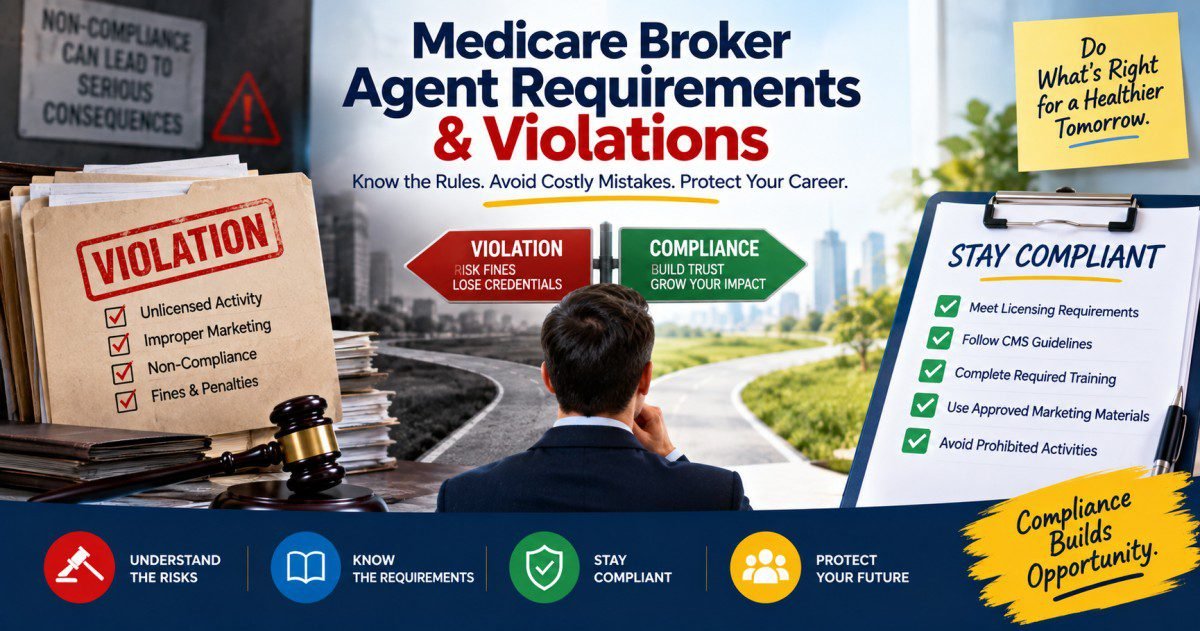
Medicare broker agent requirements violation infographic showing the path between violation risks including fines and losing credentials versus compliance including building trust and growing impact with stay compliant checklist

Medicare Broker Agent Requirements Violations: A Case Study

SITUATIONAL: Medicare Broker and Agent Requirements
One Appointment Terminated. One Complaint Filed.
How a Medicare Agent Lost Everything in 60 Days.
This Medicare broker agent requirements violation case study follows a licensed Medicare agent whose appointment was terminated by their primary carrier after a beneficiary complaint. The agent had sold Medicare Advantage plans for four years with no prior disciplinary history. Over a six-week period in the Annual Enrollment Period, three separate requirement failures occurred simultaneously: the agent conducted sales under a carrier certification that had lapsed without the agent’s knowledge, made unverifiable benefit claims to at least one client, and made an uninvited door-to-door sales visit to a beneficiary who had not requested contact. A single beneficiary complaint triggered a carrier investigation that uncovered all three. The appointment was terminated. The carrier referred the matter to the state insurance department. This is how it happened, what each failure cost, and what every agent can learn from it.
60 days
From First Violation to Appointment Termination in This Case
The three requirement failures in this case occurred during a six-week period. The beneficiary complaint that triggered the investigation was filed 14 days after the door-to-door visit. The carrier’s investigation concluded within 45 days. Total elapsed time from first violation to appointment termination: approximately 60 days. Four years of sales history did not prevent termination once the investigation found multiple simultaneous failures.
3
Separate Requirement Violations Found in a Single Investigation
The investigation began with one complaint about an uninvited visit. It found two additional violations: sales conducted under a lapsed carrier certification, and benefit claims that could not be substantiated from approved plan materials. Each violation was independent and each would have been sufficient grounds for corrective action. Together, they removed any possibility of reinstatement. Source: CMS: Medicare MCMG
Annual
Medicare Agent Certification Must Be Renewed Every Plan Year, No Grace Period
CMS requires agents to complete current plan year training before selling Medicare plans. Carriers implement this through annual certification. There is no grace period, a lapsed certification means the agent is not authorised to sell. Selling under a lapsed certification is both a carrier contract violation and a CMS marketing requirement violation. Source: CMS: Agent and Broker Training Resources

The Scenario: What the Agent’s Situation Looked Like

The agent, referred to here as Agent R, had been selling Medicare Advantage and Part D plans for four years through an independent marketing organisation (IMO). Agent R held appointments with three carriers and had completed the prior plan year’s certification with all three. Annual Enrollment Period began October 15. Agent R began taking sales appointments immediately.

What Agent R did not know: one carrier, Carrier X, had updated its certification portal in September and sent an email notification requiring agents to complete a re-credentialing module before selling. The email went to Agent R’s old email address on file with the IMO. Agent R never received it. When Agent R began selling Carrier X plans on October 15, the system showed an active appointment status. What the system did not prominently display was that the new re-credentialing module had not been completed. Carrier X’s internal compliance system had already flagged Agent R’s status as “certification incomplete” for the new plan year.

The agents’s working assumption

Agent R had completed AHIP certification in August and the prior year’s Carrier X module in September of the prior year. Agent R assumed that completing AHIP was sufficient to begin selling for the new plan year. The IMO had not communicated that Carrier X required a separate re-credentialing step beyond AHIP. Agent R had done this for four years, the assumption was that the process had not changed.

What was actually required

Carrier X had added a new compliance module for the current plan year covering updated beneficiary protection rules. Completing AHIP did not satisfy this requirement, every agent was required to complete the carrier-specific module before selling Carrier X plans. Agent R had no active authorisation to sell Carrier X plans for the current plan year, regardless of what the appointment status page showed. Every enrollment Agent R submitted for Carrier X during this period was submitted without valid certification.

Timeline: How the Violations Accumulated

August
Agent completes AHIP, assumes full certification is done
Agent R passes AHIP Medicare certification exam with a score above the 90% threshold. Believes this satisfies the full certification requirement for all three carriers. Does not log into any carrier portal to verify certification status for the new plan year.
September
Carrier X sends re-credentialing notification to old email address
Carrier X emails all appointed agents requiring completion of a new plan year compliance module before October 15. The email goes to an address Agent R had updated on their AHIP account but not on the IMO’s system, which feeds Carrier X’s database. Agent R never receives the notification.
October 15
AEP begins: Agent R starts selling Carrier X plans without valid certification
Agent R takes four Carrier X sales appointments in the first week of AEP. Submits two enrollments. The carrier’s compliance system has already flagged the incomplete certification, but the enrollment submission system accepts the transactions because the appointment itself has not been suspended. The compliance flag and the sales system are not integrated in real time.
October 22
Agent R makes an uninvited door-to-door visit
Agent R visits the home of a beneficiary who had previously requested information about Medicare options but had not confirmed a sales appointment and had not requested a visit. Agent R reasoned that the prior contact constituted an invitation. The beneficiary felt the visit was unexpected and intrusive. Agent R presented plan information and attempted to collect a Scope of Appointment at the door.
November 5
Beneficiary files complaint with 1-800-MEDICARE
The beneficiary from the October 22 visit calls 1-800-MEDICARE and reports that an agent arrived at their home without invitation, presented plan information, and asked them to sign paperwork. The complaint is forwarded to Carrier X. Carrier X opens a compliance investigation and pulls Agent R’s full certification and sales record for the current plan year.
November 6-20
Investigation uncovers lapsed certification and benefit claim issue
Carrier X’s investigation finds: (1) Agent R had not completed the current year’s required compliance module before selling; (2) in one of the October sales appointments, Agent R had told the client that a specific specialist was in-network, the carrier’s investigation of the meeting notes found this claim could not be substantiated from approved plan materials. The specialist was listed in the prior year’s directory but not the current year’s.
December 14
Appointment terminated; state insurance department notified
Carrier X terminates Agent R’s appointment effective immediately. The carrier sends a written termination notice citing three violations: selling without current-year certification, making an unverifiable benefit claim, and conducting an uninvited door-to-door sales visit. The carrier notifies the state insurance department. Agent R is unable to sell Carrier X plans for the remainder of AEP and into the new plan year.

What Went Wrong: Root Causes

Root Cause 1: No carrier portal check before AEP began

Agent R’s process for verifying certification readiness was to complete AHIP and assume the rest was done. The agent had no practice of logging into each carrier’s portal to confirm active, current-year certification status before selling. This is a process failure, not a knowledge failure, Agent R knew that certification was required. The missing control was a pre-AEP check that would have revealed the incomplete Carrier X module. A three-minute login to each carrier portal would have caught the gap six weeks before the complaint was filed.

Root Cause 2: Outdated contact information in the IMO’s system

Agent R had updated their email address with AHIP but not with the IMO. The IMO’s system fed Carrier X’s agent database. The critical notification about the new compliance module went to a dead address. This is a contact data failure, the agent’s business-critical contact information was inconsistent across systems. The agent had no process for verifying that their contact details were current in each carrier’s system at the start of each plan year. One piece of unsynced data eliminated the only early warning the agent would have received.

Root Cause 3: Misunderstanding of what constitutes an “invitation” for a sales visit

The beneficiary who received the uninvited visit had previously called an information line and left their contact information for follow-up. Agent R interpreted this as permission for a door-to-door visit. CMS’s MCMG does not support that interpretation. A prior expression of interest in Medicare information does not authorise an uninvited visit to the beneficiary’s home. The permission required is explicit and visit-specific. Agent R had never received training that drew this distinction clearly. The assumption that prior contact equals permission was the direct cause of the violation.

Root Cause 4: Plan information not verified against current-year approved materials

Agent R told a client that a specific specialist was in the plan’s network. The agent had seen this specialist in the prior year’s directory and assumed the information was still current. The specialist had not been renewed in the current year’s network. The claim was made from memory, not from current approved materials. Agents must verify all provider and benefit claims against current plan year documentation before representing them to clients. Any claim that cannot be traced to a current, approved document should not be made.

Regulatory Failures: Medicare Broker Agent Requirements Violations

Violation CMS Requirement What Agent R Did Consequence
Selling without current-year certification Agents must complete current plan year training and carrier certification before selling. AHIP alone does not satisfy a carrier’s additional certification requirements. Source: CMS Agent Training Resources Sold Carrier X plans without completing the current year’s required compliance module. Submitted two enrollments under incomplete certification. Carrier contract violation. Cited in termination notice as a primary finding.
Uninvited door-to-door sales visit CMS MCMG prohibits uninvited door-to-door visits. An explicit, visit-specific invitation from the beneficiary is required. Source: CMS: MCMG Visited a beneficiary at their home without a confirmed, visit-specific invitation. Attempted to collect an SOA at the door and presented plan information. Beneficiary complaint filed with 1-800-MEDICARE. Triggered the full investigation.
Unverifiable benefit claim All benefit and network claims must be accurate and consistent with current, CMS-approved plan materials. Agents may not represent information from prior-year materials as current. Source: CMS: MCMG Represented that a specific specialist was in-network based on prior-year directory. The specialist was not in the current year’s network. The claim was not verifiable from current approved materials. Second independent finding in termination notice. Referred to state insurance department.

Corrective Actions: What Should Have Been Done

Log into every carrier portal by October 1 and confirm active certification status

Before AEP begins, every agent should log into each carrier’s certification portal and confirm that their status shows active certification for the current plan year. A status of “appointment active” is not sufficient, the certification status must specifically reflect the current plan year’s completed training. If any carrier shows incomplete or pending, the agent must complete the missing module before taking any sales appointments with that carrier. This check takes minutes and prevents the most common certification failure in Medicare sales.

Verify and update contact information with every carrier and IMO at the start of each plan year

Carrier compliance notifications go to the contact information on file with the carrier’s agent management system. If that information is outdated, critical notifications are missed. Every agent should verify their email address, phone number, and mailing address in each carrier portal and with their IMO at the beginning of each plan year. A 10-minute contact audit at the start of each selling season protects against missing notifications that can have year-long consequences.

Never make a visit without explicit confirmation of an invitation from the beneficiary

An invitation for a door-to-door sales visit must be explicit and visit-specific. A beneficiary who expressed interest in Medicare plans, responded to a mailer, or called an information line has not invited a sales visit. Before any home visit, the agent must have documented confirmation that the beneficiary requested the visit, a phone call where the appointment was set, a written or electronic confirmation, or an online scheduling request. “They seemed interested” is not an invitation. Document the source of the invitation before making the trip.

Only use current-year approved materials and verify every benefit claim before making it

At the start of each plan year, agents should remove all prior-year plan materials from their sales kit and replace them with current-year documents. Any benefit or network claim that cannot be found in current approved materials should not be made verbally. If a client asks about a specific provider or drug, verify it from the current formulary or directory before answering. If you cannot verify it on the spot, tell the client you will confirm in writing and follow up. A wrong answer given from memory costs more than a delayed correct answer given from documentation.

Lessons Learned: What Every Agent Takes From This Case

AHIP passing does not mean you are certified to sell

AHIP is the foundational layer. Each carrier also requires its own current-year certification before the agent is authorised to sell that carrier’s plans. A carrier that adds a new module or changes its requirements can invalidate an agent’s selling authorisation mid-season without any face-to-face notification. The only way to know your status is to check each carrier’s portal directly.

A complaint about one violation will trigger a review of everything

When a beneficiary complaint is filed, the carrier’s compliance team does not investigate only the specific complaint. They pull the agent’s full record: all enrollments, all compliance certifications, any prior complaints, and meeting notes if available. A complaint about an uninvited visit became the mechanism that uncovered lapsed certification and an unverifiable benefit claim. There is no such thing as an isolated violation once an investigation opens.

Prior contact from a beneficiary is not an invitation to visit their home

CMS’s prohibition on uninvited door-to-door visits is clear. The only exception is a visit the beneficiary explicitly requested. An expression of interest, a returned mailer, a call to an information line, none of these authorise a visit. Agents who are uncertain whether they have a valid invitation should call and confirm before making the trip. The cost of a phone call is immeasurably less than the cost of a complaint and investigation.

Prior-year knowledge is a compliance risk in a plan year that has changed

Plan networks, formularies, benefit structures, and marketing rules change every year. An agent with four years of experience has four years of accumulated assumptions. Some of those assumptions are now wrong. Experienced agents are not immune to misinformation claims, they are more vulnerable to them because they rely on prior knowledge rather than checking current materials. The rule is simple: if it is not in a current approved document, do not say it.

Prevention Checklist: Before Every AEP

Certification and Contact

AHIP completed and passing certificate downloaded
Each carrier portal checked for current-year certification status (not just appointment status)
Contact information verified and updated in each carrier portal and with IMO
Any pending or incomplete carrier modules identified and completed before October 15

Materials and Client Contact

All prior-year plan materials removed from sales kit
Current-year formularies, directories, and Summary of Benefits loaded for each plan
Each client visit confirmed as explicitly requested before the appointment is made
SOA process documented, sent, received confirmation, date verified at least 48 hours before meeting

Documentation and Record-Keeping

Meeting notes completed for every sales appointment, same day
Signed SOA filed with meeting notes for every client
Source of every client visit invitation documented before the visit
Records retained for the period required by each carrier’s contract

Key Takeaways

Four years of clean history did not protect Agent R once the investigation found three simultaneous failures

Prior performance is not protection against current violations. A carrier investigation that opens from one complaint does not limit itself to that complaint. It reviews the full record. An agent who has accumulated years of clean sales history is not insulated from termination if the current investigation finds simultaneous, independent violations. The only protection is current compliance. Past compliance is context, not a defence.

Certification failures are silent, the portal shows an active appointment even when certification is incomplete

The most dangerous aspect of Agent R’s certification failure was that nothing stopped the sales. Enrollments were accepted. Appointments proceeded. The compliance flag existed in the carrier’s system but was not integrated with the submission system. An agent who relies on the absence of a rejection to confirm their authorisation is relying on a silent system. The only reliable check is a direct review of current-year certification status in each carrier portal before selling begins.

The investigation that ends a Medicare agent’s appointment rarely starts with a certification audit, it starts with a single beneficiary complaint

Agent R’s appointment was not terminated because a carrier ran a certification audit. It was terminated because a beneficiary made a phone call. One complaint, about one uninvited visit, was the mechanism that opened the file, pulled the certification records, and examined the sales notes. The certification failure and the benefit claim issue were invisible to everyone until the investigation looked. Every agent should operate with the understanding that any client interaction could generate a complaint, and that any complaint will trigger a full compliance review. If any part of the record would not survive that review, it needs to be corrected before it is discovered.

Frequently Asked Questions

What are the Medicare broker agent requirements for selling Medicare plans?

Medicare broker agent requirements include: a valid state insurance licence for the lines of authority covering the plans being sold; completion of current plan year AHIP Medicare certification (or an approved equivalent) with a passing score; completion of each carrier’s own current-year product certification for every carrier whose plans the agent intends to sell; and an active appointment with each carrier. Both the CMS-level training and the carrier certification must be completed and current before the agent sells or markets any Medicare plan. Requirements must be renewed annually. Source: CMS: Agent and Broker Training Resources

Can a carrier terminate an agent’s appointment during the Annual Enrollment Period?

Yes. A carrier can terminate an agent’s appointment at any time, including during the Annual Enrollment Period, if a compliance violation is found. There is no AEP moratorium on terminations. A termination during AEP is particularly damaging because it removes the agent from their highest-revenue selling period immediately. Enrollments submitted after the termination effective date are invalid. The carrier is also required under CMS rules to maintain oversight of their agent network and take corrective action when violations are found, AEP timing does not affect this obligation.

If AHIP is passed, does an agent need to complete each carrier’s separate certification?

Yes. AHIP certification satisfies the foundational CMS training requirement and most carriers accept it in place of their general Medicare training module. However, every carrier also requires its own product-specific certification, covering that carrier’s specific plans, benefits, formulary, network, and sales tools, before the agent is authorised to sell. Completing AHIP does not satisfy carrier-specific product certification requirements. Selling a carrier’s plans without completing that carrier’s current-year certification is a violation of the carrier contract and of CMS agent training requirements.

What counts as an “invitation” for a Medicare agent to make a home visit?

A valid invitation for a home sales visit must be explicit and visit-specific. The beneficiary must have specifically requested the visit, not just expressed interest in Medicare information. Returning a mailer, calling an information line, or asking general questions about Medicare plans does not authorise a home visit. The invitation must be for a visit, confirmed before the agent travels to the beneficiary’s home. Agents should document the source of every home visit invitation, the specific call, message, or scheduling request that constituted the invitation, before making the visit. Source: CMS: MCMG

What happens to enrollments submitted while an agent’s certification was lapsed?

The carrier determines what happens to enrollments submitted without valid certification. In some cases the carrier may void the enrollments and require new ones to be submitted once certification is complete. In other cases the carrier may allow existing enrollments to stand but prohibit new submissions. The enrolled beneficiary may be affected if the enrollment is voided, they could lose coverage or face a gap. Agents should never assume that a submitted enrollment is secure until they have confirmed active, current-year certification status with the carrier. Enrollments submitted under lapsed certification expose the agent to contract liability and the beneficiary to coverage disruption.

How should an agent respond if a client asks about a provider or drug not in their current materials?

Tell the client you will verify the information and follow up in writing before they make a plan decision. Do not make a verbal representation you cannot immediately verify from a current, approved document. Look up the provider in the current year’s directory or the drug in the current formulary before answering. If you do not have the current document with you, check the carrier’s online provider/formulary search tool in real time. A delayed accurate answer protects the client and protects the agent. An immediate inaccurate answer protects no one.

Can a terminated agent get their appointment reinstated?

Reinstatement is at the carrier’s sole discretion. There is no regulatory requirement for a carrier to reinstate a terminated appointment. Some carriers will consider reinstatement if the agent demonstrates that the violation has been corrected, completes required remediation training, and has no repeat violations. Where the termination was referred to the state insurance department, reinstatement by the carrier does not resolve the state regulatory matter, which proceeds independently. An agent with a terminated appointment and an active state regulatory review faces potential licence action independent of any carrier reinstatement decision.

Sources

Government and Regulatory Sources

  • CMS: Medicare Communication and Marketing Guidelines (MCMG): primary regulatory source for all prohibitions analysed in this case, uninvited door-to-door visits, misleading benefit claims, and the marketing standards carriers must enforce through agent oversight and corrective action.
  • CMS: Medicare Agent and Broker Training Resources: source for the annual training requirement, the AHIP-plus-carrier certification structure, and the obligation for carriers to maintain and enforce agent compliance programmes.
  • Medicare.gov: Get Help with Medicare (1-800-MEDICARE): source for the beneficiary complaint process, how complaints are filed, how they are routed to carriers, and how they trigger investigations.

Industry Sources

  • AHIP: Medicare Certification: source for the AHIP exam structure, the 90% passing requirement, and the foundational role AHIP plays in the two-layer Medicare agent certification requirement.

Related VelSafe Articles

Worker Safety
Medicare Beneficiary Protections Agent Training Guide
The direct companion to this case study, the full beneficiary protection rules that Agent R violated, in actionable form for agents who want to understand exactly what compliant conduct looks like before their next sales appointment.
Tips
7 Medicare Broker Agent Training Exam Tips
The certification exam prep companion, covering how to study the rules analysed in this case study, including the certification sequence, marketing prohibitions, and enrollment period rules that appear as exam questions.
Guides
Medicare Part D PDP Enrollment: A Complete Guide
The enrollment operations guide, covering the enrollment periods, effective dates, LIS auto-enrollment, and LEP rules that agents must understand to guide clients compliantly after the sales meeting in this case study had concluded.
MEDICARE BROKER AND AGENT TRAINING
More Medicare Agent Compliance Case Studies
Explore VelSafe’s Medicare agent compliance library, case studies, beneficiary protection guides, exam preparation tips, and operational references for agents and trainers who need to understand what compliance failures look like before they happen.
Explore All Situational Articles

Comments are closed.