

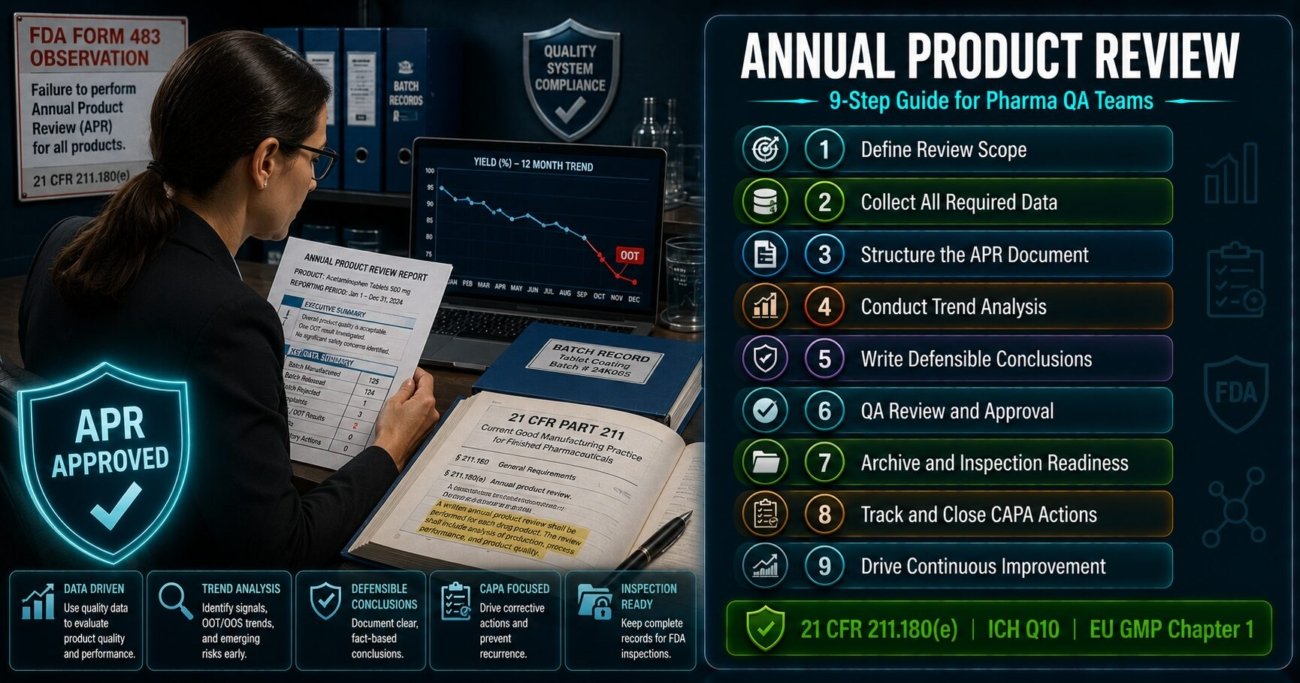
An FDA inspector is reviewing the Annual Product Review for a solid oral dosage product at a pharmaceutical facility. She notes that the APR covers the required data elements under 21 CFR 211.180(e) but that yield trends showing a consistent 2% decline over the review period were noted and then described in the conclusion as within historical norms. No investigation was initiated. No corrective action was proposed.
She issues an observation. The data was collected. The trend was visible. The decision not to act on it was documented. That documented decision not to investigate a downward yield trend is itself the citation.
This scenario illustrates the core principle of Annual Product Reviews: the APR is not a data collection exercise. It is an analytical exercise. Its purpose is not to confirm that data was collected but to determine what the data means for the ongoing quality, safety, and efficacy of the product. This guide walks through the complete APR process with that principle as the foundation.
This guide covers all nine steps of a compliant Annual Product Review: establishing the review scope, gathering data from all required sources, structuring the APR document, conducting trend analysis, writing defensible conclusions, obtaining QA review and approval, archiving the document, tracking CAPA follow-through, and common APR failures that result in FDA observations. Each step includes what the regulation requires and what effective practice adds.
The Regulatory Basis: 21 CFR 211.180(e) and EU GMP Chapter 1
The Annual Product Review (APR) requirement for US pharmaceutical manufacturers is established at 21 CFR 211.180(e), which requires that written records required by this part be maintained so that data therein can be used for evaluating, at least annually, the quality standards of each drug product to determine the need for changes in drug product specifications or manufacturing or control procedures.
The EU equivalent, the Product Quality Review (PQR), is required under EU GMP Chapter 1, Section 1.10. The PQR requirement is substantively similar to the FDA APR requirement but adds specific required elements including a review of the qualification status of relevant equipment and utilities and a review of post-marketing commitments for registered products.
ICH Q10 (Pharmaceutical Quality System) provides the broader quality management framework within which the APR/PQR functions. Under ICH Q10, the APR/PQR is one of the primary tools for management review and continual improvement, not simply a compliance document.
The most frequently cited APR-related observation in FDA Form 483s and warning letters is not missing data but inadequate analysis. Collecting data and listing it without evaluating trends, without assessing whether findings are isolated or systemic, and without reaching documented conclusions about product quality demonstrates that the APR was prepared to satisfy a requirement rather than to evaluate quality. The regulation requires evaluation. An APR that does not evaluate is non-compliant regardless of how complete the data collection is.
Step 1: Define the Review Scope and Period
Before data collection begins, define exactly what the APR will cover. This includes the product (name, dosage form, strength, NDC or marketing authorisation number), the review period (12 consecutive months, consistently defined across products), and the batches within scope (all batches manufactured or released during the period, plus any batches manufactured in a prior period but released during the review period if your SOP includes these).
If a product has multiple strengths or dosage forms, your SOP should specify whether each receives a separate APR or whether they are reviewed together with individual data sections. FDA inspectors will check that your approach is consistent with your procedure and consistently applied across products.
For products that were not manufactured during the review period (no batches produced), a reduced-scope APR is still required, covering at minimum stability data, complaints, and any regulatory changes affecting the product.
Maintain a master APR schedule listing every product, its assigned review period, the internal due date for the draft, and the target completion date. Circulate this schedule to Production, QC, Regulatory, and Supply Chain at the start of each review cycle. Cross-functional awareness of the schedule is the single most effective way to prevent the data collection delays that make late APRs the norm rather than the exception.
Step 2: Collect Data From All Required Sources
21 CFR 211.180(e) does not specify a list of required data elements, but FDA’s guidance and inspection practice establish expectations for what the APR must cover. The following data categories are required for a complete APR:
Total batches manufactured and released, batch numbers and manufacturing dates, any batches rejected or reprocessed and the reason, yield data for each batch (with trend over the period), equipment used and any significant equipment changes.
All analytical test results for the product during the review period, any out-of-specification (OOS) results and their investigation outcomes, out-of-trend (OOT) findings, any invalidated test results with justification, and method performance data if relevant to product quality trends.
All deviations related to the product during the review period, categorised by type (manufacturing, laboratory, equipment, facility). Root cause summaries and the corrective actions implemented. Any recurrence of previously investigated deviation types. Open versus closed status at the time of review.
All approved changes to raw materials, suppliers, equipment, analytical methods, specifications, manufacturing processes, or packaging during the review period. The rationale for each change and any evaluation of its impact on product quality. Any changes that triggered post-approval regulatory submissions.
Summary of all stability studies underway or completed for the product. Any failures or atypical results from stability testing. Confirmation that the approved shelf life remains supported by the available data. Any stability commitments made to regulatory agencies and their current status.
Total number and nature of product quality complaints received during the review period. Any reports of adverse events associated with the product. Market withdrawals, field alerts, or recalls. Complaint trend compared to prior review periods.
Any process validation, cleaning validation, or equipment qualification activities completed during the period. The outcomes of those activities and any revalidation triggered by changes or deviations. Current validation status of critical processes.
Any regulatory changes affecting the product’s approved specifications, labelling, or manufacturing requirements. Any commitments made to FDA or other regulatory agencies during the review period and their completion status. Any scheduled post-marketing commitments coming due in the next review period.
Assign data ownership to each section of the APR before the review cycle begins. Production owns batch manufacturing data. QC Laboratory owns test results and OOS investigations. QA owns deviations, change control, and CAPA data. Regulatory Affairs owns the regulatory section. Each owner is responsible for providing their data by a specified internal deadline. Without assigned ownership, data collection defaults to whoever is available, producing inconsistent quality and chronic delays.
Step 3: Structure the APR Document
Use a controlled template for the APR document. The template should be version-controlled under your document management system and approved by QA. A standardised template serves three purposes: it ensures consistency across products and review cycles, it makes reviewer verification faster and more reliable, and it makes the document easier to navigate during an inspection.
A complete APR document structure should include:
- Cover page with product information, review period, and approval signature blocks
- Table of contents
- Executive summary
- Scope and methodology
- Data sections corresponding to each required category above
- Trend analysis section with graphical presentations
- Conclusions and recommendations
- Open action items and responsible owners
- Appendices for supporting data tables and raw data references
Each data section should contain the raw data summary and an evaluation statement describing what the data shows, whether any trends are notable, and what conclusion QA draws from the data for that section.
Step 4: Conduct Trend Analysis
Trend analysis is the analytical core of the APR and the area most frequently cited as deficient. The purpose of trend analysis is to identify whether any quality attribute is moving in a direction that warrants investigation or corrective action before a specification failure occurs.
Effective trend analysis for pharmaceutical APRs should address:
- Yield trends: Plot batch yields over the review period. A consistent downward trend, even within specification, may indicate process drift that will eventually cause failures.
- Analytical result trends: For critical quality attributes (potency, dissolution, hardness, water content), plot individual batch results over time. OOT analysis should be performed if results are trending toward specification limits.
- Deviation frequency trends: Compare the number and types of deviations in the current review period to prior periods. An increasing frequency of a specific deviation type despite corrective actions suggests the root cause was not correctly identified.
- Complaint trends: Compare complaint volume and type to prior periods and identify any new complaint types emerging in the current period.
- Stability trends: Review stability data for any results approaching specification limits or showing non-linear degradation rates.
Graphical presentation of trend data is strongly preferred over tabular presentation alone. A graph that shows ten batch potency results trending from 101% toward 98% is immediately interpretable. A table of ten numbers requires the reviewer to perform the trend analysis themselves.
An APR that states ‘yield ranged from 94.2% to 97.8% during the review period, with an average of 96.1%’ has described the data. It has not evaluated it. An APR that states ‘yield showed a consistent downward trend from 97.8% in Q1 to 94.2% in Q4, representing a 3.6 percentage point decline over the review period. This trend was evaluated and found to correlate with a raw material supplier change in Q2. A deviation investigation has been initiated (reference DEV-2024-089)’ has evaluated the data. The difference between these two approaches is the difference between a compliant APR and an FDA observation.
Step 5: Write Defensible Conclusions and Recommendations
The conclusions section of the APR is the most important section from a regulatory perspective and the section most frequently written inadequately. The conclusions must state, with specificity and evidentiary support, whether the product maintained acceptable quality throughout the review period, whether any findings require corrective action, and what actions are recommended or have been initiated.
A defensible conclusion for an APR section addresses four elements:
- Finding: What did the data show? State the key finding specifically, with reference to the data.
- Evaluation: Is this finding acceptable, concerning, or requiring action? Why?
- Impact: What is the impact on product quality, patient safety, or regulatory compliance?
- Action: What action has been taken or is recommended? Reference the CAPA or deviation number if applicable.
If all findings are acceptable and no action is required, the conclusion must state that affirmatively and provide the basis for that determination. A conclusion that simply says no issues were identified without explaining what was evaluated and why the evaluation supports that conclusion is not defensible.
Write the conclusions section last, after all data sections and trend analyses are complete. The conclusions should synthesise findings across sections, not simply repeat what was stated in each individual section. If the yield trend analysis identified a downward trend and the deviation section identified an increase in raw material-related deviations, the conclusions should connect these findings and address the overall picture they present together.
Step 6: QA Review, Approval, and Signature
The APR must be reviewed and approved by qualified personnel with the authority to evaluate the findings and approve the conclusions. In most organisations this means review by the QA manager or designee and approval by the Quality Director or equivalent senior quality authority.
The review process should verify that: all required data sections are complete and sourced correctly, the trend analysis is appropriate for the data presented, the conclusions are supported by the data and adequately address all significant findings, all recommendations include ownership and target dates, and the document is complete for archiving.
The approval signature is a regulatory attestation. The person signing the APR is confirming that the document accurately represents the quality status of the product for the review period and that the conclusions and recommendations are appropriate. This is not a formality and should not be treated as one.
APRs that are routinely approved within 24 hours of submission, with no revision requests and no documented questions, suggest that the reviewer is approving without reading. During an inspection, an FDA investigator who asks the approver to walk through the trend analysis conclusions and cannot get a substantive explanation has evidence of an inadequate review process. The review should be documented in a way that demonstrates substantive engagement with the content.
Step 7: Archive and Ensure Inspection Readiness
Completed APRs must be stored in a controlled, retrievable location under your document management system. The document must be available for retrieval during an FDA inspection without significant delay. An APR that exists but cannot be located during an inspection provides no compliance protection.
Archive requirements for APRs include: controlled document numbering and version control, secure storage (electronic or paper) with access controls, indexing by product and review period for rapid retrieval, retention for a minimum of one year after the expiry of the last batch of product covered by the APR, and linkage to the underlying data sources and supporting records referenced in the document.
When an FDA inspection begins, the APRs for recently reviewed products should be among the first documents ready for presentation. Inspectors frequently request the most recent APR as an early step in a manufacturing facility inspection to assess the facility’s quality awareness and analytical capability.
Step 8: Track and Close CAPA Actions
An APR that identifies issues and recommends corrective actions but does not track whether those actions were completed provides no quality improvement value and creates a specific regulatory risk. FDA inspectors who find open CAPA actions from a prior year’s APR with no evidence of progress will cite both the incomplete action and the inadequacy of the quality management system that allowed it to remain open.
Every recommendation in the APR that requires action should be entered into the CAPA system with a responsible owner and a target completion date. The status of CAPA actions from the prior year’s APR should be reviewed as a standing agenda item and its completion status should be reported in the following year’s APR. This creates a continuous improvement loop that is visible across review cycles and demonstrable during inspection.
Include a dedicated section in your APR template for prior year CAPA status. List each CAPA opened in response to the prior APR, its target date, its current status, and if closed, a brief description of the outcome. An inspector who sees that the prior year’s APR identified a trend, a CAPA was opened, the CAPA was completed on time, and the trend was resolved in the current year’s data has evidence of a functioning quality system, not just a compliance document.
Step 9: Use the APR to Drive Continuous Improvement
The APR is most valuable when it is treated as a management review tool rather than a compliance document. Senior quality and operations leadership should review APR findings for strategic implications: Are certain products consistently generating more deviations than others? Are yield trends across the portfolio showing common patterns that might indicate a shared root cause? Are complaint trends suggesting a field performance issue that has not yet triggered a formal investigation?
An annual management review of APR findings across the product portfolio, separate from the individual product reviews, is a best practice that translates compliance data into operational intelligence. This review should be documented and its outputs should feed into the site’s annual quality planning process.
Facilities that use APR data this way tend to identify systemic issues earlier, initiate investigations proactively rather than reactively, and demonstrate to FDA during inspections that the quality management system is genuinely functioning rather than fulfilling a minimum obligation.
Knowledge Check
Test your understanding of Annual Product Review requirements and best practice.
Not necessarily, and likely not if OOT analysis was not performed. While all three results are technically within specification, three consecutive batches at or near the lower specification limit represents a potential OOT situation that warrants documented evaluation. A compliant APR would acknowledge the proximity to the specification limit, note whether an OOT analysis was conducted, state the conclusion of that analysis, and describe any monitoring or preventive action recommended. Simply confirming that results are within specification without evaluating the trend pattern within the specification range does not satisfy the analytical requirement of 21 CFR 211.180(e).
It may be acceptable if justified and documented in the SOP and the APR itself. FDA does not prohibit grouping product strengths or closely related products in a single APR, but the grouping must be scientifically justified and both strengths must have adequate data coverage in the document. If the two strengths share the same process and excipients and differ only in tablet weight and compression force, grouping is likely defensible. The APR must still contain strength-specific data for any quality attribute where the strengths may perform differently, and the rationale for grouping must be explicitly stated in the document.
The APR should be amended or supplemented with a documented addendum. An APR that references an open deviation investigation whose outcome is not yet known contains incomplete information. Once the investigation is closed, the outcome should be captured in the APR either through a formal revision (if the conclusion is materially affected) or through a documented addendum that updates the deviation section with the investigation outcome. The amended document should go through QA review and approval. Leaving the APR as approved with a known gap in information is not acceptable, even if the gap relates to a minor deviation.
Annual Product Review Compliance Checklist
✓ Review period is defined and covers 12 consecutive months consistently with the SOP and prior APRs
✓ All batches manufactured or released during the review period are accounted for
✓ All required data sections are complete: manufacturing, QC, deviations, change control, stability, complaints, validation, regulatory
✓ Trend analysis has been performed for all critical quality attributes and manufacturing performance indicators
✓ OOT analysis has been performed or documented as not required for each critical attribute
✓ Conclusions address all significant findings with finding, evaluation, impact, and action for each
✓ All recommendations include a responsible owner and a target completion date
✓ Prior year CAPA status has been reviewed and reported
✓ QA review was substantive and is documented
✓ Approval signatures from authorised personnel are obtained
✓ Document is archived in the DMS under controlled numbering
✓ All open CAPAs from this APR have been entered in the CAPA system with owners and dates