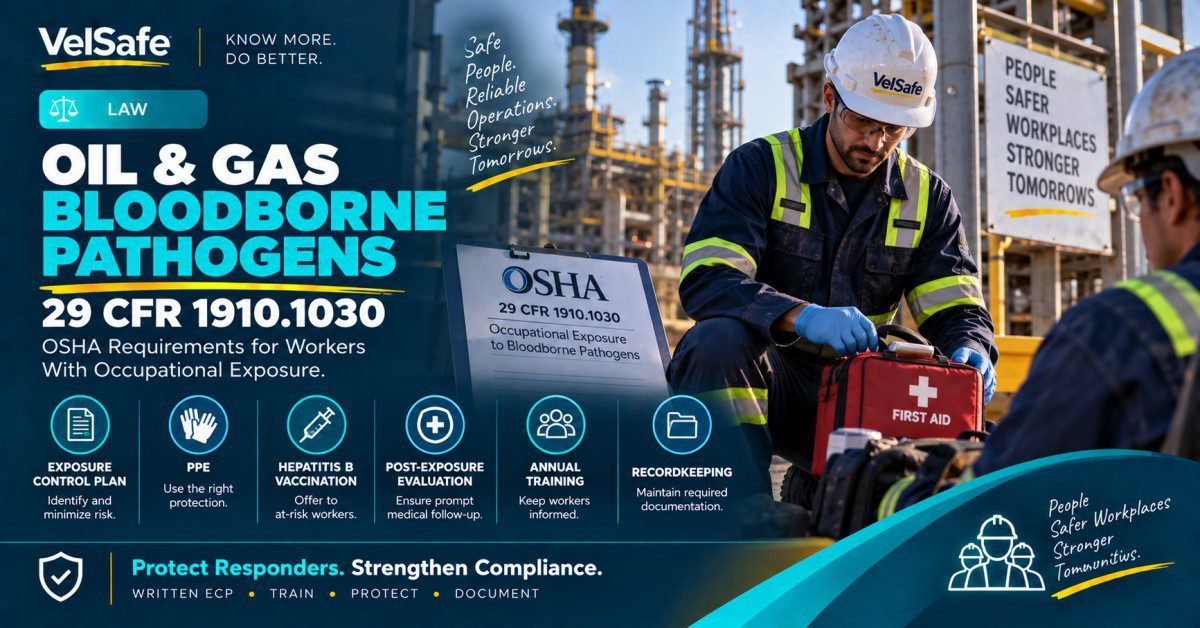
Law: Oil and Gas Bloodborne Pathogens Standard
Oil and gas bloodborne pathogens compliance under 29 CFR 1910.1030 applies to every employer in the industry whose workers have occupational exposure to blood or other potentially infectious materials during their normal duties.
The OSHA Bloodborne Pathogens Standard is most frequently associated with healthcare settings, but it extends to any workplace where workers have a reasonable anticipation of contact with blood or other potentially infectious materials (OPIM) during the performance of their duties. In oil and gas operations, this includes on-site medics and first responders, designated first aid providers, emergency response team members, and safety and health professionals who may provide emergency care at remote worksites where EMS response times are extended. This article covers what the law requires, which workers are covered, the exposure control plan obligations, training and vaccination mandates, and the penalties oil and gas employers face for non-compliance.
$16,550
Maximum OSHA Penalty Per Serious Violation of 29 CFR 1910.1030 in 2024
OSHA classifies violations of the Bloodborne Pathogens Standard as serious when the employer knew or should have known of the hazard and failed to implement the required controls. Each element of the Exposure Control Plan, each missing vaccination offer, and each training deficiency constitutes a separate citable violation. Willful or repeat violations carry penalties up to $165,514 per violation. Source: OSHA Penalty Schedule 2024
29 CFR
1910.1030
The OSHA Bloodborne Pathogens Standard: Applies to All Industries Where Workers Have Occupational Exposure
The standard is not limited to healthcare. It applies to any employer in any industry whose workers have occupational exposure, defined as reasonably anticipated skin, eye, mucous membrane, or parenteral contact with blood or OPIM during the performance of their duties. Oil and gas first aid providers, medics, and emergency responders meet this definition. Source: 29 CFR 1910.1030
Written ECP
A Written Exposure Control Plan Is the Foundation of Compliance: Without One, Every Other Element Is Uncitable
The Exposure Control Plan (ECP) is the document the standard requires every covered employer to maintain in writing. It must identify job classifications where occupational exposure occurs, describe the methods of compliance, and specify the hepatitis B vaccination programme, post-exposure evaluation, training schedule, and recordkeeping procedures. The ECP must be reviewed and updated at least annually and when job tasks or procedures change. Source: 29 CFR 1910.1030(c)
Law Summary: How the Bloodborne Pathogens Standard Applies to Oil and Gas
The OSHA Bloodborne Pathogens Standard at 29 CFR 1910.1030 was promulgated in 1991 to protect workers from the health hazards associated with exposure to blood and other potentially infectious materials, primarily the transmission risk of hepatitis B virus (HBV), hepatitis C virus (HCV), and human immunodeficiency virus (HIV). The standard establishes a hierarchy of controls, required documentation, vaccination obligations, and training requirements that apply to every employer in any industry where workers have occupational exposure.
In oil and gas operations, occupational exposure most commonly arises in three contexts. First, designated first aid providers who are trained and assigned to respond to injuries at remote upstream, midstream, or downstream worksites have occupational exposure because their duties include reasonably anticipated contact with blood during wound care and emergency response. Second, site medics, paramedics, and nurses stationed at drilling operations, pipeline construction, or processing facilities have occupational exposure as the primary function of their role. Third, safety and health professionals whose duties include investigation of serious incidents may have incidental exposure when they enter the scene of a traumatic injury.
The standard’s application to oil and gas is clarified by OSHA’s interpretation that the definition of occupational exposure is based on what the worker is assigned and reasonably expected to do, not on whether a blood contact event has actually occurred. A drilling crew member whose job duties include providing first aid as a designated responder has occupational exposure regardless of whether they have ever treated a bleeding injury.
Oil and Gas Bloodborne Pathogens: Compliance Table by Worker Category
| Worker Category |
Occupational Exposure |
Applicable Standard |
Employer Obligation |
| Designated first aid providers at oil and gas worksites |
Yes: first aid duties involve reasonably anticipated blood contact |
29 CFR 1910.1030 |
Full standard applies: ECP, training, PPE, vaccination offer, post-exposure procedures |
| On-site medics, paramedics, nurses |
Yes: medical care duties are the primary occupational exposure source |
29 CFR 1910.1030 |
Full standard applies; engineering controls, sharps injury log, and annual training required |
| Emergency response team (ERT) members |
Yes: emergency response duties include casualty care |
29 CFR 1910.1030 |
Full standard applies; ERT members must be included in the ECP by job classification |
| Safety and health professionals at incident scenes |
Conditional: if duties include trauma scene investigation with potential contact |
29 CFR 1910.1030 |
Employer must evaluate whether these duties create occupational exposure and include in ECP if they do |
| General production and operations workers |
No: unless assigned first aid or emergency response duties |
Not applicable unless duties change |
No obligation under 1910.1030 unless job classification is added to ECP |
Source: 29 CFR 1910.1030(a) and (b)
What the Law Requires: The Six Core Obligations
1. Written Exposure Control Plan (ECP)
Under 29 CFR 1910.1030(c), every covered employer must prepare and maintain a written Exposure Control Plan. The ECP must identify all job classifications in which all workers have occupational exposure and those in which some workers have occupational exposure. For each classification, it must describe the tasks and procedures that create the exposure, the engineering and work practice controls in use, the PPE provided, the hepatitis B vaccination programme, the post-exposure evaluation and follow-up procedures, and the hazard communication and training programme. The ECP must be reviewed and updated at least annually and whenever new job classifications or tasks are created that may involve occupational exposure. Workers must have access to the ECP during their working shifts. Source: 29 CFR 1910.1030(c)
2. Engineering and Work Practice Controls
The standard requires that employers use engineering controls and safe work practices as the primary means of exposure prevention, with PPE as a supplemental control. Engineering controls in oil and gas first aid and emergency care contexts include: sharps containers located immediately accessible to areas where sharps are used; self-sheathing or needleless systems for any medical procedures involving sharps; and hand hygiene facilities or alcohol-based hand rub dispensers accessible at the point of care. Work practice controls include: washing hands immediately after removing gloves, not recapping needles by hand, and not eating or drinking in areas where occupational exposure may occur. Workers must not perform mouth-to-mouth resuscitation without a barrier device. Source: 29 CFR 1910.1030(d)
3. Personal Protective Equipment (PPE)
Employers must provide, at no cost to workers, appropriate PPE to protect against occupational exposure. For oil and gas first aid and emergency response workers, required PPE typically includes: disposable examination gloves (latex-free options must be available for workers with latex allergies), face shields or safety glasses with side shields and masks for situations involving risk of splash or aerosol, and gowns or aprons for procedures likely to generate blood splash. PPE must be cleaned, laundered, repaired, and replaced by the employer at no cost to the worker. The employer may not require workers to take PPE home for cleaning. PPE must be accessible in appropriate sizes. Workers who refuse PPE must have their refusal documented. Source: 29 CFR 1910.1030(d)(3)
4. Hepatitis B Vaccination Programme
Under 29 CFR 1910.1030(f), the employer must make hepatitis B vaccination available to all workers who have occupational exposure, at no cost to the worker, at a reasonable time and place, under the supervision of a licensed healthcare professional, and according to current CDC recommendations. The vaccination must be offered after training and within 10 working days of initial assignment to duties with occupational exposure. Workers who decline vaccination must sign a declination statement using the specific language required by Appendix A of the standard. If a worker who previously declined later decides to accept, the employer must make the vaccination available at that time. The employer may not require a pre-existing immunity test as a precondition for offering vaccination. Source: 29 CFR 1910.1030(f)
5. Post-Exposure Evaluation and Follow-Up
When an occupational exposure incident occurs, the employer must make immediately available a confidential medical evaluation and follow-up. The evaluation must include: documentation of the route of exposure and the circumstances under which it occurred; identification of the source individual if feasible; collection and testing of the exposed worker’s blood; post-exposure prophylaxis when medically indicated; counselling; and evaluation of reported illnesses. In oil and gas operations at remote worksites, the employer must have pre-arranged healthcare access for post-exposure evaluation, since EMS response and hospital access may be limited. The healthcare professional conducting the evaluation provides a written opinion to the employer that states only whether the worker requires hepatitis B vaccination and whether the worker was informed of any conditions resulting from occupational exposure. The written opinion must not include specific findings or diagnoses. Source: 29 CFR 1910.1030(f)(3)
6. Training and Recordkeeping
Employers must provide bloodborne pathogens training to all workers with occupational exposure at the time of initial assignment and annually thereafter. The training must be conducted during working hours at no cost to workers and must cover: the OSHA standard and its contents; the epidemiology and symptoms of bloodborne diseases; modes of transmission; the ECP; engineering controls, PPE, and work practice controls; the hepatitis B vaccination programme; procedures for exposure incidents and post-exposure evaluation; signs and labels; and the question-and-answer session requirement. Training must be conducted by a person knowledgeable in the subject matter. Employers must maintain training records for three years from the date of training. Medical records for each worker with occupational exposure must be maintained for the duration of employment plus 30 years. A sharps injury log must be maintained if the employer has one or more workers who use sharps. Source: 29 CFR 1910.1030(g) and (h)
Penalties Table: Bloodborne Pathogens Violations in Oil and Gas
| Violation Type |
Maximum Penalty (2024) |
Common Oil and Gas Trigger |
| Serious |
$16,550 per violation |
No written ECP; no hepatitis B vaccination offered; no annual training; no PPE provided; no post-exposure evaluation following an incident |
| Willful |
$165,514 per violation |
Employer knew of obligation and intentionally failed to implement: documented refusal to provide vaccination, continued non-compliance after prior citation |
| Repeat |
$165,514 per violation |
Same standard violated within five years of a prior final order; common in multi-site oil and gas operators who correct at one site but not others |
| Other-Than-Serious |
Up to $16,550 per violation |
Administrative deficiencies: ECP not reviewed annually, training records not retained for three years, declination statements incomplete |
| Failure to Abate |
Up to $16,550 per day beyond abatement date |
Employer cited for absent ECP or absent vaccination programme and fails to implement within the abatement period specified in the citation |
Source: OSHA: Penalties and Debt Collection
Common Failures: What Triggers Citations in Oil and Gas
No written Exposure Control Plan
The most cited bloodborne pathogens violation in non-healthcare industries is the complete absence of a written ECP. Oil and gas employers who provide first aid training and medical personnel at their worksites but have not documented a formal ECP are in violation regardless of what practical controls are actually in place. The ECP must exist in writing, must identify covered job classifications, and must be accessible to workers during their shifts.
Hepatitis B vaccination not offered at assignment
Many oil and gas employers with first aid programmes fail to offer hepatitis B vaccination within the required 10 working days of a worker’s assignment to occupational exposure duties. This is a distinct violation from having no vaccination programme at all. Employers who have vaccination programmes but fail to track assignment dates and offer vaccination within the specified timeframe are citable for each worker whose vaccination offer was delayed.
Annual training not conducted or not documented
Oil and gas operators frequently conduct initial bloodborne pathogens training when first aid providers are assigned but fail to conduct annual refresher training in subsequent years. Training records must be maintained for three years from the training date. An OSHA inspector who finds a first aid provider who received training three years ago with no documented annual refresher has grounds for citation. Generic online training that does not address the site-specific ECP and the specific tasks covered workers perform also fails to meet the standard’s content requirements.
No post-exposure evaluation access at remote sites
The requirement for immediate post-exposure evaluation creates a particular challenge at remote upstream oil and gas operations where the nearest hospital is hours away. Employers must have pre-arranged relationships with occupational health providers who can conduct the evaluation, including telehealth options where available, and documented procedures for getting an exposed worker to care. An exposure incident at a remote wellsite with no documented post-exposure evaluation pathway is a serious violation, and the absence of evaluation following an actual incident significantly increases penalty severity.
ECP not reviewed or updated when operations change
Oil and gas operations change frequently: new wellsites open, emergency response teams are restructured, new job classifications with first aid responsibilities are created, and contract workers with occupational exposure join the workforce. The ECP must be updated to reflect each of these changes. An ECP that was written five years ago and has not been reviewed since, even if the employer has the practical controls in place, is non-compliant because it fails to reflect the current workforce and operations. Annual review with documentation of the review and any updates made is the minimum required practice.
Employer Responsibilities: What Must Be in Place Before Operations Begin
Identify all covered job classifications before any worker begins first aid duties
The ECP must be in writing and must identify covered job classifications before workers are assigned to occupational exposure duties. This means the employer must conduct a job hazard analysis for each position that includes first aid or emergency response in its duties, determine whether that position creates occupational exposure as defined by the standard, and document the finding before the position is staffed. The ECP must be updated each time a new classification is added. Source: 29 CFR 1910.1030(c)(2)
Stock appropriate PPE at every location where first aid or medical care may be provided
PPE must be accessible at the point of care, not stored in a central facility that requires travel time to access. In oil and gas operations, this means first aid kits and emergency response stations at every active wellsite, along all pipeline construction corridors, and at all processing facilities where first aid providers are assigned must include appropriate PPE: gloves, face shields, and mouth barrier devices at minimum. PPE must be inspected regularly and replaced before it expires or is damaged.
Pre-arrange post-exposure evaluation for all remote worksites
Before any worker with occupational exposure is deployed to a remote wellsite or pipeline location, the employer must have documented the post-exposure evaluation pathway for that location: which healthcare facility or occupational health provider will conduct the evaluation, how the worker will reach that provider, and what communication and documentation will accompany the worker. This plan must be in the site-specific ECP appendix or referenced in the site safety plan. Documented arrangements with telehealth occupational medicine providers can satisfy this requirement for initial evaluation when physical access is delayed.
Track vaccination status for all covered workers and maintain records for employment duration plus 30 years
The employer must maintain a confidential medical file for each worker with occupational exposure that includes the worker’s name and Social Security number, the worker’s hepatitis B vaccination status, the healthcare professional’s written opinion following post-exposure evaluation, and documentation of information provided to the healthcare professional. These records are confidential and must not be disclosed without the worker’s written consent. They must be maintained for the duration of employment plus 30 years, and must be made available to workers and their representatives upon request. Source: 29 CFR 1910.1030(h)
Legal Disclaimer
This article provides educational information about regulations and legal requirements. It does not constitute legal advice. Requirements vary by industry, jurisdiction, and specific workplace conditions. Consult a qualified safety professional or employment attorney for guidance specific to your workplace.
Key Takeaways
The standard applies to oil and gas employers whose workers are assigned first aid duties, not just to healthcare employers
OSHA’s definition of occupational exposure is based on what the worker is assigned to do, not on the industry sector. An oil and gas employer who designates workers as first aid providers has created occupational exposure for those workers and has the same obligations as a healthcare employer with the same risk. The written ECP, vaccination offer, annual training, and post-exposure evaluation requirements apply in full.
Remote site operations require additional planning for post-exposure evaluation access
The standard requires that post-exposure evaluation be made immediately available. For oil and gas operations at remote upstream locations where the nearest occupational health provider may be hours away, “immediately available” requires advance planning: documented arrangements with healthcare providers, telehealth protocols for initial evaluation, and transportation plans for getting an exposed worker to follow-up care. The absence of these arrangements is a citable violation in its own right, separate from whether an exposure incident has occurred.
The written ECP is not a formality: it is the legal document that proves every other compliance element was planned and implemented before an incident occurred
When OSHA investigates a bloodborne pathogen exposure incident or conducts a planned inspection, the first document requested is the written ECP. An employer who has vaccination records, training certificates, and PPE on hand but no written ECP cannot demonstrate that these elements were part of a planned compliance programme. The ECP is the document that ties every element together and demonstrates that the employer identified the exposure, assessed the risk, and implemented controls before any incident occurred. Every oil and gas employer with first aid providers must have one.
Frequently Asked Questions
Does the OSHA Bloodborne Pathogens Standard apply to oil and gas companies?
Yes, to any oil and gas employer whose workers have occupational exposure to blood or OPIM during the performance of their duties. The standard is not industry-specific. It applies based on job function. Oil and gas employers with designated first aid providers, on-site medics, or emergency response teams have occupational exposure for those workers and must comply with all provisions of 29 CFR 1910.1030. General production and operations workers without assigned first aid duties are not covered by the standard unless their job duties change. Source: 29 CFR 1910.1030(a)
What is an Exposure Control Plan and what must it contain?
The Exposure Control Plan is a written document required by 29 CFR 1910.1030(c) that must contain: an exposure determination identifying all job classifications and tasks with occupational exposure; the schedule and method of implementation for each element of the standard (engineering controls, PPE, housekeeping, hepatitis B vaccination, post-exposure evaluation, training, and recordkeeping); and a commitment to use engineering and work practice controls. The plan must be accessible to workers during their working shifts and must be reviewed and updated at least annually and when procedures or tasks create new exposure. Source: 29 CFR 1910.1030(c)
Is an oil and gas employer required to offer the hepatitis B vaccine to first aid providers?
Yes. Under 29 CFR 1910.1030(f), every employer must offer the hepatitis B vaccine series to workers with occupational exposure at no cost, within 10 working days of initial assignment to occupational exposure duties. The employer cannot make the vaccination a condition of employment, nor can it require a pre-existing antibody test before offering the vaccine. Workers who decline must sign the Appendix A declination statement. The employer must make the vaccine available at a later date if a declining worker subsequently chooses to be vaccinated. Source: 29 CFR 1910.1030(f)(1)
What must happen after a bloodborne pathogen exposure incident at an oil and gas site?
The employer must make available a confidential medical evaluation and follow-up immediately after the exposure. This includes: documenting the route and circumstances of exposure; identifying and testing the source individual if feasible and consent is obtained; collecting and testing the exposed worker’s blood; providing post-exposure prophylaxis when medically indicated; providing counselling; and evaluating reported illnesses. The healthcare professional who conducts the evaluation provides the employer with a written opinion stating only whether hepatitis B vaccination is indicated and whether the worker was informed of conditions resulting from the exposure. The full evaluation findings remain confidential. Source: 29 CFR 1910.1030(f)(3)
How often must bloodborne pathogens training be conducted for oil and gas first aid providers?
Training must be conducted at the time of initial assignment to duties with occupational exposure and annually thereafter. The training must be conducted during working hours at no cost to workers, must be interactive and allow for question-and-answer, must be conducted by a person knowledgeable in the subject matter, and must include training specific to the employer’s ECP and the tasks and procedures the worker performs. Training records must identify the dates, the content, the trainer’s name and qualifications, and the names and job titles of attendees, and must be retained for three years. Generic annual online training that does not address site-specific procedures or the ECP may not meet the content requirements of the standard. Source: 29 CFR 1910.1030(g)(2)
Does the bloodborne pathogens standard apply to contract workers at an oil and gas facility?
Yes, if the contract workers are assigned to duties with occupational exposure at the oil and gas employer’s site. Under OSHA’s multi-employer citation policy, both the host employer (the oil and gas company) and the contract employer (the labour contractor) may have obligations under the standard. The host employer must ensure that all workers at its site with occupational exposure are covered by a compliant ECP, whether those workers are direct employees or contractors. The contract employer must also ensure its workers receive the required training and vaccination offers. In practice, oil and gas operators typically require contract employers to certify compliance for workers assigned to first aid or emergency response roles as part of contractor pre-qualification. Source: OSHA: Multi-Employer Citation Policy
What is the definition of “other potentially infectious materials” (OPIM) under the standard?
Under 29 CFR 1910.1030(b), OPIM includes: (1) human body fluids including semen, vaginal secretions, cerebrospinal fluid, synovial fluid, pleural fluid, pericardial fluid, peritoneal fluid, amniotic fluid, saliva in dental procedures, any body fluid visibly contaminated with blood, and all body fluids where it is difficult or impossible to differentiate between body fluid types; (2) any unfixed tissue or organ from a human (living or dead); and (3) HIV-containing cell or tissue cultures, organ cultures, and HIV- or HBV-containing culture media or other solutions. Saliva in non-dental procedures is not OPIM unless visibly contaminated with blood. In oil and gas first aid contexts, the most relevant OPIM is blood and any body fluid visibly contaminated with blood following traumatic injuries common to upstream operations.
Sources
Government and Regulatory Sources
- 29 CFR 1910.1030: Bloodborne Pathogens: the primary OSHA standard governing occupational exposure to blood and OPIM. All definitions, obligations, vaccination requirements, training requirements, ECP requirements, and recordkeeping provisions cited in this article are drawn from this regulation.
- OSHA: Bloodborne Pathogens: OSHA’s resource page on the bloodborne pathogens standard, including guidance on exposure control plans, compliance tools, and enforcement activity.
- OSHA: Penalties: source for the 2024 maximum penalty figures for serious, willful, repeat, and other-than-serious violations of 29 CFR 1910.1030.
- OSHA: Multi-Employer Citation Policy: source for the discussion of host employer and contract employer obligations for workers at oil and gas sites.
Research and Industry Sources
- Bureau of Labor Statistics: Occupational Injuries and Illnesses: source for context on injury rates in oil and gas extraction, providing the baseline for understanding why first aid coverage and bloodborne pathogen exposure are relevant operational considerations in the industry.
Related VelSafe Articles
Worker Safety
Oil and Gas Worker Safety: Hazards, Controls, and Rights
The frontline worker safety guide for oil and gas operations: H2S, confined space, LOTO, fall protection, stop-work authority, and the OSHA rights every worker on an upstream site needs to know.
Situational
Accident Prevention Signs and Tags: Oil and Gas Case Study
A case study of how missing and misunderstood accident prevention signs and tags in an oil and gas processing facility led to a burn injury, three OSHA citations, and a $40,482 penalty under 29 CFR 1910.145 and 1910.147.
Worker Safety
ICH Q7 Materials Management: Worker Safety Guide
How ICH Q7 materials management obligations apply to worker safety in API manufacturing: incoming materials handling, contamination controls, and the documentation standards that support both product quality and occupational health protection.
Oil and Gas Safety and Compliance Law Resources
More Oil and Gas Compliance Law Guides for EHS and Legal Teams
VelSafe covers OSHA compliance law for oil and gas operations: bloodborne pathogens, H2S, confined space, lockout/tagout, fall protection, and worker rights for upstream, midstream, and downstream EHS professionals, safety managers, and legal counsel.
Browse All Law Articles