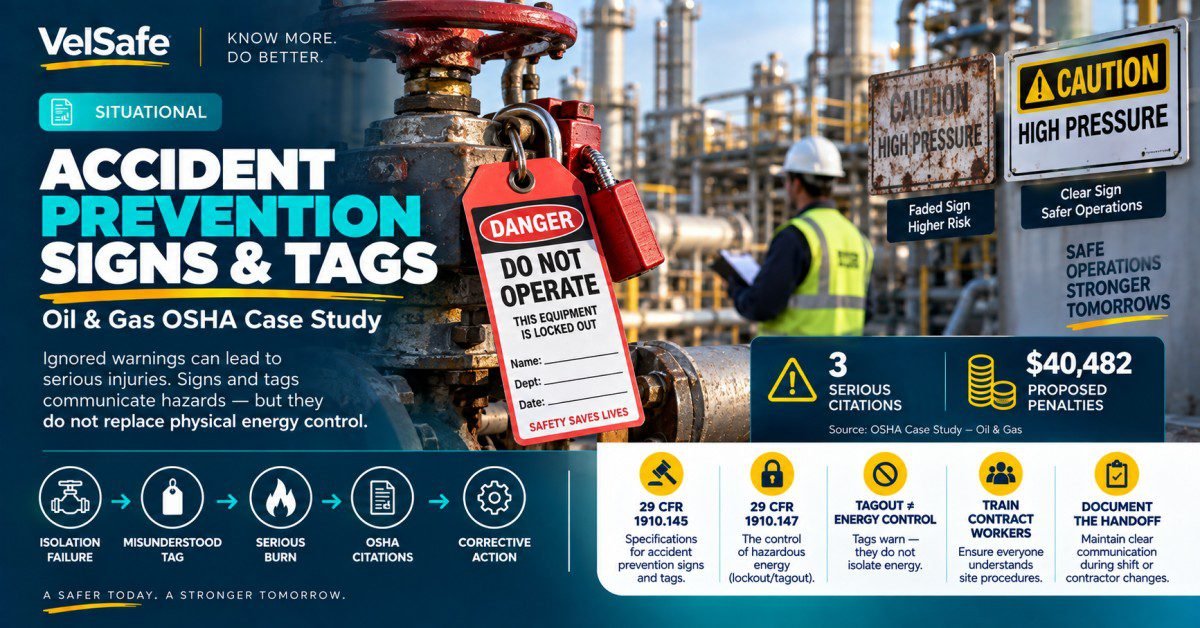
Situational: Oil and Gas: Signs and Tags Compliance Failure
Accident Prevention Signs and Tags in Oil and Gas: How Ignored Warnings Lead to Serious Injuries
Accident prevention signs and tags in oil and gas operations exist to communicate hazards that workers cannot see or that arise from temporary conditions created by maintenance, process changes, or equipment isolation. When signs are missing, faded, incorrectly placed, or when workers are not trained to act on them, the result is predictable. This case study traces how a failure in signs and tags management at an oil and gas processing facility led to a serious burn injury, an OSHA citation, and a compliance programme overhaul that could have been implemented at a fraction of the cost before the incident occurred.
29 CFR 1910.145
The OSHA Standard Governing Accident Prevention Signs and Tags in Oil and Gas Facilities
29 CFR 1910.145 specifies design, colour, application, and maintenance requirements for accident prevention signs and tags. Danger signs require a red background; caution signs require a yellow background; safety instruction signs require a green background. Tags must contain a signal word and a major message. Source: 29 CFR 1910.145
$15,625
Maximum OSHA Penalty Per Serious Violation for Signs and Tags Failures in 2024
OSHA classifies violations of 29 CFR 1910.145 as serious when the missing or non-compliant sign or tag is directly associated with a recognised hazard that could cause death or serious physical harm. Each location and each missing or incorrect sign constitutes a separate violation and a separate penalty. Source: OSHA Penalty Schedule 2024
Tagout Only
When a Tag Is Used Without a Lock, OSHA Requires Additional Protective Measures
Under 29 CFR 1910.147, tagout-only programmes must provide equivalent protection to lockout through additional measures: removal of a circuit element, blocking a controlling switch, opening a valve, or removing a component so the tag cannot be bypassed. A tag alone on energised equipment without equivalent protection is a violation. Source: 29 CFR 1910.147
A mid-sized oil and gas processing facility in the US Gulf Coast region operates a network of separators, compressors, heat exchangers, and pressurised transfer lines. The facility runs 24 hours a day with rotating crews of operators and contract maintenance workers. The facility’s accident prevention signs and tags programme had not been reviewed or updated since the previous safety audit three years earlier. Several danger signs posted at the exchanger train had faded to illegibility. A process line that was out of service for maintenance carried a single tagout tag with no additional energy isolation measures. And a new contract maintenance crew that arrived for a turnaround job received a site orientation that did not include the facility’s signs and tags programme or the meaning of its tag colours.
These three conditions existed simultaneously, and the combination of them is what turned a routine valve operation into a serious incident.
Root Cause 1: The tagout programme used tags without equivalent energy isolation measures
29 CFR 1910.147(c)(3) permits tagout-only programmes only when the employer demonstrates that the tagout system provides full employee protection equivalent to lockout. This requires additional protective measures beyond the tag alone: removal of a circuit element, blocking a controlling switch, opening an extra disconnecting device, or removing a valve handwheel. At this facility, the operator applied a single danger tag to a pressurised line without any physical energy isolation, without pressure bleeddown documentation, and without a second barrier. The tag communicated a prohibition on valve operation, but it was the only control between the worker and the residual process energy. Under 1910.147, this is not equivalent protection to lockout.
Root Cause 2: Contract workers were not trained on the facility’s accident prevention signs and tags programme
29 CFR 1910.147(c)(7) requires that all employees who work in an area where energy control procedures are used (including contract workers who are not the authorised employees performing the isolation) must receive training about the energy control programme. This training must cover: the purpose and function of the energy control procedure, the prohibition on restarting or re-energising equipment that has been locked or tagged out, and how to interpret the specific tags used at that facility. The site orientation delivered to the contract crew covered general site safety but did not include the energy control programme or the meaning of the facility’s tags. The injured technician had no basis for understanding what the danger tag communicated about the energy state of the line.
Root Cause 3: The danger tag did not contain the information required by 29 CFR 1910.145
29 CFR 1910.145(f)(4) requires that tags communicate a specific hazard and a major message. A tag that says “DO NOT OPERATE” without identifying what energy source is present, who applied the tag, when it was applied, and what the specific hazard is if the equipment is operated fails the standard’s informational requirements. The OSHA citation specifically noted that the tag applied by the operator did not identify the installer, the date applied, or the specific energy hazard (residual process pressure in a hot condensate line). A worker who sees a tag that does not contain this information cannot make an informed decision about whether and how to interact with the isolated equipment.
Root Cause 4: The handoff between the facility operator and the contract crew was not documented
The isolation performed by the facility operator created a hazardous condition that the contract crew was about to work around. A safe handoff required the operator to communicate directly with the contract crew supervisor: here is what is isolated, here is the isolation method, here is the specific valve that is tagged out and why, here is the residual hazard. This handoff did not occur. The operator applied the tag and moved on. The contract crew supervisor did not seek confirmation of the isolation status from the operator before beginning work. There was no documented isolation log or handoff record for the contract crew to consult.
29 CFR 1910.145: Signs and Tags
The standard requires that tags contain the signal word (DANGER, CAUTION, or BIOLOGICAL HAZARD), a major message describing the specific hazardous condition, and instructions to limit risk. The “DO NOT OPERATE” tag applied to the valve did not identify the specific hazard (residual process pressure), the energy source type, the person who applied it, or the date. It communicated a prohibition without communicating the reason for the prohibition, which made it uninformative to a worker who did not know the facility’s tagging system. Source: 29 CFR 1910.145(f)(4)
29 CFR 1910.147: Control of Hazardous Energy
Two separate violations under 1910.147 were cited. First, the tagout-only isolation did not provide equivalent protection to lockout as required by 1910.147(c)(3): no physical barrier, no circuit element removed, no handwheel removed, no second energy isolation point. Second, 1910.147(c)(7) requires that all employees in areas where energy control is used receive training; the contract crew’s orientation omitted this. Both violations were classified as serious because together they created the conditions for the burn injury that occurred. Source: 29 CFR 1910.147(c)(3) and (c)(7)
Why tagout alone is not equivalent to lockout unless additional measures are implemented
OSHA’s energy control standard reflects a fundamental principle: a physical lock prevents equipment from being energised by an action, deliberate or accidental. A tag communicates a warning but relies entirely on human compliance to remain effective. In an environment with multiple crews, shift changes, and workers unfamiliar with a facility’s specific tagging conventions, a tag-only isolation is vulnerable to misinterpretation or accidental bypass. The standard permits tagout only when the employer can demonstrate that additional measures make bypassing the tag as difficult as bypassing a lock. In this incident, no such measures existed. The tag was the only barrier between the worker and 140°C process pressure.
Before contractor mobilisation: include energy control and tags training in all contract worker orientations
The site orientation delivered to the contract crew should have included: an explanation of the facility’s accident prevention signs and tags programme, a demonstration of what each tag colour means, the rule that all tagged-out equipment is off-limits to any worker other than the one who applied the tag, and the requirement to contact the shift supervisor before interacting with any tagged equipment. This training takes 15 to 20 minutes. The incident investigation estimated that a burn treatment, lost time, OSHA penalty, and compliance remediation cost the company approximately 400 times that.
At isolation: apply lockout or implement documented equivalent protection measures
The facility operator should have applied a physical lock to the upstream valve in addition to the danger tag. Where the valve design does not accept a hasp and lock, the equivalent protection procedure requires: removing the valve handwheel, blocking the controlling mechanism, or installing a blind flange on the line; documenting which measure was applied on the isolation form. The isolation form must be completed and retained for the duration of the isolation. No isolation of a pressurised process line should be documented as complete without pressure bleeddown confirmation.
At handoff: communicate directly and document the isolation status with the receiving crew
After completing the isolation, the facility operator must brief the contract crew supervisor face to face: which valve is isolated, which tag is applied, what the residual energy state is, and what the contract crew must not do without first contacting the operator. This briefing must be documented on the isolation log with the time, both parties’ names, and the nature of the handoff. The contract crew supervisor signs to acknowledge the communication. This single step, absent in this incident, would have given the injured technician the information he needed to understand that the line was not safe to interact with.
Programme level: conduct an annual review of all accident prevention signs and update or replace degraded signs
The investigation also found that several permanent danger signs in the exchanger area had faded to illegibility. 29 CFR 1910.145(b) requires that signs be maintained in a legible condition. An annual walkthrough of all permanent signs, with replacement of any that are faded, damaged, or obscured, is a low-cost programme requirement that the facility had allowed to lapse. Faded signs normalise the absence of visible hazard communication and train workers to disregard what they see.
A tag without context is not hazard communication
A tag that says “DO NOT OPERATE” communicates a prohibition. It does not communicate why, what will happen if the equipment is operated, who applied the tag, or how long it has been in place. A worker who does not understand why a tag is present cannot make a safe decision about how to interact with the tagged equipment. Tags must contain enough information to be meaningful to a worker who did not observe the isolation process.
Contract workers are affected employees under 1910.147 and require energy control training
OSHA’s energy control standard does not limit training requirements to the authorised employee who performs the isolation. Every worker who enters an area where energy control procedures are in use is an affected employee and must receive training on the energy control programme. This includes contract workers, subcontractors, and temporary labour. The host employer’s obligation to provide or verify this training does not disappear because the worker is employed by another company.
A tagout-only programme that does not implement equivalent protection is a lockout violation
Facilities that use tagout in lieu of lockout must ensure that their written procedure specifies the additional measures that make tagout equivalent to lockout for each piece of equipment in the scope of the procedure. “We can’t always put a lock on it” is not a defence to a tagout-only citation unless the written procedure describes the specific alternative measures applied to each equipment type and demonstrates why lockout is infeasible. Infeasibility must be documented, not assumed.
The handoff from facility operations to a contract crew is a safety-critical communication point
Every transfer of work scope between the facility’s own operations staff and a contract crew is a point where information about existing hazards, active isolations, and in-progress work can fail to transfer. Formalising this handoff with a documented briefing, a mutual sign-off, and a copy of the active isolation log for the contract crew supervisor is a simple procedure that removes the information gap that caused this incident.
Programme Controls
Tag Content Requirements
Written energy control programme on file and current
All affected employees trained including contractors
Tagout-only procedures include documented equivalent measures
Isolation log maintained for every active isolation
Handoff briefing procedure for contractor work scopes
Annual inspection of all permanent signs for legibility
Faded or damaged signs replaced before the next shift
Programme reviewed after every near-miss or incident
Signal word: DANGER, CAUTION, or appropriate designation
Major message: specific hazard and consequence if bypassed
Energy source identified: electrical, pressure, thermal, etc.
Installer name and employee number
Date and time tag was applied
Isolation method: lock, blind, handwheel removed, etc.
Contact person if questions arise during work
Removal authorisation: only by installer or designated person
Tags communicate hazards. They do not control them.
A tag placed on an energised piece of equipment does not remove the energy. It communicates a warning that the energy is present and that the equipment must not be operated. The energy control is the physical lock, the blind, the removed handwheel, or the bled-down pressure. When a tag is used without an energy control, the hazard remains. The tag communicates its presence. This distinction is what OSHA’s tagout-only equivalency requirement is designed to enforce.
The most expensive part of signs and tags compliance failure is not the OSHA penalty
The $40,482 in proposed OSHA penalties in this case was significant. The medical treatment, workers’ compensation, lost time, turnaround delay, remediation of the energy control programme, and retraining of all affected employees cost substantially more. The programme improvements that would have prevented the incident cost a fraction of either figure. Signs and tags compliance is not expensive to maintain. It is expensive to neglect.
Contract workers entering an area with active isolations must be trained on what those isolations mean before they enter
This principle is in 29 CFR 1910.147(c)(7) and it was violated in this incident with direct consequences. A contractor who arrives at an oil and gas facility and enters work areas with active process isolations marked by tags they do not understand is not protected by those tags. They are exposed to a hazard that the tags are trying to communicate but cannot if the worker does not have the training to interpret them. The host employer’s responsibility for contractor safety under the multi-employer citation policy extends to ensuring that contractors who work in energy-controlled areas are trained before they enter those areas.
What does 29 CFR 1910.145 require for accident prevention tags in oil and gas operations?
29 CFR 1910.145(f) requires that tags contain: a signal word (DANGER for immediate hazard, CAUTION for potential hazard), a major message describing the specific hazardous condition or the action required, and sufficient information to allow the worker to understand the nature of the hazard. Tags must be made of durable material capable of withstanding the environmental conditions of the application. They must be attached by a means that prevents inadvertent removal and cannot be accidentally unfastened. Tags must be maintained in a legible and undamaged condition throughout their use. Source: 29 CFR 1910.145
When can a facility use tagout instead of lockout under OSHA’s energy control standard?
29 CFR 1910.147(c)(3) allows tagout-only programmes only when the employer can demonstrate that the tagout system provides full protection equivalent to a lockout system. To demonstrate equivalency, the employer must implement at least one additional measure that makes bypassing the tag as difficult as bypassing a physical lock: removing a fuse or circuit element, blocking a controlling switch, opening an extra disconnecting device, or removing a valve handwheel. The employer must also demonstrate that utilising lockout on the specific equipment is infeasible. In most oil and gas applications, physical lockout devices exist for valves; the default should be lockout, with tagout equivalency measures documented for any exceptions. Source: 29 CFR 1910.147(c)(3)
Are contract workers covered by the host employer’s energy control training requirements?
Yes. 29 CFR 1910.147(c)(7) requires that all affected employees receive training on the energy control programme. An affected employee is any employee whose job requires them to work in an area where energy control procedures are used. This explicitly includes workers who are not performing the isolation but who work in areas where locked-out or tagged-out equipment is located. The host employer must either verify that the contracting company has trained its workers on the host facility’s specific energy control programme, or provide that training directly as part of site orientation. Relying on the contracting company’s general energy control training without confirming that it covers the host facility’s specific programme does not satisfy 1910.147(c)(7).
What colour is required for a DANGER sign under 29 CFR 1910.145?
Under 29 CFR 1910.145(d), DANGER signs must have a predominantly red background with the word DANGER in white lettering. The background of the DANGER panel must be red, and the safety alert symbol (exclamation point in a triangle) may be included. CAUTION signs must have a predominantly yellow background with the word CAUTION in black lettering. These colour specifications are mandatory, not advisory. A danger-level hazard communicated on a yellow-background sign does not meet the CAUTION standard and does not meet the DANGER standard, creating an ambiguous and potentially non-compliant sign. Source: 29 CFR 1910.145(d)
Who can remove a lockout or tagout device from equipment?
Under 29 CFR 1910.147(e)(3), the lockout or tagout device must be removed by the authorised employee who applied the device. If the authorised employee is no longer available at the worksite, the device may only be removed by following a specific procedure that includes: verifying the authorised employee is not at the facility, making reasonable attempts to contact the authorised employee, ensuring the authorised employee is aware the device has been removed before they resume work. This procedure must be documented in writing. A supervisor or another employee cannot remove someone else’s lock without following this procedure, regardless of operational urgency. Source: 29 CFR 1910.147(e)(3)
How often must an oil and gas facility inspect its permanent accident prevention signs?
29 CFR 1910.145(b) requires that signs be maintained in good condition, which means they must be legible and undamaged throughout their use. OSHA does not specify an inspection frequency for permanent signs, but the standard’s requirement for maintained legibility creates an ongoing obligation that is typically met through periodic inspection programmes. In oil and gas facilities with outdoor signage exposed to UV, moisture, and process chemicals, annual inspection of all permanent safety signs is the minimum reasonable practice. Signs that are faded, torn, or partially obscured must be replaced before workers encounter the hazard they are intended to communicate.
Can an oil and gas facility be cited for a signs and tags violation even if no injury occurred?
Yes. OSHA can issue a citation for a violation of 29 CFR 1910.145 or 1910.147 based on observed non-compliance during an inspection, regardless of whether an injury has occurred. OSHA classifies violations as serious when the condition could cause death or serious physical harm, and as willful or repeat when the employer has been previously cited for the same standard or has demonstrated intentional disregard. In oil and gas facilities, a missing or non-compliant tag on a pressurised line, a faded danger sign at a high-hazard area, or a written energy control programme that does not exist or is not followed are all citable serious violations on discovery by an OSHA compliance officer during a planned or unplanned inspection.
Worker Safety
Oil and Gas Worker Safety: Hazards, Controls, and Rights
The frontline worker companion to this case study: H2S hazards, confined space entry, LOTO procedures, fall protection, and the OSHA right to stop unsafe work in oil and gas operations.
Law
Oil and Gas: Bloodborne Pathogens Legal Requirements
The OSHA bloodborne pathogen standard requirements for oil and gas operations: when the standard applies, exposure determination, training, and PPE obligations for workers with potential exposure.
Insights
Oil and Gas: Breaking Containment Incident Trends and Prevention
Evidence-based analysis of breaking-containment incidents in oil and gas operations: what the incident data shows about root causes, the role of isolation failures, and what operators and safety programmes can do to reduce the frequency and severity of containment loss events.
Oil and Gas Safety Case Studies and Compliance Analysis
More Situational Safety Case Studies for Oil and Gas EHS Teams
VelSafe’s Situational library delivers real-scenario safety incident case studies, root cause breakdowns, regulatory failure analysis, and corrective action frameworks for EHS professionals, safety managers, and compliance teams in oil and gas and general industry.
Explore All Situational Articles