

Worker Safety: Oil and Gas Operations
Oil and Gas Worker Safety: Hazards, Controls, and What Every Worker Needs to Know
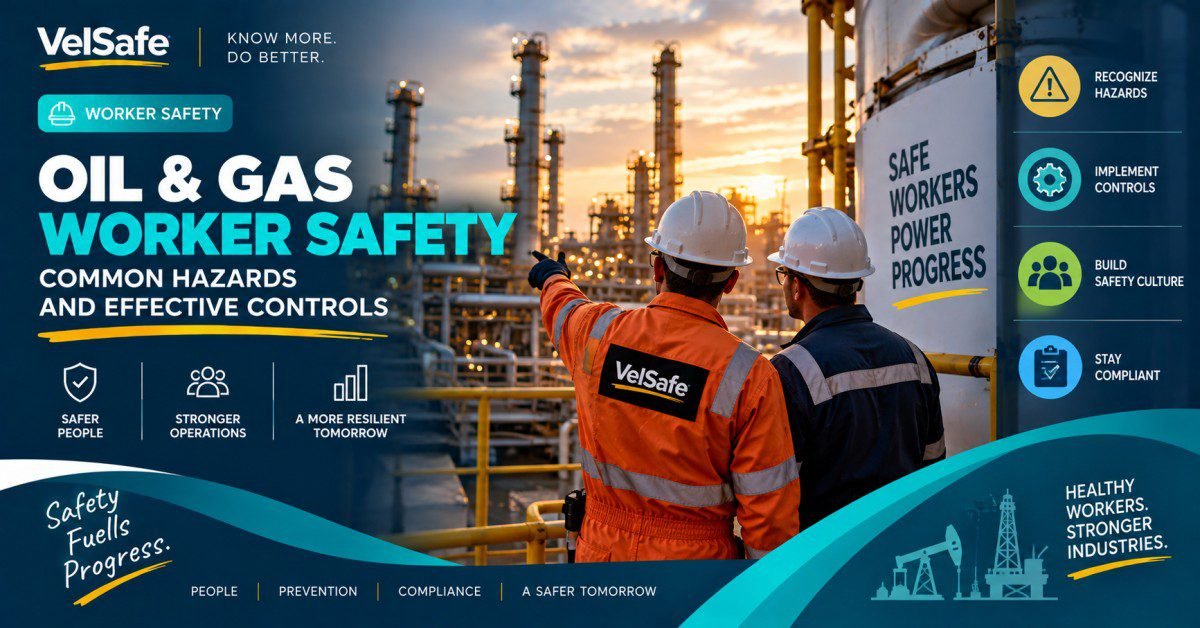
Oil and gas operations are among the most hazardous work environments in the United States. Workers face H2S gas, fire and explosion, heavy equipment, confined spaces, and falls every shift. Knowing the hazards, recognising the warning signs, and understanding exactly what to do is the difference between going home and not. This guide covers the five highest-risk hazards in oil and gas work, the controls your employer must provide, and the steps every worker should follow to stay safe.
7x
Higher Fatal Injury Rate in Oil and Gas Than All Private Industry
Bureau of Labor Statistics data shows the fatal injury rate in oil and gas extraction is approximately seven times higher than the overall private industry rate. The leading causes are transportation incidents, contact with objects and equipment, and falls. Source: BLS: Fatal Occupational Injuries
10 ppm
OSHA Ceiling Limit for H2S: Above This Level You Must Leave the Area
OSHA sets a ceiling of 10 ppm for hydrogen sulfide exposure. Above 100 ppm H2S causes rapid loss of consciousness. At high concentrations it can incapacitate and kill within seconds. Your gas monitor alarm is not an alert to investigate. It is a signal to leave immediately. Source: OSHA: Hydrogen Sulfide Hazards
29 CFR
1910.146: Confined Space Entry Is Illegal Without a Permit and a Trained Attendant
OSHA’s permit-required confined space standard at 29 CFR 1910.146 applies across oil and gas operations: tanks, vessels, sumps, and pits are all permit-required spaces. Entering without a permit, a trained attendant, and atmospheric testing equipment is an OSHA violation and one of the most common causes of multiple-fatality incidents. Source: 29 CFR 1910.146
Oil and Gas Hazard Overview: The Five Risks That Kill Most Workers
Oil and gas worker safety starts with knowing what can kill you on the job. The same hazards appear in nearly every serious incident and fatality report across upstream, midstream, and downstream operations. Some are sudden. Some build slowly. All of them are preventable when workers know the warning signs and know what to do.
H2S: Hydrogen Sulfide Poisoning
H2S is a colourless gas with a rotten egg smell at low levels. At high concentrations your nose stops detecting it. It can knock you unconscious within seconds and kill you before you can react. It collects in low-lying areas and is found during drilling, production, and tank gauging operations.
Fire and Explosion
Hydrocarbons ignite easily. A spark from a tool, static electricity, a running vehicle engine, or a cigarette is enough to cause a flash fire or explosion when vapours are present. Wellsite work, tank gauging, flowback, and loading operations all carry fire and explosion risk.
Struck-By and Caught-In
Heavy equipment, pipe, drill string, winches, and pressure-release events can all strike or catch a worker. Rotating equipment is one of the leading causes of serious injuries on drilling rigs. Never position yourself between a load and a fixed surface. Never reach over or into moving equipment.
Confined Space Entry
Tanks, vessels, pits, and enclosed processing equipment are permit-required confined spaces. They can contain toxic gases, oxygen-deficient atmospheres, or flammable vapours. They can also trap you if conditions change. Never enter a confined space without a permit, atmospheric testing, ventilation, and an attendant outside the space at all times.
Falls from Height
Working at height is unavoidable in oil and gas operations. Derrick work, mast climbing, tank top access, and working on elevated platforms all create fall hazards. Fall protection is required whenever you work at four feet above a lower level in general industry (six feet in construction). Your harness, lanyard, and anchor point must be inspected before every use. Source: OSHA: Fall Protection
Signs of Danger: When to Stop Work and Leave
Stop work and move upwind immediately if you notice any of these:
H2S Indicators
Rotten egg smell at any level. Gas monitor alarm. Headache, dizziness, or nausea. Co-workers losing coordination. Any unexplained loss of consciousness nearby.
Fire and Explosion Indicators
Visible mist or vapour near equipment. Hydrocarbon smell stronger than normal. Liquid or gas releasing from a fitting. Equipment vibrating or making unusual sounds before a pressure event.
Confined Space Indicators
Gas monitor reading outside safe range before entry. Entrant showing signs of confusion or weakness. Change in atmospheric conditions during the job. Attendant losing communication with entrant.
General Stop-Work Conditions
You are asked to do something without the proper permit or PPE. A supervisor tells you to skip a safety step. Equipment you are supposed to use is damaged or missing. You are unsure and no one will give you a straight answer.
You have the right to refuse unsafe work. OSHA Section 11(c) protects you from retaliation for stopping work when you reasonably believe there is a serious danger. Source: OSHA: Worker Rights
Safe Work Procedure: Oil and Gas Operations
Step 1: Attend the pre-job safety meeting and know the hazards before work starts
Every oil and gas job starts with a pre-job safety meeting. Listen and participate. Know the specific hazards for that location and that task. Ask about H2S levels, hot work permits, confined space entry requirements, and the emergency response plan for that site. If there is no pre-job meeting and you are about to do a high-hazard task, ask for one. You are entitled to know the hazards of your job before you start it. Source: OSHA: Worker Rights
Step 2: Put on and inspect all required PPE before entering the work area
In oil and gas operations, your PPE typically includes: hard hat, safety glasses or goggles, flame-resistant clothing (FRC), steel-toed boots, gloves appropriate to the task, and a personal H2S monitor. For heights: full-body harness, lanyard, and confirmed anchor point. For confined space entry: supplied-air or SCBA respirator where required. Inspect every piece of PPE before you put it on. A cracked hard hat, a harness with a frayed strap, or a gas monitor with a low battery reading does not protect you. Report damaged equipment before entering the work area.
Step 3: Confirm the permit is in place before starting any permitted work
Hot work, confined space entry, and lock-out/tag-out all require written permits before work begins. Read the permit yourself. Confirm that the conditions on the permit match the conditions you see. A hot work permit authorises work in a specific location for a specific period; if you move to a different location or if the permit has expired, the authorisation is no longer valid. A confined space entry permit specifies the atmospheric readings required for safe entry. If the readings at the time of entry do not match the permit requirements, entry cannot proceed. Source: 29 CFR 1910.146
Step 4: Keep your gas monitor on your body and respond to every alarm
A personal H2S monitor clipped to your collar or lapel gives you the most accurate reading of what you are breathing. Never clip it to your belt or put it in a pocket. When the alarm sounds, do not silence it and continue working. Move upwind immediately. Alert co-workers. Follow the site emergency plan. After any alarm, report the event to your supervisor and do not re-enter the area until atmospheric testing confirms safe conditions and your supervisor gives clearance. Alarm events are not minor inconveniences. They are the system working correctly.
Step 5: Isolate energy sources before any maintenance, repair, or equipment servicing
Lockout/tagout (LOTO) under 29 CFR 1910.147 requires that all energy sources (electrical, pneumatic, hydraulic, chemical, and mechanical) must be isolated and locked before any worker performs maintenance or servicing on equipment where unexpected startup or energy release could cause injury. In oil and gas operations, this includes blinding lines, bleeding pressure, and confirming zero energy before opening any pressurised system. Only the worker who applied the lock may remove it. If someone else removes your lock, report it immediately as a serious safety violation. Source: 29 CFR 1910.147
Step 6: Stop work immediately when conditions change and you are unsure it is safe to continue
Stop work authority means every worker has the right to stop any job at any time when they believe it is unsafe, without fear of retaliation. This is not just a right on paper. It is a practice that saves lives. When conditions change during a job (weather deteriorates, gas readings change, a permit expires, equipment behaves unexpectedly): stop the task, alert your supervisor, and do not restart until the changed condition is assessed and safe conditions are confirmed. Most serious oil and gas incidents happen when workers continued working despite warning signs they had been trained to recognise.
Oil and Gas Safety: Do and Do Not
Do
Wear your H2S monitor on your collar, not your belt
Read the permit before starting permitted work
Inspect your PPE before every shift and every task
Attend the pre-job safety meeting and ask questions
Apply your own lock during LOTO and remove it yourself
Move upwind immediately when any gas alarm sounds
Use your stop work authority when something feels wrong
Report near-misses, equipment defects, and alarm events
Know the muster point and emergency response plan for your site
Confirm atmospheric testing before confined space entry
Read the permit before starting permitted work
Inspect your PPE before every shift and every task
Attend the pre-job safety meeting and ask questions
Apply your own lock during LOTO and remove it yourself
Move upwind immediately when any gas alarm sounds
Use your stop work authority when something feels wrong
Report near-misses, equipment defects, and alarm events
Know the muster point and emergency response plan for your site
Confirm atmospheric testing before confined space entry
Do Not
Enter a confined space without a permit and an attendant outside
Silence a gas monitor alarm and continue working
Remove another worker’s LOTO lock for any reason
Assume H2S is absent because you cannot smell it
Use non-intrinsically safe equipment in flammable atmospheres
Smoke, use open flames, or idle vehicles near hydrocarbon releases
Work at height without a harness and confirmed anchor point
Skip a permit because the job “will only take a minute”
Attempt rescue of an H2S victim without breathing protection
Continue working when you are unsure it is safe to do so
Silence a gas monitor alarm and continue working
Remove another worker’s LOTO lock for any reason
Assume H2S is absent because you cannot smell it
Use non-intrinsically safe equipment in flammable atmospheres
Smoke, use open flames, or idle vehicles near hydrocarbon releases
Work at height without a harness and confirmed anchor point
Skip a permit because the job “will only take a minute”
Attempt rescue of an H2S victim without breathing protection
Continue working when you are unsure it is safe to do so
Emergency Response: What to Do When Something Goes Wrong
H2S Release or Worker Down: Self-Rescue First, Then Alert
If your gas alarm sounds or you see a worker collapse in an H2S area: hold your breath, move upwind immediately, and get clear of the affected area before doing anything else. Do not attempt to rescue a collapsed worker in an H2S atmosphere without a supplied-air respirator or SCBA; every year, rescuers die alongside the original victim. Once you are clear: activate the site alarm, call emergency services, report your location and the number of workers affected, and wait for emergency responders with breathing apparatus to conduct the rescue. Source: OSHA: H2S Hazards and Emergencies
Fire or Explosion: Evacuate, Alert, Account for All Workers
If a fire starts or an explosion occurs: evacuate all workers from the area immediately using pre-established escape routes. Do not attempt to fight an uncontrolled fire involving hydrocarbons without proper training and equipment. Move to the designated muster point. Account for all workers. Call emergency services. Do not re-enter the area for any reason until the incident commander declares it safe. In a gas cloud situation before ignition: do not activate any electrical equipment, do not start or stop vehicle engines in the area, and move all personnel upwind.
Confined Space Emergency: Call for Help, Do Not Enter
If an entrant in a confined space shows signs of distress or becomes unresponsive: the attendant must not enter the space. The attendant’s job is to call for rescue. Activate non-entry rescue equipment if it is available and the space has been configured for it. Alert the supervisor and call emergency services. Untrained rescue attempts in confined spaces routinely result in the rescuer becoming a second victim. Do not enter without supplied air and proper rescue training and equipment.
Supervisor Tips: What You Must Do Before Every Shift
Conduct the pre-job hazard analysis before work begins
Every shift, every task, every location requires a job hazard analysis (JHA). Walk the job site, identify the specific hazards for that day’s work, and communicate them to every worker in the crew. A JHA from last week is not the JHA for today’s conditions. H2S readings, weather, equipment status, and permit requirements all change.
Confirm every worker has functional PPE before starting
Visually check that every crew member has functional, correctly worn PPE for the task. Confirm gas monitors are bump-tested and calibrated. If a worker’s PPE is damaged or missing, do not start the job until it is replaced. You are responsible for your crew’s safety; that responsibility begins with confirming they have the equipment to do the job safely.
Support stop work authority: never pressure workers to continue
A worker who invokes stop work authority is doing exactly what they are trained to do. Respond with investigation, not pressure. Assess the concern, correct the condition if a hazard exists, and document the stop work event. Pressuring a worker to continue after they have raised a safety concern is a retaliatory act that violates OSHA Section 11(c).
Ensure every permitted task has an active, valid permit on site
Permits for hot work, confined space entry, and LOTO must be active for the specific location and time period before work begins. It is the supervisor’s responsibility to confirm the permit is on site, that workers have read it, and that conditions at the start of the job match the permit conditions. Expired permits are not valid and must be renewed before work continues.
Oil and Gas Worker Safety Checklist
Before the Shift
During the Task
After the Shift
Attend pre-job safety meeting
Inspect all PPE before wearing
Bump-test H2S monitor
Know the site muster point
Confirm permit is active and on site
Know the emergency contact number
Inspect all PPE before wearing
Bump-test H2S monitor
Know the site muster point
Confirm permit is active and on site
Know the emergency contact number
Keep H2S monitor on collar at all times
Respond to every alarm immediately
Never bypass or silence safety systems
Confirm permit conditions are still met
Use stop work authority if unsure
Keep escape route clear at all times
Respond to every alarm immediately
Never bypass or silence safety systems
Confirm permit conditions are still met
Use stop work authority if unsure
Keep escape route clear at all times
Report all near-misses and alarm events
Return or properly store all PPE
Report any damaged equipment
Sign off on permit closure if required
Complete incident reports before leaving
Brief the incoming crew on any issues
Return or properly store all PPE
Report any damaged equipment
Sign off on permit closure if required
Complete incident reports before leaving
Brief the incoming crew on any issues
Key Takeaways
When your gas alarm goes off, leave first and ask questions after
H2S moves faster than you can reason about it. The alarm means conditions may no longer be safe for unprotected workers. Your only job when it sounds is to move upwind immediately. Every second you spend investigating instead of moving is a second in which you may be exposed to a concentration that will incapacitate you before you can take the next step.
No permit means no entry, no exceptions
Confined space fatalities are among the most preventable in oil and gas, and they are almost always the result of entry without a permit or entry after conditions changed and the permit was not re-evaluated. A confined space that looks safe has killed hundreds of workers. Atmospheric testing and a valid permit are not procedural formalities. They are the information that tells you whether the space will let you out alive.
Stop work authority exists because production pressure kills workers: use it
Incident investigations in oil and gas consistently find that workers who were injured or killed had seen warning signs before the incident. They continued because they felt pressure to keep the job moving. Stop work authority is your protection against that pressure. You will not be fired for invoking it legitimately. You may save your own life and the lives of everyone else on the site. The OSHA anti-retaliation provision under Section 11(c) protects you if your employer responds negatively to a legitimate safety stop.
Frequently Asked Questions
What is H2S and why is it so dangerous in oil and gas operations?
Hydrogen sulfide (H2S) is a colourless, flammable, and extremely toxic gas produced naturally in oil and gas reservoirs. At low concentrations it smells like rotten eggs, but at concentrations above about 100 ppm it paralyses the olfactory nerve, meaning you lose the ability to smell it just as it becomes most dangerous. Above 700 ppm, unconsciousness and death can occur within minutes. H2S is heavier than air and collects in low-lying areas, sumps, and confined spaces. It is present during drilling, production, and tank operations. OSHA’s permissible exposure limit (ceiling) is 10 ppm. Source: OSHA: H2S Hazards
What PPE is required for oil and gas workers?
Required PPE varies by task and site-specific conditions, but baseline PPE for most oil and gas worksites includes: hard hat, safety glasses, flame-resistant clothing (FRC), steel-toed boots, gloves, and a personal H2S monitor. Additional PPE based on task includes: full-face respiratory protection for confined space entry in atmospheres requiring it, fall arrest harness for work at height, hearing protection in high-noise areas, and chemical protective clothing when working with hazardous substances. Your employer must conduct a hazard assessment and provide the appropriate PPE at no cost to you under 29 CFR 1910.132. Source: 29 CFR 1910.132
Can I be fired for refusing to do unsafe work in oil and gas?
OSHA Section 11(c) of the OSH Act prohibits employers from retaliating against workers who refuse to perform work they reasonably believe poses imminent danger of death or serious physical harm, when the danger is not correctable through normal reporting channels and there is no time to contact OSHA. If you are fired, demoted, or disciplined for refusing unsafe work, you can file a complaint with OSHA within 30 days. OSHA can order reinstatement, back pay, and other remedies. Most reputable oil and gas employers also have their own stop work authority policies that protect workers who raise safety concerns. Source: OSHA: Worker Rights
What is lockout/tagout and when does it apply in oil and gas?
Lockout/tagout (LOTO) is the procedure for isolating energy sources before any maintenance, servicing, or repair work on equipment where unexpected startup or energy release could cause injury. In oil and gas, LOTO applies to electrical systems, pumps, compressors, valves, and pressurised systems. It requires shutting down the equipment, bleeding all stored energy (electrical, pneumatic, hydraulic, chemical, gravitational), applying a physical lock that only the worker performing the task can remove, and verifying zero energy before starting work. In oil and gas, this often includes blinding or blanking lines and bleeding pressure to zero before opening any process equipment. Source: 29 CFR 1910.147
What must happen before a worker enters a confined space on an oil and gas site?
Before any worker enters a permit-required confined space, the following must occur: the space must be identified as permit-required and posted, a written entry permit must be prepared and authorised, the atmosphere must be tested for oxygen content (19.5% to 23.5%), flammable gases (less than 10% of the lower explosive limit), and toxic gases including H2S, continuous ventilation must be provided where feasible, a trained attendant must be posted outside the space at all times during entry, and rescue equipment and procedures must be identified. The entrant may not enter until the permit conditions are met. Source: 29 CFR 1910.146
What are the leading causes of death in oil and gas operations?
Bureau of Labor Statistics data for oil and gas extraction shows that the four leading causes of fatal occupational injuries are: transportation incidents (driving to and from remote sites and on-site vehicle movements), contact with objects and equipment (struck-by, caught-in, and pressure-release events), falls (from derricks, tanks, platforms, and elevated equipment), and exposure to harmful substances or environments (H2S, fire, and explosion). Together these categories account for the large majority of all oil and gas fatalities. The high vehicle mile exposure and the prevalence of H2S, high-pressure systems, and elevated work make oil and gas one of the highest-risk industries in the US. Source: BLS: Fatal Occupational Injuries
What is flame-resistant clothing (FRC) and why do oil and gas workers need it?
Flame-resistant clothing (FRC) is designed to resist ignition and self-extinguish if exposed to a flash fire or arc flash event. It does not prevent burns, but it significantly reduces burn injury severity compared to standard clothing, which can ignite and continue burning after the initial flame source is removed. In oil and gas operations where hydrocarbons and ignition sources are both present, FRC is required PPE under most company policies and is recommended by OSHA for workers exposed to flash fire hazards. FRC must be maintained in good condition and worn correctly (not unbuttoned or with non-FRC garments over it that could defeat its protection).
Sources
Government and Regulatory Sources
- OSHA: Hydrogen Sulfide Hazards: H2S exposure limits, physiological effects by concentration, emergency response guidance, and the 10 ppm ceiling limit cited in the stat cards and throughout the article.
- 29 CFR 1910.146: Permit-Required Confined Spaces: the confined space entry standard governing permit requirements, atmospheric testing, attendant and entrant roles, and rescue procedures in oil and gas operations.
- 29 CFR 1910.147: The Control of Hazardous Energy (Lockout/Tagout): LOTO requirements for isolating energy sources during maintenance and servicing of equipment in oil and gas operations.
- 29 CFR 1910.132: Personal Protective Equipment: General Requirements: employer obligations to provide PPE at no cost based on hazard assessment for oil and gas workers.
- OSHA: Worker Rights: Section 11(c) anti-retaliation protections for workers who refuse unsafe work, report hazards, or exercise safety rights in oil and gas operations.
- OSHA: Fall Protection: fall protection requirements and standards for oil and gas workers performing elevated work.
Research and Industry Sources
- Bureau of Labor Statistics: Fatal Occupational Injuries: source for the seven times higher fatal injury rate in oil and gas extraction compared to all private industry, and for the leading fatal injury cause categories cited in the FAQ.
Related VelSafe Articles
Situational
Oil and Gas: Accident Prevention Signs and Tags
A case study in how missing, misapplied, or ignored accident prevention signs and tags contribute to oil and gas incidents, with root cause analysis and the regulatory requirements for tagging systems.
Law
Oil and Gas: Bloodborne Pathogens Legal Requirements
The OSHA bloodborne pathogen standard obligations for oil and gas workers and employers, including exposure determination, training, and PPE requirements where BBP exposure risk exists.
Insights
Oil and Gas: Breaking Containment: Incident Trends and Prevention
Data-driven analysis of breaking-containment incidents in oil and gas operations: what the incident data shows about root causes, the human and systems factors that drive them, and what operators and workers can do to prevent the next one.
Oil and Gas Worker Safety Resources
More Safety Guides for Oil and Gas Workers and Supervisors
VelSafe covers oil and gas safety, confined space, H2S, fall protection, and LOTO for frontline workers, supervisors, and safety trainers. Browse worker safety guides, case studies, and compliance resources built for high-hazard environments.
Browse Worker Safety Guides