LAW: Microlearning and Safety Training Compliance
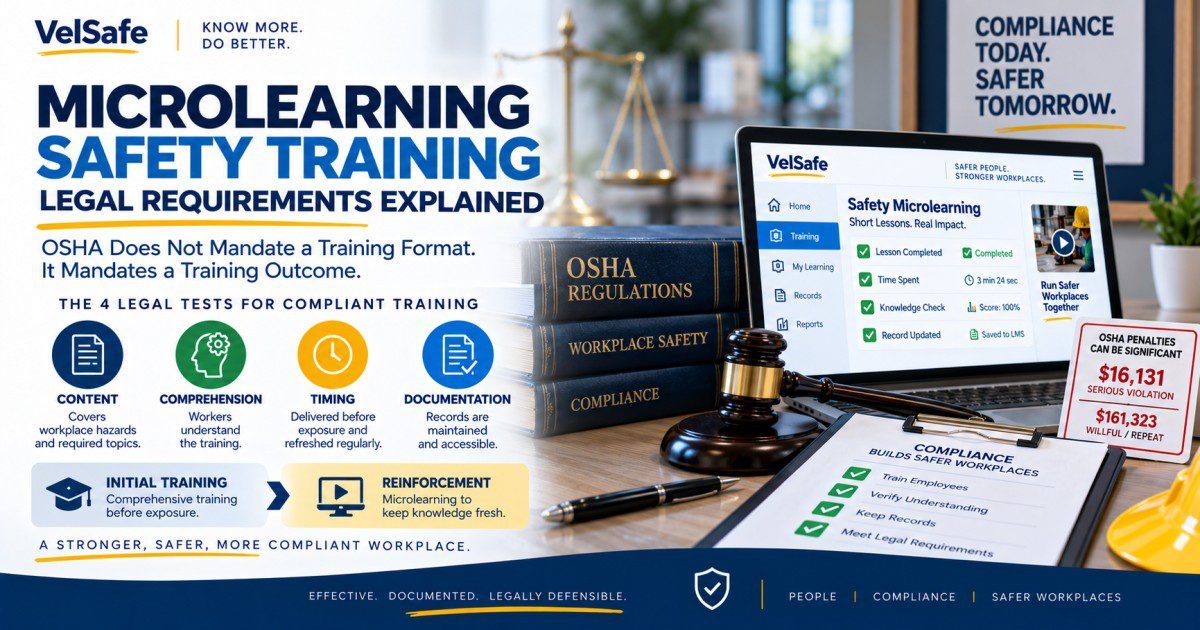
OSHA Does Not Mandate a Training Format.
It Mandates a Training Outcome. Here Is What That Means.
Microlearning safety training legal requirements are not found in a single OSHA standard that says “use microlearning” or “do not use microlearning.” The regulatory framework is more demanding than that. OSHA’s training requirements specify topics, outcomes, timing, and documentation. Whether those requirements are satisfied by a 90-second microlesson, a 4-hour classroom session, or a blended programme is a question of evidence, specifically, whether the employer can demonstrate that workers received the required information, understood it, and are capable of applying it. This article examines what the law actually requires, where microlearning satisfies those requirements, where it does not, and what employers must do to keep their microlearning safety programmes legally defensible.
$16,131
OSHA Maximum Penalty Per Serious Violation, Including Inadequate Safety Training
OSHA’s maximum penalty for a serious violation (including training failures) is $16,131 per violation as of 2024, adjusted annually for inflation. Willful or repeated violations reach $161,323 per violation. When OSHA investigates an incident and finds that adequate training was not provided, the employer faces penalties on top of workers’ compensation costs, litigation exposure, and reputational damage. Source: OSHA: Penalty Amounts
No format
OSHA Does Not Specify a Minimum Session Length or Delivery Format for Most Safety Training
Most OSHA training standards specify what workers must be trained on and when, but do not prescribe the format, duration, or delivery method. The employer must demonstrate that training was effective, that workers received the required information and are capable of using it safely. This means microlearning can satisfy OSHA training requirements when properly documented, comprehensive, and demonstrably effective. Source: OSHA: Training Guidelines
General Duty
The General Duty Clause Applies When Training Fails to Control a Recognised Hazard
Even when microlearning satisfies the technical training requirement of a specific standard, OSHA can still cite an employer under the General Duty Clause (Section 5(a)(1) of the OSH Act) if the training demonstrably failed to control a recognised hazard. Recurring incidents in areas covered by training content are evidence that the training was not an effective control, regardless of completion rates or format. Source: OSHA: General Duty Clause
Law Summary: Microlearning Safety Training Legal Requirements
Microlearning safety training legal requirements under OSHA do not form a single, unified legal framework. Instead, they emerge from the intersection of three legal sources: the specific training provisions in applicable OSHA standards (which specify topics and outcomes but rarely mandate format), the General Duty Clause (which requires effective hazard control regardless of format), and OSHA’s Training Guidelines (OSHApub 2254), which set out the principles OSHA uses when evaluating whether employer training satisfies legal requirements.
The legal test for whether training is adequate is not format-based. OSHA does not ask: was this delivered as a 60-minute module or a series of microlessons? OSHA asks: did workers receive the information they needed, in a format they could understand, at a time that allowed them to apply it, with verification that they understood it? A microlearning programme that satisfies all four of those conditions is legally defensible. A microlearning programme that cannot demonstrate any of them is not, regardless of how many completion records exist.
State plan states, those operating their own OSHA-approved programmes (California, Michigan, Washington, and 24 others), may have additional or more specific training format requirements. Employers in state plan states must verify compliance with state-level standards in addition to federal OSHA requirements. The analysis in this article applies to the federal OSHA framework and should be supplemented with state-specific review where applicable. Source: OSHA: State Plans
Where microlearning is legally strongest: behaviour reinforcement, not initial hazard communication
OSHA’s training requirements typically require initial training on a topic before exposure to the hazard, and refresher training when there is reason to believe knowledge or performance has changed. Initial training, where the regulatory standard most precisely specifies content and worker comprehension, is legally most defensible when delivered through a comprehensive, documented format. Microlearning is legally strongest as a spaced reinforcement mechanism after initial training is completed, building retention, sustaining behaviour change, and providing the documented evidence of ongoing training that OSHA expects in a mature safety programme.
Compliance Table: OSHA Training Requirements and Microlearning Applicability
| Standard |
Training Requirement |
Format Specified |
Microlearning Applicability |
| Hazard Communication (29 CFR 1910.1200) |
Train on hazardous chemicals present, SDS information, labelling, and protective measures |
No format specified. Must be effective and in language workers understand |
Applicable for refresher and reinforcement. Initial HazCom training must comprehensively cover all required topics |
| PPE (29 CFR 1910.132) |
Train each worker required to use PPE on when, what, how to wear, limitations, and care |
No format specified. Worker must demonstrate understanding before equipment use |
Limited for initial training, demonstration of correct use required. Applicable for refresher on specific PPE topics |
| Walking-Working Surfaces (29 CFR 1910.30) |
Train workers on STF hazards they face and methods of protection before work begins |
No format specified |
Applicable for initial and ongoing training when content covers all required topics. Strong fit for seasonal reinforcement |
| Lockout/Tagout (29 CFR 1910.147) |
Authorised and affected workers must be trained; retraining required when deficiency is observed |
No format specified, but practical demonstration of procedural knowledge expected |
Insufficient as sole method, practical procedure demonstration required. Use for awareness reinforcement only |
| Respiratory Protection (29 CFR 1910.134) |
Training before use; annual retraining required. Must cover fit, use, maintenance, and limitations |
No format specified; fit test is a separate physical requirement |
Applicable for knowledge reinforcement and refresher. Fit testing and initial use demonstration must be separate |
| Bloodborne Pathogens (29 CFR 1910.1030) |
Annual training required for occupationally exposed workers. Content specifically enumerated in the standard |
No format specified. Must include opportunity for questions |
Applicable when all enumerated topics covered and a mechanism for questions is provided. Strong fit for annual compliance cycle |
| Emergency Action Plans (29 CFR 1910.38) |
Train all workers on the EAP before initial assignment and when plan changes |
No format specified |
Applicable for familiarisation and review. Applicable for reinforcing specific procedures (evacuation routes, assembly points) |
What the Law Requires: Four Elements Every Training Must Satisfy
Element 1: Content, the specific topics required by the applicable standard
OSHA training standards specify the topics that must be covered. For example, 29 CFR 1910.1030 (Bloodborne Pathogens) requires training to include: the epidemiology and symptoms of bloodborne diseases, modes of transmission, the exposure control plan, engineering and work practice controls, PPE use and limitations, hepatitis B vaccination information, post-exposure evaluation and follow-up procedures, signs, labels and colour-coding requirements, and an opportunity for questions. A microlearning programme that covers all of these topics across its lesson library satisfies the content requirement. A programme that covers only some of them, even with high completion rates, does not. Source: 29 CFR 1910.1030(g)(2)
Element 2: Comprehension, training must be in a language and format workers understand
OSHA requires that training be presented “in a manner that the employee can understand.” This encompasses language, literacy level, and format accessibility. A 90-second microlesson delivered in English to a predominantly Spanish-speaking workforce does not satisfy this requirement, not because of its length, but because of its language. A microlearning programme is legally vulnerable if its content is not available in the languages spoken by the workers it trains, or if its format assumes a literacy level workers do not have. Employers must audit their workforce’s language and literacy profile and ensure their microlearning content is accessible. Source: OSHA: Voluntary Training Guidelines, OSHApub 2254
Element 3: Timing, initial training before exposure, refreshers when conditions change
Most OSHA training standards require initial training before a worker is exposed to the relevant hazard. A microlearning programme that delivers initial training as a series of weekly lessons over two months does not satisfy this requirement for a worker hired on day one who begins hazard exposure on day two. Initial training must be comprehensive and completed before first exposure. Microlearning delivered as a pre-exposure onboarding package, where all required topics are covered in the first week, satisfies the timing requirement. Weekly reinforcement after that point is supplemental, not substitutional. For refresher training, which most standards require when there is cause to believe knowledge or performance has changed, microlearning is particularly well-suited.
Element 4: Documentation, who was trained, what they were trained on, when, and by whom
OSHA’s recordkeeping requirements for training vary by standard. Some standards (such as 29 CFR 1910.1030 for bloodborne pathogens) require employers to maintain training records for the duration of employment plus 30 years. Others impose shorter or no specified retention period, but documentation is always a practical requirement for demonstrating compliance during an inspection or in post-incident litigation. A microlearning programme delivered through an LMS that records completion, timestamps, lesson content, and knowledge check scores produces exactly the documentation OSHA expects. A microlearning programme delivered informally through chat messages or shared video links without LMS tracking produces no defensible documentation at all. Source: 29 CFR 1910.1030(h)
What an LMS must capture to support OSHA documentation requirements
Completion date and time for each lesson; the specific content covered in each lesson; the worker’s name and employee identifier; knowledge check scores or assessment results; the name and credentials of the trainer or training content provider (where required by the standard); and any corrective action taken when a worker fails a knowledge check. Records must be stored in a format that is retrievable and producible during an OSHA inspection without days of preparation.
State plan states: additional or different documentation requirements may apply
California (Cal/OSHA), Michigan (MIOSHA), Washington (L&I), and 24 other state plan states operate their own OSHA-approved safety programmes. Some have training requirements that are more specific than federal OSHA, including minimum training duration for certain hazard categories, mandatory in-person components for specific standards, or additional language access requirements. Employers operating in state plan states must review state-specific requirements. The compliance table in this article reflects federal OSHA requirements only. Source: OSHA: State Plans
Penalties: What Inadequate Safety Training Costs Employers
| Violation Type |
Maximum Penalty (2024) |
What Triggers It |
Training Failure Connection |
| Serious violation |
$16,131 per violation |
Hazard that could cause serious harm or death that the employer knew or should have known about |
Insufficient initial training on the hazard; training not covering all required topics; training not provided before first exposure |
| Willful violation |
$161,323 per violation |
Employer intentionally or knowingly failed to comply with a requirement |
Using microlearning as a documented substitute for required training, knowing it does not cover all required content |
| Repeat violation |
$161,323 per violation |
Same or similar standard violated within five years of a prior citation |
Recurring training failures on the same standard; continuing to use the same inadequate programme after a prior citation |
| Failure to abate |
$16,131 per day past the abatement deadline |
Employer fails to correct a cited violation by the abatement date |
Continuing to use a training programme that was cited as inadequate; not correcting training gaps by the deadline in the citation |
Source: OSHA: Penalty Amounts (2024). Penalties adjusted annually for inflation.
Common Failures: What Triggers OSHA Citations for Microlearning Programmes
Using microlearning as a substitute for initial training without covering all required topics
The most common citation-triggering failure is replacing the initial comprehensive training with a series of microlessons that, in aggregate, do not cover all topics required by the applicable standard. Employers who break their HazCom, BBP, or respirator training into weekly 90-second microlessons beginning on day one may find that a worker is exposed to a hazard before the lesson covering that specific hazard has been delivered. Initial training must cover all required topics before first exposure, microlearning cannot sequence across weeks when exposure begins in the first shift.
Delivering microlearning content in English to workers whose primary language is not English
OSHA’s comprehension requirement applies to all training regardless of format. If an employer’s microlearning content is available only in English and the workforce includes workers whose primary language is Spanish, Vietnamese, or another language, the training programme does not satisfy the legal requirement for those workers. OSHA has cited employers specifically for providing training in a language workers did not understand. Microlearning platforms that offer multilingual content production are not optional for employers with linguistically diverse workforces, they are a legal requirement.
No LMS tracking, delivering microlearning through informal channels without documentation
Employers who deliver microlearning through email links, WhatsApp videos, or posted QR codes without LMS tracking have no documentation that any specific worker completed any specific lesson. During an OSHA inspection, “we posted the video in the break room” is not evidence that workers received the training. OSHA expects documented evidence of who was trained, what they were trained on, when, and with what result. An undocumented microlearning programme is legally equivalent to no training at all.
Using microlearning for safety topics that require hands-on demonstration or physical practice
Lockout/tagout, confined space entry, respirator fit and use, fire extinguisher operation, first aid procedures, and fall protection equipment inspection are examples of safety topics where regulatory expectation includes demonstration of practical competence, not just knowledge of the procedure. A microlesson teaching workers that there are six steps to LOTO does not substitute for a worker physically demonstrating those six steps on the specific equipment they will be locking out. Employers who use microlearning for these topics without a practical demonstration component face citation risk when inspectors ask workers to demonstrate procedures they have only watched on a screen.
Employer Responsibilities: Building a Legally Defensible Microlearning Programme
Map every required training topic to a microlesson and verify complete coverage
Before deploying a microlearning programme for any regulated safety topic, create a content map that lists every topic required by the applicable OSHA standard and identifies which microlesson covers it. Any gap in coverage is a legal compliance gap. If the standard requires 11 specific training elements and the microlearning library covers 8, the programme does not satisfy the standard regardless of completion rates. The content map is also documentation, a compliance officer should be able to produce it during an inspection.
Use microlearning as a reinforcement layer, not a replacement for initial comprehensive training
Initial training, delivered before first exposure, covering all required topics, in a language workers understand, must be completed before microlearning reinforcement begins. The initial training satisfies the regulatory requirement. Microlearning then builds on that foundation by spacing repetition of key content through the period when workers are actually encountering the hazards. This layered approach is legally defensible: the initial training satisfies OSHA’s requirement; the microlearning supplements and reinforces it.
Produce all content in the languages spoken by your workforce
Conduct a workforce language audit before deploying a microlearning safety programme. Identify every language in which workers may need content. Ensure your microlearning platform supports content production and delivery in those languages. Assign completion requirements by language group and track completion separately. An English-only microlearning programme in a multilingual workforce is a documented compliance failure waiting for an inspection to reveal it.
Verify that topics requiring practical competence include a hands-on component
For every safety topic in your microlearning programme, evaluate whether the topic has a practical competence dimension that a screen-based microlesson cannot verify. Lockout/tagout, confined space, respirator use, first aid, and equipment-specific procedures typically require a competency demonstration before OSHA would consider the training effective. Document the practical demonstration separately from the microlesson completion, the combined record (lesson completed plus competence demonstrated) is the legally defensible training record.
Legal Disclaimer
This article provides educational information about regulations and legal requirements. It does not constitute legal advice. Requirements vary by industry, jurisdiction, and specific workplace conditions. Consult a qualified safety professional or employment attorney for guidance specific to your workplace.
Key Takeaways
OSHA does not specify a training format, it specifies a training outcome. Microlearning is legally defensible when it achieves that outcome with documented evidence.
The four legal tests, content coverage, comprehension, timing, and documentation, apply regardless of whether training is delivered as a 4-hour classroom course or a series of 90-second microlessons. A microlearning programme that satisfies all four is as legally defensible as any other format. A programme that fails any one of them is not defensible, and completion rates do not fix a content, language, timing, or documentation failure.
The General Duty Clause applies to training effectiveness, not just training completion, recurring incidents override documented compliance.
An employer with 95% microlesson completion rates who sustains recurring incidents in the trained hazard area cannot rely on those completion rates as a complete defence. OSHA’s General Duty Clause allows citation when a recognised hazard exists and the employer’s controls, including training, have failed to address it effectively. The incidents are the evidence that the training was not an effective control. Updating content, changing delivery frequency, adding supervisor reinforcement, and engineering controls alongside microlearning are the responses that address both the legal exposure and the real-world risk.
Microlearning is legally strongest as a reinforcement layer, and legally weakest as a sole training method for topics requiring initial comprehensive coverage or practical demonstration
The legal risk profile of microlearning is not uniform across all safety training topics. For topics where OSHA requires comprehensive initial training before exposure (HazCom, BBP, respirator, LOTO), microlearning works best as a reinforcement layer after an initial comprehensive training event, not as the primary delivery vehicle. For topics where OSHA requires periodic refreshers and ongoing awareness (walking-working surfaces, EAP, general housekeeping), microlearning can serve as the primary mechanism. Understanding where microlearning fits, and where it does not, in the regulatory framework for each topic is the foundation of a legally defensible programme design.
Frequently Asked Questions
Does OSHA allow microlearning as a training format?
OSHA does not prohibit or specifically authorise any training format, including microlearning. Most OSHA training standards specify what must be covered, when training must occur, and how employers must verify understanding, but do not prescribe format or duration. Microlearning is permissible when it satisfies all four legal requirements: content coverage of all required topics, comprehension in a language workers understand, correct timing (before first exposure for initial training), and documented completion with evidence of understanding. A microlearning programme that meets all four requirements is as legally defensible as any traditional format. Source: OSHA: Voluntary Training Guidelines
What OSHA penalty can an employer face for inadequate safety training?
OSHA’s maximum penalty for a serious violation (which includes training failures that create or contribute to a hazard that could cause serious harm or death) is $16,131 per violation as of 2024, adjusted annually for inflation. Willful violations, where the employer intentionally or knowingly failed to comply, reach $161,323 per violation. Repeat violations (same or similar standard violated within five years of a prior citation) also reach $161,323 per violation. Failure to abate a cited training deficiency by the specified deadline carries penalties of up to $16,131 per day past the abatement date. Source: OSHA: Penalty Amounts
Can microlearning satisfy the initial training requirement under OSHA standards?
Yes, with an important condition: the initial training must cover all topics required by the applicable standard before the worker is exposed to the hazard. If a microlearning programme delivers required content across weekly lessons over two months, but the worker begins hazard exposure on day one, the timing requirement is not satisfied, even if the content would eventually be complete. Initial training delivered through a focused pre-exposure microlearning package, where all required topics are covered in a short compressed period before first exposure, satisfies the timing requirement. For most regulated topics, this means completing all initial training content in the first day or first week, then using weekly microlessons as reinforcement afterward.
What training records must an employer keep for a microlearning programme?
Records must document who was trained (name, job title, employee ID), what they were trained on (lesson title, content covered, applicable OSHA standard), when the training occurred (date and time of completion), and evidence of comprehension (knowledge check score or assessment result). For standards with specific retention requirements (such as 29 CFR 1910.1030, which requires training records for the duration of employment plus 30 years), records must be stored in a retrievable format for the required period. For standards without specified retention periods, practical guidance recommends maintaining records for at least the duration of employment plus three to five years, consistent with general civil litigation standards, but employers should consult legal counsel for jurisdiction-specific requirements.
Which safety training topics are NOT appropriate for microlearning as the sole delivery method?
Safety training topics that require practical demonstration of competence before the worker is safe to perform the task should not rely on microlearning as the sole training method. These include: lockout/tagout (29 CFR 1910.147), requires demonstration of the facility-specific procedure; confined space entry (29 CFR 1910.146), requires demonstration of entry procedures and rescue awareness; respiratory protection (29 CFR 1910.134), requires fit testing as a separate physical requirement; fall protection equipment inspection and use, requires hands-on practice; and first aid procedures, requires physical practice to develop practical competency. Microlearning can reinforce knowledge of these topics, but a practical competence demonstration must be documented separately.
What does OSHA’s General Duty Clause mean for employers using microlearning?
Section 5(a)(1) of the OSH Act (the General Duty Clause) requires every employer to provide a workplace free from recognised hazards likely to cause death or serious physical harm. Even when a specific OSHA standard does not explicitly address a hazard, or when an employer has technically complied with a standard’s training requirements, OSHA can cite under the General Duty Clause if the employer’s controls, including training, have demonstrably failed to prevent a recognised hazard. For employers using microlearning, this means that recurring incidents in hazard areas covered by microlearning content can trigger a General Duty citation even when completion rates are high. Effectiveness, not just completion, is the legal standard. Source: OSH Act Section 5(a)(1)
Do state plan states have different rules for microlearning safety training?
State plan states (26 states and territories operating their own OSHA-approved programmes) may have training requirements that are more specific or more stringent than federal OSHA. Some state plans specify minimum training durations for certain hazard categories, require mandatory in-person or practical components for specific topics, or have additional language access requirements. California’s Cal/OSHA, for example, has specific injury and illness prevention programme requirements that may affect how training (including microlearning) must be structured and documented. Employers operating in state plan states must review applicable state requirements independently of the federal OSHA analysis in this article. Source: OSHA: State Plans
Sources
Government and Regulatory Sources
- OSHA: Penalty Amounts (2024): source for the $16,131 serious violation maximum and $161,323 willful and repeat violation maximum, adjusted annually for inflation under the Federal Civil Penalties Inflation Adjustment Act.
- OSH Act Section 5(a)(1): General Duty Clause: source for the employer obligation to provide a workplace free from recognised hazards, and the legal basis for citation when training fails to prevent a hazard regardless of format compliance.
- OSHA: Voluntary Training Guidelines (OSHApub 2254): source for OSHA’s four-element framework for evaluating training adequacy: determining training needs, identifying training goals, designing activities, and evaluating effectiveness.
- 29 CFR 1910.1030: Bloodborne Pathogens: source for the specific training content requirements enumerated in paragraph (g)(2), the documentation requirements in paragraph (h), and the training record retention period (duration of employment plus 30 years).
- 29 CFR 1910.132: PPE General Requirements: source for the employer obligation to train each worker required to use PPE on the required topics and to verify understanding before equipment use.
- OSHA: State Plans: source for the 26 state plan states and the framework under which they may have more specific or stringent requirements than federal OSHA.
Research and Industry Sources
- ATD: Microlearning Research: source for the learning science evidence on microlearning effectiveness, spaced repetition, and the Ebbinghaus forgetting curve research that underlies the behaviour-change case for microlearning as a reinforcement mechanism in safety training programmes.
Related VelSafe Articles
Situational
Microlearning Slips Trips and Falls Prevention
The real-world case study companion to this law article, showing what happens when a microlearning STF programme is designed and deployed correctly, including the legal context for what made it effective rather than merely compliant.
Law
OSHA Incident Reporting: What to Report and When
The post-incident regulatory obligation article, what must be reported to OSHA when a training failure contributes to an injury, including the timeline and documentation requirements that apply when a microlearning programme’s inadequacy is a contributing factor.
Guides
Effective Safety Orientation for New Construction Workers
The safety orientation design guide, where the initial comprehensive training requirement discussed in this law article is built into the onboarding process, with the microlearning reinforcement layer that follows it producing the legally defensible programme design.
SAFETY TRAINING LAW AND COMPLIANCE
More Safety Training Law Resources
Explore VelSafe’s safety training law library for regulatory analysis covering OSHA training requirements, General Duty Clause obligations, penalty exposure, documentation standards, and the compliance programme design considerations that keep employer safety programmes legally defensible.
Explore All Law Articles