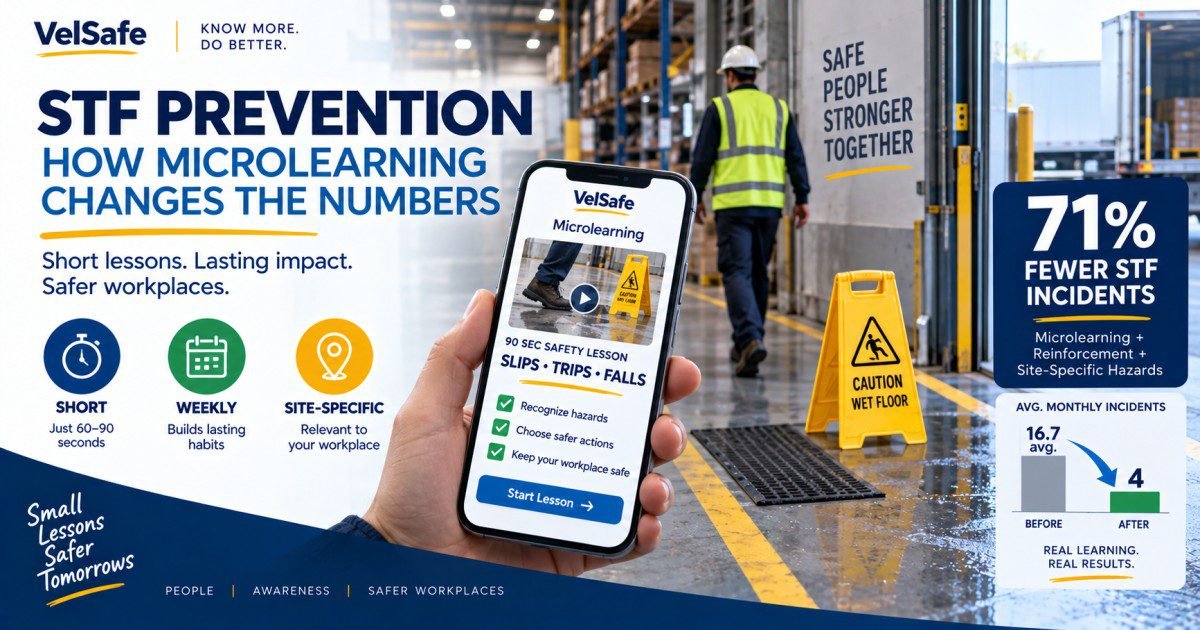
SITUATIONAL: Awareness and Microlearning, Slips, Trips and Falls Prevention
Annual STF Training Passed. February Incident Filed.
What Changed When the Training Did.
Microlearning slips trips and falls prevention is one of the most practical applications of microlearning in workplace safety. Slips, trips and falls are the second leading cause of non-fatal workplace injuries in the United States, responsible for more than 800 worker deaths and over 211,000 days-away-from-work cases annually. Yet the majority of employers address this hazard through annual training modules that workers complete, forget, and repeat the following year. This case study follows a mid-size distribution centre where that exact pattern held for three years, until a microlearning intervention broke it. It examines what changed, what the data showed, and what every safety manager needs to understand about why short, frequent, situation-specific training outperforms annual compliance modules for STF prevention.
800+
Worker Deaths from Slips, Trips and Falls in US Workplaces Each Year
Slips, trips and falls are the second leading cause of non-fatal occupational injuries and the third leading cause of fatal work injuries in the US, behind only transportation incidents and contact with objects and equipment. The majority of STF incidents are preventable through a combination of engineering controls, housekeeping discipline, and consistent worker behaviour reinforcement. Source: BLS: Census of Fatal Occupational Injuries
90 sec
The Optimal Length for a Safety Microlesson According to Learning Science Research
Learning science research consistently shows that short, focused learning episodes of 60 to 120 seconds are more effective for behaviour change than longer training modules when delivered repeatedly over time. Spaced repetition, the practice of revisiting content at intervals, produces stronger retention than massed learning events. A 90-second microlesson delivered weekly outperforms a 90-minute module delivered once per year for safety behaviour retention. Source: ATD: Microlearning Research
Day 5
When Workers Forget Half of New Training Content Without Reinforcement
Ebbinghaus’s forgetting curve research, replicated repeatedly in occupational training contexts, shows that learners forget approximately 50% of new content within a week without reinforcement and up to 80% within a month. Annual safety training is particularly vulnerable to this effect, content delivered in January is largely forgotten before the peak slip season in winter conditions. Regular microlearning interventions interrupt this forgetting curve. Source: ATD: Microlearning and Retention Research
A 340-person distribution centre in the Midwest had completed annual slips, trips and falls training for three consecutive years. Completion rates were above 95% each year. The training covered wet floor awareness, proper footwear, housekeeping responsibilities, and how to report hazards. The content was accurate, OSHA-referenced, and professionally produced. Workers signed completion acknowledgements. Supervisors verified completion in the learning management system.
And yet. In each of those three years, the facility recorded between 14 and 19 STF-related recordable incidents. The incidents were concentrated in the same three months: January, February, and March, the same period when outdoor footwear tracked moisture into the receiving area. The same receiving area. The same hazard. The same training. The same incidents.
Who was involved
The workforce included approximately 180 permanent employees and 80 to 120 seasonal warehouse workers hired each year from October through March, the highest-risk period for STF incidents. Seasonal workers completed an onboarding safety module on their first day, which included the same annual STF training content delivered to permanent staff. They retained it no better, and their incident rate was disproportionately high relative to their time on site.
What the data showed before the intervention
Year 1: 17 STF recordables, all occurring between January and March. Year 2: 19 STF recordables, same period, same receiving area accounting for 11. Year 3: 14 STF recordables, a slight reduction attributed by management to a physical change (anti-fatigue matting installed in November) rather than training effectiveness. Incident investigation reports consistently identified “failure to recognise hazard” and “failure to follow housekeeping procedure” as contributing factors. Training completion remained above 95%.
Root Cause 1: Training designed for compliance, not for behaviour change
The annual STF training was designed to achieve regulatory compliance, to document that workers had been informed of the hazards and controls. It was not designed to change what workers do when they walk into the receiving area in February. Compliance-oriented training asks “did the worker complete the module?” Behaviour-change training asks “does the worker behave differently as a result?” The facility measured the first and assumed the second. That assumption was wrong.
Root Cause 2: Content delivered months before the hazard was encountered
Annual STF training was completed in October. The peak risk period was January through March. By the time workers encountered the seasonal wet floor conditions in the receiving area, the training content had been in their memory for three to five months without reinforcement. Ebbinghaus’s forgetting curve predicts exactly what happened: most of the content was forgotten long before it was needed. Training is most effective when it is closest in time to the situation it addresses.
Root Cause 3: Seasonal workers received one-time training with no reinforcement
Seasonal workers hired in October completed the onboarding module, signed the acknowledgement, and began working. They received no further safety training until the next annual cycle, which most would not reach, having left at the end of the season. Their incident rate per hours worked was significantly higher than permanent employees. A population that receives safety training exactly once, with no reinforcement, during their first week of employment, will not retain that training for the months they are actually on-site.
Root Cause 4: Training was generic, not specific to the facility’s known hazard locations
The annual training covered STF hazards in general terms, wet surfaces, cluttered walkways, improper footwear. It did not specifically address the receiving area, the moisture pattern caused by outdoor footwear, the specific housekeeping reporting process for that area, or the seasonal timing of the risk. Workers who completed the training had no reason to connect the generic content to the specific hazard they encountered every January. Site-specific content, delivered close in time to the hazard, is consistently more effective than generic content delivered once annually.
OSHA’s General Duty Clause and STF
OSHA does not have a single comprehensive standard specifically for slips, trips and falls in general industry. Instead, STF hazards are addressed through the General Duty Clause (Section 5(a)(1) of the OSH Act), which requires employers to provide a workplace free from recognised hazards likely to cause death or serious harm. When an employer knows a hazard exists, as documented by three years of incident reports, and fails to implement effective controls, it has failed this duty. Annual training that demonstrably fails to prevent recurring incidents is not an effective control for General Duty Clause purposes. Source: OSHA: Section 5 General Duty Clause
Walking-Working Surfaces standard (29 CFR 1910 Subpart D)
OSHA’s Walking-Working Surfaces standard requires employers to inspect walking surfaces regularly, maintain them in clean and dry condition where possible, provide adequate drainage and drainage-related controls, and ensure workers are trained on the hazards they face and the methods of protection. The training requirement under Subpart D is not satisfied by a single annual module if the employer knows that the training is not producing the required hazard awareness and safe behaviour. OSHA evaluates training effectiveness as part of its overall assessment of the employer’s hazard control programme. Source: 29 CFR 1910.22, General Requirements for Walking-Working Surfaces
Design content around your site’s actual hazard map, not generic STF topics
Start with your incident records and near-miss logs. Where have STF events happened? In what season? Under what conditions? What specific hazards were present? Build microlesson content that addresses those specific locations and conditions, not a general overview of wet floor risks. Workers who see their own facility, their own work areas, and their own seasonal patterns in the training content are far more likely to connect the content to their actual behaviour.
Deliver microlessons on a weekly cadence during the high-risk period
Microlearning’s effectiveness for behaviour change depends on spaced repetition, returning to relevant content at intervals before the forgetting curve takes hold. Weekly microlessons during the October to March period maintain STF hazard awareness at the front of workers’ minds during the season when conditions are actually dangerous. A single annual training event cannot provide this. Weekly microlessons take approximately 90 seconds of a worker’s time and can be completed on a mobile device before the shift begins.
Include seasonal and temporary workers in the same microlearning cadence from day one
Seasonal workers hired into high-risk periods should begin the microlearning programme in their first week, not complete a one-time onboarding module and receive no further reinforcement. Their LMS account should be enrolled in the active microlearning cycle on their first day. Supervisors should receive a daily or weekly topic guide so they can reinforce microlesson content in team huddles, shift briefings, or tool-box talks. Reinforcement at the supervisor level amplifies the effect of the microlesson content.
Track microlesson completion and knowledge check scores, and link them to incident data
Microlearning programmes should be evaluated against the outcome they are designed to affect, incident rates, not just completion metrics. If knowledge check scores for a specific microlesson are consistently low, the content is not being understood and needs to be redesigned. If incidents continue in areas covered by microlesson content, the content may be accurate but not transferring to behaviour, and a different format or delivery mechanism should be considered. Completion rates are a leading indicator; incident rates are the lagging outcome that confirms whether the programme is working.
Training completion is not evidence of behaviour change
The facility achieved 95%+ completion rates every year while sustaining 14 to 19 STF incidents in the same quarter. Completion proves that workers watched or clicked through the training. It does not prove that they retained the content, that they can recall it at the point of a hazard encounter, or that they behave differently as a result. If your safety programme measures training completion but not safety behaviour, you are measuring the input, not the outcome.
Recurring incidents in the same location are a training design failure, not a worker failure
When the same incident type occurs in the same location year after year, the root cause is not “workers not paying attention.” The root cause is that the hazard is known, recurring, and predictable, and the control system, including training, has not addressed it effectively. Incident investigation that attributes recurring STF incidents to individual worker inattention without examining the training programme’s effectiveness is missing the systemic cause.
Microlearning is not a replacement for annual compliance training, it is what makes compliance training work
The facility retained its annual STF compliance module for regulatory documentation purposes. Microlearning was layered on top of it, not instead of it. The annual module provides the foundational knowledge base. Microlearning provides the spaced repetition that keeps that knowledge accessible when it is actually needed. Treating microlearning as a replacement for compliance training creates a documentation gap. Treating compliance training as sufficient without microlearning creates a behaviour gap.
The 71% incident reduction was not accidental, it was caused by specific programme design decisions
Site-specific content, weekly delivery timing, immediate onboarding into the active cycle for seasonal workers, supervisor reinforcement aligned to the microlesson schedule, and completion monitoring with escalation, these are the design decisions that produced the outcome. Replicating the outcome requires replicating the design, not just adopting a microlearning platform and uploading generic STF videos to it.
A 71% reduction in STF incidents came from changing the training frequency and specificity, not the training content
The content of the annual training was accurate. The problem was that it was delivered once, in the wrong format, at the wrong time, to an audience that included seasonal workers who received no reinforcement. The microlearning programme addressed all three of those structural failures. The lesson is not that the training content was wrong, it is that the delivery mechanism was not designed for the outcome it needed to produce.
OSHA’s General Duty Clause holds employers to effective hazard control, annual training that fails to prevent known, recurring incidents does not satisfy this standard
When an employer has documented evidence of a recurring hazard and continues to use the same control that has consistently failed to prevent it, the employer is not meeting its General Duty obligation. The documentation of the three-year incident pattern, combined with 95%+ training completion rates, makes the case clearly: training completion is not equivalent to effective hazard control. OSHA expects the control to work, not just to be attempted.
The two incidents that still occurred in covered areas are the most important data point in the case study
Microlearning is not a zero-incidents guarantee. Two of the four Year 4 incidents occurred in areas where microlesson content had been delivered. This tells the EHS manager that training alone, even well-designed microlearning delivered consistently, is not sufficient for complete STF prevention. Engineering controls (anti-fatigue matting, adequate drainage, entrance matting for moisture control) and administrative controls (housekeeping inspection schedules, hazard reporting systems) must work alongside microlearning, not be replaced by it. The 71% reduction proves the microlearning worked. The 29% residual proves it was not enough on its own.
What is microlearning in the context of slips, trips and falls prevention?
Microlearning for STF prevention is the delivery of short (60 to 90 second), focused safety lessons on specific slip, trip and fall topics at regular intervals throughout the high-risk period. Rather than delivering all STF content in a single annual module, microlearning breaks the content into small, single-topic episodes that are delivered weekly. This approach takes advantage of spaced repetition, the proven learning science principle that content revisited at intervals is retained far longer than content delivered in a single mass learning event. For STF prevention, this means workers are regularly reminded of specific hazards in the period when conditions are actually dangerous, not months before.
Does microlearning satisfy OSHA’s training requirements for slips, trips and falls?
Microlearning is a delivery mechanism, not a separate training standard. OSHA’s training requirements for walking-working surfaces under 29 CFR 1910 Subpart D require that workers be trained on the hazards they face and the methods of protection, but do not prescribe the format or duration of that training. Microlearning that covers the required topics and is documented in an LMS with completion records satisfies the format requirement. The annual compliance module should be retained alongside the microlearning programme to ensure all required topics are covered in a comprehensive and documented format. Source: 29 CFR 1910.22
How long should a microlesson on slips, trips and falls prevention be?
Learning science research consistently supports 60 to 120 seconds as the optimal length for a safety microlesson designed for behaviour change. At this length, the lesson can cover one specific topic, one actionable takeaway, and a brief knowledge check, without competing with workers’ attention spans or operational schedules. Microlessons longer than 3 minutes begin to lose the key advantage of microlearning: that they can be completed in a natural break in the workday, before a shift, or on a mobile device without requiring scheduled training time. Keeping lessons to 90 seconds or under is a practical design standard that the most effective microlearning programmes consistently apply.
Why do seasonal workers have higher STF incident rates than permanent employees?
Seasonal workers typically receive onboarding safety training in their first week and then receive no further reinforcement. They are unfamiliar with the facility’s specific hazard locations, they may not know the housekeeping reporting procedure, and they are often working during the highest-risk period of the year. Permanent employees, by contrast, have developed familiarity with hazard locations through daily experience, even without effective training. Seasonal workers lack that accumulated familiarity and receive the least reinforcement, which is why they have disproportionately high incident rates. Enrolling seasonal workers in the same microlearning cadence as permanent employees from day one directly addresses this structural disadvantage.
What is the forgetting curve and how does it apply to STF prevention training?
The forgetting curve, first described by psychologist Hermann Ebbinghaus in the 19th century and replicated extensively in occupational training research, shows that humans forget approximately 50% of new content within one week without reinforcement, and up to 80% within a month. For annual STF training completed in October, this means that by January, when seasonal moisture conditions create peak slip risk, the majority of the training content has been forgotten. Spaced repetition interrupts the forgetting curve by revisiting content before it is fully lost. A weekly microlesson during October to March means that workers are reinforcing STF awareness every seven days throughout the exact period when the hazard is most present.
Can microlearning replace engineering controls for slips, trips and falls prevention?
No. OSHA’s hierarchy of controls places engineering controls above administrative controls and PPE in terms of effectiveness. Microlearning is an administrative control, it changes worker awareness and behaviour, but it does not eliminate the hazard. Engineering controls for STF prevention include: adequate drainage in high-moisture areas, entrance matting to absorb moisture from footwear, slip-resistant flooring surfaces, sufficient lighting in walkways, and physical barriers to prevent access to wet surfaces while they are being cleaned. Microlearning should supplement a comprehensive engineering and administrative control programme, it should not be treated as a substitute for physical hazard elimination.
How do you measure whether a microlearning programme is actually reducing STF incidents?
Compare STF incident rates in the same period in the year before and after implementing microlearning, controlling for any other changes (engineering controls, workforce size changes, seasonal conditions). Track not just total incidents but location-specific incidents, incidents in areas covered by microlesson content should decrease more than incidents in uncovered areas, which is itself evidence that the content is having an effect. Also track knowledge check scores per lesson to identify content that workers are not understanding and need redesigned. Leading indicators (near-miss reports, hazard observations reported by workers) should increase as worker awareness improves before incidents decrease. Source: OSHA: Recommended Practices for Safety and Health Programmes
Guides
Effective Safety Orientation for New Construction Workers
The safety orientation design guide, covering how to build onboarding content for new workers that includes STF hazard awareness and connects to the ongoing microlearning cadence described in this case study.
Law
OSHA Incident Reporting: What to Report and When
The OSHA incident reporting requirements article, covering what must be reported to OSHA after an STF incident results in medical treatment, days away from work, or a fatality, and the timelines that apply to each threshold.
Worker Safety
Methylene Chloride Safety: What Every Worker Needs to Know
A Worker Safety article demonstrating the direct-action format that microlearning STF content should complement, the kind of specific, hazard-focused guidance that belongs in a 90-second microlesson on chemical safety in facilities where both chemical and STF hazards are present.
MICROLEARNING AND WORKPLACE SAFETY
More Microlearning and Safety Programme Resources
Explore VelSafe’s safety programme case studies, EHS management guides, and training design resources for safety managers building microlearning programmes, analysing incident patterns, and designing prevention strategies that produce measurable outcomes.
Explore All Situational Articles