

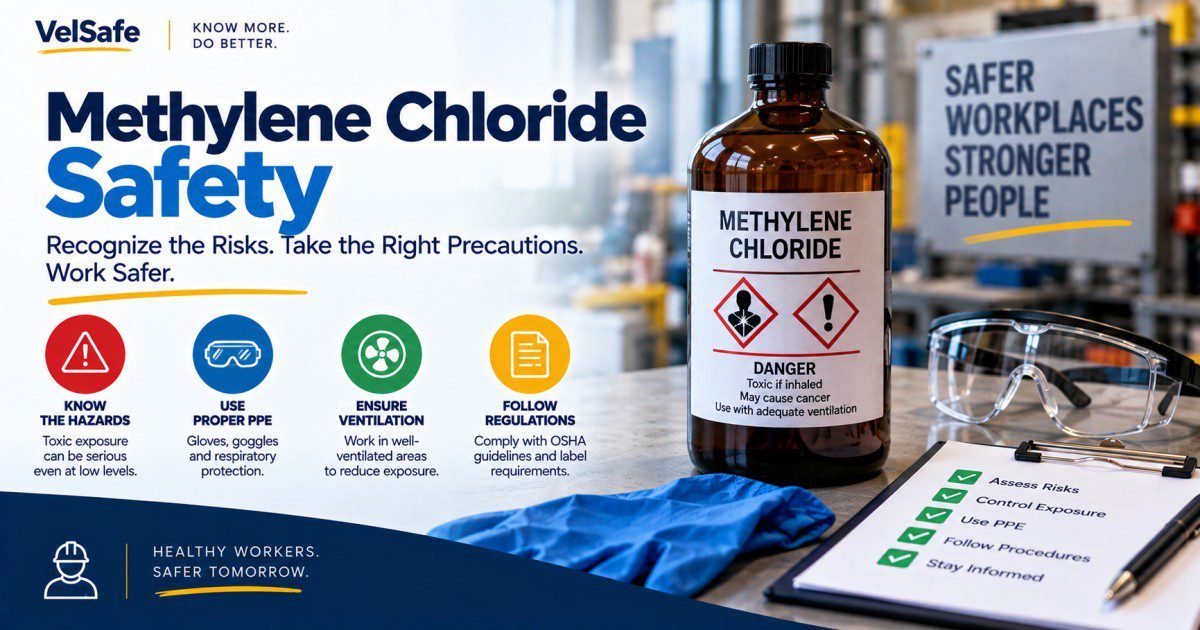
WORKER SAFETY: Chemicals and Hazard Communication
Methylene Chloride Is One of the Most Dangerous Solvents in Any Workplace.
Here Is What You Need to Know Before You Use It.
Here Is What You Need to Know Before You Use It.
Methylene chloride safety is a serious workplace concern in construction, manufacturing, laboratories, and anywhere paint strippers, adhesives, or degreasers are used. Methylene chloride (also called dichloromethane or DCM) is a colourless liquid solvent with a sweet smell. It evaporates fast, builds up quickly in enclosed spaces, and causes harm you often cannot feel until it is already serious. Your body converts it to carbon monoxide, the same gas that kills people in closed garages. OSHA has a dedicated standard for methylene chloride because it is that dangerous. This article tells you what the hazards are, how to protect yourself, and what your employer must provide.
25 ppm
OSHA 8-Hour Permissible Exposure Limit, Do Not Exceed This
OSHA’s 8-hour time-weighted average PEL for methylene chloride is 25 ppm. The short-term exposure limit (STEL) is 125 ppm over 15 minutes. The action level, where your employer must start monitoring and take protective steps, is 12.5 ppm. These numbers apply to air in your breathing zone, not to air across the whole room. Source: OSHA: Methylene Chloride
CO Poison
Your Body Converts Methylene Chloride to Carbon Monoxide, That Is Why It Is So Dangerous
When you breathe methylene chloride, your liver turns it into carbon monoxide inside your body. Carbon monoxide blocks your blood from carrying oxygen. You can feel fine at first, then collapse without warning. This is why workers using methylene chloride in enclosed or poorly ventilated spaces have died, the CO level in their blood kept rising even after they stopped working. Source: CDC/NIOSH: Methylene Chloride
Banned
EPA Banned Methylene Chloride in Consumer Paint Strippers, It Is Still Used in Industry
The EPA banned methylene chloride in consumer paint strippers in 2019 under the Toxic Substances Control Act due to fatalities from consumer use in enclosed spaces. It remains in use in some industrial and commercial applications where controls are in place. If you work with any product labelled as a paint stripper, degreaser, or adhesive remover, check the Safety Data Sheet, it may still contain DCM. Source: EPA: Methylene Chloride
What Is Methylene Chloride and Why Is It Dangerous
Methylene chloride is a clear liquid that evaporates quickly and has a faint sweet smell. You may know it as DCM or dichloromethane. It is used to strip paint, clean metal parts, dissolve adhesives, and as a solvent in laboratories and manufacturing. Because it evaporates so fast, invisible vapour builds up in the air around you, sometimes faster than your body can give you warning signs.
How it enters your body
Methylene chloride enters your body mainly by breathing the vapour. It also soaks through skin, especially from liquid contact. Once it is in your blood, your liver converts it to carbon monoxide. That CO stays in your blood for hours, even after you have left the work area. This is why exposure that seems mild during the job can cause serious harm after.
What it does to your body
Short-term: dizziness, headache, nausea, feeling drunk, chest pain, and at high levels unconsciousness and death from CO poisoning. Long-term or repeated exposure can cause liver and kidney damage. Methylene chloride is also classed as a probable human carcinogen, cancer risk increases with repeated exposure over time. Skin contact causes defatting and burns.
Signs of Danger: When to Stop Work Immediately
Stop immediately if you feel dizzy, lightheaded, or have a headache
These are early signs of CO poisoning from methylene chloride exposure. Do not wait to see if it gets better. Leave the area immediately, get into fresh air, and tell your supervisor. Do not return to the work area until your employer has checked air levels and confirmed they are safe. Carbon monoxide builds up in your blood and the symptoms can get worse after you leave.
Stop if ventilation fails or the area becomes poorly ventilated
If your local exhaust ventilation fan stops, a vent gets blocked, or you are moved to a more confined area, stop using methylene chloride products immediately. Vapour concentration can rise quickly in enclosed spaces. Do not try to work faster to finish the job before conditions get worse, leave the area and report the problem.
Stop if you smell a strong sweet odour, the product level may already be dangerous
Methylene chloride has an odour threshold above its action level, meaning you can smell it at concentrations that require your employer to take protective action. A strong or persistent sweet smell during work is a warning sign. Your nose does not reliably tell you how much you have been exposed to, because the harmful effect comes from CO that your body is making internally, not just from what you can currently smell.
Stop if a co-worker collapses or becomes confused
If someone working near you collapses, seems confused, or loses consciousness in an area where methylene chloride is in use, do not enter the area to help without respiratory protection, you could also be overcome. Call for emergency help immediately. Only trained rescuers with supplied-air respirators should enter a confined space where someone has collapsed from chemical vapour exposure.
How to Work Safely with Methylene Chloride
1
Read the Safety Data Sheet before you open the container
The SDS tells you the exact chemicals in the product, the exposure limits, the hazards, and what PPE is required. Check that you have the correct SDS for the specific product you are using, not a generic one for a similar product. Ask your supervisor if you do not have access to it. You have the right to see the SDS for every chemical you work with. Source: OSHA: Hazard Communication Standard
2
Work only in areas with adequate ventilation or local exhaust ventilation
Methylene chloride vapour is heavier than air and collects at floor level and in low areas. General ventilation (opening windows) is not enough for most methylene chloride work. Your employer should provide local exhaust ventilation, a fan that captures vapour at the source and removes it from your breathing zone. If you are working in a confined space or basement area, ask your supervisor what air monitoring and ventilation controls are in place before you start.
3
Wear the correct PPE, including gloves that actually protect against DCM
Standard latex or nitrile gloves provide little protection against methylene chloride, it penetrates them quickly. Use gloves made from polyvinyl alcohol (PVA) or laminated materials such as Silver Shield for liquid contact. Wear chemical splash goggles if there is any risk of liquid splashing. If air monitoring shows levels above the action level, you will also need respiratory protection, ask your supervisor what has been assigned for your task. Source: OSHA: Methylene Chloride Standard
4
Never use methylene chloride products in a confined space without a confined space permit and rescue plan
Bathrooms, basements, tanks, crawlspaces, and enclosed vehicles are examples of confined or semi-confined spaces where methylene chloride vapour can build up to fatal levels fast. Most methylene chloride fatalities have occurred in confined or semi-confined spaces. If your task requires using DCM products in a confined space, a permit-required confined space procedure must be in place, with air monitoring, rescue equipment, and a trained attendant outside. Never enter alone.
5
Keep containers closed when not in use and dispose of waste correctly
An open container of methylene chloride rapidly raises vapour levels in the surrounding area. Keep containers tightly closed except when you are actively pouring or applying. Transfer liquids in controlled, well-ventilated conditions. Waste materials soaked with methylene chloride (rags, paper, containers) must be placed in sealed containers and disposed of as hazardous waste, do not throw them in regular bins where they can off-gas and expose other workers.
6
Wash skin thoroughly after contact, do not eat, drink, or smoke in work areas
If methylene chloride contacts your skin, wash the area thoroughly with soap and water. Remove contaminated clothing before washing, and do not put contaminated clothing back on until it has been decontaminated. Never eat, drink, or smoke in areas where methylene chloride is in use, residue on your hands can transfer to your mouth. Wash hands before eating, drinking, or using the bathroom.
Do and Do Not: Methylene Chloride Safety Rules
DO
Read the SDS before using any product that may contain methylene chloride
Use only in well-ventilated areas with local exhaust ventilation confirmed to be working
Wear chemical-resistant gloves (PVA or Silver Shield), not latex or standard nitrile
Leave the area immediately if you feel dizzy, lightheaded, or develop a headache
Report any symptoms to your supervisor and seek medical attention
Keep containers tightly closed when not actively in use
DO NOT
Use methylene chloride in a confined space without a permit, attendant, and rescue plan
Rely on standard nitrile or latex gloves, they do not protect against DCM
Try to rescue a collapsed co-worker in a DCM work area without supplied-air protection
Eat, drink, or smoke in areas where methylene chloride is in use
Keep working through dizziness or headaches, these are emergency warning signs
Dispose of DCM-soaked materials in regular bins, they must go in sealed hazardous waste
Emergency Response
If someone collapses or loses consciousness
Call emergency services (911) immediately. Do not enter a confined or semi-confined space to rescue a person without supplied-air respiratory protection, multiple rescuers have died attempting unprotected entry. Move the person to fresh air only if you can do so safely from outside the contaminated area. Inform emergency responders that methylene chloride is involved so they know to treat for CO poisoning, not just loss of consciousness.
If you are exposed and feel symptoms
Leave the work area immediately and get fresh air. Tell your supervisor what happened and how long you were exposed. Seek medical attention even if you start to feel better, CO from methylene chloride metabolism remains in your blood for hours and symptoms can return. Do not drive yourself to medical care if you are experiencing dizziness or confusion. Tell the medical provider that you were exposed to methylene chloride, not just a solvent.
If a spill occurs
Evacuate all non-essential personnel from the spill area. Eliminate ignition sources if safe to do so from a distance. Do not re-enter until the area has been ventilated and air monitoring confirms it is safe. Only trained personnel with appropriate PPE and respiratory protection should clean up methylene chloride spills. Contain the liquid if possible to prevent it running into drains or waterways, methylene chloride is an environmental contaminant. Report the spill to your supervisor and to your facility’s emergency response team.
What Supervisors Must Do
Conduct air monitoring and tell workers the results
OSHA requires air monitoring when exposures may reach or exceed the action level of 12.5 ppm. Workers must be told the results of monitoring within 15 days. If exposures are at or above the action level, a medical surveillance programme must be in place. Workers have the right to request monitoring and to see the results. Source: OSHA: 29 CFR 1910.1052
Provide training before workers use or are exposed to methylene chloride
OSHA requires employers to train workers before they are exposed to methylene chloride. Training must cover the hazards, the controls, the PPE, the symptoms of overexposure, and what to do in an emergency. Training must be provided in a language and format the worker understands. Source: 29 CFR 1910.1052(l)
Substitute or eliminate methylene chloride where possible
OSHA’s hierarchy of controls requires considering substitution before relying on PPE. Safer alternatives exist for some methylene chloride applications, benzyl alcohol-based or N-methylpyrrolidone-based paint strippers, for example, carry significantly lower acute toxicity risk. If an alternative is feasible for your application, use it. This is both a legal obligation under the hierarchy of controls and the most effective worker protection measure.
Enrol exposed workers in medical surveillance
Workers exposed at or above the action level for 30 or more days per year, or exposed above the PEL or STEL, must be included in a medical surveillance programme. Surveillance includes an initial exam, periodic exams, and exams on termination of employment. Exams must be conducted by or under the supervision of a licensed physician. Source: 29 CFR 1910.1052(j)
Methylene Chloride Safety Checklist
Before Work Begins
SDS for the specific product reviewed and understood
Ventilation confirmed as working before starting
Correct PPE obtained and inspected (gloves, goggles, respirator if required)
Confined space controls confirmed if working in enclosed area
During Work
PPE worn throughout, not removed until out of the work area
Containers kept closed when not actively pouring or applying
Any symptoms of dizziness or headache treated as an emergency, stop work and exit
Waste materials placed in sealed hazardous waste containers immediately
After Work
Hands and exposed skin washed thoroughly with soap and water
Contaminated clothing removed before leaving the work area
Any symptoms reported to supervisor even if they seem minor
Containers sealed and stored in correct location
Key Takeaways
Methylene chloride turns into carbon monoxide inside your body, that is the real danger
Most workers think of methylene chloride as a solvent that makes you dizzy. The mechanism is more serious: your liver converts it to CO, which builds up in your blood and keeps building even after you leave the work area. Symptoms that seem mild during the job can become severe an hour later. This is why you must leave the area and get medical attention for any symptoms, not wait to see if they pass.
Most methylene chloride fatalities happen in confined or semi-confined spaces, never work alone in them
Bathtubs, bathrooms, basements, vehicle interiors, crawlspaces, and similar enclosed areas are where the majority of methylene chloride deaths have occurred. Vapour concentrates fast in these spaces. The OSHA confined space standard exists specifically because of this risk. If your work takes you into any enclosed space with methylene chloride products, your employer must have a permit system, monitoring, and a trained attendant outside who can summon help.
Your employer has legal obligations, you have the right to training, monitoring results, and medical care
Under 29 CFR 1910.1052, your employer must train you before you are exposed, monitor air levels and tell you the results within 15 days, provide the correct PPE at no cost to you, and enrol you in medical surveillance if exposures reach the required threshold. If your employer is not doing these things, you can contact OSHA to file a complaint confidentially. You cannot be fired or disciplined for exercising your safety rights. Source: OSHA: Methylene Chloride
Frequently Asked Questions
What is methylene chloride and where is it found?
Methylene chloride (also called dichloromethane or DCM) is a colourless liquid chemical solvent with a mild sweet smell. It evaporates quickly at room temperature. It is found in some paint strippers, adhesive removers, degreasers, chemical blending processes, and laboratory solvents. The EPA banned it in consumer paint strippers in 2019, but it remains in use in some industrial and commercial applications. Always check the SDS (Safety Data Sheet) for any paint stripper, adhesive, or degreaser you use, it will tell you whether the product contains methylene chloride.
How much methylene chloride in the air is dangerous?
OSHA’s permissible exposure limit (PEL) is 25 ppm as an 8-hour time-weighted average. The short-term exposure limit (STEL) is 125 ppm over 15 minutes. The action level, where your employer must start monitoring and take protective steps, is 12.5 ppm. The key point for workers is this: even exposure below the STEL can cause harm because your body converts methylene chloride to carbon monoxide internally, and that CO builds up over the course of a shift. There is no “safe” level for unprotected enclosed-space use. Source: OSHA: Methylene Chloride Standard
What type of respirator protects against methylene chloride?
The type of respirator required depends on the airborne concentration. For concentrations above the action level, OSHA requires respiratory protection. For concentrations up to 10 times the PEL (up to 250 ppm), a half-face air-purifying respirator with an organic vapour cartridge may be used. For higher concentrations or oxygen-deficient atmospheres, a supplied-air respirator or self-contained breathing apparatus (SCBA) is required. A dust mask or surgical mask provides zero protection against methylene chloride vapour. Your employer must fit-test you for any respirator used and include you in a written respiratory protection programme. Source: OSHA: Respiratory Protection
Is methylene chloride a cancer risk?
Yes. Methylene chloride is classified as a probable human carcinogen by the International Agency for Research on Cancer (IARC Group 2A) and as reasonably anticipated to be a human carcinogen by the National Toxicology Programme. Long-term or repeated exposure has been associated with increased risk of liver and lung cancer in animal studies and with biliary tract cancer in some human occupational studies. Reducing exposure is not just about avoiding acute poisoning, it is also about reducing cumulative cancer risk. Source: CDC/NIOSH: Methylene Chloride
What should I do if I accidentally inhale methylene chloride?
Leave the area immediately and get into fresh air. Remove yourself from any enclosed or poorly ventilated space. Loosen any tight clothing. If you have symptoms, dizziness, headache, chest tightness, confusion, or nausea, seek emergency medical attention. Tell the medical provider that you were exposed to methylene chloride and give them an estimate of how long and at what level. Do not wait for symptoms to go away on their own, CO produced by methylene chloride metabolism peaks in your blood after exposure ends, not during it, so symptoms can worsen after you leave the work area.
Does my employer have to provide medical exams if I work with methylene chloride?
Yes, under specific conditions. OSHA’s methylene chloride standard (29 CFR 1910.1052) requires your employer to provide medical surveillance if you are exposed at or above the action level (12.5 ppm) for 30 or more days per year, if your exposure is at or above the PEL (25 ppm) or STEL (125 ppm) on any day, or if you show signs or symptoms of overexposure. Medical exams must be conducted by or under the supervision of a licensed physician, at no cost to you, at a reasonable time and place. Source: 29 CFR 1910.1052(j)
Can I refuse to work with methylene chloride if I think the conditions are not safe?
Under OSHA’s General Duty Clause and section 11(c) of the OSH Act, you have the right to refuse work that you reasonably believe presents an imminent danger of death or serious injury, when there is no time to contact OSHA and your employer has not corrected the condition after you brought it to their attention. Your belief must be reasonable, not just a general discomfort with the task. If you are being asked to use methylene chloride in a confined space without proper controls, that is a reasonable basis for refusal. You cannot be fired or discriminated against for exercising this right. Source: OSHA: Right to Refuse Dangerous Work
Sources
Government and Regulatory Sources
- OSHA: Methylene Chloride: primary source for the 25 ppm PEL, 125 ppm STEL, 12.5 ppm action level, employer training obligations, air monitoring requirements, PPE standards, and medical surveillance provisions under 29 CFR 1910.1052.
- 29 CFR 1910.1052, Methylene Chloride Standard: the full regulatory text for the OSHA methylene chloride standard, including exposure limits, PEL, STEL, action level, monitoring, respiratory protection, medical surveillance, training, and recordkeeping requirements.
- EPA: Methylene Chloride under TSCA: source for the 2019 EPA ban on methylene chloride in consumer paint strippers under the Toxic Substances Control Act, including the risk basis and the scope of the ban.
- CDC/NIOSH: Methylene Chloride: source for the toxicology data including the CO conversion mechanism, the IARC Group 2A carcinogen classification, acute exposure effects, and the health basis for NIOSH recommended exposure limits.
- OSHA: Workers Right to Refuse Dangerous Work: source for the legal basis and conditions under which workers may refuse work presenting imminent danger under section 11(c) of the OSH Act.
Related VelSafe Articles
Worker Safety
Medicare Beneficiary Protections Agent Training Guide
A Worker Safety article covering a different regulated interaction, the MCMG rights and protections that govern Medicare agents and the people they serve, with the same direct-action format as this methylene chloride safety guide.
Guides
Effective Safety Orientation for New Construction Workers
The construction safety orientation guide, covering how to build the hazard communication and chemical safety content that new workers at construction sites (where methylene chloride products may be used) need to receive before they start work.
Law
OSHA Incident Reporting: What to Report and When
The OSHA incident reporting requirements article, covering what employers must report and when after a workplace injury or illness, including chemical exposure incidents involving methylene chloride that result in medical treatment, hospitalisation, or fatality.
CHEMICAL SAFETY FOR WORKERS
More Chemical Safety Resources for Workers and Supervisors
Explore VelSafe’s chemical safety library for worker-focused guides on hazardous chemicals, exposure limits, PPE selection, emergency response, and the OSHA rights that protect workers in construction, manufacturing, and laboratory environments.
Explore All Worker Safety Articles