GUIDES: Rigging, Lifting, and Load Support Safety
What Gets Workers Killed Is Not the Load
It Is the Material and Configuration Under It
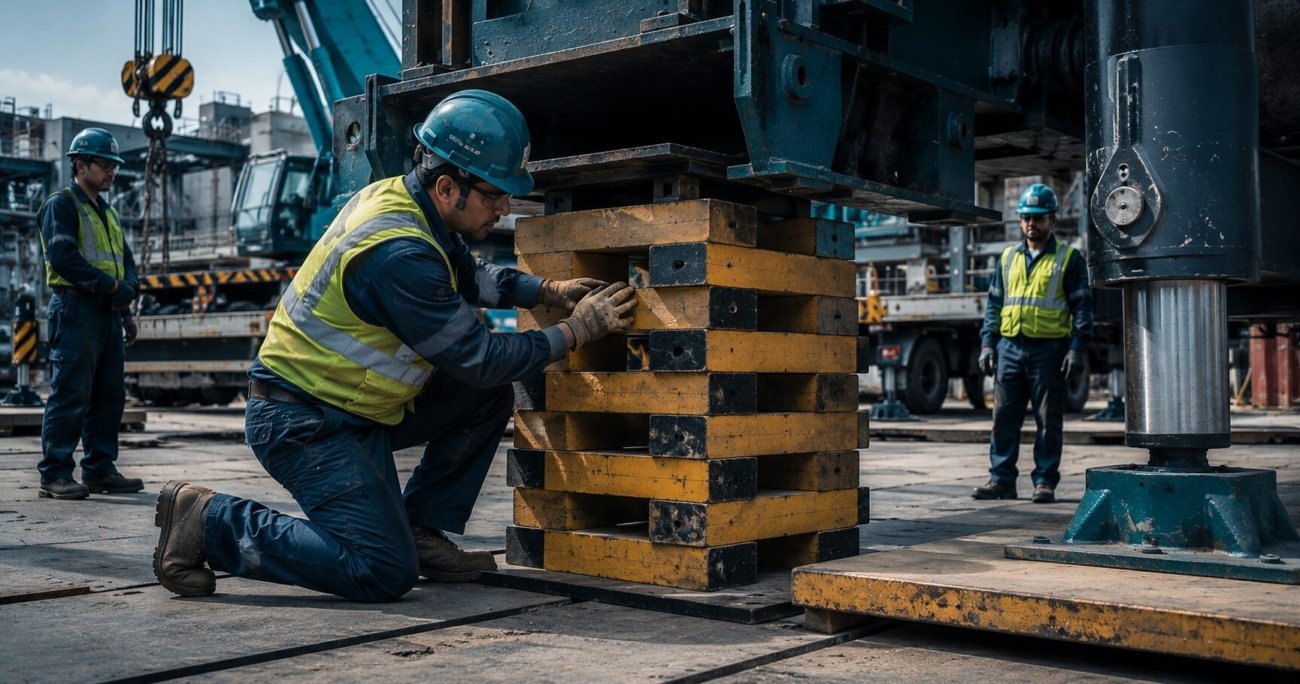
Blocking and cribbing failures kill workers. A crib stack that looks stable but uses the wrong material, exceeds the height-to-width ratio, or was never rated for the actual load will collapse without warning. This guide covers material selection, load capacity calculation, height-to-width ratios, regulatory requirements under 29 CFR 1926 Subpart CC, application-specific guidance, and pre-use inspection requirements across wood, HDPE, and composite cribbing systems.
3:1
Max Height-to-Width Ratio
Crib stack height must never exceed three times the base width. A 4×4 base (4 inches) limits the stack to 12 inches. Exceeding this ratio dramatically increases lateral instability and collapse risk under load.
Industry Standard | Turtle Plastics WLL Guidance
500
PSI Wood Planning Reference
500 PSI is the widely used planning reference for Douglas fir and southern yellow pine cribbing under cross-grain loading. Softwood cribbing may range from 200 to 1,000 PSI depending on species, condition, and loading direction.
University of Extrication | Firehouse Training Data
1926
OSHA Subpart CC
29 CFR 1926.1401 and 1926.1402 define blocking, mats, and cribbing as “supporting materials” required for crane and heavy equipment operations where ground conditions require load distribution to meet equipment manufacturer specifications.
OSHA, 29 CFR 1926 Subpart CC
What Blocking and Cribbing Are and Why Material Selection Is Critical
Cribbing is the placement of stacked material, usually arranged in a box or log-cabin pattern, to support or stabilize a heavy object from beneath. Blocking refers to the placement of solid material under a load to hold it in a fixed position or to distribute load across a surface. In practice, the terms are often used interchangeably. Both operations involve placing a material system between a load and the ground, and both carry the same failure risk: if the material is wrong for the load, the conditions, or the configuration, the stack fails and the load comes down.
The load does not care whether the failure mode is material weakness, incorrect height-to-width ratio, surface contamination, or wood decay. It comes down at full weight and full speed, and whatever is beneath it, including workers, equipment, and structures, absorbs the result. Choosing the right material is not the only element of safe cribbing practice, but it is the first decision and one that determines what load capacities and height limitations are even possible for the configuration being built.
Three primary cribbing materials are used in construction, rescue, and heavy equipment operations: wood (typically hardwood or construction-grade softwood), high-density polyethylene (HDPE) plastic, and composite engineered materials. Each has a different load profile, environmental performance, and service life. The choice between them must be driven by the load, the environment, and the application, not by what happens to be available on the truck or in the yard.
Safety Disclaimer
This guide provides general educational information about blocking and cribbing material selection. It is not a substitute for site-specific engineering assessment, manufacturer load ratings, or employer-specific safe work procedures. Load calculations and material selection for specific operations should be verified by a qualified person. OSHA requirements under 29 CFR 1926 and the General Duty Clause apply to all blocking and cribbing operations in covered workplaces.
OSHA Regulatory Context for Blocking and Cribbing
29 CFR 1926.1401
Defines “supporting materials” as “blocking, mats, cribbing, marsh buggies (in marshes/wetlands), or similar supporting materials or devices” in the context of crane and derrick operations in construction.
OSHA, Cranes and Derricks in Construction
29 CFR 1926.1402
Requires that crane and equipment assembly or use occur only when ground conditions are firm, drained, and graded to the extent that, in conjunction with supporting materials if necessary, equipment manufacturer specifications for adequate support and level are met.
OSHA, Ground Conditions
General Duty Clause
Where no specific standard applies, OSHA’s General Duty Clause (Section 5(a)(1) of the OSH Act) requires employers to provide a workplace free from recognized hazards likely to cause death or serious physical harm. Inadequate or incorrectly configured cribbing is a recognized hazard.
OSH Act, Section 5(a)(1)
OSHA 29 CFR 1910.147
Lockout/Tagout standard: cribbing is a secondary restraint used alongside LOTO when equipment is supported for maintenance or service. Cribbing under a raised load does not substitute for energy isolation. LOTO and cribbing are complementary controls, not alternatives.
OSHA, Control of Hazardous Energy
Material 1: Wood Cribbing
Wood is the oldest and most widely used cribbing material. When properly selected, maintained, and inspected, wood cribbing is a reliable and cost-effective support system for a broad range of loads. The critical variables are species, condition, moisture content, loading direction, and the specific configuration built.
Variable
What to Know
Impact on Load Capacity
Species
Hardwoods (oak, maple): higher compressive strength. Softwoods (Douglas fir, southern yellow pine): widely used in rescue and construction; more variable.
Douglas fir and southern yellow pine: planning reference of 500 PSI under cross-grain loading. Range for softwoods: 200 to 1,000 PSI. Do not apply softwood ratings to hardwood loads without verification.
Loading direction
Cross-grain loading (load applied perpendicular to wood grain, grain running horizontally) provides the maximum load capacity. Parallel-to-grain (end-grain loading) is significantly weaker.
Cross-grain loading maximizes compressive strength. End-grain loading can reduce effective capacity by 30 to 60% depending on species. Always orient wood for cross-grain contact at load points.
Moisture content
Wet wood is weaker than dry wood. Wood stored outdoors absorbs moisture that degrades compressive strength over time. Submerged or saturated wood can lose substantial load-bearing capacity.
Saturated softwood may drop to 50 to 70% of dry-condition capacity. Never assume wet-looking wood meets its dry-condition rating.
Damage
Cracks, splits, knots, rot, insect damage, and oil contamination all reduce load capacity in ways that are not always visible from the surface. Wood that looks acceptable may be structurally compromised internally.
Internal decay cannot be detected visually. Any visible cracking, splintering, soft spots, or discoloration is grounds for removing the piece from service.
Source: Firehouse University of Extrication | US Army Corps of Engineers USAR Shoring Operations Guide | Industry practice
Wood Cribbing Strengths
Good surface grip: natural wood friction resists lateral sliding better than many smooth synthetic materials. Widely available and low-cost. Can be cut to exact dimensions on site. Predictable compressive behavior under moderate loads. Long established use in rescue and construction with well-understood failure modes.
Wood Cribbing Limitations
Absorbs water, oil, and chemicals that degrade strength over time. Subject to rot, insect damage, and UV degradation with extended outdoor storage. Splinters and fractures under overload rather than compressing gradually. Requires frequent inspection and periodic rotation of stock. Cannot be accurately re-rated after use or environmental exposure.
Material 2: HDPE Plastic Cribbing
High-density polyethylene (HDPE) plastic cribbing is manufactured from recycled or virgin HDPE resin. It does not absorb water, resist oil and chemical exposure, and does not rot, splinter, or degrade in the ways wood does. HDPE cribbing has become the standard choice for many outdoor, rescue, and industrial applications where environmental conditions compromise wood performance.
HDPE Cribbing Strengths
Waterproof and chemical resistant. Does not rot, splinter, or absorb contaminants that would reduce wood capacity. Consistent dimensions that do not change with moisture content. Long service life with proper maintenance. Manufacturer-tested and rated load capacities that remain stable throughout service life. Easy to clean and decontaminate.
HDPE Cribbing Limitations
Smooth surfaces can be slippery, especially on wet or contaminated ground. HDPE can deform (creep) under sustained loads at elevated temperatures. More expensive than wood for equivalent sizes. Lighter weight can be a handling advantage but may require anchoring in high-wind conditions. Some configurations exhibit lateral sliding risk on smooth surfaces.
Critical Note on HDPE Surface Slip: Smooth HDPE cribbing on smooth ground, wet concrete, or oily surfaces can slide laterally under eccentric loading. In applications where lateral stability is critical, interlock-designed blocks, surface texture, and ground preparation are essential. Never stack smooth HDPE on smooth concrete under a load that applies any horizontal force component without verifying the base is secured.
Material 3: Composite Cribbing
Composite cribbing typically combines recycled plastic resin with rubber, fiberglass, or other reinforcing materials. The result is a product that maintains HDPE’s environmental resistance while improving compressive strength, heat tolerance, and lateral stability. Composite cribbing is common in emergency rescue operations, utility work, and industrial maintenance where consistent high performance is required regardless of conditions.
Property
Typical Range
Operational Implication
Compressive strength
800 to 1,200 PSI (engineered composites); some systems rated to 60,000+ lbs. per block
Higher compressive ratings than most wood or standard HDPE at equivalent cross-section. Always use the specific manufacturer’s published WLL, not generic composite estimates.
Heat resistance
Typically rated to higher sustained temperatures than standard HDPE; varies by manufacturer
Reduced creep under sustained load at elevated temperatures compared to standard HDPE. Still requires manufacturer temperature ratings to be confirmed for hot environment applications.
Lateral stability
Many composite systems feature interlocking surfaces (Lincoln log or pyramid configurations)
Interlocking significantly improves lateral stability over smooth-face HDPE. Reduces the risk of horizontal displacement under eccentric loads. Still subject to height-to-width ratio limits.
Service life
Significantly longer than wood under equivalent conditions; manufacturer service life varies
Long service life reduces per-use cost despite higher initial price. Composite blocks must still be inspected for deformation, cracking, and surface damage before each use.
Source: Turtle Plastics WLL Data | ESCO Cribbing System Technical Data | US Army Corps of Engineers USAR Shoring Guide
Material Comparison: Choosing for the Conditions
Condition
Wood
HDPE
Composite
Dry indoor environment, light to moderate load
Preferred
Acceptable
Acceptable
Wet, outdoor, or oily environment
Avoid
Preferred
Preferred
High heat environment (above 100°F / 38°C)
Acceptable
Verify ratings
Preferred
Chemical or solvent exposure
Avoid
Acceptable (verify chemical compatibility)
Preferred
Emergency rescue and vehicle stabilization
Widely used but condition-dependent
Acceptable with textured surfaces
Preferred (interlocking)
Crane outrigger support / heavy equipment
Acceptable with documented WLL
Acceptable with documented WLL
Preferred for sustained loads
Long-term support (days or weeks)
Inspect frequently
Monitor for creep
Preferred
This table provides general guidance. Always verify suitability against the specific manufacturer’s published load ratings and application guidelines for the product in use.
Load Capacity: How to Calculate and Verify
Every cribbing configuration has a load capacity determined by the material’s compressive strength, the contact area, the number of contact points, and how evenly the load is distributed across those points. Understanding how to calculate and verify load capacity is essential before any cribbing stack is built under a live load.
Step 1: Determine the Total Load
Before selecting any material, determine the total weight to be supported. For equipment and vehicles, use manufacturer data or scale weights, not estimates. Add a safety margin: the load on cribbing during lifting or stabilization can exceed static weight due to dynamic forces, equipment movement, and uneven load distribution. A loaded vehicle or piece of equipment routinely weighs more than initial estimates, and the consequences of underestimating are severe.
Load Capacity Calculation: Box Crib Example
Step 1: Calculate contact area at each corner
For a 4×4 box crib with 2×4 top pieces crossing: each contact point where a 2×4 crosses a 4×4 is approximately 1.5 inches x 3.5 inches = 5.25 square inches. With four contact points: 21 square inches total contact area.
Step 2: Apply material compressive strength
Using 500 PSI planning reference for Douglas fir or southern yellow pine: 21 square inches x 500 PSI = 10,500 lbs. at uniform loading. The US Army Corps of Engineers USAR guide suggests a 4×4 two-member box crib can support approximately 24,000 lbs. with proper construction and even load distribution across four contact points (6,000 lbs. per contact point).
Step 3: Apply safety factor
Always apply a safety factor to the calculated capacity. In rescue operations, a 2:1 safety factor is a common minimum. For construction and industrial applications, follow the applicable standard or employer SOP. Never operate at the theoretical maximum capacity of the configuration.
Critical: Even load distribution
Calculated capacity assumes even load distribution across all contact points. If the load is applied unevenly (a common real-world condition), individual contact points may be overloaded even when the total load is within the theoretical system capacity. Use wedges or leveling blocks to ensure even contact across all points.
Source: US Army Corps of Engineers Urban Search and Rescue Shoring Operations Guide | University of Extrication (Firehouse) Extrication | Firehouse Training Data
Step 2: Verify the Working Load Limit
Every cribbing product should have a published Working Load Limit (WLL): the maximum weight the manufacturer states the product can safely support under specified conditions. The WLL is not the crush or failure load. It already incorporates a safety margin. Never operate above the published WLL. If a product has no published WLL from the manufacturer, treat it as unrated and do not use it for load-bearing applications without independent testing and documentation.
The 3:1 Height-to-Width Ratio Limit
Height-to-width ratio is the most commonly violated configuration rule in cribbing practice. As a crib stack height increases relative to its base width, lateral instability increases exponentially. The widely used industry limit is 3:1: the total stack height must not exceed three times the base width dimension. For a 4×4 crib base (4 inches), maximum stack height is 12 inches. For a 6×6 base (6 inches), maximum is 18 inches.
Why the Ratio Matters
A tall, narrow stack acts like a column under load. Small lateral forces or uneven load application cause the stack to shift, lean, and ultimately collapse sideways before the material reaches its compressive failure limit. Stack failures are typically not material failures. They are geometry failures that occur because the ratio was not observed.
When You Need More Height
When a task requires height beyond what the 3:1 ratio allows with the available base dimension, use a wider base. A 6×6 base supports twice the height of a 4×4 base at the same ratio. Do not compromise the ratio by adding height. Increase the base instead. For very tall requirements, engineered shoring systems replace improvised crib stacking.
Vehicle Rescue Guideline
For vehicle rescue operations specifically, a 2:1 height-to-length ratio is commonly used as a conservative limit (stack height should not exceed twice the length of the crib pieces). This provides an additional margin of lateral stability for the dynamic loads and ground conditions common at vehicle extrication incidents.
Application-Specific Guidance
Application
Cribbing Considerations
Material Preference
Crane outrigger support
Cribbing must meet equipment manufacturer specifications for ground support per 29 CFR 1926.1402. Ground conditions must be assessed. Outrigger loads can exceed hundreds of tons on large cranes. Cribbing must distribute load to acceptable ground bearing pressure.
Engineered timber mats or rated composite outrigger pads
Vehicle rescue and extrication
Requires rapid deployment, environmental exposure, and potentially unstable ground surfaces. 2:1 height-to-length ratio is a conservative working limit. Step chocks and wedges provide low-clearance points of contact. Crib stack must stabilize before airbag or tool placement. Never build crib stacks above the 3:1 ratio under dynamic rescue conditions.
Interlocking composite; wood as secondary
Heavy equipment maintenance (under raised loads)
Blocking placed under raised machinery during maintenance is a secondary energy control, not a primary LOTO device. 29 CFR 1910.147 governs LOTO; cribbing provides redundant mechanical protection. Cribbing must be sized for the full weight of the raised component plus safety factor. Must be positioned to remain stable if the primary lifting device fails.
Rated HDPE or composite; hardwood for sustained loads
USAR / collapsed structure operations
Highly variable and unpredictable load conditions. FEMA USAR teams use field operations guides (FOG) and shoring operations guides (SOG) for standardized cribbing and shoring decisions. Cribbing is one component of a broader shoring system in structure collapse; improvised cribbing must be supplemented by engineered shoring as soon as resources permit.
Per FEMA USAR SOG; composite preferred for portability
Source: OSHA 29 CFR 1926.1402 | 29 CFR 1910.147 | FEMA USAR Program Guidelines
Pre-Use Inspection: What to Check Before Every Use
Cribbing must be inspected before each use. This is not a periodic requirement. It is a before-every-deployment requirement. A block that passed last week’s inspection may have been damaged in transport, exposed to contamination, or structurally compromised in ways that were not visible before.
Pre-Use Inspection Checklist: All Cribbing Materials
Visual inspection for structural damage
Inspect each piece for cracks, splits, fractures, deep gouges, or deformation. Wood: check grain runs horizontally (flat grain); reject pieces with cracking along the grain, large knots at load points, or any soft or discolored areas indicating rot. Plastic and composite: inspect for cracks, crazing, delamination, or permanent deformation from prior overloading.
Surface contamination check
Check contact surfaces for oil, grease, mud, ice, or other materials that reduce friction or transfer chemicals into wood. Contaminated wood cribbing that cannot be cleaned and verified clean must be removed from service. Plastic and composite surfaces can be wiped clean but must be confirmed dry before stacking under load.
Moisture and condition check (wood only)
Visually assess for excessive moisture: darker coloration, swollen dimensions, or water visible at cut ends. If in doubt about the condition of stored wood, rotate to dry stock. Wood stored outdoors through precipitation should be assessed against its rated application before use on heavy loads.
Dimension verification
Confirm all pieces intended for a given configuration are the correct and consistent dimensions. Mixed dimensions in a box crib create uneven load distribution and reduce the effective capacity of the entire assembly. Check that plastic or composite blocks have not permanently deformed from prior use (measure against new-stock dimensions if available).
Manufacturer markings and rating legibility
For rated composite and HDPE blocks, confirm the WLL marking is legible. If a block’s rating marking is no longer readable, it must be removed from service until the WLL is confirmed from manufacturer documentation and the block is re-marked or replaced.
Damaged or suspect blocks must be removed from service, marked “DO NOT USE,” and stored separately from serviceable stock until repaired, tested, or destroyed.
Storage, Maintenance, and Service Life
Wood Storage
Store off the ground on a pallet or rack to prevent moisture absorption from ground contact. Protect from direct weather exposure where possible. Rotate stock so older pieces are used first. Inspect stored wood annually and remove any pieces showing rot, insect damage, or excessive weathering.
HDPE and Composite Storage
Store away from sustained UV exposure where possible: UV degrades some HDPE formulations over extended periods. Clean after use before storing. Do not store heavy objects stacked directly on cribbing blocks for extended periods: sustained off-axis loads can cause creep deformation that permanently changes block geometry.
Retirement Criteria
Remove any cribbing piece from service when: visible structural damage is present; WLL marking is unreadable and cannot be confirmed; the piece was subjected to a load exceeding its WLL; permanent deformation is present on any surface; or for wood, any soft spot, significant cracking, or rot is detected. Destroyed retirement means cut, split, or otherwise made unusable: do not leave retired blocks in accessible storage where they may be inadvertently used.
Key Takeaways
Material Drives the Starting Conditions, Not the Outcome
Choosing wood in a wet or oily environment, or using an unrated piece for a heavy load, sets a failure condition before a single block is stacked. Material selection determines what load capacities and configurations are even possible for the job. Make the selection based on conditions, load, and manufacturer data, not on convenience.
The 3:1 Ratio Is a Hard Limit
Most crib stack failures are not material failures. They are geometry failures from exceeding the height-to-width ratio. Stack height must not exceed three times the base width. When more height is needed, increase the base dimension, not the ratio.
Use the WLL, Not an Estimate
Every cribbing system used under a live load must have a documented Working Load Limit from the manufacturer that covers the load being applied. For wood, use published species data for cross-grain loading. For plastic and composite, use the manufacturer’s published WLL for the specific product and configuration.
Inspect Before Every Deployment
Pre-use inspection is not a periodic program. It happens before each use. Cribbing damaged in transport, contaminated in storage, or cracked from a prior load must be caught before it goes under a load, not after. Remove suspect blocks immediately and mark them out of service.
Frequently Asked Questions
Can I use treated lumber for cribbing?
Pressure-treated lumber should not be used for cribbing in most applications. CCA-treated wood contains arsenic and presents a hazard when cut or burned. Newer treatment chemicals can also alter wood’s compressive properties in ways that make standard capacity calculations unreliable. Use untreated construction-grade lumber of a known species and document it.
Can plastic or composite cribbing be repaired after damage?
Generally no. Cracked, deformed, or structurally damaged plastic and composite blocks should be removed from service and replaced. Field repairs are not reliable unless specifically approved by the manufacturer in writing. When in doubt, retire the piece rather than risk a load failure.
Does OSHA specify which cribbing material to use?
No. OSHA’s construction standard (29 CFR 1926 Subpart CC) defines blocking, mats, and cribbing as “supporting materials” and requires that they meet equipment manufacturer specifications. OSHA does not mandate a specific material. The requirement is that the selected material in the configuration used must demonstrably meet the load requirements. The employer must be able to show adequacy for the actual load.
How high can cribbing be stacked?
No higher than three times the base width (3:1 height-to-base ratio). For vehicle rescue operations, a conservative 2:1 ratio provides additional stability. Beyond these limits the stack becomes progressively less stable under load and vulnerable to lateral collapse. If required height exceeds what the ratio allows, increase the base dimension or use engineered shoring systems designed for that height.
What is the difference between blocking and cribbing?
Blocking typically refers to single solid pieces placed to prevent movement, such as wheel chocks or stabilising pads under outriggers. Cribbing refers to stacked configurations of layered blocks assembled to increase height while distributing load across a larger base area. OSHA’s 29 CFR 1926.1401 treats both as “supporting materials” under the same adequacy requirement, though the structural engineering considerations for stacked cribbing are more complex than for single-piece blocking.
What happens if a cribbing piece fails a pre-use inspection?
Remove it from service immediately and tag it out. A single failed piece is not a reason to improvise with a borderline piece from the same kit. If you cannot replace the failed piece before the job, the job does not start. The OSHA standard requires that supporting materials meet the load requirement, a piece that fails inspection cannot be verified to do that. Inspect replacement pieces from a different storage location using the same criteria.
Can cribbing be used in wet or frozen ground conditions?
Yes, but with significantly different considerations. Wet soil has reduced bearing capacity that must be recalculated before deploying the same cribbing configuration used on dry, firm ground. Frozen ground can be deceptively stable and then lose bearing capacity rapidly as it thaws under load. OSHA 29 CFR 1926.1402 requires that ground conditions be assessed and, where inadequate, that the employer either improve them or use ground-bearing mats or blocking systems rated for the reduced capacity conditions.
Can plastic or composite cribbing be repaired after damage?
Generally, no. Cracked, deformed, or structurally damaged plastic and composite cribbing blocks should be removed from service and replaced. Field repairs that attempt to restore load-bearing capacity (gluing, welding, patching) are not reliable unless specifically approved by the manufacturer. Contact the manufacturer if you believe a damaged piece might be salvageable. When in doubt, retire the piece.
Does OSHA specify which cribbing material to use?
OSHA’s construction standard (29 CFR 1926 Subpart CC) defines blocking, mats, and cribbing as “supporting materials” and requires that ground conditions and supporting materials together meet equipment manufacturer specifications. OSHA does not mandate a specific cribbing material. The requirement is that the selected material, in the configuration used, must demonstrably meet the load requirements for the application. The employer must be able to show that the cribbing chosen is adequate for the load.
How high can I stack cribbing?
No higher than three times the base width using the 3:1 ratio. For vehicle rescue operations, a conservative 2:1 height-to-length ratio provides additional stability. Beyond these limits, the stack becomes progressively less stable under load and increasingly vulnerable to lateral collapse. If the required height exceeds what the ratio allows, increase the base dimension or use engineered shoring systems designed for the required height.
Government and Regulatory Sources
Sources
Government and Regulatory Sources
- OSHA 29 CFR 1926.1402: Ground Conditions: requires assessment of ground conditions and adequate supporting materials before crane or equipment operation.
- OSHA 29 CFR 1926.1401: Definitions Including Supporting Materials: defines blocking, cribbing, and mats as supporting materials subject to adequacy requirements.
- OSHA 29 CFR 1910.147: Control of Hazardous Energy (LOTO): applies to blocking and cribbing used for energy isolation during maintenance operations.
Industry and Technical References
- Moore, Ron: University of Extrication: Vehicle Rescue Cribbing. Firehouse Magazine.
- Turtle Plastics: Vehicle Stabilisation Cribbing Load Ratings and Capacity Guide (2025).
Related VelSafe Articles
Law
Legal Consequences of Ignoring Lockout/Tagout in Construction
OSHA citations, penalties, and employer liability when LOTO procedures are bypassed on construction and maintenance sites.
Worker Safety
HAZWOPER: Hierarchy of Controls Overview
How the hierarchy of controls applies to hazardous energy, load support, and confined space operations under OSHA standards.
Law
OSHA Requirements for Bench and Pedestal Grinders
Guard requirements, work rest adjustments, and inspection obligations for grinding equipment used in construction and manufacturing environments.
CONSTRUCTION AND RIGGING SAFETY
The Right Material, the Right Configuration, Every Time
Blocking and cribbing failures do not give warnings. Find more construction safety guides, load support resources, and OSHA compliance references at VelSafe.
Explore More Guides