


Trends, Statistics, and Industry Hotspots
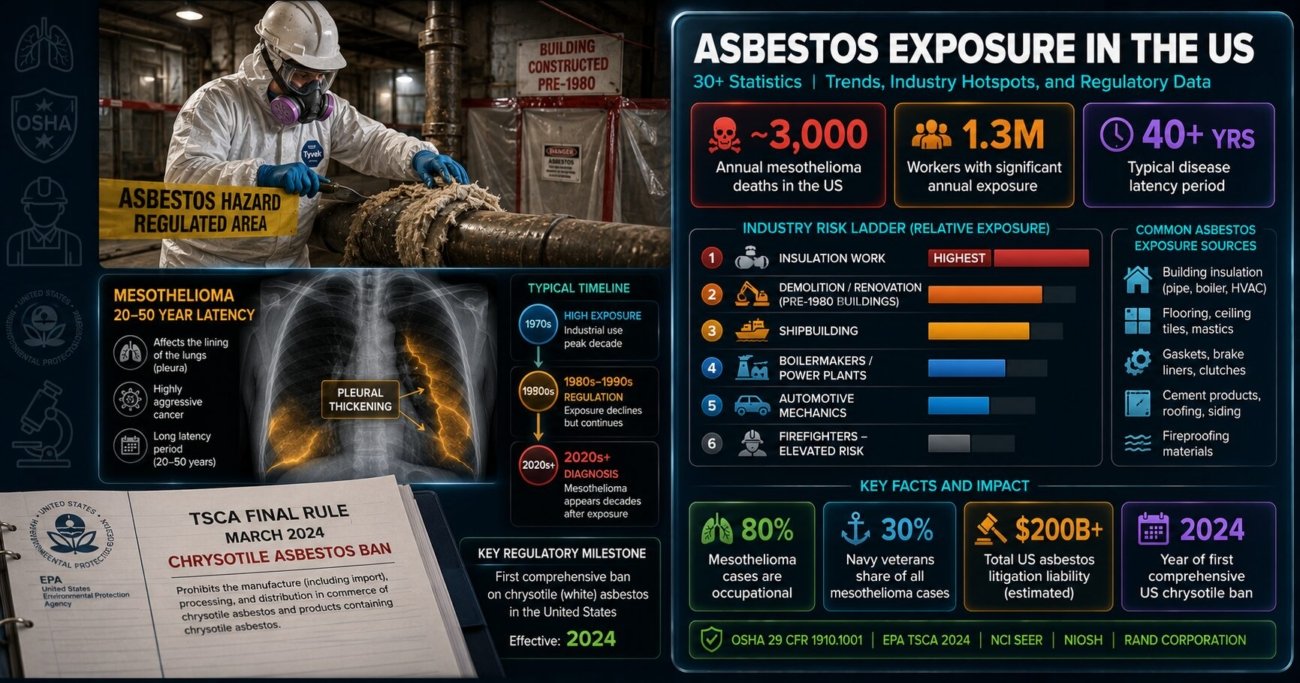
Asbestos remains one of the most significant occupational carcinogens in the United States. Unlike most developed nations, the US has never enacted a comprehensive asbestos ban. Certain uses remain legal and in-service asbestos in buildings constructed before 1980 continues to expose workers during renovation, demolition, and maintenance operations. The CDC estimates approximately 3,000 Americans die from mesothelioma each year, and NIOSH data shows asbestos-related disease mortality has not followed the same downward trend as asbestos production, because the diseases caused by historical exposures continue manifesting decades later.
Below we have compiled 30+ statistics and data points on asbestos exposure in the US, covering mortality trends, industry hotspots, regulatory exposure limits, geographic concentration, disease burden, and the occupations currently at highest risk.
1. Mesothelioma Mortality: Trends and Current Burden
- Approximately 3,000 Americans die from mesothelioma annually – a figure that has plateaued rather than declined, because the 20-50 year latency period means current deaths reflect exposures from the 1970s through 1990s when asbestos use remained high. (CDC / NCI)
- Mesothelioma mortality increased from approximately 2,000 deaths in 1999 to approximately 3,000 by the early 2020s, reflecting the peak-exposure cohort of workers who encountered asbestos heavily in the 1960s-1980s now reaching the disease manifestation window. (CDC WONDER Database)
- The median age at mesothelioma diagnosis is 72 years, consistent with the 40-50 year latency period and the occupational exposure cohort that was most heavily exposed before asbestos regulation began in earnest in the late 1970s. (NCI SEER Database)
- Five-year survival for mesothelioma remains below 10% for most histological types, making it one of the most lethal occupational cancers and reinforcing the primacy of prevention over treatment. (NCI SEER 2024)
- Asbestosis mortality in the US runs at approximately 1,000-1,500 additional deaths annually, separate from mesothelioma, bringing total asbestos-related annual mortality to over 4,000. (NIOSH Work-Related Lung Disease Surveillance Report)
2. Current Legal Status: What Is and Is Not Banned in the US
- In March 2024, the EPA issued its final TSCA rule banning ongoing uses of chrysotile asbestos – the last commercially used asbestos type in the US – with phase-out timelines for chlor-alkali facilities (2 years) and other uses (varying timelines). This is the first comprehensive federal asbestos ban in US history. (EPA TSCA Final Rule, March 2024)
- More than 55 countries have already enacted comprehensive asbestos bans, including all EU member states, Australia, Canada, Japan, and the UK. The US 2024 EPA rule brings it significantly closer to this standard but with staggered phase-out timelines. (WHO; IARC)
- The 1989 EPA asbestos ban under TSCA was largely overturned by the Fifth Circuit Court of Appeals in 1991 in Corrosion Proof Fittings v. EPA, which is why the US maintained legal asbestos uses for over 30 years until the 2024 rule. (Corrosion Proof Fittings v. EPA, 947 F.2d 1201)
- In-place asbestos-containing materials (ACM) in buildings constructed before approximately 1980 remain legal to maintain in undisturbed condition. EPA’s National Emission Standards for Hazardous Air Pollutants (NESHAP) regulate disturbance and removal. (40 CFR Part 61 Subpart M)
3. Industry Hotspots: Occupations at Highest Current Risk
- OSHA estimates 1.3 million construction and general industry workers face significant asbestos exposure annually. Construction workers account for the largest share due to renovation and demolition of pre-1980 structures. (OSHA Asbestos Standards)
- Insulation workers (insulators) have historically had the highest mesothelioma mortality rates of any occupation – approximately 300 times the rate of the general population in cohort studies of heavily exposed workers. (NIOSH; Collegium Ramazzini)
- Shipbuilding workers represent a historically high-exposure group. Navy veterans who served before 1980 have elevated mesothelioma risk because asbestos was used extensively in ship construction for insulation, pipe lagging, and fireproofing. (US Department of Veterans Affairs; NIOSH)
- Firefighters responding to structural fires in pre-1980 buildings face secondary asbestos exposure when ACM is disturbed by fire or suppression activities. IAFF data shows elevated mesothelioma rates among career firefighters. (International Association of Fire Fighters; NIOSH)
- Automotive mechanics performing brake and clutch work on vehicles manufactured before approximately 1990 may have encountered chrysotile asbestos in friction materials. OSHA’s 1910.1001 action level of 0.1 f/cc applies to this work. (29 CFR 1910.1001)
4. Geographic Concentration: States and Regions With Highest Burden
- Mesothelioma incidence rates are highest in states with historical shipbuilding, steel production, petrochemical refining, and asbestos mining industries – Pennsylvania, New Jersey, California, Washington, and Louisiana consistently appear among the highest-burden states. (NCI State Cancer Profiles; CDC WONDER)
- Libby, Montana is the site of a declared public health emergency – the only asbestos-related public health emergency in US history – where vermiculite mining operations contaminated the town with tremolite asbestos, resulting in elevated mesothelioma rates in the general population, not only workers. (EPA Libby Asbestos Site)
- US Navy veterans account for approximately 30% of all US mesothelioma cases, reflecting the extensive use of asbestos in naval vessels constructed between 1930 and 1975. The VA provides disability compensation for veteran asbestos-related disease. (US Department of Veterans Affairs)
- Urbanised areas with large pre-1980 building stock – New York City, Chicago, Philadelphia – present ongoing renovation and demolition exposure risks proportional to the volume of construction activity and the age of the building stock. (EPA NESHAP; NIOSH)
5. OSHA Regulatory Limits and Compliance Data
- OSHA’s asbestos PEL of 0.1 f/cc as an 8-hour TWA applies to general industry under 29 CFR 1910.1001 and to construction under 29 CFR 1926.1101. The construction standard is more stringent in some respirator and competent person requirements. (OSHA 1910.1001; 1926.1101)
- When asbestos air concentrations are at or above the action level of 0.1 f/cc, employers must implement air monitoring, medical surveillance, regulated areas, exposure records, and annual training. This makes the action level effectively the compliance trigger for most programme elements. (29 CFR 1910.1001(c)-(n))
- NIOSH’s recommended exposure limit is also 0.1 f/cc, but NIOSH emphasises that no safe level of asbestos exposure has been established and recommends exposure be reduced to the lowest feasible level. (NIOSH Criteria Document for Asbestos)
- OSHA asbestos violations are among the agency’s most frequently cited health standards in construction. Common citations involve inadequate initial exposure assessments, failure to use required respirators, and lack of regulated area designation. (OSHA Enforcement Data)
- Serious OSHA violations for asbestos standard non-compliance carry penalties of up to $16,131 per violation, with willful violations reaching $161,323. Given the latency of asbestos disease, enforcement actions frequently follow disease diagnosis years after the exposure violation. (OSHA Penalty Schedule 2024)
6. Disease Burden Beyond Mesothelioma
- Asbestos exposure is associated with four distinct diseases: mesothelioma, asbestosis, asbestos-related lung cancer, and pleural disease (pleural plaques and pleural effusions). Of these, mesothelioma is causally attributed to asbestos exposure in approximately 80% of cases. (IARC; NIOSH)
- Occupational asbestos exposure is estimated to cause approximately 4% of all lung cancer deaths in the US – adding several thousand additional deaths annually beyond the mesothelioma count. Asbestos and cigarette smoking have a multiplicative (not merely additive) interaction in lung cancer risk. (NIOSH; IARC Monographs)
- Asbestosis – fibrotic scarring of the lung tissue – typically requires higher cumulative exposure levels than mesothelioma and is less prevalent than mesothelioma in current mortality statistics, reflecting the effectiveness of lower-exposure regulations in reducing the highest-dose exposures. (NIOSH Surveillance)
- Peritoneal mesothelioma, affecting the abdominal lining, accounts for approximately 20-25% of all mesothelioma diagnoses and is associated with very high cumulative asbestos exposures, particularly in insulation workers. (NCI SEER)
7. Economic and Litigation Data
- Asbestos litigation is the longest-running mass tort in US history, with over 700,000 claims filed against more than 8,400 defendants since the 1970s. Total liability has been estimated by RAND Corporation at over $200 billion in resolved and projected future claims. (RAND Corporation: Asbestos Litigation)
- More than 100 US companies have sought bankruptcy protection at least in part due to asbestos liability, including major manufacturers, insurers, and construction firms. Asbestos bankruptcy trusts now hold billions in reserved funds for future claimants. (RAND; Mealey’s Asbestos Bankruptcy Report)
- Annual economic costs of asbestos-related diseases in the US – including medical treatment, workers compensation, disability, and productivity losses – are estimated at $2.5 billion or more per year in recent analyses. (RAND Corporation)
- Workers compensation claims for occupational asbestos disease remain active across most US states, with many states having extended statutes of limitations for asbestos claims to account for the long latency period. (ATSDR; State Workers Compensation Data)
- The average compensation in mesothelioma lawsuits ranges from approximately $1 million to $1.4 million through verdicts and settlements, though amounts vary widely by jurisdiction, exposure history, and defendant. Trust fund payments average significantly lower. (Mealey’s Asbestos Litigation Data)
8. What the 2024 EPA TSCA Rule Changes
- On March 18, 2024, EPA finalised a rule under TSCA Section 6 banning ongoing uses of chrysotile asbestos – the only form of asbestos still commercially used in the US. This is the first time EPA has successfully imposed a comprehensive asbestos restriction since the 1991 court decision overturned the 1989 ban. (EPA TSCA Final Rule, 89 FR 21970, March 2024)
- The 2024 rule requires chlor-alkali facilities – the primary remaining commercial users of chrysotile asbestos in the US – to phase out asbestos use within 2 years of the rule’s effective date. Approximately 12 US facilities used chrysotile asbestos in diaphragm production at the time of the rule. (EPA TSCA Final Rule 2024)
- The rule does not address legacy asbestos already in place in buildings, products, and infrastructure. EPA’s NESHAP programme, OSHA’s asbestos standards, and state regulations continue to govern legacy ACM management. (EPA; OSHA)
- Advocacy groups and public health researchers estimate that a complete asbestos ban – including addressing legacy ACM – could prevent thousands of future mesothelioma deaths in the decades ahead, as exposures generating current disease reflect the pre-regulation era. Preventing future exposures now determines disease burden 20-50 years from today. (Asbestos Disease Awareness Organization; EWG)
- Despite the 2024 rule, environmental justice researchers note that asbestos-containing legacy products and building materials remain disproportionately concentrated in lower-income communities and communities of colour, where older housing and commercial building stock is more prevalent. (EPA Environmental Justice Analysis)
Key Takeaways for Safety Managers and EHS Professionals
Sources
Government and Regulatory
- OSHA: Asbestos Safety and Health Topics (1.3M worker exposure estimate; PEL; enforcement)
- 29 CFR 1910.1001: OSHA Asbestos Standard for General Industry
- 29 CFR 1926.1101: OSHA Asbestos Standard for Construction
- EPA: Asbestos Ban and Phase-Out (2024 TSCA Final Rule, March 2024)
- NIOSH: Asbestos – Work-Related Lung Disease Surveillance and Exposure Data
- NCI SEER: Mesothelioma Statistics (incidence, survival, demographics)
Industry and Research Sources
