
Source: FDA Warning Letter Database analysis, 2015-2023
Source: FDA 483 observation frequency data, CDER/ORA
Source: FDA Annual Drug Quality Report series, 2012-2023
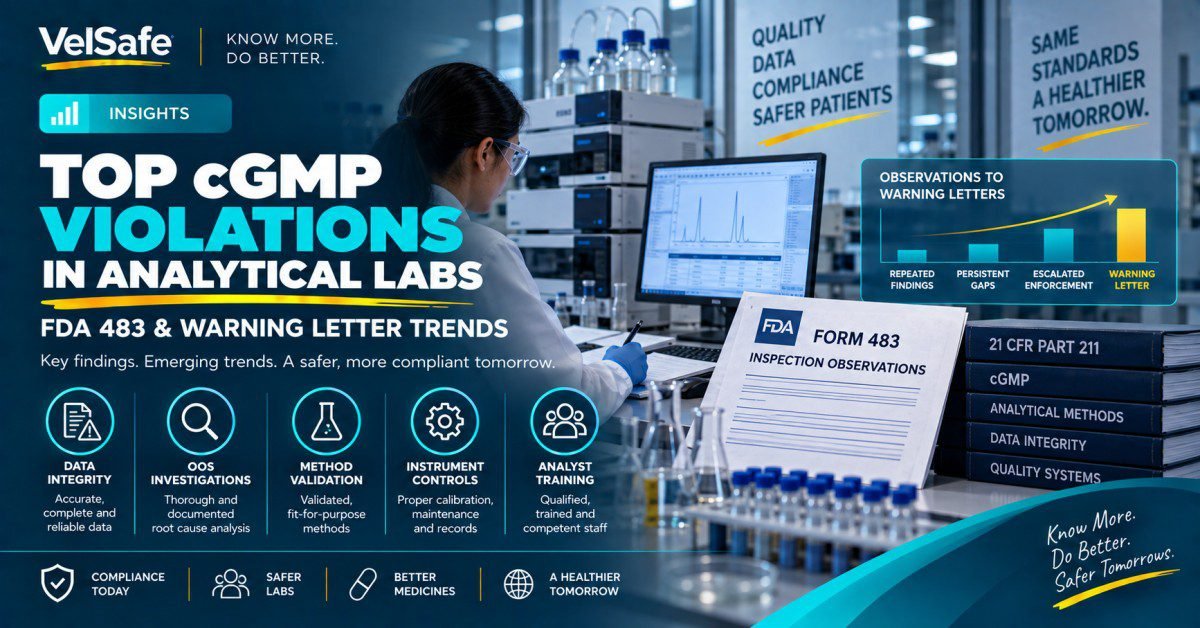
Top cGMP Violations Cited in FDA 483s and Warning Letters
The table below ranks the most frequently cited deficiency categories in FDA inspections of pharmaceutical and contract analytical laboratories, based on 483 observation patterns and Warning Letter analysis across CDER and ORA enforcement actions.
| Rank | Violation Category | CFR Citation | Frequency |
|---|---|---|---|
| 1 | Data integrity: audit trail manipulation, deletion of failing runs, backdating | 21 CFR 211.68, 211.194 | Very High |
| 2 | Inadequate OOS investigation: missing Phase I/II steps, premature invalidation | 21 CFR 211.192 | Very High |
| 3 | Method validation gaps: incomplete specificity, linearity, or robustness data | 21 CFR 211.160(b) | High |
| 4 | Laboratory controls: inadequate specifications, missing reference standards | 21 CFR 211.160 | High |
| 5 | Stability programme deficiencies: missing bracketing, inadequate storage | 21 CFR 211.166 | High |
| 6 | Laboratory records: incomplete logbooks, missing raw data, unsigned entries | 21 CFR 211.194 | Moderate |
| 7 | Equipment calibration and qualification: missing IQ/OQ/PQ for analytical instruments | 21 CFR 211.68 | Moderate |
Sources: FDA cGMP Resources | FDA Data Integrity Guidance (2018)
Data Integrity: The Dominant Warning Letter Theme
FDA’s 2018 Data Integrity guidance acknowledged data integrity as a top concern from inspections globally. Warning Letters citing DI failures have involved deletion of failing chromatographic runs, falsification of raw data entries, audit trail manipulation in LIMS and CDS systems, and sharing of login credentials that prevent individual attribution under ALCOA+ criteria.
Source: FDA: Data Integrity and Compliance With Drug CGMP (2018)
OOS Investigations: A Perennial High-Frequency Finding
Nearly two decades after FDA published its OOS investigation guidance, inadequate OOS procedures remain one of the most cited findings in every inspection cycle. Labs continue to invalidate failing results without completing Phase I or Phase II investigations, skip the required assignable cause determination, and fail to extend investigations to other potentially affected batches.
What Inspectors Look For
Assignable cause identified or ruled out
Phase II full-scale investigation when required
Extension to other batches assessed
QA sign-off before result invalidation
Original data retained, not overwritten
Source: FDA: Investigating Out-of-Specification Test Results (2006)
How FDA Categorizes Analytical Lab cGMP Deficiencies
FDA inspectors assess analytical laboratories against the laboratory controls subpart of 21 CFR Part 211 (sections 211.160 through 211.194). The six categories below represent the full scope of what is examined during a GMP inspection of an analytical lab.
Laboratory Controls
Scientifically sound specifications, standards, and test procedures (21 CFR 211.160)Lab Records
Complete, accurate, contemporaneous records of all tests and results (21 CFR 211.194)Automated Systems
Validated HPLC, LIMS, CDS: audit trails enabled, access controlled (21 CFR 211.68)Testing of Components
Representative sampling, identity testing, conformance to specifications (21 CFR 211.84)Stability Programmes
Written programmes, adequate sample retention, expiry determination (21 CFR 211.166)OOS Investigations
Phase I and II investigation procedures, assignable cause, batch extension (21 CFR 211.192)OSHA and FDA Penalty Figures You Should Know
Each missing or inadequate cGMP procedure, each training record gap, and each uncontrolled hazardous material exposure in a pharmaceutical lab constitutes a separate citable violation. Source: OSHA Penalty Schedule 2024
Willful violations occur when an employer knew of the obligation and intentionally failed to comply. In pharmaceutical labs, this applies to documented data integrity violations where management was aware. Source: OSHA Penalty Schedule 2024
9 Important cGMP Lab Compliance Facts
What every lab quality manager should know about FDA enforcement patterns and compliance obligations.
Lab controls (21 CFR 211.160 through 211.194) accounts for more cGMP observations annually than any other single subpart of Part 211. Source: FDA cGMP Resources
FDA has issued data integrity Warning Letters to companies in more than 30 countries since 2018. India, China, and the U.S. top the list. Source: FDA Warning Letter database
Despite nearly two decades, inadequate OOS investigations remain a top-5 finding in every FDA inspection cycle. Source: FDA OOS Guidance (2006)
Attributable, Legible, Contemporaneous, Original, Accurate, Complete, Consistent, Enduring, Available. Every failing criterion is a separate violation. Source: FDA DI Guidance (2018)
Specificity, linearity, range, accuracy, precision, detection limit, quantitation limit, and robustness. Missing any one is citable under 21 CFR 211.160(b). Source: ICH Q2(R2)
= CITED Shared Logins Are the Top Part 11 Citation
21 CFR Part 11 requires individual user accounts in every CDS and LIMS. Shared credentials prevent attribution and are among the most cited Part 11 deficiencies. Source: 21 CFR Part 11
= INVALID Expired Reference Standard Voids All Tests
Using an expired reference standard without documented justification invalidates every result dependent on it. Standards must carry assigned expiry dates and correct storage. Source: 21 CFR 211.160
Written programme, defined storage conditions, defined testing intervals, and retained samples. Miss any one under 21 CFR 211.166 and it is a direct 483 observation.
= WARNING LETTER Repeat 483 Observations Trigger Escalation
The same finding in two consecutive inspections signals a broken quality system. Labs without verified CAPA before the next cycle face significantly elevated Warning Letter risk. Source: FDA Enforcement Policy
5 Myths About cGMP Lab Compliance
If the final result passes specification, the investigation path does not matter
FDA inspectors assess the investigation process, not just the outcome. An OOS result invalidated without a documented assignable cause is a violation regardless of whether the retest passed.
Small contract labs are rarely inspected and face lower compliance risk
FDA inspects contract testing laboratories independently and a data integrity finding there can trigger enforcement against both the lab and every client whose products were tested there.
Printing the audit trail and filing it satisfies the audit trail review requirement
FDA requires audit trails be reviewed as part of batch record review, not merely retained. The review must be documented, periodic, and cover anomalies: a printed but unreviewed trail is not compliant.
Method validation completed years ago does not need to be revisited
Method transfers, instrument changes, and specification tightening all require revalidation or a documented adequacy assessment. A method validated on one instrument is not automatically valid on a replacement of the same model.
A 483 observation that was responded to is closed
A 483 response commits to corrective actions. FDA evaluates implementation at the next inspection. A response that proposed training but did not implement it before the next visit is treated as a repeat observation, significantly increasing Warning Letter probability.
Impact of cGMP Lab Violations on Your Business
Import Alerts and Shipment Holds
A Warning Letter citing data integrity can result in detention without physical examination of all products manufactured at the facility, blocking market access until issues are resolved.
Product Recalls and Lot Rejections
Lab data integrity failures call into question every test result produced during the violation period. Recalls triggered by lab data unreliability are typically broader and more expensive than product defect recalls.
Application Delays and Approval Holds
An outstanding Warning Letter can result in Complete Response Letters (CRLs) for pending drug applications, blocking product launches until compliance issues are resolved.
Consent Decrees and Criminal Referrals
Persistent data integrity violations have resulted in consent decrees requiring third-party oversight and, in the most serious cases, DOJ criminal referrals against laboratory personnel and management.
How to Prevent cGMP Lab Violations
Avoiding FDA 483 observations and Warning Letters requires consistent, system-level programme execution rather than pre-inspection remediation sprints.
Quarterly Audit Trail Reviews
Review CDS and LIMS audit trails every quarter and document the review outcome.
Mock OOS Investigations
Train analysts on Phase I and II process using practice scenarios before a real OOS event occurs.
Individual User Accounts
Zero tolerance for shared logins in any CDS, LIMS, or ERP system that generates regulated data.
Reference Standard Expiry Tracking
Maintain a register with expiry dates and automate alerts 60 days before expiry.
CAPA Effectiveness Checks
Schedule and document an effectiveness check for every 483 CAPA. Close only when confirmed the finding has not recurred.
Annual Mock Inspections
Use an internal or third-party auditor to walk through the lab as an FDA investigator would, document findings, and track closure.
Sources
Government and Regulatory Sources
- FDA: Data Integrity and Compliance With Drug CGMP (2018): primary FDA guidance on ALCOA+ requirements, audit trail obligations, and the most common data integrity deficiency categories.
- FDA: Investigating Out-of-Specification Test Results for Pharmaceutical Production (2006): governing guidance for the Phase I and Phase II OOS investigation framework.
- 21 CFR Part 211: Current Good Manufacturing Practice for Finished Pharmaceuticals: the complete cGMP regulation, including laboratory controls subpart 211.160 through 211.194.
- 21 CFR Part 11: Electronic Records and Electronic Signatures: audit trail, access control, and validation requirements for electronic laboratory systems.
- FDA: Facts About cGMPs: source for citation frequency context by CFR section.
- OSHA: Penalty Schedule 2024: source for serious and willful violation penalty figures.
Standards and Industry Sources
- ICH Q2(R2): Validation of Analytical Procedures (2022): international standard for method validation requirements referenced under 21 CFR 211.160(b).
Related VelSafe Articles
Quality Assurance Supports Data Integrity: 7 Tips
ALCOA+ compliance, audit trail verification, CAPA to root cause, and inspection readiness for QA professionals in pharmaceutical and clinical research settings.
Computerized Systems Validation Project Tips: 7 to Know
How to start a CSV project correctly: GAMP 5 categories, Validation Plan, risk-based testing, URS, vendor documentation gap assessment, and post-go-live change control for GMP labs.