

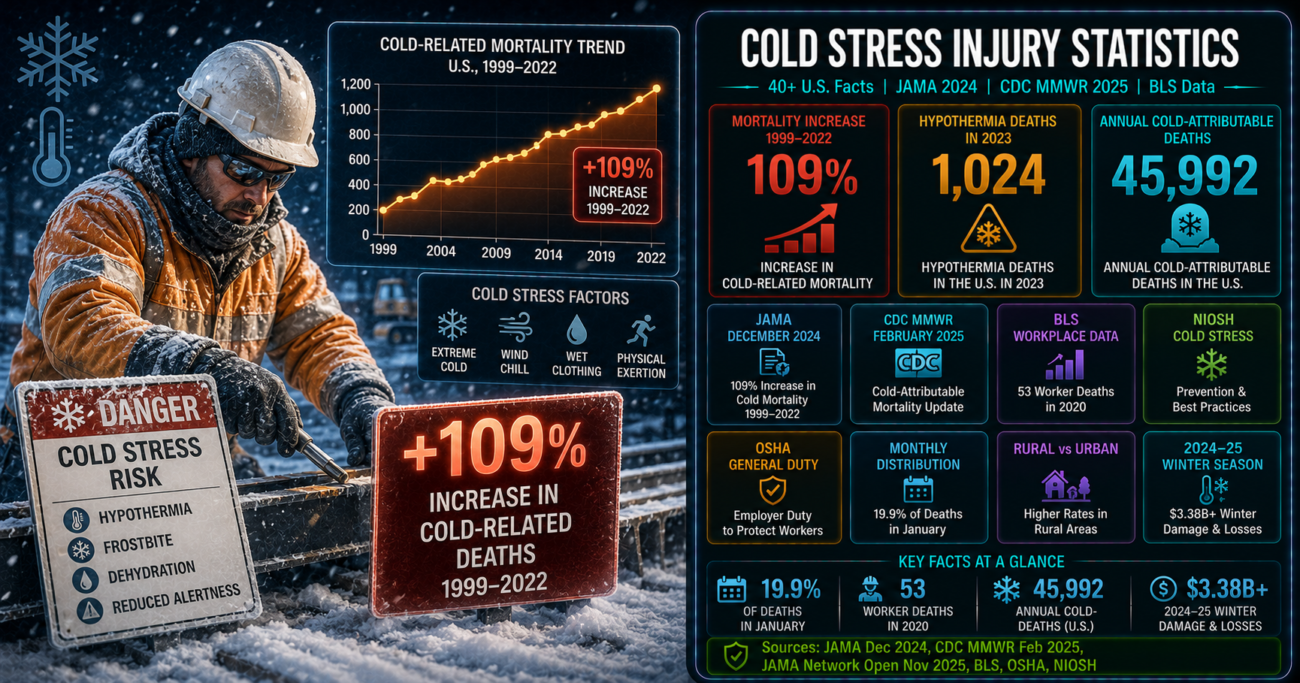
Cold is a more lethal force in the United States than most public health discussions acknowledge. A landmark JAMA study published in December 2024 found that cold-related mortality rates increased 109% between 1999 and 2022, with the steepest acceleration – 95% – occurring between 2017 and 2022. A separate 2025 JAMA Network Open study analyzing 54 million death records found that low temperatures are associated with approximately 45,992 mean annual deaths – more than 13 times the toll from high temperatures – because cold-related deaths span cardiovascular, respiratory, and renal causes that standard “cold death” coding misses.
The workplace dimension is equally significant. Between 2003 and 2019, cold exposure caused 31 occupational fatalities and 2,770 serious nonfatal injuries – an average of 163 workers hurt each year. In 2020 alone, 53 workers died from environmental cold exposure. OSHA has no specific cold stress standard, but the General Duty Clause obligates employers to protect workers from recognized cold hazards. Below we compile 40+ statistics from CDC, NIOSH, BLS, OSHA, and peer-reviewed research through 2025.
Editor's Choice: Key Cold Stress Statistics for 2024-25
1. National Cold-Related Mortality Trends: The JAMA December 2024 Findings
- A landmark study of U.S. death certificate data published in JAMA on December 19, 2024 found that the cold-related age-adjusted mortality rate increased from 0.44 per 100,000 persons in 1999 to 0.92 per 100,000 in 2022 – a 109% increase, with a statistically significant 3.4% annual increase throughout the study period (P less than 0.001). (Liu, Patel, Wadhera. JAMA, December 2024)
- The increase was not steady across the study period. Cold-related mortality was relatively stable through approximately 2017, after which rates surged by 95% between 2017 and 2022 alone. Study co-author Dr. Rishi Wadhera described the findings as “surprising” given that mean temperatures have been increasing. (JAMA, December 2024; WBUR, December 2024)
- Between 1999 and 2022, more than 40,000 people died due to cold exposure in the United States based on underlying cause of death coding for hypothermia and cold exposure – a figure that substantially undercounts the true cold-attributable burden. (JAMA, December 2024)
- In 2023, the CDC MMWR reported that 1,024 deaths were attributed to excessive cold or hypothermia, based on ICD-10 code X31 (Exposure to excessive natural cold) and T68 (Hypothermia) from the National Vital Statistics System. (CDC MMWR, February 27, 2025, Vol. 74, No. 6)
- A 2025 JAMA Network Open study analyzing 54.2 million death records found that low temperatures are associated with approximately 45,992 mean annual deaths across all causes (not just hypothermia-coded deaths) – more than 13 times the 3,414 mean annual deaths from high temperatures. The burden from high temperatures increased 53% between 2000-2009 and 2010-2020, but cold remains the dominant temperature-related cause of death. (JAMA Network Open, November 2025)
2. When Cold Deaths Happen: Monthly Distribution in 2023
- January 2023 accounted for 19.9% of all cold/hypothermia deaths (204 of 1,024), making it the single deadliest month. February was second at 16.9% (173 deaths) and December third at 16.7% (171 deaths). (CDC MMWR, February 2025)
- Combining January and February, approximately 36.8% of all 2023 cold deaths occurred in the first two months of the year. When November and December are added, the four coldest months account for approximately 65.4% of all annual cold fatalities. (CDC MMWR, February 2025; calculated)
- Even summer months show some cold-related mortality: July and August recorded 1.6% and 1.4% of deaths respectively (16 and 14 deaths), reflecting cold-environment worker deaths, hypothermia from cold water immersion, and air conditioning-related cold events. (CDC MMWR, February 2025)
- For workplace safety planning, the CDC data confirms that cold stress prevention programs must be operationally active by November at the latest, not just during the January-February peak. October already accounts for 5% of annual cold fatalities. (CDC MMWR, 2025; OSHA guidance)
3. Who Is Most At Risk: Demographics, Geography, and Vulnerability Factors
- Adults aged 75 and older carry the highest cold-related death rate per capita, driven by impaired thermoregulation, chronic disease, medication effects, social isolation, and reduced ability to respond to cold warning signs. (JAMA, December 2024)
- The JAMA 2024 study found that adults aged 45 to 74 showed the largest absolute increase in cold-related deaths over the study period. The researchers identified homelessness, drug and alcohol use, and social isolation among this age group as potential drivers of the accelerated mortality rise after 2017. (JAMA, December 2024; WBUR, December 2024)
- During 2018-2020, rural males in noncore areas had cold death rates of 0.93 per 100,000 – more than three times the 0.29 rate for large central metro males. Rural areas have lower access to emergency services, heating resources, and cold weather shelter infrastructure. (CDC MMWR, February 2022)
- Three structural factors that the JAMA 2024 researchers identified as likely drivers of the post-2017 surge: the rising unsheltered homeless population; the growing share of Americans aged 50 and older who are less physiologically resilient; and youth social isolation, which reduces the informal monitoring that historically reduced cold deaths. (JAMA, December 2024; WBUR)
- People with hypertension, hypothyroidism, diabetes, poor circulation, or prior frostbite are at elevated risk from cold stress – conditions that are more prevalent in older adults and workers in sedentary roles who may underestimate their exposure risk. (OSHA.com; CDC-NIOSH)
4. Cold Stress in the Workplace: Occupational Fatalities and Injuries
- Between 2003 and 2019, cold exposure caused 31 occupational fatalities and 2,770 serious nonfatal injuries in the U.S. workforce – an average of approximately 1.9 deaths and 163 injuries per year directly attributable to cold environmental conditions. (BLS / NIOSH)
- In 2020, 53 workers died from exposure to environmental cold, with 22 of those deaths directly tied to snow, ice, or sleet conditions that create compounding hazards including slips, falls, vehicle crashes, and direct cold exposure. (BLS, cited in DuraLabel, November 2025)
- The industries with highest cold stress risk include construction, snow removal, agriculture, utilities, transportation, and outdoor security. Workers in these sectors face prolonged exposure to wind chill, wet conditions, and inadequate warm-up opportunities during winter months. (OSHA; CDC-NIOSH, March 2026)
- OSHA does not have a specific standard covering cold stress. However, under the OSH Act of 1970, employers have a General Duty Clause obligation to protect workers from recognized hazards – including cold stress hazards – that are causing or likely to cause death or serious physical harm. (OSHA.gov; OSHA.com, December 2024)
- Cold stress injuries in the workplace include hypothermia, frostbite, trench foot, and chilblains. Cold immersion hypothermia develops far faster than standard hypothermia and can occur in any water temperature below 70 degrees F – a particular risk for workers in marine, construction, and utility environments. (CDC-NIOSH, March 2026)
- Workers in indoor cold environments – refrigerated warehouses, walk-in freezers, cold storage facilities – face cold stress risks that are often underrecognized because they are not in traditional outdoor winter settings. Sedentary workers in cold environments are at particular risk because reduced physical activity lowers heat generation. (OSHA.com; CDC-NIOSH)
5. Military Cold Injury Data: 2024-25 U.S. Armed Forces Statistics
- U.S. Armed Forces cold injury rates between 2019 and 2024 ranged from 6.4 to 31.1 cold injuries per 100,000 person-years – a nearly five-fold variation reflecting the impact of specific training cycles, geographic assignments, and winter severity on military cold injury rates. (U.S. Armed Forces Medical Surveillance data)
- In the 2023-2024 winter season, 456 service members were diagnosed with at least one cold injury. The Army and Marine Corps reported the highest rates among the services, consistent with their greater proportion of ground combat training under winter field conditions. (MSMR / Medical Surveillance Monthly Report)
- Military cold injury data has occupational safety implications beyond the armed forces: it demonstrates that even highly trained, physically fit individuals with access to proper gear and medical support can suffer cold stress injuries under sustained cold exposure. Training and equipment do not eliminate cold stress risk; they manage it.
6. The 2024-25 Winter Season and the Structural Drivers of Rising Cold Mortality
- The 2024-25 North American winter was characterized by 21 weather prediction center storm events, producing 55 total fatalities and over $3.38 billion in property damage. The 2024-25 season was described as considerably colder and more wintry than recent years. (Wikipedia / NWS, 2025)
- The January 20-22, 2025 Gulf Coast blizzard brought historic snow accumulations to areas including New Orleans, southern Alabama, and the Florida Panhandle – regions with minimal cold weather infrastructure, unaccustomed populations, and populations particularly vulnerable to sudden cold exposure. The event caused 13 deaths and $200 million in damage. (NWS; Wikipedia, 2025)
- JAMA’s 2025 JAMA Network Open analysis found that the world experienced its record-breaking warmest year in 2024 alongside unusually low temperatures in the U.S. in the winter of 2025, illustrating the coexistence of warming trends with extreme cold events that disproportionately affect unprepared populations. (JAMA Network Open, November 2025)
- The JAMA December 2024 authors identified three structural contributors to the rising cold mortality rate: more Americans lacking stable housing; a growing proportion of adults aged 50 and older with reduced physiological resilience; and increased social isolation among younger adults that reduces the informal social monitoring that historically protected vulnerable people during cold events. (JAMA, December 2024; WBUR)
- Drug and alcohol use impair the body’s ability to sense cold and respond to it, and contribute to outdoor sleeping behavior during cold periods. The JAMA 2024 study period coincided with the surge in U.S. overdose deaths, and the researchers identified this as a probable contributor to accelerated cold mortality among adults aged 45-74 specifically. (JAMA, December 2024)
7. Cold Stress Prevention: What OSHA and NIOSH Recommend in 2025-26
- OSHA’s Cold Stress Guide (updated 2025-26) specifies that employers must train workers on prevention, recognition, and first aid for cold stress illnesses, and must provide appropriate engineering controls, personal protective equipment, and safe work practices. (OSHA Cold Stress Guide, OSHA.gov)
- Cold stress prevention does not require sub-freezing temperatures to be legally applicable. OSHA notes that hypothermia can occur above 40 degrees F when wetness, wind, or physical fatigue are present – meaning cold stress hazard assessment should begin well above freezing in wet or windy conditions. (OSHA.com, December 2024)
- The CDC-NIOSH Cold Stress page (updated March 3, 2026) identifies four cold-related illness categories for worker recognition training: hypothermia, frostbite, trench foot, and chilblains. Each has distinct onset timing, symptoms, and first aid requirements that workers should be able to identify in themselves and colleagues. (CDC-NIOSH, March 2026)
- Wind chill is the primary amplifier of cold stress risk: wind speeds that make the effective temperature feel lower than the air temperature accelerate heat loss from exposed skin. OSHA recommends that employers know the wind chill temperature during outdoor cold work – not just the ambient temperature – before assigning workers to prolonged outdoor tasks. (OSHA Winter Weather – Cold Stress page)
- For workers in cold water environments, cold immersion hypothermia represents the highest-urgency cold stress emergency: survival times in water below 70 degrees F are measured in minutes to hours depending on water temperature and physical condition, and immersion hypothermia develops much faster than standard air cold exposure. (CDC-NIOSH, March 2026)
Key Takeaways for Safety Managers and Occupational Health Professionals
Sources
Government and Peer-Reviewed Sources
- Liu M, Patel VR, Wadhera RK. Cold-Related Deaths in the US. JAMA. 2025;333(5):427-429. (Published December 19, 2024) – 109% increase 1999-2022, 95% surge 2017-2022, 3.4% annual increase, driver analysis
- CDC MMWR Vol. 74 No. 6, February 27, 2025 – 1,024 cold/hypothermia deaths in 2023, monthly distribution by month, January at 19.9%
- JAMA Network Open, November 2025 – Heat and Cold-Related Mortality Burden in the US 2000-2020: 45,992 mean annual cold deaths vs 3,414 heat deaths (54.2M death records analyzed)
- CDC MMWR, February 2022 – Cold death rates by urbanization and sex 2018-2020: rural males 0.93 per 100,000 vs large metro 0.29; rural females 0.40 vs large metro 0.11
- CDC-NIOSH – Cold Stress page (updated March 3, 2026): worker types at risk, illness categories, prevention framework
- OSHA – Winter Weather Cold Stress: General Duty Clause applicability, wind chill, cold stress types, employer obligations
- OSHA Cold Stress Guide: engineering controls, work practice controls, PPE, training requirements
News, Analysis, and Industry Sources
- WBUR News (December 27, 2024) – While earth warmed, cold weather killed more Americans: Dr. Wadhera findings summary, structural driver analysis
- OSHA Online Center (October 2025) – Winter Safety Guide: 1,300 annual hypothermia deaths (CDC), thousands of nonfatal cold illnesses annually, prevention framework
- DuraLabel (November 2025) – Cold Stress Prevention: BLS 2020 data (53 worker deaths, 22 linked to snow/ice/sleet), OSHA seven-tip prevention framework
- 2024-25 North American Winter (Wikipedia / NWS sources) – 21 storm events, 55 fatalities, over $3.38B damage, January 2025 Gulf Coast blizzard statistics