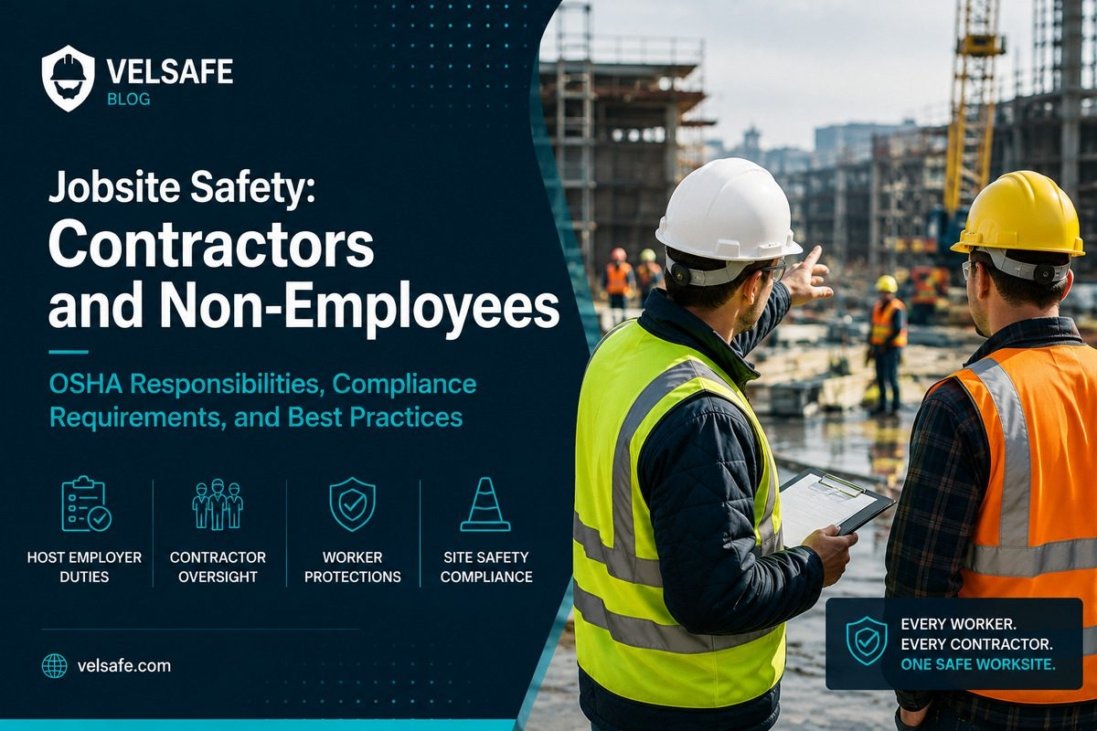
INSIGHTS: Contractor and Non-Employee Safety
What Host Employers Actually Owe
Every Contractor on Their Site
Most host employers assume the contractor’s employer handles the contractor’s safety. OSHA’s multi-employer worksite policy says otherwise, and the gap between what host employers assume and what OSHA actually requires is where most contractor fatalities occur.
23%
Of All Fatalities
Contractors represent roughly 23% of US workplace fatalities despite being a smaller share of total hours worked, concentrated in construction, energy, and manufacturing.
BLS, 2023
58%
Subcontractor Fatalities
Of construction fatalities involve subcontractor workers, not the general contractor or project owner who controls the site, even though the controlling employer holds the authority to prevent site-wide hazards.
CPWR, 2022
4
Employer Roles
OSHA CPL 02-00-124 defines four distinct employer roles on shared worksites, creating, exposing, correcting, and controlling, each carrying separate citation liability regardless of who employed the injured worker.
OSHA CPL 02-00-124
The Assumption Gap: What Host Employers Believe vs. What OSHA Requires
Common Belief
“The contractor’s employer is responsible for the contractor’s safety. Our contract says so. We have no obligation beyond letting them on site.”
What most host safety managers believe
OSHA Reality
Contract language does not transfer OSHA liability. A controlling employer is citable for hazardous conditions on their site regardless of who employed the injured worker.
OSHA CPL 02-00-124, 1999
58%
Of construction fatalities involve subcontractor workers, not the general contractor or project owner who controls the site and sets the safety programme.
CPWR, 2022
The Four Employer Roles OSHA Uses to Assign Liability
OSHA’s multi-employer worksite policy (CPL 02-00-124) identifies four distinct employer roles on shared worksites. Each carries a separate citation basis. An employer can hold more than one role simultaneously. The host employer who thinks they are only a bystander is almost always the controlling employer, the role that carries the broadest citation liability.
Creating Employer
The employer whose actions or omissions caused the hazardous condition. Citable even if none of their own employees were exposed. A general contractor whose scaffolding design is defective is the creating employer even if only subcontractor workers use it.
Exposing Employer
The employer whose own workers are exposed to the hazard. Citable if they knew or should have known and failed to remove workers, request correction, or warn them. The most commonly cited role in multi-employer enforcement actions.
Correcting Employer
The employer engaged specifically to identify and fix hazardous conditions, typically a safety contractor or engineering firm. Citable if they fail to correct a known hazard within their contracted scope.
Controlling Employer
The employer with general supervisory authority over the worksite. This is the role most host employers hold without realising it. The controlling employer must exercise reasonable care to detect and prevent violations by anyone on their site, including workers they did not hire.
What You Actually Owe Every Contractor Who Steps on Your Site
The host employer’s obligation is not to run the contractor’s safety programme. It is to ensure that conditions under the host’s control do not expose contractor workers to uncontrolled hazards. The boundary between these two is where most violations occur. Host employers draw the line at “we let them in”, OSHA draws it at “what was within your authority to prevent.”
Three obligations are non-negotiable regardless of contract language, contractor experience, or duration of the engagement.
Communicate every site-specific hazard before work begins
Every hazardous chemical present, every restricted area, every active overhead lift path, every permit-required confined space, every energy isolation point relevant to the contractor’s work. This is not a walkthrough, it is a documented briefing that the contractor receives and signs off on before their first shift. A generic safety video does not meet this standard when the contractor later encounters a hazard the video did not address.
Include contractors in your emergency plan
The host employer owns the emergency evacuation plan and the alarm system. Contractors must know which alarms apply to their work area, where the muster points are, and who to contact in an emergency. A contractor worker injured during an evacuation they did not know how to respond to is a host employer failure regardless of how experienced the contractor is at their own facilities.
Coordinate overlapping hazards between your operations and theirs
When host operations create hazards for contractor workers, active forklift traffic near a contractor’s work zone, chemical processes running adjacent to maintenance work, overhead crane operations above a crew on the ground, the controlling employer must coordinate hazard controls between the two parties. This cannot be delegated entirely to either party. It requires the host to actively manage the interface between the two operations.
The Four Assumptions That Create Liability
Post-incident OSHA investigations and civil litigation follow a consistent pattern. These are not obscure failures. They are the same four assumptions, in construction sites, manufacturing facilities, and warehouses, that turn a contractor injury into a host employer citation.
“The contract transfers the safety responsibility”
Contract indemnification clauses can transfer financial risk. They cannot transfer OSHA liability. OSHA cites based on employer roles and site authority, not contractual language. A host employer who points to a contract clause after a contractor fatality will still receive a citation if they held controlling employer authority on the site and did not exercise reasonable care.
“They’re only here for a few hours, orientation is overkill”
Duration does not reduce hazard exposure. A maintenance contractor spending two hours in a chemical processing area faces the same exposure risk as one spending two weeks. The first-day fatality data exists precisely because short-duration engagements skip orientation. OSHA does not scale the host’s communication obligation based on how long the contractor is on site.
“They’re experienced, they know what they’re doing”
A contractor’s general expertise does not substitute for site-specific hazard communication. An experienced electrical contractor who is expert at their trade may have no knowledge of the specific energy sources, process chemicals, or overhead hazards present on your particular site. Their competence at their own work does not eliminate the host’s obligation to communicate what exists on the host’s site.
“If something goes wrong, it’s their incident to investigate”
Host employers who treat contractor injuries as the contractor’s problem to investigate leave themselves exposed on two fronts. First, they fail to correct the underlying site condition that caused the injury, creating liability for the next incident. Second, OSHA investigators treat the absence of a host root cause investigation as evidence that the host did not take its controlling employer responsibilities seriously. Participating in root cause analysis for contractor injuries is not optional, it is the mechanism through which a controlling employer demonstrates reasonable care.
What Reasonable Care Actually Looks Like
OSHA defines the controlling employer standard as “reasonable care”, not perfection, not zero incidents, and not running the contractor’s safety programme for them. Reasonable care is evaluated against the level of hazard. Higher-hazard work requires more frequent and more rigorous oversight. A controlling employer on a low-hazard administrative services site is held to a different standard than one on a chemical processing or heavy construction site.
Reasonable Care by Hazard Level
High hazard (chemical, heavy construction, confined space)
Daily oversight
Documented site inspections, permit verification, daily hazard briefings, immediate correction of observed violations.
Medium hazard (general construction, warehouse maintenance)
Regular inspections
Periodic site walkthroughs, orientation documentation, permit system verification, documented correction of identified hazards.
Lower hazard (office services, low-risk maintenance)
Baseline documentation
Site-specific hazard communication, signed orientation record, emergency procedure briefing, incident reporting requirement communicated.
Source: OSHA CPL 02-00-124
The practical implication for safety managers in construction, manufacturing, and warehouse environments is that every contractor engagement requires a deliberate decision about how much oversight the hazard level warrants. This is not about paperwork for its own sake. It is about being able to demonstrate, if a contractor is injured on your site, that you knew what the hazards were, you communicated them, you verified the contractor had controls in place, and you monitored for compliance while they were present. Without that evidence, the controlling employer citation is almost automatic.
The data on first-day contractor fatalities points to a specific and preventable failure: the host employer assumes the contractor arrives with all the information they need. In practice, contractors arrive with expertise in their trade and no knowledge of your specific site. The gap between those two things is where people get hurt. Bridging it takes less time than a post-incident OSHA investigation, and it costs nothing compared to a willful citation.
For warehouse and manufacturing environments specifically, the risk concentrates around forklift and mobile equipment traffic, chemical storage areas, and energy isolation. Contractors who do not know your forklift traffic patterns, your energy source locations, or your chemical process areas are operating blind in an environment you know well. The orientation that takes twenty minutes before work begins is the control for all three of those exposures simultaneously.
For construction sites with multiple subcontractors working simultaneously, the coordination obligation is most complex. The general contractor who controls site access, sets work schedules, and manages the site layout holds controlling employer authority over all subcontractor operations. When a concrete subcontractor’s work creates a struck-by hazard for the electrical subcontractor working in the same zone, the general contractor is responsible for identifying and resolving that interface. Neither subcontractor is responsible for the other’s safety. Only the controlling employer holds that coordination authority, and with it, the citation exposure when the interface is not managed.
The record-keeping obligation exists precisely because memory is not evidence. After a contractor injury, the question OSHA asks is not what you intended to communicate but what you can prove you communicated. A signed orientation record dated before the incident is evidence. A verbal walkthrough that left no record is not. Investing thirty seconds per engagement in a signature on an orientation form is the difference between a defensible position and a citation that assumes you communicated nothing because you can prove nothing.
Key Takeaways
The contract does not protect you from OSHA
Indemnification clauses transfer financial risk between private parties. They do not transfer OSHA enforcement liability. The controlling employer is citable based on site authority, not contractual language. Review what you assumed the contract was covering.
Duration and experience do not reduce your obligations
Short-duration contractors carry the same first-day risk as long-term ones. Experienced contractors still need site-specific hazard communication. Neither factor changes what you are required to communicate and document before work begins.
Reasonable care is demonstrated through documentation, not intention
OSHA investigators and plaintiff attorneys assess reasonable care by what was documented, not by what you intended. A signed orientation record, a permit log, an inspection report, and a root cause participation record are the evidence that separates a host employer who exercised reasonable care from one who did not. Without documentation, good intentions are invisible.
Frequently Asked Questions
Can OSHA cite us for an injury to a worker we did not employ?
Yes. Under OSHA’s multi-employer worksite policy (CPL 02-00-124), a controlling employer can be cited for violations affecting contractor workers, even if no host employees were exposed. The citation basis is your authority over site conditions, not the employment relationship with the injured worker.
Does our contract language actually protect us?
Not from OSHA citations. Contract indemnification shifts financial liability between private parties and may protect you in civil litigation depending on jurisdiction. It has no effect on OSHA enforcement. OSHA cites based on who held authority to prevent the hazard, not on what the contract says about who is responsible.
Do we have to do a full orientation for a contractor who is only on site for two hours?
Yes, for the hazards relevant to their work area and task. The orientation does not need to cover the entire facility, but it must address every site-specific hazard they will encounter in the scope of their work. Duration of the engagement does not reduce the hazard communication obligation. The first-day fatality risk data exists specifically because short-duration contractors frequently skip this step.
Are we required to investigate a contractor injury?
You are required to participate in or conduct root cause analysis for injuries involving conditions under your control as a controlling employer. Leaving the investigation entirely to the contractor’s employer, when the hazard existed on your site and was within your authority to correct, is treated by OSHA as failure to exercise reasonable care. The investigation is also how you identify and correct the underlying condition before the next contractor is exposed.
Must contractor injuries appear on our OSHA 300 log?
Under 29 CFR 1904.31, injuries to contractors who are supervised on a day-to-day basis by your employees must be recorded on your OSHA 300 log, regardless of who pays them. Contractors who control their own work without your day-to-day supervision are recorded on their own employer’s log. The test is supervision, not payment.
What is the difference between a temporary worker and a subcontractor for OSHA purposes?
Temporary workers placed by a staffing agency are treated as joint employees of both the agency and the host. The host is responsible for day-to-day site safety, task-specific training, and hazard controls. The staffing agency is responsible for general safety training. Subcontractors who bring their own supervisory structure and control their own work are distinct, the host’s obligations toward them are those of a controlling employer, not a joint employer.
What records should we keep for every contractor engagement?
At minimum: signed site-specific orientation records with date and hazards covered, copies of any permits issued, inspection records for the period of contractor presence, and documentation of any corrective actions taken. For high-hazard work, also retain the contractor’s safety plan reviewed before work began and any qualification screening records. OSHA specifies no retention period for contractor orientation records. Civil litigation standards and state employment law typically require three to seven years post-contract. Consult legal counsel for jurisdiction-specific guidance.
Sources
Government and Regulatory Sources
- OSHA CPL 02-00-124: Multi-Employer Worksite Policy: defines the four employer roles and citation criteria for shared worksites.
- 29 CFR 1904.31: Recording Criteria for Cases Involving Contractors: establishes when contractor injuries appear on the host employer’s OSHA 300 log.
- 29 CFR 1910.1200: Hazard Communication Standard: requires host employers to communicate chemical hazards to all workers, including contractors.
Research and Industry Sources
- Bureau of Labor Statistics: Injuries, Illnesses, and Fatalities (2023): contractor fatality rates and industry distribution.
- CPWR: The Center for Construction Research and Training (2022): subcontractor share of construction fatalities on multi-employer sites.
Related VelSafe Articles
Law
Job Hazard Analysis: Legal Requirements and OSHA
What OSHA actually requires for pre-task hazard analysis and how JHA documentation failures become citation evidence after a contractor injury.
Guides
Hot Work Safety: Permits, Controls and OSHA Compliance
How hot work permits function as the primary contractor coordination mechanism on multi-employer sites where welding and cutting are performed.
Worker Safety
Housekeeping on the Job: Worker Safety Guide
Site housekeeping obligations that apply to both host employees and contractors sharing common work areas, including OSHA requirements and inspection criteria.
CONTRACTOR SAFETY COMPLIANCE
Know What You Owe Before the Next Contractor Steps On Site
Find more workplace safety insights, OSHA frameworks, and employer guidance at VelSafe.
Explore More Insights