INSIGHTS: Building Emergency Response
What the Data Shows About Floor Wardens
and Why Most Programmes Underestimate the Gap
NIST identifies initiation delay as the primary driver of evacuation casualties. High-rise fires kill dozens annually, and the research consistently points to the same failure: occupants who did not know when to move, or who hesitated. Floor wardens exist to eliminate that hesitation. This article examines what the data shows about where warden programmes succeed and where they fail.
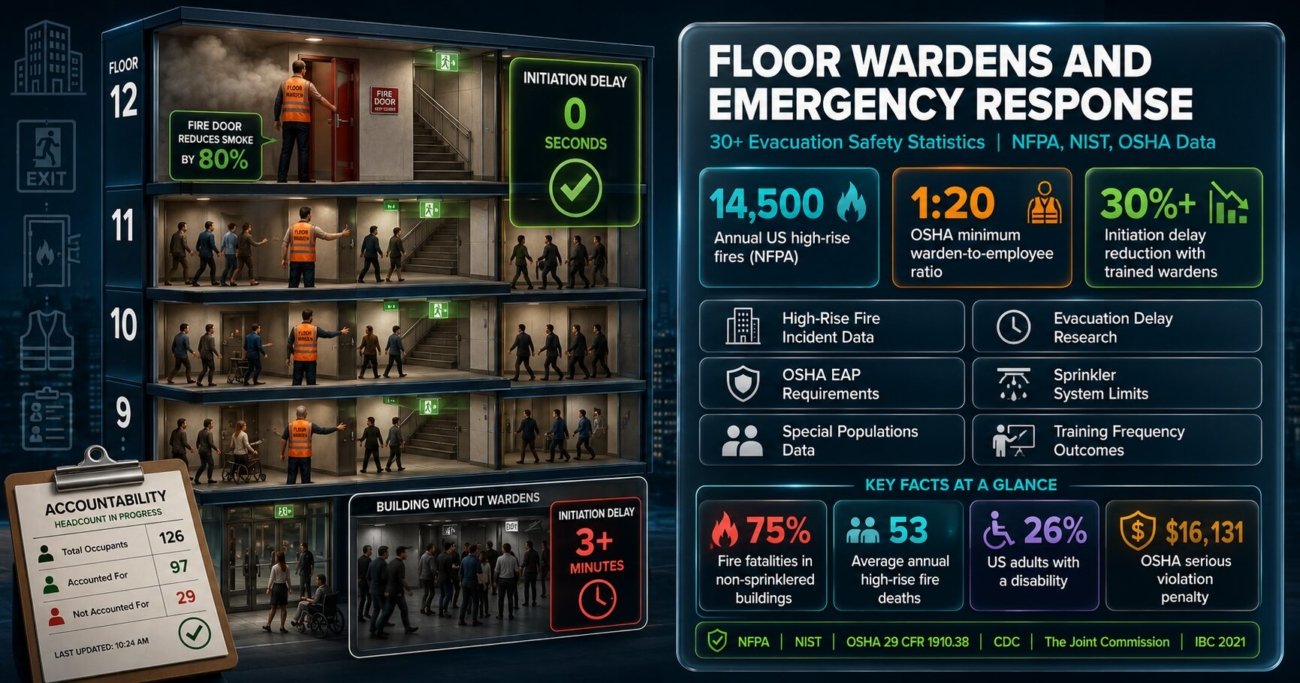
14,500
High-Rise Fires Per Year
Average US high-rise structure fires annually (2009-2013), down from 15,700 as suppression systems improved. Suppression systems do not replace organised evacuation.
NFPA High-Rise Report
1:20
OSHA Warden Ratio
Minimum floor warden to employee ratio per OSHA Emergency Preparedness guidance. Complex layouts, shift operations, and mobility-impaired occupants require a higher ratio.
OSHA eTool
30%+
Delay Reduction
Initiation delay reduction achieved with trained wardens and regular drills, per NIST evacuation research. Initiation delay is the single variable most strongly linked to casualty outcomes.
NIST WTC Report
Key Statistics: Where Evacuation Programmes Fail
53
Average annual deaths from high-rise structure fires (2005-2009). Smoke inhalation, not flame contact, is the primary cause.
NFPA High-Rise Report
75%
Of fire fatalities occur in buildings without functioning sprinkler systems. Warden programmes remain essential even in sprinklered buildings.
NFPA, 2023
26%
Of US adults have some type of disability. In a multi-story workplace, a significant share of occupants may need assistance or additional time to evacuate via stairs.
CDC Disability Data
High-Rise Fire Incidents: Scale and Trend Data
High-rise and multi-story buildings present evacuation challenges that flat-floor workplaces do not: vertical travel distances, stairwell congestion, smoke migration between floors, and occupants who require mobility assistance. NFPA data shows US fire departments respond to over 14,000 high-rise structure fires annually, resulting in dozens of deaths and hundreds of injuries each year. NIST analysis of major evacuation events consistently identifies the same primary driver of casualties: initiation delay, the time between an alarm and when occupants actually begin to move.
US High-Rise Structure Fires: Annual Averages
Incidents (2005-2009)
15,700/yr
Incidents (2009-2013)
14,500/yr
Annual deaths (average)
53
Source: NFPA High-Rise Building Fires Report
Apartment buildings account for the majority of high-rise fire incidents, followed by offices and hotels. The reduction from 15,700 to 14,500 annual incidents between the two periods reflects the impact of improved suppression systems, but suppression systems do not replace the need for organised evacuation when suppression fails or when pre-ignition smoke conditions affect multiple floors simultaneously.
Evacuation Delay: The Primary Driver of Casualties
NIST research on major building evacuations identifies initiation delay as the variable most strongly associated with casualty outcomes. Floor wardens exist specifically to eliminate this delay. NIST’s investigation of the WTC evacuation found that initiation delay and stairwell flow rate were the two primary determinants of total evacuation time. Buildings where occupants began moving immediately upon alarm evacuated faster than those where occupants waited to confirm the alarm was real.
Initiation Delay: The Variable Wardens Control
NIST research shows trained wardens with regular drills reduce initiation delay by 30% or more. A warden on each floor provides the human authority signal that converts alarm ambiguity into immediate action. No automated system replaces this.
NIST WTC NCSTAR 1-7
Alarm Fatigue Compounds the Problem
Occupants in buildings with frequent false alarms take significantly longer to begin evacuating than those in buildings with a strong history of responsive, real alarms. Warden credibility built through consistent drill participation directly counteracts alarm fatigue.
NIST NCSTAR 1-7
OSHA Requirements: What the Law Mandates for Warden Programmes
OSHA Requirement
Regulation
Specific Standard
Written Emergency Action Plan
29 CFR 1910.38
Required for all employers with 10+ employees. Must include evacuation procedures and employee alarm systems.
Floor Warden Designation
OSHA eTool
Minimum 1 warden per 20 employees. Ratio increases for complex layouts or shifts with fewer employees present.
Employee Training
29 CFR 1910.38(e)
Training required when the EAP is developed, when employees are assigned to new duties under the plan, and when the plan changes.
Accountability Procedure
29 CFR 1910.38(c)(5)
Must include a headcount or roll-call system to account for all employees at assembly points after evacuation.
The 1:20 ratio is a minimum guidance figure, not a regulatory maximum. OSHA guidance specifies that the ratio should increase for buildings with complex layouts, shift operations where fewer employees are present, or floors with a significant number of mobility-impaired occupants. In practice, 1:15 or better is the standard adopted by organisations that have conducted post-drill gap analyses.
Sprinkler Systems: What the Data Shows About Their Limits
Where Sprinklers Succeed
NFPA data shows sprinkler systems control or extinguish fires in 96% of cases where they operate successfully. The operative condition is “successfully”, proper maintenance and a fire that originates in a sprinklered area are both required.
NFPA Sprinkler Data, 2023
Where Sprinklers Do Not Protect
Electrical rooms, stairwells, and storage areas may not be sprinklered. Pre-ignition smoke from smouldering fires is not addressed by sprinklers. And 75% of fire fatalities occur in buildings without functioning systems at all, underlining why warden programmes are essential regardless of suppression infrastructure.
NFPA, 2023
Emergency Types and Warden Response Protocols
Fire and Smoke
Guide to safe stairwells, close fire doors, keep stairwell lines moving, monitor for smoke infiltration. Closed fire doors reduce corridor smoke concentrations by up to 80%, directly improving visibility and air quality for evacuating occupants. Wardens who actively close doors on their floor contribute materially to tenable conditions in the egress path.
NFPA Research Foundation
Shelter in Place
For hazmat releases or severe weather events requiring shelter in place, wardens direct occupants to interior rooms, away from windows, and communicate holding instructions until the all-clear. The accountability role is unchanged: wardens must confirm all occupants on their floor have received and understood the shelter instruction.
Active Threat (Run-Hide-Fight)
The DHS and FEMA Run-Hide-Fight protocol requires floor-level decision-making about which action applies to specific room configurations. Wardens who have pre-identified lockable rooms and alternate exits reduce decision time under stress. This is the area where warden programmes most often lack specific protocol training.
DHS/FEMA Active Threat Guidance
Accountability and Headcount: What Effective Programmes Track
OSHA’s EAP requirement under 29 CFR 1910.38(c)(5) includes a procedure to account for all employees after evacuation. Without a warden conducting the count, many organisations have no mechanism to identify missing individuals in real time. First responders at a building evacuation need to know how many people are unaccounted for and on which floors before committing search and rescue resources. A warden accountability report delivered at the command post is operationally critical, not procedurally optional.
Training Frequency vs Evacuation Performance
Annual drill + warden training
Best outcomes
Annual drill, no warden training
Moderate outcomes
Drill without warden coordination
Poor outcomes
No drill programme
Highest casualty risk
NFPA 101 (Life Safety Code) recommends annual drills for high-rise office buildings, with quarterly drills for healthcare occupancies. Source: NFPA 101 Section 4.7
Special Populations: Mobility Assistance and Areas of Rescue
The CDC estimates that approximately 26% of US adults have some type of disability, with mobility limitations the most common functional difficulty. In a typical multi-story workplace, a significant share of occupants may require assistance or additional time to evacuate via stairs. IBC Section 1009 requires Areas of Rescue Assistance in high-rise buildings, positioned in stairwell vestibules with two-way communication to the fire command centre.
Area of Rescue Assistance Assignment
Without a warden programme that assigns specific wardens to escort mobility-impaired occupants to Areas of Rescue Assistance, the IBC requirement functions as infrastructure without a user. The physical space exists; the human process to use it reliably does not.
Personal Emergency Evacuation Plans
Best-practice warden programmes maintain individual Personal Emergency Evacuation Plans (PEEPs) for occupants who cannot use stairs independently. These must be reviewed annually and when the occupant’s floor assignment changes. Wardens are the point of contact for activating the PEEP during an actual evacuation.
Warden turnover is the most common structural failure in floor warden programmes and the hardest to detect before a drill or real event exposes it. An organisation that designates wardens annually at a training session and then does nothing to track departures will find, on the day it matters, that several floors have wardens who changed roles, changed floors, or left the organisation months earlier. The warden list on the wall and the warden list in practice are different documents. Reconciling them is not an annual task. It is a continuous one.
Key Takeaways for Safety Managers
Initiation delay kills, wardens eliminate it
NIST identifies initiation delay as the primary driver of evacuation casualties. A trained warden on every floor provides the human authority signal that converts alarm ambiguity into immediate movement. No automated alarm system replaces the credibility of a known, trained person directing action.
1:20 is a floor, not a target
The OSHA 1:20 ratio is a minimum. Organisations that have conducted post-drill gap analyses consistently find they need 1:15 or better to execute accountability reliably. The ratio should be reassessed whenever floor occupancy, layout, or the proportion of mobility-impaired occupants changes.
Warden turnover is the programme’s silent failure mode
Studies show that warden programmes with annual refresher training and a formal handover procedure for departing wardens maintain higher preparedness than programmes where warden roles are informally transferred. A warden who left the organisation six months ago is still on the chart. That gap does not become visible until a drill or a real event reveals it. Build the succession into the programme, not the incident.
Frequently Asked Questions
Is a floor warden programme legally required under OSHA?
Yes, indirectly. OSHA 29 CFR 1910.38 requires all employers with 10 or more employees to have a written Emergency Action Plan that designates employees to assist in safe and orderly evacuation. The designation of floor wardens is the mechanism through which this obligation is fulfilled. OSHA’s eTool specifies the 1:20 minimum ratio as guidance for implementing the EAP requirement.
How often should floor wardens be trained?
OSHA 29 CFR 1910.38(e) requires training when the EAP is developed, when employees are assigned new duties under the plan, and when the plan changes. NFPA 101 recommends annual drills for high-rise office buildings. Best-practice programmes conduct annual warden training plus a formal refresher after every drill to capture lessons learned and close gaps before the next event.
What does a floor warden actually do during an evacuation?
A floor warden’s primary functions are: initiate movement on their floor immediately upon alarm, confirm all occupants have exited including restrooms and enclosed offices, close fire doors on exit, escort or coordinate assistance for mobility-impaired occupants to Areas of Rescue Assistance, and deliver a headcount report to the building emergency coordinator at the assembly point. The warden is the accountable human link between the alarm and confirmed evacuation of every person on the floor.
What is an Area of Rescue Assistance and who is responsible for it?
An Area of Rescue Assistance (also called Area of Refuge) is a fire-rated space, typically in a stairwell vestibule, where occupants who cannot use stairs wait for assistance from first responders. IBC Section 1009 requires these in high-rise buildings with two-way communication to the fire command centre. Floor wardens are responsible for knowing which occupants on their floor require placement in the Area of Rescue and for ensuring they reach it before the warden evacuates the floor.
How should warden programmes handle occupant turnover?
Every time a warden leaves the floor or the organisation, a successor must be designated and trained before the warden departs. The gap in coverage between the departing warden and the trained successor is the most common structural failure in warden programmes. Maintain a current warden list updated quarterly, with alternate warden designations for every floor so that warden absence does not leave a floor uncovered during a real event.
What is the difference between a floor warden and a building emergency coordinator?
Floor wardens operate at the floor level: their authority and accountability is their assigned floor. The building emergency coordinator (BEC) operates at the building level, receives headcount reports from all floor wardens, liaises with first responders, and manages the overall emergency response. Large buildings may also have a deputy BEC per zone. The roles are complementary and both must be trained and current for the system to function.
What is alarm fatigue and how does it affect evacuation outcomes?
Alarm fatigue is the tendency of occupants to delay or ignore evacuation signals after repeated false alarms. Research shows that occupants in buildings with frequent false alarms take significantly longer to begin evacuating than those in buildings with a strong history of real, correctly managed alarms. Floor wardens directly counteract alarm fatigue: when a known, credible person is physically present telling occupants to move, hesitation drops regardless of alarm history.
Sources
Government and Regulatory Sources
- OSHA 29 CFR 1910.38: Emergency Action Plans: warden designation requirements, training triggers, and accountability procedures.
- OSHA eTool: Emergency Preparedness and Response: 1:20 warden ratio guidance and programme implementation standards.
- NIST WTC Investigation Report (NCSTAR 1-7): initiation delay and stairwell flow rate as primary determinants of evacuation time.
- CDC Disability Data: 26% of US adults have some type of disability; mobility limitations are the most common functional difficulty.
Research and Industry Sources
- NFPA High-Rise Building Fires Report: annual incident rates, death averages, and suppression system effectiveness data.
- NFPA 101: Life Safety Code: drill frequency recommendations for high-rise and healthcare occupancies.
- DHS/FEMA: Active Shooter and Active Threat Guidance: Run-Hide-Fight protocol and building-level emergency response framework.
Related VelSafe Articles
Insights
When a Contractor Is Hurt on Your Site, Are You Responsible?
OSHA multi-employer liability, four employer roles, and what host employers owe contractors during emergency events on their sites.
Law
Job Hazard Analysis: Legal Requirements and OSHA
What OSHA requires for pre-task hazard identification, including how EAP obligations interact with site-specific JHA documentation.
Worker Safety
How Lockout/Tagout Prevents Electrical Injuries at Work
The six-step LOTO procedure and how controlled shutdown of equipment during emergencies intersects with building evacuation sequencing.
BUILDING EMERGENCY RESPONSE
Your Warden Programme Is Only as Strong as Its Last Drill
Find more building safety insights, OSHA compliance resources, and emergency response data at VelSafe.
Explore More Insights