

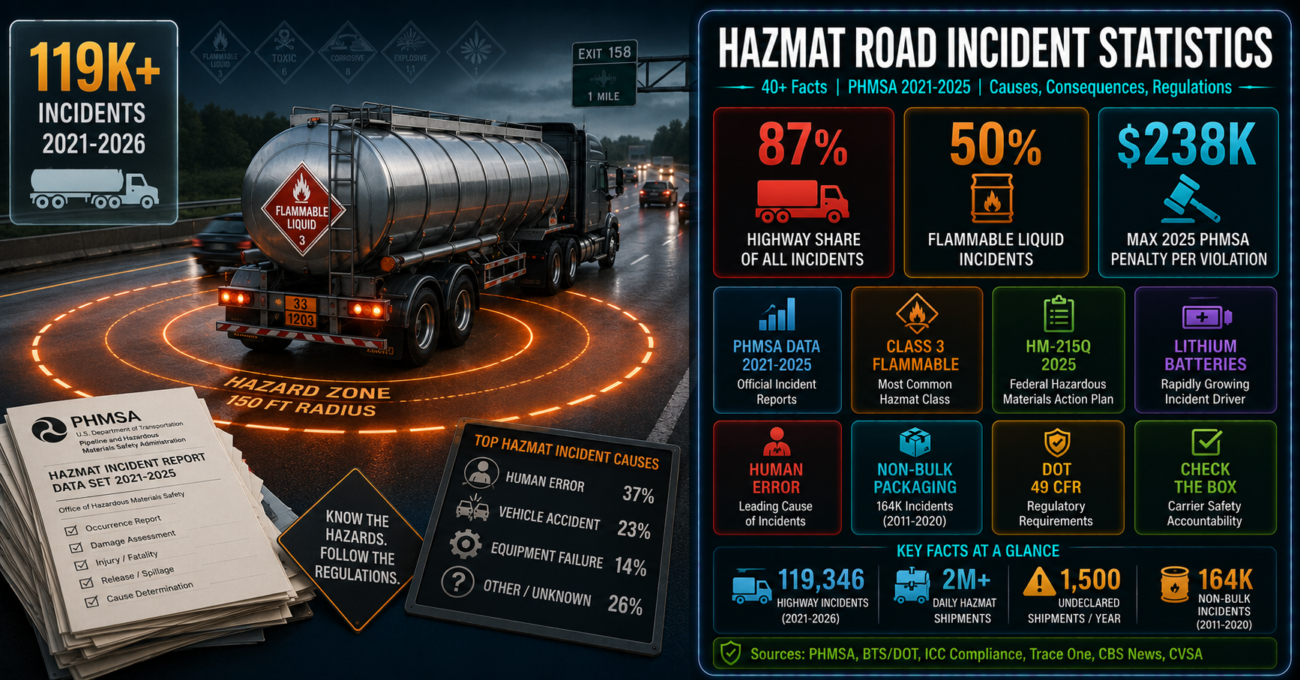
Hazardous materials are everywhere on U.S. roads – in tankers, in freight containers, in packages stacked on flatbeds, and in everyday consumer deliveries that shippers fail to declare. Over 2 million hazmat shipments move through American highways every day. Most arrive safely. But when they do not, the consequences range from minor spills to fires, explosions, environmental contamination, and deaths. The pattern of where these incidents happen and why they happen is well documented by PHMSA – and the numbers tell a consistent story.
Highway transport dominates hazmat incident data by a significant margin, accounting for the vast majority of all reported incidents and damages across every mode of U.S. transportation. Flammable liquids are involved in half of all incidents. Human error drives the majority of causes. And the regulatory environment tightened further in 2025, with PHMSA raising maximum civil penalties and new rules addressing lithium battery transportation risks. Below we have compiled 40+ statistics on U.S. road hazmat incidents from PHMSA, BTS, DOT, and FMCSA sources, updated through 2025.
Editor's Choice: Key U.S. Hazmat Road Incident Statistics
1. Scale of Hazmat Transportation on U.S. Roads
- Between April 2021 and April 2026, highway transport generated 119,346 hazmat incidents – compared to 8,106 by air, 1,684 by rail, and just 37 by water. Highways dominate the incident picture by every measure. (Trace One analysis of DOT data, April 2026)
- Over 2 million hazardous material shipments move through U.S. roads every day, according to former PHMSA deputy associate administrator Bob Richard – making highway exposure orders of magnitude larger than any other mode. (CBS News / PHMSA, 2023)
- Highway incidents represent 87% of all reported hazmat incidents and generate 86% of all reported damages across air, highway, rail, and water transport. (Labelmaster / PHMSA incident data)
- Annual hazmat incidents across all modes climbed from approximately 15,000 per year in 2011 to over 21,000 by 2020 – a 40% increase over the decade, driven primarily by growth in highway freight volume. (ICC Compliance Center analysis of PHMSA data, 2022)
- Truck transportation accounts for over 85% of all reported U.S. road hazmat incidents, reflecting the structural dominance of highway freight in the hazardous materials supply chain. (PHMSA / FMCSA)
2. Most Common Hazardous Materials in U.S. Road Incidents
- Flammable liquids (Hazard Class 3) account for 50% of all highway hazmat incidents and 49% of all related damages – the dominant material category by both frequency and financial impact. (Labelmaster / PHMSA Q1 data)
- The single most commonly spilled hazmat commodity on U.S. roads is paint, followed by fuel oil for home heating – a reminder that many high-frequency hazmat incidents involve everyday commercial products, not exotic industrial chemicals. (CBS News interview with former PHMSA official Bob Richard, 2023)
- Flammable non-toxic gas (Class 2.1) represents only 3% of incidents but 20% of all damages, reflecting that compressed gas releases produce the most costly individual incidents even when relatively rare. (Labelmaster / PHMSA)
- Corrosives and flammable liquids together make up the majority of hazmat transit incidents in the 2021-2026 five-year dataset, concentrated along heavily traveled roadways through densely populated areas. (Trace One analysis of DOT data, 2026)
- Lithium batteries are classified as Class 9 dangerous goods under 49 CFR and are increasingly regulated after a pattern of thermal runaway fires during highway transport. PHMSA’s HM-215Q final rule (effective April 10, 2025) updated packaging, labeling, and state-of-charge requirements. (PHMSA / Hazmat University, 2024-2025)
- Over the 2011-2020 decade, 164,789 incidents involved non-bulk packaging compared to 15,743 in bulk – confirming that small-package hazmat shipments generate far more incidents than tanker or bulk transport. (ICC Compliance Center / PHMSA, 2022)
3. Causes of Hazmat Road Incidents: Human Error, Crashes, and Packaging
- Human error is the number one cause of hazmat road incidents, according to PHMSA data analysis – including improperly secured loads, poorly closed container valves, inaccurate labeling, and failure to follow packaging and marking requirements. (CBS News / former PHMSA official Bob Richard, 2023)
- In over 60% of serious hazmat incidents, a vehicle collision was the triggering event – meaning that general highway safety (following distance, speed, driver distraction) directly determines hazmat incident probability. (PHMSA incident analysis)
- Approximately 1,500 transportation incidents occur annually when hazardous materials are shipped undeclared – packages that were not properly identified or declared by the shipper, creating unknown risks for carriers and emergency responders. (PHMSA Check the Box campaign, Q1 2024)
- Packaging failures are the second most preventable cause category – improper packaging, damaged containers, or containers inadequate for road vibration and impact result in material release before the vehicle is even involved in a crash. (PHMSA incident data)
- Equipment failure including brake failure, leaking hoses, and faulty tank seals causes a significant share of incidents – a risk that increases with the age of the vehicle fleet and the intensity of long-haul trucking cycles. (PHMSA/FMCSA)
- Many hazmat transit incidents stem from preventable paperwork and documentation failures – incomplete shipping papers, outdated classifications, or missing safety data sheets – that leave emergency responders without critical information during an incident. (Trace One, 2026)
4. Fatalities, Injuries, and Financial Consequences of Hazmat Road Incidents
- From 2011-2015, hazmat transportation incidents caused 60 fatalities; this declined to 34 fatalities from 2016-2020. Nearly all hazmat fatalities over the entire decade occurred on highways. (ICC Compliance Center / PHMSA portal data, 2022)
- Approximately 5% of all reported hazmat incidents involve significant damage, injury, or death – meaning the vast majority are minor spills or packaging failures. But within that 5%, the consequences can be catastrophic. (PHMSA / FMCSA)
- In-transit highway hazmat accidents generated over $41 million in damages in 2013 alone, far exceeding the $4 million in damages from the unloading phase and $2.5 million from loading. The transit phase is where exposure and financial risk concentrate. (PHMSA via Jason R. Schultz P.C.)
- Fires and explosions occur in less than 2% of hazmat road incidents, but they represent the most severe outcome category – producing the highest fatality, injury, and property damage figures. (PHMSA incident data)
- Human health consequences include burns, respiratory damage from inhalation, chemical poisoning, and death. First responders arriving at hazmat scenes without accurate material information face compounded risk, which is why undeclared shipments are treated as a serious enforcement priority by PHMSA. (PHMSA safety programs)
- Environmental consequences from hazmat spills include soil contamination, waterway pollution, and air quality impacts that can persist for years after the incident and trigger Superfund-level cleanup obligations. (EPA / PHMSA)
5. Geographic Distribution: States and Corridors With Highest Hazmat Exposure
- Hazmat incident risk is concentrated along heavily traveled roadways through densely populated areas – the same corridors that carry the highest freight volumes also carry the highest exposure for communities along the route. (Trace One, 2026)
- The expanding U.S. logistics landscape – driven by industrial output growth and increased freight movement – means more hazardous materials are moving through more communities than at any prior point, raising the public impact potential of each incident. (Trace One, April 2026)
- Spills, fires, and exposure events commonly produce road closures, evacuations, environmental contamination, and disruptions to local economies – consequences that extend well beyond the immediate incident site. (Trace One / DOT, 2026)
- In Georgia alone, there were 553 hazmat incidents involving highway transportation in 2013 (one state in one year), illustrating the scale of the exposure at the state level even in years with no major catastrophic events. (PHMSA state data via Jason R. Schultz P.C.)
6. 2025 Regulatory Updates: PHMSA Penalties, HM-215Q, and Lithium Battery Rules
- PHMSA raised maximum civil penalties effective in 2025 to fines ranging from $617 to over $238,000 per violation, with substantially higher penalties where injury or significant damage occurred – a significant escalation from prior penalty structures. (ICC Compliance Center Q1 2025; Trace One, 2026)
- PHMSA Final Rule HM-215Q became fully enforceable on April 10, 2025, harmonizing U.S. hazmat regulations with international standards including the 2025-26 ICAO Technical Instructions, the 2024 IMDG Code, and the 23rd revised UN Model Regulations. (PHMSA; Hazmat University, 2024)
- HM-215Q introduced updated lithium battery transport requirements including new state-of-charge provisions, revised emergency response information requirements for UN 3536 shipments, and new sodium-ion battery classifications. (PHMSA / Lion Technology, February 2026)
- The Commercial Vehicle Safety Alliance (CVSA) recommended in April 2025 that PHMSA require CDL hazmat endorsements for drivers transporting lithium batteries at placarding thresholds – a proposal reflecting growing concern over thermal runaway fires during highway transport. (CVSA letter to PHMSA Acting Administrator, April 2025)
- The U.S. is currently the only country that does not require Class 9 materials to be placarded, and CVSA has specifically recommended amending this exception to exclude lithium battery shipments – a regulatory gap with direct highway safety implications. (CVSA, April 2025)
- PHMSA’s 2025 proposed rule (comment period ending April 13, 2026) would further align U.S. hazmat regulations with international standards by expanding state-of-charge restrictions for lithium and sodium-ion batteries transported by air and adding new Hazardous Materials Table entries. (PHMSA / Lion Technology, 2026)
7. Hazmat Road Incident Prevention: What the Data Supports
- Hazmat shipper training is required by law under 49 CFR Part 172 Subpart H for any employee who directly affects hazmat transportation safety. This includes drivers, loaders, handlers, and documentation staff – not only the driver of the vehicle. (PHMSA; Lion Technology)
- Industry stakeholders increasingly point to SDS management software and digital compliance tools as effective ways to reduce documentation errors, standardize hazard communication, and lower the likelihood of violations during transit. (Trace One, April 2026)
- Because over 60% of serious incidents are triggered by vehicle collisions, general safe driving practices for hazmat carriers – extended following distances, reduced speeds, route planning to avoid high-risk times and corridors – directly reduce hazmat incident probability. (PHMSA incident analysis)
- The Check the Box campaign has been running since 2019 specifically to address the 1,500 annual undeclared hazmat incidents – targeting shippers who unknowingly or negligently fail to identify hazardous materials before tendering them to carriers. (PHMSA Q1 2024 newsletter)
Key Takeaways for Safety Managers and Hazmat Compliance Professionals
Sources
Government and Regulatory Sources
- PHMSA – Data and Statistics: incident tracking by year, state, type, cause, and result (updated February 2026)
- PHMSA – Hazardous Matters Q1 2024: undeclared shipments, Check the Box campaign, 1,500 annual undeclared incidents
- Bureau of Transportation Statistics – Hazardous Materials Fatalities, Injuries, Accidents, and Property Damage Data 1990-2024
- CVSA – Letter to PHMSA Acting Administrator (April 2025): lithium battery placarding, CDL endorsement recommendations
- PHMSA – Transporting Lithium Batteries: regulatory requirements, UN 3536, state of charge restrictions
Industry and Research Sources
- Trace One (April 2026) – U.S. States Most Exposed by Hazardous Materials Transport Incidents: 119,346 highway incidents 2021-2026
- ICC Compliance Center (2022) – PHMSA Incident Statistics Portal analysis: 15,000 to 21,000 annual incidents, fatality data 2011-2020
- ICC Compliance Center (April 2025) – 2025 HazMat Industry Updates: PHMSA penalties $617 to $238K+, HM-215Q updates
- Labelmaster – PHMSA Q1 Incident Report: 87% of incidents on highways, 50% flammable liquids, 86% of damages
- CBS News (May 2023) – Hazmat road accidents in the U.S.: former PHMSA official on 2M+ daily shipments, human error as primary cause
- Hazmat University (2024) – PHMSA Final Rule HM-215Q: compliance date April 10, 2025; international harmonization provisions
- Lion Technology (February 2026) – US DOT proposed rule: 2025-26 ICAO TI, 2024 IMDG, sodium-ion batteries, state-of-charge rules