
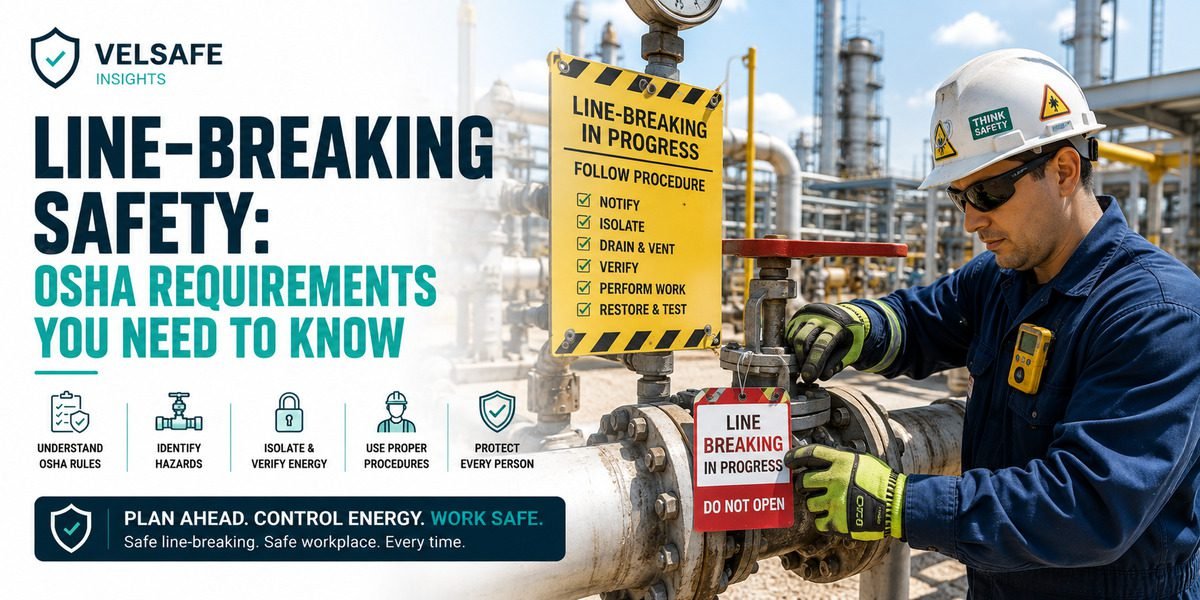
Line breaking, the process of opening a piping system, process vessel, or fluid line while it may still contain pressure, temperature, or hazardous chemical content, is one of the most consistently underestimated high-hazard tasks in general industry. When a permit system exists only on paper, or when workers begin breaking containment before verifying that isolation and depressurisation are complete, the result is predictable: chemical releases, burns, asphyxiation, and serious injury. This article examines the OSHA framework governing line breaking, the failure patterns that repeat across industries, and what safety managers can do to close the gaps.
1. What Line Breaking Actually Involves
The term line breaking refers to any deliberate opening of a closed piping system, process vessel, tubing assembly, or fitting. This includes removing a flange, cracking a union, loosening a compression fitting, or cutting into a line. What makes it high-hazard is not the mechanical act itself, but the condition of the system at the moment of opening. A line that has been properly isolated, depressurised, drained, purged, and verified is rarely the source of a serious incident. The incidents happen when one or more of those steps is assumed complete rather than confirmed.
Line breaking applies across virtually every sector covered by the Chemicals and Hazard Communication standard and the Electrical and LOTO standard. Refineries, chemical plants, food processing facilities, pharmaceutical manufacturers, water treatment operations, and general manufacturing all perform line breaking as a routine maintenance activity. The frequency and familiarity of the task is itself a risk factor: workers and supervisors who have broken the same line dozens of times begin to treat verification as a formality rather than a genuine control.
Hazard Categories in Line Breaking Incidents
2. The OSHA Framework Governing Line Breaking Safety
There is no single OSHA standard titled Line Breaking Requirements. Instead, the obligation to control this hazard is distributed across several standards that converge on any task involving the opening of a pressurised or chemically charged system. Understanding which standards apply, and where they overlap, is the starting point for an effective programme.
The most specific requirement comes from the Process Safety Management standard. Under 29 CFR 1910.119(f)(4), covered facilities must develop and implement safe work practices to provide for the control of hazards during operations such as lockout/tagout, confined space entry, opening process equipment or piping, and control over entrance into a facility by contractors. That phrase, opening process equipment or piping, is the direct regulatory hook for line breaking at PSM-covered sites. However, PSM only applies where processes involve threshold quantities of listed highly hazardous chemicals. Facilities outside that scope fall under the General Duty Clause and sector-specific standards.
| OSHA Standard | What It Covers | Key Line Breaking Obligation |
|---|---|---|
| 29 CFR 1910.119 | Process Safety Management (PSM) | Written safe work practices for opening process equipment and piping; permit system required |
| 29 CFR 1910.147 | Control of Hazardous Energy (LOTO) | Energy isolation, lockout/tagout procedures before breaking any line connected to powered equipment |
| 29 CFR 1910.132 | Personal Protective Equipment | Hazard assessment before task; PPE selected based on actual worst-case content, not assumed content |
| 29 CFR 1910.1200 | Hazard Communication (HazCom) | SDS access required before breaking into any line carrying a hazardous chemical; workers must be trained on potential exposures |
| OSH Act Sec. 5(a)(1) | General Duty Clause | Applies where no specific standard covers the exact scenario; OSHA cites under this provision when a recognised hazard exists without adequate controls |
The intersection of LOTO and line breaking is frequently misunderstood. 29 CFR 1910.147 explicitly covers the control of hazardous energy, and energy in this context includes not only electrical energy but stored hydraulic pressure, pneumatic pressure, spring tension, gravity, thermal energy, and chemical energy. Any line connected to a pump, compressor, or pressurised vessel involves multiple forms of stored energy that must be isolated and verified before the break. An employer who locks out the motor on a pump but fails to isolate and bleed residual line pressure has satisfied the electrical requirement while leaving the chemical and pressure hazard unaddressed.
3. Where Line Breaking Permit Systems Fail
Most facilities operating in regulated industries have a line breaking permit system on paper. Audits and incident investigations consistently reveal that the system exists but the controls it is supposed to guarantee do not. The gap between the permit and actual worker protection is where injuries occur.
Failure 1: Permit Issued Remotely, Not Verified at the Break Point
The permit is written by a supervisor or control room operator who cannot see the actual line. Workers receive the permit, walk to the work location, and begin without independently confirming the stated conditions. Pressure gauges are not checked. Drain valves are not tested. The permit becomes a communication document rather than a verification record.
Failure 2: Isolation Listed but Not Physically Confirmed
The permit states that valves A, B, and C are closed. A worker records this based on a control room display or the memory of the last person who operated the system. No one physically touches the valve handles to confirm position, and no one checks the indicator gauge downstream of the isolation point before the break begins.
Failure 3: PPE Selected for the Assumed Content, Not the Actual Content
The permit states the line carries cooling water. The worker wears safety glasses and nitrile gloves. The line was used for a chemical transfer three days prior and was not fully flushed. The break releases a concentration of chemical that the selected PPE does not protect against. This failure pattern appears in dozens of CSB incident summaries for chemical release events.
Failure 4: Pressure Not Verified Before Breaking
Residual pressure in a depressurised line is not always visible on a remote gauge. Small-bore lines, deadleg sections, and lines with check valves can retain pressure even after the main drain procedure is complete. The verification step must include a physical test at the break point, not only a reading from a control panel gauge located at a distance from the opening.
Failure 5: No Person-in-Charge at the Break Point
The permit names a responsible person, but that individual is in the control room or performing another task when the break begins. No one with authority to stop the work is physically present at the opening. When unexpected conditions appear, the workers at the break point have no clear escalation path and may continue rather than halt the job.
Failure 6: Production Pressure Shortens the Verification Sequence
Maintenance windows are short. Supervisors face pressure to return equipment to service. Steps that add time to the permit process, such as extended soak-and-test periods after draining, or independent verification by a second qualified worker, are shortened or skipped. The CSB has found production scheduling pressure in the causal chain of multiple chemical release incidents.
4. Hazard Verification Before the Break
Verification is the step that distinguishes a functional permit system from a paper exercise. It requires physical confirmation, at the break point, that each stated isolation is effective and each stated condition is actual. This is distinct from documentation, which records what was done, and distinct from assumption, which relies on the last known state of the system.
The verification sequence for a line break should follow a fixed order. Skipping or reordering steps removes the protection the sequence is designed to provide. The sequence must be in writing, trained to everyone who may be involved in a break, and witnessed where required by the permit.
Verification Sequence for Line Breaking
The blinding question is worth addressing specifically. A valve provides mechanical isolation, but valves fail. They leak past seats, they are inadvertently operated by other personnel, and their position is not always visible from the break location. For high-hazard lines, including those carrying toxic chemicals, flammable gases, or steam above atmospheric pressure, a blind flange or spade installed at the break point provides positive isolation that a closed valve cannot guarantee. OSHA’s PSM programme expects employers to specify which lines require blinding rather than valve isolation, and this decision should be documented in the written procedure, not left to individual judgement at the time of the break.
5. What Effective Line Breaking Programmes Look Like
The difference between a compliant line breaking programme and an effective one is the degree to which the controls actually function when a supervisor is not watching and when the schedule is tight. Effective programmes have four characteristics that paper-only programmes lack: specificity in the procedure, independence in the verification, authority in the field, and consistency under pressure.
Written Procedures That Cover Actual Scenarios
Generic line breaking permits that ask workers to fill in blanks are less reliable than procedures written for specific line types, content categories, and break configurations. An effective programme identifies the lines most frequently broken, categorises them by hazard level, and provides a matching procedure for each category. Workers who perform the task know before they arrive at the permit station which procedure applies to their job.
Physical Verification Witnessed by a Second Competent Person
The person who performs the isolation should not be the only person who verifies it. An independent confirmation, whether by a designated lead worker, a safety professional, or a second qualified tradesperson, catches the errors that single-point verification misses. For high-hazard lines, PSM programmes routinely require a two-person verification sign-off before the permit is issued.
Field-Level Authority to Stop Work
Workers and field supervisors must have the explicit, established authority to stop a line break when conditions at the work site do not match what the permit describes. This authority must be exercised without fear of reprisal and without requiring approval from a higher level before the job is halted. Programmes that lack this create a predictable incentive to continue despite warning signs.
Post-Break Verification and Restoration
The permit should not close when the break is complete. Effective programmes require a restoration check: confirming that all blinds are removed, all LOTO devices are lifted, all drain and vent valves are closed, and all fasteners are torqued to specification before the line is returned to service. A line returned to service without this check is a second opportunity for injury.
Training is not a programme element that can be separated from the permit system. Workers who have memorised the verification sequence, who can read a P&ID, and who know what residual pressure feels like when they crack the first fastener are fundamentally safer than workers who have received classroom instruction but have never physically performed a controlled practice break. Competence in line breaking is developed through supervised field experience, not through passing a test.
Permits Without Physical Verification Are Not Controls
A line breaking permit that is written remotely and not confirmed at the work site provides no actual protection against residual pressure, chemical content, or energy release. The verification sequence must happen at the break point, with gauges and physical tests, not based on panel readings or assumptions about the last known system state.
Three OSHA Standards Apply Simultaneously on One Task
A line break in a process area triggers PSM written procedure requirements, LOTO energy isolation obligations, PPE hazard assessment requirements, and HazCom SDS access. A programme that addresses only one of these standards is incomplete. OSHA citations from a single line breaking incident frequently span multiple standards, each with its own penalty calculation.
PPE Must Reflect the Worst-Case Content, Not the Assumed Content
Line histories change. A line that carried treated water last week may carry a chemical solution today. PPE selected based on the label on a P&ID rather than the SDS for every substance that has passed through the line in recent service puts workers at risk from exposures the selected PPE is not rated to handle. The hazard assessment requirement under 29 CFR 1910.132 applies every time the task is performed, not only the first time a procedure is written.
Frequently Asked Questions
Is there a specific OSHA standard that requires line breaking procedures?
No single standard is titled Line Breaking Requirements. The obligation comes from 29 CFR 1910.119(f)(4) for PSM-covered facilities, which requires written safe work practices for opening process equipment and piping. Outside PSM coverage, the General Duty Clause and 29 CFR 1910.147 (LOTO) create the combined obligation to control energy and pressure hazards before breaking containment.
Does LOTO apply to line breaking if the line is not electrically connected?
Yes. 29 CFR 1910.147 covers all forms of hazardous energy, not only electrical. Stored pneumatic pressure, hydraulic pressure, chemical potential energy, and thermal energy are all within scope. If a line is connected to any system that stores or generates hazardous energy, LOTO procedures apply regardless of whether an electrical component is directly involved.
What is the difference between valve isolation and positive isolation in line breaking?
Valve isolation closes a valve to stop flow. Positive isolation, typically achieved with a blind flange, spade, or spectacle blind, physically blocks the flow path in a way that cannot be reversed by an inadvertent valve operation. OSHA’s PSM programme expects employers to specify which lines require positive isolation based on the severity of the consequence if the isolation fails. For toxic or highly flammable lines, valve isolation alone is generally not considered adequate.
What PPE is required for line breaking?
The PPE requirement is determined by a hazard assessment performed under 29 CFR 1910.132 before the task begins. There is no fixed PPE specification for line breaking as a category. The assessment must consider the actual content of the line, including residuals from prior service, the pressure and temperature at the moment of opening, and the potential for splash, vapour release, or thermal exposure. PPE is selected for the worst-case condition, not the typical condition.
How does HazCom (29 CFR 1910.1200) apply to line breaking?
Before any line carrying a hazardous chemical is opened, workers must have access to the Safety Data Sheet for that chemical. The SDS provides the exposure limits, health effects, PPE requirements, and emergency response information needed to perform the task safely. Workers must be trained on the hazards of the specific chemicals in the lines they may be required to open, not only on hazard communication as a general concept.
What should a line breaking permit include at minimum?
An effective line breaking permit should document: the specific line identification, all known contents and residual materials, all energy sources and their isolation method, a confirmation that each isolation has been physically verified, the PPE required based on a completed hazard assessment, the name of the person-in-charge who is physically present, the time and duration of the permit, and a post-break restoration checklist. Permits that omit any of these elements leave gaps that are predictably exploited under time pressure.
Can OSHA cite an employer for a line breaking injury even without a specific standard violation?
Yes. The General Duty Clause (Section 5(a)(1) of the OSH Act) requires employers to provide a workplace free from recognised hazards likely to cause death or serious physical harm. If a line breaking incident results from a known hazard that the employer failed to address with an adequate written programme, OSHA can cite under this provision regardless of whether a specific standard was violated. General Duty citations can carry the same penalty classification as standard-specific citations.
How often should line breaking procedures be reviewed?
PSM requires that operating procedures be reviewed as often as necessary to assure that they reflect current operating practice. In practice, this means procedures should be reviewed when the process changes, when an incident or near-miss occurs, when equipment modifications affect the lines included in the procedure, and on a regular interval that the facility defines in its PSM programme. A procedure that has not been reviewed since the initial PSM implementation is a flag for both internal audits and OSHA inspectors.
Sources
Government and Regulatory Sources
- OSHA 29 CFR 1910.119: Process Safety Management of Highly Hazardous Chemicals: requires written safe work practices including a line break permit system for PSM-covered facilities under section (f)(4).
- OSHA 29 CFR 1910.147: Control of Hazardous Energy (LOTO): energy isolation requirements that apply as a prerequisite to line breaking on equipment where stored energy presents a hazard.
- OSHA 29 CFR 1910.134: Respiratory Protection: respiratory programme and equipment requirements for line breaking tasks where atmospheric hazards are anticipated.
- OSHA 29 CFR 1910.146: Permit-Required Confined Spaces: applies where line breaking access requires entry into a permit space or where the line breaking task creates a confined space hazard.
- OSH Act Section 5(a)(1): General Duty Clause: basis for citations at non-PSM facilities where line breaking hazards are recognised and uncontrolled.
Research and Industry Sources
- Center for Chemical Process Safety (CCPS): Process Safety Resources: industry guidance on line breaking programme design, permit system elements, and competent person qualifications.
- Energy Institute: Process Safety and Risk Management: loss prevention guidance covering line breaking permit systems and hazard verification procedures for the energy and chemical sectors.