
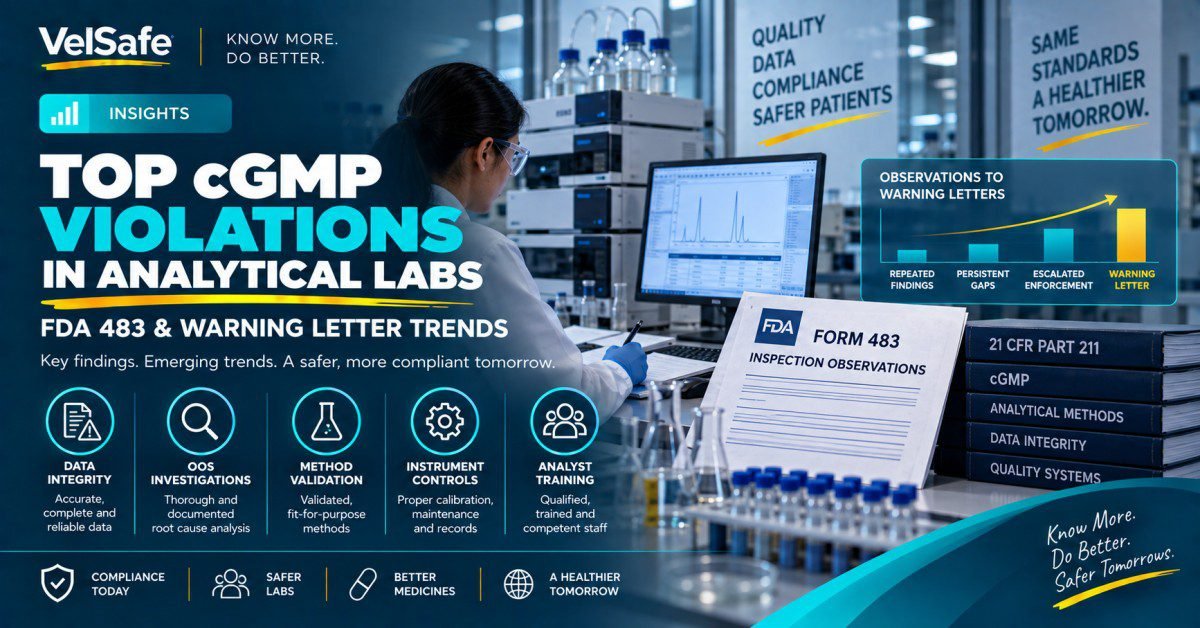
cGMP violations in analytical labs featured image showing a female pharmaceutical quality analyst reviewing a chromatogram with an OOS flag on screen at an HPLC workstation, with a horizontal bar chart of top FDA 483 findings including data integrity and OOS investigation gaps in the left panel.

Top cGMP Violations in Analytical Labs: FDA 483 and Warning Letter Trends

INSIGHTS: cGMP Compliance Trends
Top cGMP Violations in Analytical Labs: FDA 483 and Warning Letter Trends
Analytical laboratory deficiencies have been a consistent source of FDA 483 observations and Warning Letters for more than a decade. Data integrity failures, inadequate OOS investigation procedures, incomplete method validation, and laboratory control weaknesses appear across inspection cycles regardless of facility size or company type. This analysis examines the patterns in FDA enforcement data, explains why these specific areas generate repeated citations, and identifies what labs that avoid repeat findings do differently.
Executive Summary
Laboratory controls, data integrity, and OOS investigation procedures have each appeared in FDA’s most-cited 21 CFR Part 211 observations for multiple consecutive years. FDA’s own analysis of inspection data, published through its Form 483 database and annual budget justification reports, consistently identifies these as the highest-frequency finding categories for pharmaceutical manufacturing inspections that include analytical laboratory review. The pattern is not random. It reflects a gap between what cGMP regulations require of analytical laboratory programs and what many facilities actually implement. This article draws on FDA inspection observation data, published Warning Letters, and FDA guidance documents to examine what that gap looks like in practice and where it tends to appear first in an inspection.
#1
Most Cited CFR Section
21 CFR 211.68 (automatic, mechanical, and electronic equipment) and 21 CFR 211.192 (production record review including laboratory records) have consistently ranked among the most cited sections in pharmaceutical manufacturing inspections. Laboratory controls under 21 CFR 211.160-211.194 account for a substantial proportion of drug cGMP observations each year.
Source: FDA | FDA cGMP Resources
DI
Data Integrity: Dominant WL Theme
FDA’s 2018 Data Integrity and Compliance With Drug cGMP guidance acknowledged data integrity as a primary concern emerging from inspections. Warning Letters citing data integrity failures in analytical laboratories have involved falsification of raw data, deletion of failing results, and audit trail manipulation across API, finished drug, and testing laboratory operations.
OOS
Perennial High-Frequency Finding
Inadequate investigation of out-of-specification results has appeared in FDA observations and Warning Letters every year for which inspection data is available. The 2006 FDA OOS guidance provides a detailed investigation framework, and failures to follow it remain one of the most actionable finding categories inspectors look for in analytical lab audits.
Source: FDA | FDA OOS Guidance 2006

Why Analytical Labs Attract Disproportionate FDA Scrutiny

Analytical laboratory data sits at the foundation of every product release, stability programme, and specification decision a pharmaceutical manufacturer makes. When an inspector finds a problem in the lab, it calls into question not just the specific result that was incorrectly generated or documented, but the entire body of data that lab has produced. This is why laboratory deficiencies that might seem procedural or administrative in isolation can trigger the most serious enforcement responses FDA has available, including import alerts, consent decrees, and facility shutdown.

FDA inspectors who conduct pre-approval inspections (PAIs) and surveillance inspections consistently approach the analytical laboratory with a specific set of questions. Are OOS results investigated according to a written procedure? Do the audit trails in the chromatography data system reflect the actual sequence of injections and result processing? Are the test methods in use validated to the parameters specified in the approved filing? Does the laboratory exercise appropriate controls over analyst training, equipment qualification, and reference standard management? Each of these areas has its own regulatory citation pathway, and each appears repeatedly in FDA enforcement data.

Expert Insight: What Inspectors Look for First
FDA inspectors entering an analytical laboratory typically begin with three requests: the laboratory investigation log for the past two years, the audit trail from the chromatography data system for a representative set of recent analyses, and the training records for analysts who ran those analyses. What they find in those three documents determines the direction and depth of the rest of the inspection. A facility with complete, consistent documentation in those three areas is in a substantially different position than one with gaps, corrections, or anomalies. The first 90 minutes of an analytical lab inspection often establish the tone for everything that follows.
Source: FDA | FDA Inspection Guides

The Five Most Cited Violation Categories in Analytical Labs

1
Data Integrity Failures
Highest Severity

Data integrity failures in analytical laboratories encompass a spectrum of conduct, from deliberate falsification and deletion of failing results to inadequate audit trail configuration that prevents the reconstruction of the true sequence of laboratory events. FDA’s 2018 Data Integrity guidance defines ALCOA+ principles: data must be Attributable, Legible, Contemporaneous, Original, Accurate, plus Complete, Consistent, Enduring, and Available. Violations appear when any of these attributes cannot be demonstrated.

Common Finding Patterns
Audit trails disabled or not reviewed as part of the QC process. Shared login credentials for chromatography data systems preventing attribution of specific actions to specific analysts. Raw data files deleted or overwritten outside the audit trail. Paper records with unexplained corrections. Blank-signing of records before analysis is complete.
Regulatory Citation
21 CFR 211.68 (electronic equipment and data); 21 CFR 211.188 (batch production and control records); 21 CFR 211.194 (laboratory records). Warning Letters citing data integrity failures typically reference multiple sections simultaneously and frequently include language about systemic failures suggesting a broader quality culture problem.
2
Inadequate OOS Investigation Procedures
High Frequency

FDA’s 2006 OOS guidance describes a two-phase investigation framework that remains the regulatory standard against which OOS procedures are evaluated. Phase I is the laboratory investigation, examining analyst error, instrument malfunction, and sample preparation issues. Only after Phase I is complete and documented can a Phase II investigation extend to manufacturing causes. Deficiencies arise when facilities invalidate OOS results based on Phase I findings that are not adequately documented, or when the investigation is conducted informally without the written procedure and supervisor oversight the guidance requires.

Where Investigations Break Down
Laboratory investigations closed without identifying a root cause. Assignable cause assigned based on analyst recollection rather than documented evidence. Results invalidated and retested without a written procedure authorising this. Retesting conducted without supervisor approval. Investigation timelines that suggest the conclusion preceded the investigation rather than following from it.
Regulatory Citation
21 CFR 211.192 requires that all drug product production and control records, including laboratory control records, be reviewed and approved by the quality unit. Failure to investigate, document, or properly resolve OOS results is cited under this section and frequently under 21 CFR 211.22 (responsibilities of quality unit).
3
Incomplete or Missing Method Validation
Consistently Cited

Test method validation deficiencies fall into two distinct patterns. The first involves methods that were never adequately validated: specificity, linearity, accuracy, precision, detection limit, quantitation limit, and robustness not demonstrated. The second involves methods that were validated but subsequently changed without revalidation. The latter is particularly common in facilities where column lots are substituted, instrumentation is upgraded, or sample preparation procedures are modified without recognising that these changes constitute method modifications requiring revalidation assessment.

Specificity
Most commonly missing or inadequate. Failure to demonstrate that the method measures the analyte in the presence of related impurities, degradation products, and matrix components is a frequent finding, particularly for stability-indicating methods.
Transfer Validation
Methods transferred from development to QC laboratories or between sites without a formal transfer validation study that includes head-to-head comparative testing are a recurring inspection finding. Transfer qualification reports that conclude equivalence without statistical evaluation are frequently cited.
Change Control Gaps
Method changes implemented without going through formal change control and without revalidation assessment. Inspectors typically identify this by comparing the method currently in use with the validated method on file and finding undocumented differences in procedure, equipment, or materials.
4
Laboratory Controls: Instrument Qualification and Reference Standards

21 CFR 211.160 through 211.194 establishes the laboratory controls framework. Within this framework, two areas generate a disproportionate share of inspection citations: instrument qualification and reference standard management. Both represent areas where the regulatory requirement is specific and the documentary expectations are well-defined, making gaps relatively straightforward for inspectors to identify.

Instrument Qualification Gaps
Instruments used for testing without documented installation qualification (IQ), operational qualification (OQ), or performance qualification (PQ). HPLCs, UV-Vis spectrophotometers, dissolution apparatus, and balance systems are the most frequently cited categories. IQ/OQ/PQ protocols that exist but were never executed, or were executed on instruments that have since been modified without requalification, generate the same citation as instruments with no qualification records at all.
Calibration and Maintenance
Calibration records out of date or missing. Instruments used beyond calibration intervals without a documented exception. Maintenance logs that do not capture all service events, or that document service but not whether the instrument was requalified following service that could affect performance.
Reference Standard Management
Reference standards used without characterisation or with characterisation that does not meet USP or pharmacopoeial requirements. Working standards prepared from reference standards without a documented qualification procedure. Expiration dates assigned to reference standards without a stability programme to support them. Storage conditions not monitored or not documented.
Regulatory Citation
21 CFR 211.160(b) (laboratory controls shall include the calibration of instruments); 21 CFR 211.194(a) (laboratory records shall include a description of the sample received for testing). Warning Letters have cited reference standard failures as the analytical basis for questioning the validity of all product release testing conducted with uncharacterised or unqualified standards.
5
Analyst Training and Qualification Deficiencies

Analyst training deficiencies typically appear in one of two forms: training records that exist but cannot be connected to the specific methods and procedures an analyst was actually performing, or training programmes that are based on attendance and acknowledgement of SOPs rather than demonstrated competency. FDA’s cGMP framework under 21 CFR 211.68 and 211.160 requires that personnel performing testing have the education, training, and experience to perform their assigned functions. An SOP sign-off sheet demonstrates that the analyst read the procedure; it does not demonstrate that they can perform it correctly.

What Adequate Training Records Include
Specific methods and procedures the analyst is qualified to perform. The basis for qualification: training course completion, supervised practice runs, qualification sample analysis. The date qualification was established. Evidence of periodic requalification or competency assessment. Supervisor sign-off on the qualification determination.
Common Inspection Findings
Analysts performing methods for which their training file shows only SOP acknowledgement, not qualification testing. Training completion dates that post-date the analyses performed. Analysts who transferred from other departments with no documented assessment of relevant prior experience. Lack of any periodic requalification programme for analysts performing critical testing.

Industry Trends: What Has Changed and What Has Not

Several observable shifts have occurred in FDA’s analytical laboratory enforcement posture over the past decade. The most significant is the elevation of data integrity from a procedural concern to a systemic quality culture indicator. Prior to approximately 2013, data integrity findings in analytical labs were typically treated as individual violations tied to specific records. From 2013 onward, FDA’s Warning Letter language changed markedly: data integrity findings increasingly appeared with language indicating that the failures “call into question the reliability of all data generated at the facility,” triggering broader remediation expectations.

The shift toward computerised systems in laboratory data management, driven by FDA’s own push toward 21 CFR Part 11 compliance and electronic records, created a new category of vulnerability. Facilities that implemented chromatography data systems without configuring audit trails correctly, without establishing user access controls, or without procedures for reviewing audit trails as part of the QC release process discovered during inspections that their electronic record systems did not meet Part 11 requirements.

Trend Area
Pre-2015 Pattern
2015-Present Pattern
Data integrity enforcement
Individual record-level citations; primarily paper records
Systemic findings in electronic systems; broader reliability determinations; import alerts and consent decrees
OOS investigation
Focus on procedure existence; whether investigation was done
Focus on investigation quality and independence; whether conclusions are supported; reviewer qualifications
Method validation
ICH Q2 parameters; original validation completeness
Increased focus on lifecycle approach per ICH Q14; method changes and revalidation assessment; transfer validation rigour
Instrument qualification
IQ/OQ/PQ existence and currency
Computerised system validation emphasis; 21 CFR Part 11 audit trail review requirements; vendor qualification

Regulatory Perspective: How FDA Prioritises These Findings

Not all 483 observations carry the same enforcement weight. FDA distinguishes between observations that reflect isolated procedural lapses and those that indicate systemic failures in the quality system. In analytical laboratories, findings that suggest data reliability cannot be assured tend to receive the most serious classification and the fastest enforcement response.

When a 483 Becomes a Warning Letter

FDA issues Warning Letters when an establishment’s response to a 483 is inadequate, when the violations are of a type that could directly affect product safety or efficacy, or when the same observations have been cited in previous inspections without adequate correction. Analytical laboratory findings are particularly likely to escalate to Warning Letters when they involve: data integrity failures that call multiple products’ test results into question, OOS investigations that appear to have been conducted to reach a predetermined conclusion rather than to find the root cause, and repeated findings in the same area that suggest the facility’s corrective actions have not been effective.

Source: FDA | FDA Warning Letters

FDA’s approach to import operations has added a layer of complexity to analytical laboratory compliance for contract testing laboratories and foreign manufacturing sites. Sites that supply data to support US product releases are subject to FDA inspection and the same cGMP standards as domestic facilities. Warning Letters to foreign API and finished drug manufacturers frequently cite the analytical laboratory as the source of the most serious observations, reflecting the fact that inspection coverage of foreign sites has increasingly focused on laboratory data quality since the data integrity enforcement push began in the mid-2010s.

What Facilities That Avoid Repeat Findings Do Differently

Looking across facilities that receive 483 observations in analytical laboratories and then do not receive them in subsequent inspections reveals some patterns in what effective remediation looks like versus what superficial remediation looks like.

They treat the investigation as a learning exercise, not a compliance obligation
Facilities that avoid repeat findings typically conduct root cause analyses that go beyond the specific violation to ask what process or cultural condition allowed the violation to persist undetected. A data integrity finding in one lab section leads them to audit all lab sections, not just correct the specific finding. An OOS procedure gap leads them to review all their investigation procedures, not just rewrite the OOS SOP.
They validate effectiveness before closing CAPAs
The most common reason the same finding appears in consecutive inspections is that the corrective action was implemented but never verified to be working. Facilities that break this pattern establish specific, measurable effectiveness criteria before initiating the CAPA, and verify against those criteria before closing. For data integrity findings, this might mean a period of internal audit trail reviews conducted by the quality unit to confirm the new procedure is being followed consistently.
They invest in independent laboratory audits between inspection cycles
Internal audits conducted by quality personnel who also work in the laboratory they are auditing tend to miss the things FDA inspectors find. Facilities that consistently receive clean laboratory inspections typically supplement internal audits with periodic independent assessments by personnel with no reporting relationship to the laboratory being reviewed. The independence criterion matters as much as the technical competency of the auditor.

Key Takeaways

Data integrity is a system design issue, not just a training issue
Facilities that respond to data integrity findings primarily with retraining without addressing the system design conditions that enabled the failure, such as shared credentials, audit trails not reviewed as part of QC release, or lack of second-person review for critical computations, tend to find the same issues in the next inspection. Data integrity programmes that pass inspections consistently are built on system controls that make violations difficult, not just policies that prohibit them.
The OOS investigation framework in the 2006 guidance is the audit standard
FDA has not updated its OOS guidance since 2006, but it has not needed to. The two-phase investigation framework remains the template against which every analytical lab’s OOS procedure is evaluated during inspection. Facilities whose OOS procedures align with the guidance’s sequence, documentation, and oversight requirements are in a substantially stronger position than those that have developed their own frameworks without reference to it.
Method changes are the most common source of unrecognised validation gaps
Most analytical laboratory method validation gaps that inspectors find are not in the original validation work. They are in the changes made after validation without formal change assessment or revalidation. Column substitutions, instrument platform changes, sample preparation modifications, and software version upgrades are each common sources of undocumented method changes. A process for evaluating whether any change to a validated method requires revalidation assessment is the control that prevents this category of finding.

Frequently Asked Questions

What is the difference between a Form 483 observation and a Warning Letter?
A Form 483 (Inspectional Observations) is issued at the conclusion of an FDA inspection and lists conditions the investigator observed that they believe may violate cGMP or other FDA regulations. It is not a final FDA determination of a violation. The facility has an opportunity to respond with proposed corrective actions. A Warning Letter is a formal regulatory action that FDA issues when it concludes that a company has a significant violation of regulations that FDA administers, typically when a 483 response is inadequate or the violations are serious enough to warrant immediate action. Warning Letters are publicly posted on FDA’s website and require a response within 15 business days.

Can an analytical contract testing laboratory receive a Warning Letter directly?
Yes. Contract testing laboratories that test pharmaceutical products for release, stability, or regulatory submission purposes are subject to FDA cGMP requirements and inspection under 21 CFR Part 211. FDA has issued Warning Letters directly to contract labs citing data integrity failures, OOS investigation inadequacies, and laboratory control deficiencies. These Warning Letters can affect the laboratory’s ability to continue testing for customers whose products are subject to FDA regulation.

How far back do FDA inspectors typically review laboratory data during an inspection?
There is no fixed lookback period written into the inspection framework. FDA investigators typically request data covering the period since the last inspection, which may be two to five years or longer for infrequently inspected facilities. For pre-approval inspections, the review scope is typically defined by the filing being reviewed. For data integrity investigations, inspectors may request records going significantly further back if they identify anomalies that suggest a pattern of conduct rather than isolated incidents.

What should a facility do immediately after receiving a 483 observation related to data integrity?
The priority is stopping the conditions that enabled the failure while the formal CAPA is being developed. This may mean disabling shared accounts, implementing additional reviewer controls, temporarily suspending certain testing pending an audit of potentially affected records, and notifying the quality unit and senior management. The 483 response should describe both immediate containment actions and the longer-term systemic remediation plan, with realistic timelines. Responses that promise extensive remediation within unrealistically short timeframes are less credible to FDA reviewers than responses with conservative timelines and clear interim controls.

Government and Regulatory Sources

Related VelSafe Articles

Building a Laboratory Programme That Holds Up to Inspection

The five violation categories examined in this article are not new. They have appeared in FDA inspection data consistently across inspection cycles, regulatory policy updates, and changes in FDA staffing and priorities. What changes is the enforcement severity and the specific technical context, from paper records to electronic systems, from domestic inspections to foreign site oversight, from isolated findings to systemic determinations. Analytical laboratories that build programmes around the specific requirements in 21 CFR Part 211, FDA’s published guidances, and ICH standards, and that invest in independent assessment of whether those programmes are actually working, are in the strongest position regardless of when an inspection occurs. Find more pharmaceutical quality and compliance resources at velsafe.com.

Add a Comment

Your email address will not be published. Required fields are marked *