

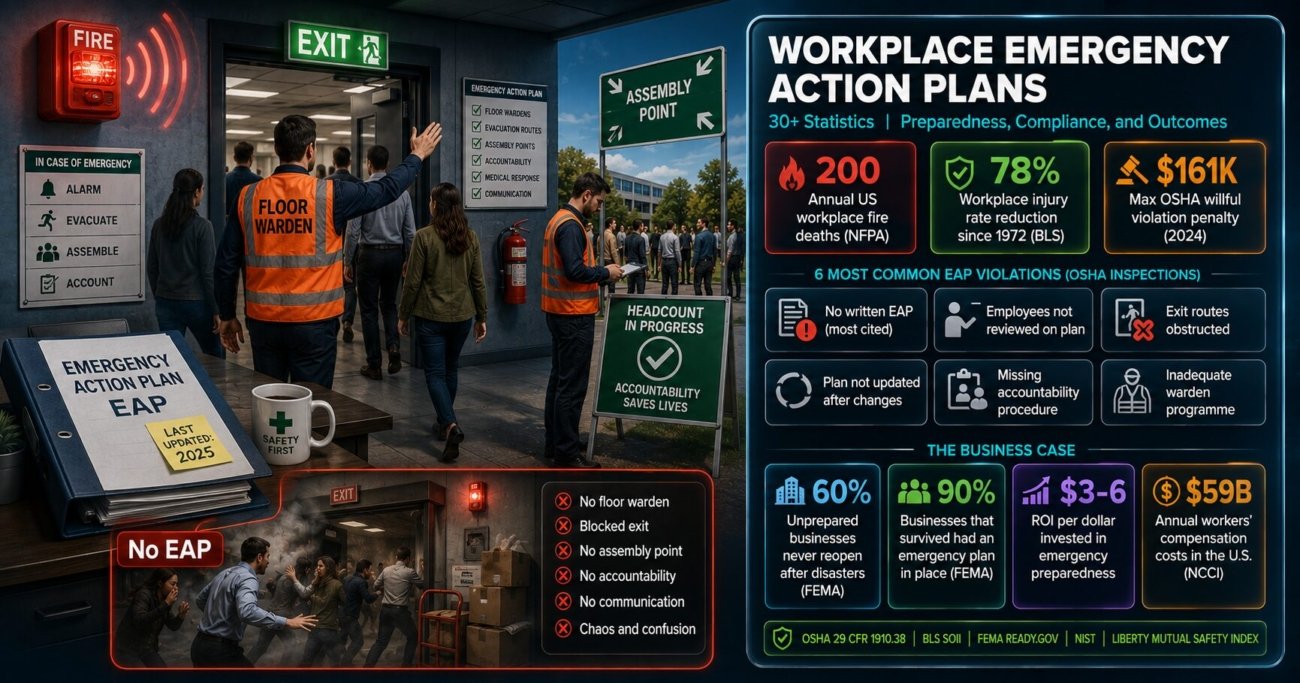
30+ Statistics on Preparedness, Compliance, and Outcomes
Emergencies can occur in any workplace at any time. Fires, chemical releases, severe weather events, and medical emergencies put workers at risk in every industry sector. OSHA estimates workplace fires and explosions cause approximately 200 deaths and 5,000 injuries annually in the United States. The US workplace injury rate has fallen from 10.9 injuries per 100 workers in 1972 to 2.4 in 2023 – a 78 percent reduction that reflects decades of safety regulation including mandatory Emergency Action Plans.
OSHA requires written EAPs under 29 CFR 1910.38 for most employers, with specific provisions for exit routes under 29 CFR 1910.36 and 1910.37. Despite this requirement, EAP non-compliance remains among the most frequently cited OSHA violations in General Industry inspections. The gap between having a plan and having an effective, tested, and current plan is where most enforcement findings originate.
Below we have compiled 30+ statistics and data points on workplace emergency preparedness, covering incident data, OSHA compliance requirements, the business case for EAPs, drill frequency and effectiveness, and the organisational characteristics associated with better emergency outcomes.
1. Workplace Emergency Incident Data: Scale and Trend
- OSHA estimates workplace fires and explosions cause approximately 200 deaths and 5,000 injuries in the United States annually, making fire the second most common cause of workplace fatality after transportation incidents. (OSHA; NFPA)
- The total US workplace fatality rate was 3.7 per 100,000 full-time equivalent workers in 2022, the most recent BLS Census of Fatal Occupational Injuries annual figure. The rate reflects significant improvement from over 18 per 100,000 in the early 1970s. (BLS CFOI 2022)
- Workplace injury and illness rates have declined 78% since 1972, from 10.9 to 2.4 recordable cases per 100 full-time workers. OSHA attributes a significant share of this improvement to safety regulation compliance including EAP and evacuation programme requirements. (BLS SOII; OSHA Historical Data)
- Despite overall improvement, workplace medical emergencies – cardiac arrest, stroke, severe injury – remain a leading cause of on-site death. EAPs that include AED placement, first aid designation, and EMS notification procedures directly address this category. (OSHA; American Heart Association)
- Natural disaster-related workplace evacuations are increasing as climate events intensify. FEMA data shows declared major disasters have increased significantly over the past three decades, expanding the range of emergency scenarios workplaces must plan for beyond fire and chemical release. (FEMA Disaster Declarations Data)
2. OSHA EAP Requirements: What the Law Mandates
- The six required elements of an EAP under 29 CFR 1910.38(c) are: procedures for reporting emergencies, procedures for emergency evacuation including exit route assignments, procedures for employees who remain to operate critical operations before evacuating, procedures for accounting for all employees after evacuation, procedures for rescue and medical duties, and the name or title of every employee who may be contacted for information. (29 CFR 1910.38(c))
- EAP violations are among OSHA’s top-10 most frequently cited standards in General Industry annually. The most common specific violations are failure to review the EAP with each employee, missing contact information, and outdated evacuation route assignments. (OSHA Annual Top 10 Violations)
- OSHA requires the EAP to be reviewed with each employee covered by the plan at hire, when the employee’s responsibilities change, and when the plan itself changes. Annual drill-based review satisfies this requirement if all plan elements are covered. (29 CFR 1910.38(f))
- Construction industry employers are subject to the parallel requirement at 29 CFR 1926.35. Multi-employer construction sites must coordinate evacuation procedures across all contractors present – a requirement frequently cited for deficiency when a general contractor and multiple subcontractors share an exit route. (29 CFR 1926.35)
3. Business Continuity: The Economic Case for Emergency Preparedness
- FEMA data shows that approximately 60% of small businesses do not reopen following a major emergency or disaster, while approximately 90% of businesses that survive such events had a continuity and emergency response plan in place before the event. (FEMA / SBA Ready.gov)
- The Liberty Mutual Workplace Safety Index estimates that serious, non-fatal workplace injuries cost US businesses $59 billion annually in direct workers compensation costs alone – not including indirect costs such as productivity loss, replacement hiring, and reputational damage. (Liberty Mutual Workplace Safety Index 2023)
- OSHA’s business case analysis estimates that proactive safety investments return $3 to $6 per dollar invested through reduced injury costs, lower workers compensation premiums, and avoided productivity losses. EAP implementation is among the lowest-cost, highest-return safety investments available to most employers. (OSHA Business Case for Safety and Health)
- Insurance industry data shows that businesses with documented emergency response plans and regular drills experience lower claims frequency and severity for property damage, business interruption, and workers compensation than those without structured programmes. (Insurance Institute for Business and Home Safety)
- The average cost of a workplace fire that causes business interruption significantly exceeds the direct property damage cost. Business interruption losses – lost revenue, ongoing fixed costs, and customer relationship damage – typically equal two to three times the direct loss. (Zurich Insurance / FM Global Loss Data)
4. Drill Frequency and Training Effectiveness Data
- NIST evacuation research consistently identifies initiation delay as the primary driver of emergency casualties – the time between an alarm and when occupants actually begin to move. Regular drills are the only intervention that reliably reduces initiation delay at the individual level. (NIST NCSTAR 1-7)
- Organisations that conduct unannounced drills reveal substantially longer initiation delays and more procedural gaps than those that conduct only announced drills. Unannounced drills are the only way to measure actual rather than practiced emergency response capability. (NIST; Fire Safety Journal)
- Post-drill debriefs that document specific gaps – blocked exits, wardens who missed sweeps, assembly point crowding – produce measurably faster evacuation times in subsequent drills compared to drills conducted without structured review. (SFPE Handbook)
- Healthcare facilities subject to The Joint Commission standards must conduct two fire drills per shift per year – the most prescriptive drill frequency requirement of any industry sector. This frequency reflects the complexity of healthcare evacuation with non-ambulatory patients. (The Joint Commission EC.02.03.03)
- Employee turnover creates a continuous knowledge gap in EAP familiarity. Organisations with annual turnover above 25% that conduct only annual drills may have a significant share of their workforce that has never participated in a drill for that facility. (OSHA; Industry HR Data)
5. Emergency Types and EAP Response Requirements by Scenario
- Workplace medical emergencies – cardiac arrest, stroke, severe trauma – are among the most time-critical scenarios an EAP must address. The American Heart Association estimates that for every minute of delay in CPR and defibrillation, survival probability decreases by 7-10%. An EAP that includes AED location, trained first responder designation, and an EMS notification procedure directly improves survival probability. (AHA)
- Active shooter incidents have increased in US workplaces over the past decade. DHS data shows workplace locations account for a significant share of active shooter incidents annually, with commercial businesses and educational institutions most frequently affected. The Run-Hide-Fight protocol requires pre-event planning that must be in the EAP. (DHS Active Shooter Preparedness)
- Shelter-in-place decisions for chemical releases require knowing the material, the wind direction, and the building envelope quality. Facilities near chemical plants, rail yards, or highways with HAZMAT traffic should include pre-identified shelter areas with sealing procedures in their EAP rather than relying on real-time improvisation. (OSHA HAZWOPER; EPA RMP)
6. Common EAP Deficiencies Identified in OSHA Inspections
- The single most common EAP deficiency is the complete absence of a written plan at a workplace with more than 10 employees – a violation of 29 CFR 1910.38(b) that is straightforward to cite and carries serious violation penalty exposure. (OSHA Enforcement)
- The second most common deficiency is a written EAP that has not been reviewed with employees. A plan that exists in a binder but has not been communicated to the people it covers does not satisfy the requirement under 29 CFR 1910.38(f). (29 CFR 1910.38(f); OSHA)
- Exit route obstructions are particularly common in warehousing, manufacturing, and retail environments where storage requirements compete with exit corridor clearance. A blocked exit during a real emergency converts a minor compliance deficiency into a potentially lethal condition. (OSHA 29 CFR 1910.37)
- EAPs that are not updated after facility layout changes, new hazard introductions, or personnel changes to warden or coordinator roles are functionally obsolete even if they were compliant at initial creation. OSHA inspectors routinely ask about the date of the last plan update as part of EAP review. (29 CFR 1910.38; OSHA Inspection Protocol)
7. Industry-Specific EAP Requirements Beyond 29 CFR 1910.38
- Healthcare facilities accredited by The Joint Commission must comply with Environment of Care standard EC.02.03.03, requiring a fire response programme with two drills per shift per year and a documented process improvement cycle based on drill performance. (TJC EC.02.03.03)
- HAZWOPER-covered facilities must maintain an Emergency Response Plan under 29 CFR 1910.120(q) that goes beyond the basic EAP to include emergency recognition, notification, evacuation routes specific to chemical release scenarios, decontamination procedures, and personnel accountability. (29 CFR 1910.120(q))
- Process Safety Management-covered facilities (29 CFR 1910.119) must have an Emergency Action Plan that integrates with the PSM programme – including emergency shutdown procedures, release containment, and coordination with local emergency responders through a written community emergency response coordination plan. (29 CFR 1910.119(n))
- Nuclear facilities, aviation operations, and maritime vessels each have sector-specific emergency response requirements from NRC, FAA, and USCG respectively that overlay and exceed the base OSHA EAP requirements. (NRC; FAA; USCG)
- Schools and childcare facilities are subject to state education agency requirements for emergency response planning that typically exceed OSHA minimums, including specific provisions for lockdown, reunification, and communication with parents and law enforcement. (US Department of Education; State Requirements)
8. What Effective EAP Programmes Have in Common
- Organisations with the lowest emergency response times share a common structural feature: designated, trained, and exercised emergency response roles assigned to specific individuals by floor or zone, not pooled to a generic safety team. Named accountability produces faster response than diffuse responsibility. (NIST; OSHA EAP Guidance)
- EAPs that are scenario-specific rather than generic produce better outcomes in real events. A plan that says fire requires evacuation but chemical release may require shelter-in-place, and specifies which chemicals at the site drive each decision, gives workers the information they need without requiring real-time improvisation. (OSHA; FEMA)
- Organisations that conduct tabletop exercises with management at least annually identify EAP gaps before real events. Tabletop exercises do not require physical evacuation and can cover complex scenarios – multi-casualty medical events, simultaneous building areas affected – that physical drills rarely test. (FEMA IS-100; DHS)
- Post-incident reviews following any real activation of the EAP – whether a false alarm, a minor medical event, or a significant emergency – are the most effective improvement mechanism available. Real activations reveal gaps that drills mask because they involve actual conditions including day-of staffing, visitor presence, and equipment status. (NIST; OSHA)
- Visitor and contractor accountability is the most commonly unresolved gap in otherwise effective EAP programmes. Organisations with high visitor volumes or rotating contractors who do not receive EAP briefings on site entry are systematically unable to achieve complete accountability at assembly points. (ASIS International Emergency Management Standard)
Key Takeaways for Safety Managers and Compliance Teams
Sources
Government and Regulatory
- OSHA 29 CFR 1910.38: Emergency Action Plans (written requirement, content, employee review)
- OSHA 29 CFR 1910.36: Exit Route Design Requirements
- OSHA 29 CFR 1910.37: Exit Route Maintenance and Marking
- FEMA / Ready.gov: Business Continuity Data (60% of unprepared businesses; 90% of survivors had plans)
- DHS: Active Shooter Preparedness (Run-Hide-Fight; workplace incident data)
Industry and Research Sources
- BLS: Survey of Occupational Injuries and Illnesses (10.9 to 2.4 injury rate trend data)
- OSHA: Business Case for Safety and Health ($3-6 ROI on safety investments)
- Liberty Mutual: Workplace Safety Index 2023 ($59B direct workers compensation costs)
- NIST: WTC Investigation Report NCSTAR 1-7 (evacuation delay and initiation data)
- The Joint Commission: Environment of Care Standards EC.02.03.03 (healthcare drill requirements)