

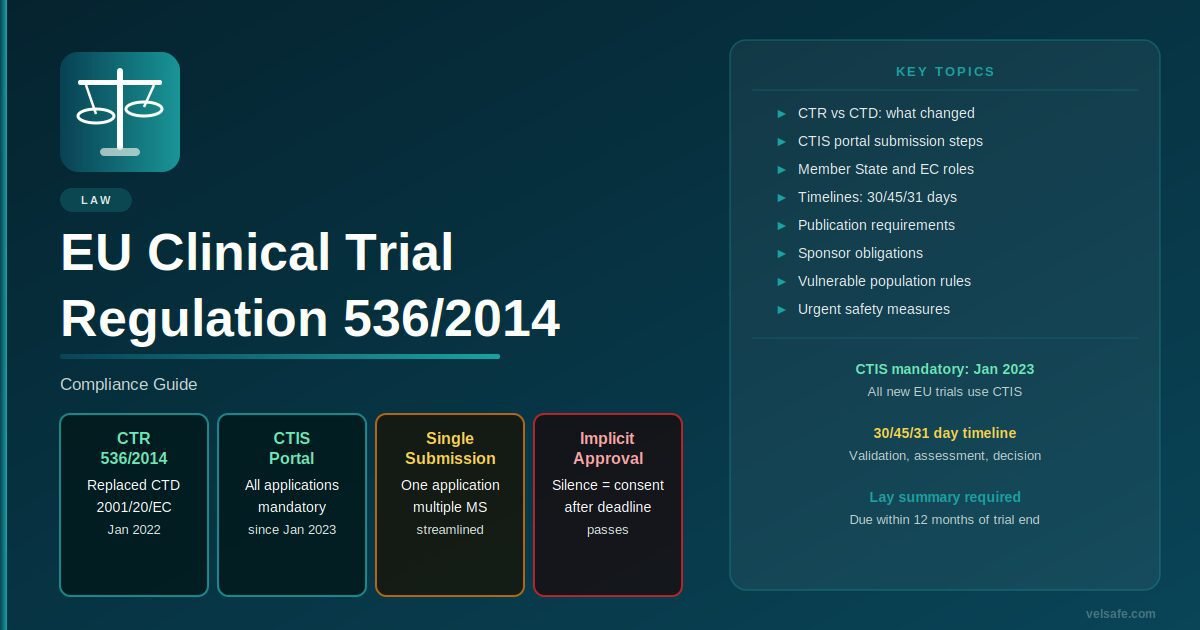
On 31 January 2022, Regulation (EU) No 536/2014 (the Clinical Trials Regulation, CTR) became applicable across the European Union, replacing the Clinical Trials Directive 2001/20/EC. The CTR applies to all clinical trials on medicinal products for human use conducted in EU member states, including trials sponsored by non-EU organisations. Since 31 January 2023, all new clinical trial applications must be submitted through CTIS, the EU Clinical Trials Information System.
This guide covers the CTR’s core obligations for sponsors and investigators, the CTIS submission process, safety reporting timelines, transparency requirements, penalties for non-compliance, and a six-step practical implementation checklist.
Overview: What the CTR Changes
The CTR’s core objectives are to harmonise submission and assessment procedures across EU member states, reduce administrative burden for multinational trials, increase transparency, and strengthen participant protection. The three most significant structural changes from the Directive are:
One application covers all participating EU member states. No longer required to submit separately to each national competent authority for multinational trials.
If the competent authority and ethics committee do not respond within the assessment deadline, the application is deemed approved. Silence equals consent after the deadline passes.
All CTIS submissions are publicly accessible by default unless specific confidentiality justification is accepted. Results must be published within 12 months of trial end.
The CTR applies beyond EU-based organisations: if a trial is conducted in an EU member state, or if data from a trial conducted elsewhere will be used to support a marketing authorisation in the EU, the regulation applies to that trial.
Key Requirements
Sponsor Obligations
CTIS Submission Requirements
All submissions (initial application, substantial modifications, safety reports, and results) must be made through CTIS. The application has two parts assessed on different timelines:
Transparency Requirements
All CTIS submissions are publicly accessible through the CTIS public portal by default unless specific, justified confidentiality requests are approved. This includes the protocol, summary of the trial results, and the informed consent documents. Commercially sensitive information may be protected for a defined period, but the default position is transparency.
Results must be published in CTIS within 12 months of trial end for adult trials and within 6 months for paediatric trials. This is a legal obligation, not a recommendation.
Safety Reporting Timelines
Penalties and Consequences
Penalties for non-compliance with CTR 536/2014 are set at member state level, not uniformly by the regulation itself. The CTR requires member states to establish appropriate and effective penalty regimes. In practice, the range across member states is significant.
6-Step Implementation Checklist
The CTR applies to clinical trials on medicinal products for human use. Non-interventional studies, observational studies, and medical device investigations are not covered. Confirm scope before investing in CTIS infrastructure.
Non-EU sponsors must appoint an EU legal representative before registering, since the representative’s EU address is required for the registration process. Allow adequate lead time: registration is not instantaneous.
The dossier must include a completed protocol, investigator’s brochure, informed consent form templates, subject information sheets, the IMP dossier, and supporting documents for each participating member state’s Part II requirements. CTIS has specific formatting and upload requirements; plan for technical preparation time.
SUSAR reporting to EudraVigilance requires a registered organisation, technical setup for electronic submissions, and trained staff. This infrastructure takes time to establish. Setting it up after enrolment begins is too late: the 7-day and 15-day timelines start on the day of awareness, not the day the system is ready.
Trial master files must be structured and populated from the moment the trial is authorised, not retroactively assembled ahead of inspection. Whether paper or electronic, the TMF must be structured according to the ICH E6(R3) reference model and available for regulatory inspection at any point during the trial and for a minimum of 25 years after its conclusion.
Results publication within 12 months of trial end is a legal obligation. Sponsors should build results reporting into the trial timeline from the protocol development stage, assign responsible owners, and confirm data lock and analysis completion timelines allow for publication within the required window.
Frequently Asked Questions
Yes, if the trial is conducted in an EU member state, or if data from a trial conducted elsewhere will be used to support a marketing authorisation application in the EU. Non-EU sponsors must appoint an EU legal representative per Article 74, who bears legal responsibility for CTR compliance.
Trials authorised under Directive 2001/20/EC had until 31 January 2025 to transition to CTIS. As of that date, all active clinical trials in the EU are governed by CTR 536/2014. There are no remaining trials operating under the Directive framework.
Yes. CTIS allows a single application covering multiple member states. This is one of the primary operational benefits over the Directive. One reporting member state (RMS) coordinates the Part I assessment, while each concerned member state conducts its own Part II review. A single authorisation decision per member state follows.
A Suspected Unexpected Serious Adverse Reaction is a serious adverse reaction to the investigational medicinal product that is unexpected (not described in the investigator’s brochure) and that the sponsor suspects may be causally related to the IMP. The sponsor is responsible for reporting to EudraVigilance within 7 days (fatal or life-threatening) or 15 days (all others). Investigators report suspected SUSARs to the sponsor; the sponsor reports to EudraVigilance.
No. Clinical investigations of medical devices are governed by MDR 2017/745 (Articles 62 to 82). Clinical performance studies of in vitro diagnostic devices are governed by IVDR 2017/746 (Articles 57 to 77). CTR 536/2014 covers only clinical trials on medicinal products for human use.
Sources
- Regulation (EU) No 536/2014 full text (EUR-Lex)
- CTIS public portal (European Medicines Agency)
- EMA, “Clinical Trials Regulation (EU) No 536/2014”
- EMA, “EudraVigilance: SUSAR reporting”
- ICH E6(R3): Good Clinical Practice Guideline (2023)
- European Commission, “CTIS guidance for sponsors”
- TransCelerate BioPharma, “CTR Implementation Guidance” (2023)