

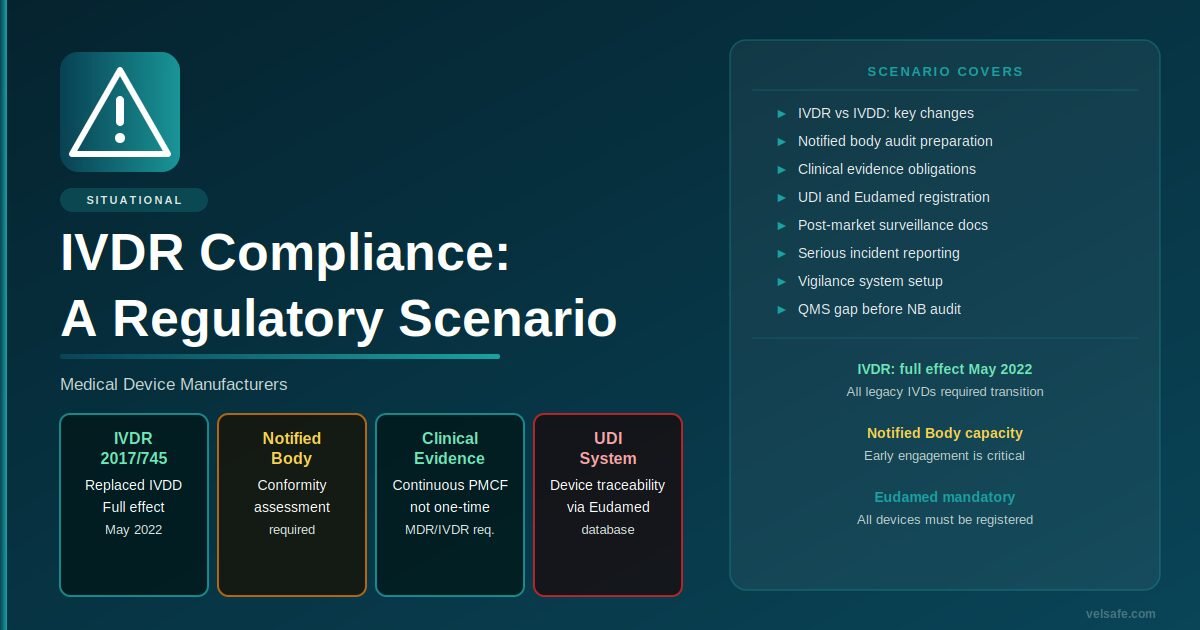
A regulatory affairs manager at a mid-sized in vitro diagnostics manufacturer is three weeks out from submitting a dossier to a notified body for CE marking under IVDR. During a final internal review, she notices that the device’s IVDR classification has not been formally confirmed. The device was classified under the old IVDD framework, but the IVDR classification rules differ significantly. If the classification is wrong under IVDR, the entire submission approach may need to change.
This scenario works through the decision the regulatory team faces, the four options available, and the correct regulatory sequence under EU Regulation 2017/746 and its transitional provisions.
The Scenario
Decision Point
The regulatory affairs manager has flagged the classification gap. The head of commercial wants to know: can we proceed with the submission in three weeks? Four options are on the table.
Proceed with the current submission as planned, relying on the IVDD self-certification framework since the device has existing CE marking.
Halt the submission, conduct a formal IVDR classification review, engage the notified body, and reset the commercial timeline based on the classification outcome.
Submit the dossier on the current timeline but flag the classification question in a covering note, asking the notified body to advise on classification as part of the review.
Escalate to senior leadership and legal counsel immediately, treat this as a material compliance risk, and make the timeline decision at leadership level.
Analysis: Why Option B Is Correct
The transitional provisions introduced by Regulation (EU) 2024/1860 extend deadlines for legacy devices that already hold valid IVDD certificates, but they do not permit a new submission for a device that has not completed IVDR classification. Proceeding with an IVDD-framed submission for a device that may be Class C or D under IVDR would result in a technically deficient dossier that the notified body would be unable to accept.
Halt the current submission and conduct a formal IVDR classification review. This is the correct action, but the binary framing of “halt everything” misses an important nuance: the classification review itself may take as little as two to four weeks if the regulatory team is experienced with the IVDR classification rules. The right action is to halt the submission, not the project. Reset commercial expectations based on what the classification outcome requires, not on a feared worst case.
Submitting a dossier with a known unresolved classification question in a covering note is not a viable approach. Notified bodies are not classification advisory services. They will not resolve classification ambiguity as part of a submission review. The dossier will be rejected or placed on hold pending resolution, which means the team will have spent three weeks preparing and submitting a dossier they will need to revise and resubmit. Option C loses the time it was trying to save.
Escalating to senior leadership and legal counsel is the right framing for governance, but it is not a substitute for action. Senior leadership and legal counsel need to be informed and involved in the decision about how to communicate the timeline change to the commercial partner. They are not the people who will conduct the classification review. Option D provides organisational cover without providing the technical resolution the situation requires.
The IVDR Classification Review: What It Involves
The classification review may not take as long as feared. IVDR Annex VIII sets out the classification rules for IVDs across four risk classes (A, B, C, D). The classification depends on the device’s intended purpose, the risk of incorrect results, and the clinical context of use. A cardiac biomarker assay used in time-critical acute clinical decision-making is likely Class C; if it is a companion diagnostic, it is Class D.
If the device falls into Class C, the classification review outcome informs the notified body engagement scope, and the submission can proceed once classification is confirmed and the dossier is structured correctly. If Class D, additional EU reference laboratory involvement is required, which adds time but is a known, structured process.
In IVDR transition projects, classification review is consistently the step that manufacturers underestimate, not because it is technically difficult, but because the consequences of getting it wrong are severe (the entire submission architecture changes), and because the responsible person rarely has prior hands-on IVDR experience. Engaging an external regulatory consultant for classification review is not a sign of weakness; it is appropriate risk management for a regulation where the classification rules are genuinely more complex than their IVDD equivalents.
Learning Points
Between 70 and 80 percent of IVDs are reclassified at a higher risk level under IVDR compared to IVDD. The classification rules in IVDR Annex VIII are more granular and risk-stratified than the IVDD framework. An IVDD Class 3 device may become IVDR Class C or D, each with different notified body and process requirements.
A CE mark placed on a device with an incorrect classification is invalid and constitutes a violation of IVDR. The legal and commercial consequences of a market withdrawal after launch are significantly worse than a delayed launch. The Q4 timeline may need to move; it may not need to move as far as feared if the classification review is completed promptly.
In this scenario, the regulatory affairs manager found a serious compliance gap three weeks before submission. This is the correct function of a regulatory professional. Organisations that treat this kind of flag as a problem rather than a solution will find the same gap discovered by their notified body or a market surveillance authority, at a far greater cost.
At least one person responsible for regulatory compliance (PRRC) must be in place. The PRRC must have formal qualifications in regulatory affairs or life sciences and verifiable professional experience. This is not a nominal requirement; it is a condition of market access.
IVDR requires manufacturers to implement a proactive, risk-based post-market surveillance system, submit periodic safety update reports (PSURs) for Class C and D devices, and conduct post-market performance follow-up (PMPF). These obligations continue throughout the commercial life of the device and are subject to notified body audit.
Sources
- EU IVDR Full Text: Regulation (EU) 2017/746
- Regulation (EU) 2024/1860: IVDR Transitional Provisions Extension
- IVDR Annex VIII: Classification Rules for IVDs
- MDCG 2021-2: Guidance on IVDR Classification
- Emergo by UL, “EU IVDR Classification Guide”
- European Commission, “EUDAMED and IVDR Implementation”
- TEAM-NB, “IVDR Notified Body Capacity and Submission Requirements” (2024)