

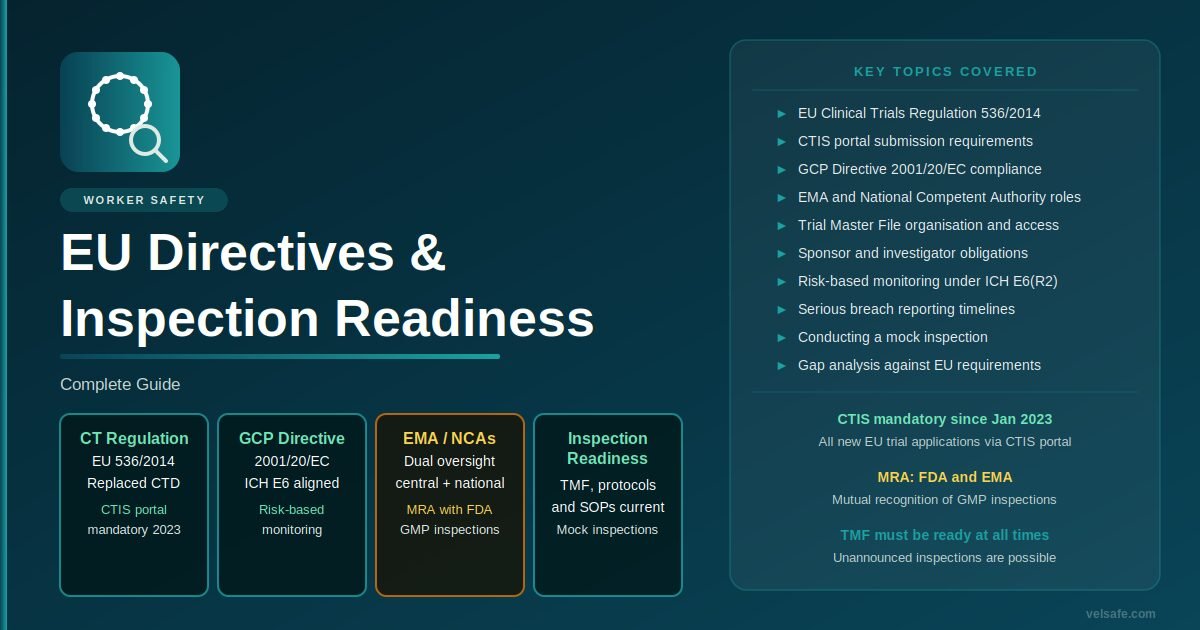
Inspection readiness is not something an organisation builds in the weeks before a regulator arrives. It is the condition the organisation is in every other day of the year. For companies operating in or supplying to the EU market, that condition is shaped by a web of directives, regulations, and enforcement frameworks that have shifted considerably since 2022.
The Clinical Trials Regulation (CTR) No. 536/2014 fully replaced the old Clinical Trials Directive in January 2022. GMP certificate extensions granted during the COVID-19 pandemic expired at the end of 2024. The EU-FDA Mutual Recognition Agreement (MRA) continues to expand. This guide covers the directives that shape EU inspection readiness, what inspectors are currently focused on, and the practical steps that separate organisations that pass inspections from organisations that pass inspections comfortably.
The Core Regulatory Framework
EU GMP and EudraLex Volume 4
The foundational GMP framework in the EU is EudraLex Volume 4, the EU’s GMP guidelines. Any manufacturer of medicines intended for the EU market must comply with EU GMP regardless of where in the world they are located. The European Medicines Agency (EMA) coordinates inspections to verify compliance and plays a central role in harmonising GMP activities across member states.
Clinical Trials Regulation (EU) No. 536/2014
On 31 January 2022, the EU Clinical Trials Regulation (CTR) No. 536/2014 replaced the Clinical Trials Directive No. 2001/20/EC, harmonising the processes for assessment and supervision of clinical trials throughout the EU. For sponsors and CROs, the CTR introduced a centralised submission and authorisation process via the Clinical Trials Information System (CTIS).
Member states must appoint inspectors to supervise compliance with the regulation and ensure those inspectors are adequately qualified and trained. Implementing Regulation (EU) 2017/556 sets out the detailed arrangements for Good Clinical Practice (GCP) inspection procedures under CTR 536/2014. Both the EMA and national competent authorities are empowered to conduct GCP inspections under the CTR. Findings are documented within CTIS and may be subject to follow-up, suspension, or revocation of trial authorisations.
The EU-FDA Mutual Recognition Agreement
The EU-FDA Mutual Recognition Agreement (MRA), which covers pharmaceutical GMP inspections for human medicines and veterinary products, has progressively expanded. On 30 May 2023, the US FDA confirmed that the national competent authorities of Austria, Belgium, Bulgaria, Denmark, Estonia, Finland, France, Greece, Hungary, Ireland, Luxembourg, Netherlands, Poland, Portugal, Slovenia, and Spain have pharmaceutical GMP inspection capability, capacity, and procedures equivalent to those of the US. Sweden was added on 26 September 2023, and Latvia on 28 November 2023.
What EU GMP Inspectors Are Currently Focused On
Pharmaceutical audits focus on specific critical areas that regulators use to assess overall GMP compliance and system robustness. In 2024, more than 70 percent of critical GMP inspection findings were directly linked to failures in data integrity and weak pharmaceutical quality systems, highlighting a growing gap between regulatory expectations and real operational compliance.
The single largest source of critical findings in 2024. Audit trail gaps, retrospective record alteration, and inadequate ALCOA+ controls remain the consistent pattern across EU GMP inspections.
Inspectors increasingly expect digital quality management systems and electronic batch records. Paper-based systems are not prohibited, but they are scrutinised more heavily for the same data integrity controls expected of digital systems.
Expanded focus on vendor audits and raw material traceability. Approved supplier status and qualification documentation gaps are a consistently cited finding category.
EMA and PIC/S are actively aligning inspection practices with FDA for mutual reliance. This means organisations preparing for either FDA or EU GMP inspections are increasingly preparing for both at the same time, whether they intend to or not. Risk-based targeting also means high-risk facilities are prioritised for more frequent inspections, not assessed on a fixed cycle.
FDA vs EU GMP Inspection Models
Practical Steps for Inspection Readiness
Most inspection gaps don’t result from organisations ignoring GMP. They result from standards evolving faster than internal procedures do. EudraLex Volume 4 has been updated, CTR 536/2014 brought new CTIS requirements, and the end of pandemic-era flexibilities means some previously tolerated practices are now findings. Compare current SOPs against the latest versions of applicable directives, not the versions your procedures were last updated against.
A thorough internal audit should evaluate documentation practices, quality systems effectiveness, and employee training readiness. “Readily accessible” means having records at your fingertips when inspectors ask, not spending the first morning of an inspection locating files. Run a mock document retrieval exercise with someone unfamiliar with your filing system and time how quickly specific records can be found.
Inspectors reviewing a TMF are not just checking whether the files exist. They are checking whether the files reflect what actually happened in the trial, in the correct version, documented at or close to the time of the event. An eTMF that is complete but months out of date on recent entries is itself a finding.
A mock inspection conducted six weeks before a real one is a remediation exercise. A mock inspection conducted eight months before a real one is an improvement cycle. Continuous readiness requires embedding compliance into daily operations rather than treating it as a one-time project. Mock inspections, internal audits, and CAPA follow-through are the mechanisms that make that embedding real rather than aspirational.
Successful CTR 536/2014 implementation requires readiness in sponsor systems, SOP alignment, CTIS training, and real-time regulatory engagement. For organisations that transitioned from the old Directive framework, this means ensuring CTIS submissions are current, that staff have completed the relevant CTIS training modules, and that safety reporting timelines (including SUSAR reporting to EudraVigilance) are built into trial workflows rather than handled ad hoc.
Common Inspection Findings to Avoid
Supporting Resources
- EudraLex Volume 4: EU Guidelines for Good Manufacturing Practice
- EU Clinical Trials Regulation 536/2014, official text
- Implementing Regulation (EU) 2017/556: GCP inspection procedures
- EMA Good Manufacturing Practice guidance
- EU-FDA Mutual Recognition Agreement: GMP
- CTIS training resources for sponsors