

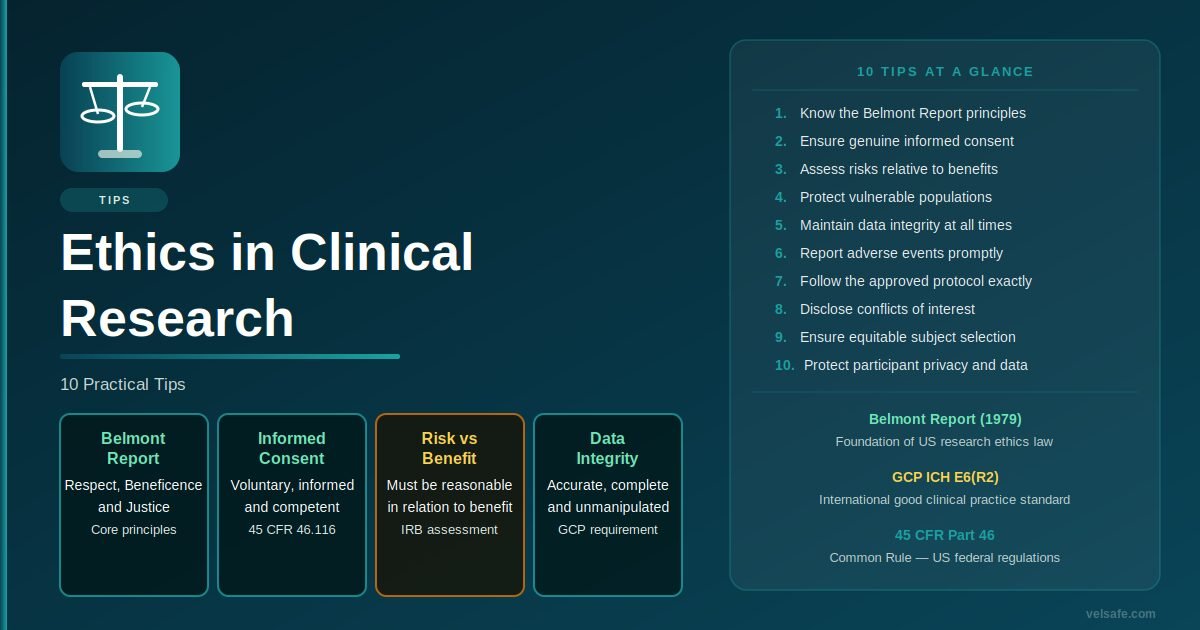
According to ICH E6, ethical conduct is the first of thirteen core principles of Good Clinical Practice, and every other principle rests on it. Trial design, data integrity, safety monitoring: none of it holds if participants were not informed honestly, treated fairly, or protected when something went wrong.
For coordinators, investigators, and regulatory staff, ethics shows up less as a philosophical question and more as a series of everyday decisions: how a consent conversation goes, how quickly a safety signal gets escalated, how a translated form gets handled. These 10 tips focus on those decisions specifically, drawn from regulatory guidance, audit data, and research on how consent plays out in practice.
1. Treat Informed Consent as a Conversation, Not a Signature
A signed form is the record of a conversation, not a substitute for one. Participants need real time to ask questions, think things over, and talk to family before deciding. A University Hospital Galway study using the validated Quality of Informed Consent (QuIC) questionnaire found persistent gaps between what participants thought they had agreed to and what the form actually said.
Walk through key sections of the form together, rather than handing it over and waiting for a signature. Where visit schedules allow, let the participant take the document home before deciding.
Handing a participant a 20-page consent form at the start of a long screening visit and asking for a signature at the end. The participant is overwhelmed; the record shows consent obtained.
2. Use Only IRB-Approved Consent Forms and Translations
When a non-English-speaking participant is screened and no approved translation exists, the instinct to have a bilingual staff member walk them through it verbally is the one to resist. CenterWatch’s survey found 41% of participants had consent reviewed verbally only, which helps with comprehension but does not substitute for an IRB-reviewed translated document when language is the actual barrier.
In site readiness reviews we conduct ahead of sponsor audits, informal language workarounds are one of the most consistent gaps. Sites document the participant’s primary language in the screening log, enroll them using a form in a language they did not confirm understanding of, and consider the matter resolved. Auditors do not.
3. Keep the Consent Document and Protocol in Sync
A recurring problem flagged in PMC’s review of cancer trial consent practices: the consent form states a procedure happens every visit, while the protocol specifies alternating visits. Nobody intended the discrepancy, but the participant was told something inaccurate regardless.
4. Re-Consent Participants Promptly When Anything Material Changes
Consent is not a one-time event, and treating it that way is one of the most frequent and serious findings coordinators encounter during site audits. If new safety information emerges, a protocol is amended, or a procedure changes, the participant’s original signature no longer reflects the study they are actually in.
5. Build In Time for Participants Under Pressure
Qualitative interviews with clinical research nurses consistently surface this tension: time constraints and information overload can quietly undermine whether consent is genuinely voluntary, particularly for patients facing serious or advanced illness. A participant who feels they have no real choice, or who is overwhelmed during a single high-stakes visit, has not given truly voluntary consent, even with a signature on file.
In post-audit debrief sessions, we find that coordinators almost universally identify time pressure as the most significant practical barrier to thorough consent conversations. The issue is rarely intent: it is scheduling. Sites that build a dedicated consent appointment into the protocol workflow, separate from screening procedures, consistently perform better on consent-related findings.
6. Apply Enhanced Protections for Vulnerable Groups Before Enrollment Starts
Children, people with limited literacy, economically disadvantaged participants, and other vulnerable groups need protections beyond what a standard adult consent process provides. IRB ethics committees increasingly have to be proactive about how consent methods and digital tools affect these populations, rather than assuming standard procedures are adequate.
7. Treat New Safety Information as a Trigger to Revisit Consent
When a safety signal appears in another trial of the same product, the first question is whether it needs to be reported. The second, easy to skip, is whether it changes what enrolled participants were told when they signed. If the answer is yes, updated consent language or direct communication with enrolled participants may be required, and that obligation does not expire once enrollment closes.
1. Does this safety information require regulatory reporting?
2. Does it change what participants were told about risk? If yes to either, both questions need answers before the next participant contact.
Safety signal is logged and reported. The consent implication is not evaluated. Enrolled participants continue under outdated risk information. This is a consent deficiency, not only a reporting one.
8. Get the Documentation Right, Completely and at the Time
Missing signatures, missing dates, incomplete forms, incorrect consent versions: these appear constantly in audit data. A descriptive analysis of FDA and EMA inspection findings grouped documentation and trial management as the two largest deficiency categories overall, with informed consent issues sitting inside both.
In regulatory binder reviews, we find outdated consent form versions in active participant files on roughly one in three sites we assess for first-time audits. The version was superseded after a protocol amendment; the coordinator used a form printed before the IRB approved the updated version. The participant and site staff both behaved in good faith. The documentation does not reflect that.
9. Revisit the Risk-Benefit Balance, Not Just at the Start
ICH E6 is explicit that a trial should be initiated, and continued, only if the anticipated benefits justify the risks. What is easy to forget is that this is not a calculation made once during protocol design and filed away.
10. Make Ethics Training Part of Onboarding and Keep It Current
Everyone on a trial, from data managers to investigators, needs both the qualifications and the trial-specific training their role demands under ICH E6, with retraining when protocols change or staff turn over. Training gaps tend to surface as consent-related findings first: the connection between “this person was not retrained after the amendment” and “the wrong consent version is in this participant’s file” usually is not visible until an auditor draws the line between them.
Under ICH E6, how many core GCP principles are there, and where does ethical conduct appear in that list?
Show answer
There are 13 core principles under ICH E6. Ethical conduct is the first principle, and the guideline states that all other principles build on it.
Common Mistakes
Build re-consent and ongoing assessment into trial workflows. A participant’s original signature does not cover a study they were not informed about.
A verbal walkthrough by a bilingual staff member does not substitute for an IRB-reviewed translated document. It creates an audit-visible mismatch between what was heard and what the record shows.
Discrepancies between what the consent form says and what the protocol requires are among the most common consent-related findings across FDA and EMA inspections.
From a regulatory standpoint, an undocumented action is treated as if it did not happen. A missing date on a consent form is a finding regardless of how well the conversation went.
Children, participants with limited literacy, and cognitively impaired adults require enhanced protections built into the protocol, not retrofitted after enrollment.
Training gaps surface as consent findings. The delegation log must tie each team member’s responsibilities to current documented training at all times.
Additional Recommendations
Teams looking to go further should review the full set of ICH E6(R2) principles directly rather than relying on summaries, since the guideline’s structure makes clear how interdependent these thirteen principles actually are. A consent version tracking system that automatically flags participants needing re-consent after a form update removes much of the manual burden described above.
For organisations updating their SOPs around informed consent ahead of a sponsor audit or regulatory inspection, a line-by-line review of current consent forms against the approved protocol, IRB correspondence, and delegation logs is the most reliable way to surface gaps before an auditor does.
Sources
- Journal of Medical Internet Research, “Comparative Effectiveness of eConsent: Systematic Review” (2023)
- Egnyte, “Good Clinical Practice Standards for Ethical Clinical Trials”
- IntuitionLabs, “Good Clinical Practice (GCP): The 13 Principles Explained”
- PMC, “A New Look at Informed Consent for Cancer Clinical Trials”
- PMC, “The ethics of clinical research”
- ICH, E6(R2) Good Clinical Practice Guideline