

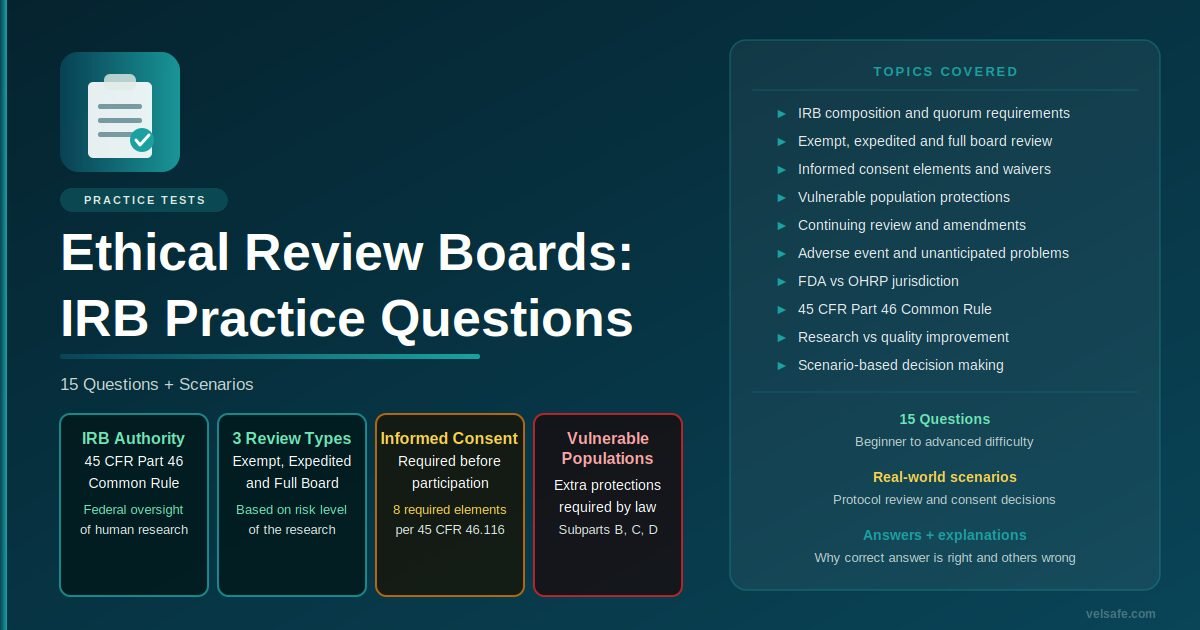
Institutional Review Boards (IRBs), also known as Ethical Review Boards or Independent Ethics Committees (IECs) outside the United States, exist to protect the rights, safety, and welfare of people who take part in research. Before any clinical trial involving human subjects can begin, an IRB must review and approve the protocol, the informed consent process, and the risk-benefit balance of the proposed research.
This practice test covers IRB composition and authority, review categories, informed consent requirements, vulnerable population protections, and scenario-based questions reflecting real-world IRB decision points. Reveal each answer only after choosing your own.
Section 1: Fundamentals
Question 1 | Beginner
What is the primary purpose of an Institutional Review Board?
- A) To approve the budget for clinical research
- B) To protect the rights, safety, and welfare of human research subjects
- C) To manage the recruitment timeline for a clinical trial
- D) To certify investigators as qualified to conduct research
Under 45 CFR 46.107 and ICH GCP, the IRB’s core function is to protect the rights, safety, and welfare of human subjects participating in research. This includes reviewing the scientific merit of the protocol only insofar as it affects the risk-benefit balance, evaluating the adequacy of informed consent, and assessing whether the selection of subjects is equitable. Budget approval, recruitment timelines, and investigator certification are administrative or institutional functions separate from the IRB’s ethical oversight role.
Question 2 | Beginner
Which federal regulation establishes the Common Rule governing IRB oversight of federally funded human subjects research in the United States?
- A) 21 CFR Part 11
- B) 45 CFR Part 46
- C) 42 CFR Part 2
- D) 29 CFR Part 1910
45 CFR Part 46, also known as the Common Rule, establishes the federal policy for protection of human research subjects and was adopted by multiple federal agencies. 21 CFR Part 11 governs electronic records and signatures, not IRB oversight. 42 CFR Part 2 governs confidentiality of substance use disorder records. 29 CFR Part 1910 is an OSHA workplace safety standard. For FDA-regulated clinical research specifically, 21 CFR Parts 50 and 56 apply alongside, and largely parallel, the Common Rule.
Section 2: IRB Composition and Review Types
Question 3 | Intermediate
Under 45 CFR 46.107, what is a minimum requirement for IRB membership composition?
- A) At least one member must be a licensed physician
- B) The IRB must have at least five members with varying backgrounds, including at least one member whose primary concerns are scientific and one whose primary concerns are non-scientific
- C) All members must hold a doctoral degree
- D) The IRB must consist exclusively of institutional employees
45 CFR 46.107 requires at least five members of varying backgrounds, with at least one member whose primary concerns are scientific, one whose primary concerns are non-scientific, and at least one member who is not otherwise affiliated with the institution and is not an immediate family member of someone affiliated with the institution. A physician member is not a strict requirement, though boards reviewing medical research commonly include one. A doctoral degree is not required for all members; the non-scientific and unaffiliated member roles specifically exist to bring lay community perspective.
Question 4 | Intermediate
A study proposes minimal risk research involving only anonymous survey data with no identifiable information. Which IRB review category most likely applies?
- A) Full board review
- B) Expedited review
- C) Exempt review
- D) No review is required because the data is anonymous
Anonymous survey research involving no identifiable information and minimal risk typically qualifies for exempt review under 45 CFR 46.104, specifically the category covering educational tests, surveys, interviews, or observation of public behaviour where responses cannot be linked to subjects. Importantly, “exempt” does not mean “no review”: the determination that a study qualifies as exempt must still be made by the IRB or a designated reviewer, not by the investigator alone. Self-determination of exempt status by investigators is a documented compliance risk.
Question 5 | Advanced
What distinguishes expedited review from full board review under the Common Rule?
- A) Expedited review is conducted by the full board but completed within 24 hours
- B) Expedited review may be conducted by the IRB chair or designated experienced reviewers for research involving no more than minimal risk that falls into specific federally defined categories
- C) Expedited review applies only to research involving children
- D) Expedited review eliminates the requirement for informed consent
Expedited review, under 45 CFR 46.110, allows the IRB chair or one or more designated experienced reviewers to review and approve certain categories of minimal-risk research without convening the full board. The categories are defined by federal list (e.g., collection of blood samples by finger stick, minor changes to previously approved research). Expedited review does not waive informed consent requirements, and it is not defined by speed alone; it is defined by risk level and the federally specified category list. It is also not limited to paediatric research.
Section 3: Informed Consent and Documentation
Question 6 | Intermediate
Under 45 CFR 46.116, which of the following is a required element of informed consent?
- A) A statement that the research has been approved by the institution’s legal counsel
- B) A statement describing the purposes of the research, the expected duration, and a description of the procedures to be followed
- C) A guarantee that the research will not be published without subject approval
- D) Confirmation that the subject has private health insurance
45 CFR 46.116 specifies eight basic elements of informed consent, including a statement of the research purpose, expected duration, and description of procedures. Other required elements include foreseeable risks and discomforts, anticipated benefits, alternative treatments, confidentiality provisions, compensation and treatment for research-related injury (where applicable), contact information, and the voluntary nature of participation. Legal counsel approval, publication guarantees, and insurance status are not among the required elements.
Question 7 | Intermediate
A research participant wishes to withdraw from a clinical trial midway through the study. What must the informed consent document have established about this right?
- A) Withdrawal is only permitted with sponsor approval
- B) Participation is voluntary and the subject may discontinue participation at any time without penalty or loss of benefits to which they are otherwise entitled
- C) Withdrawal forfeits any compensation already earned
- D) Withdrawal requires a formal hearing before the IRB
45 CFR 46.116(a)(8) requires that informed consent include a statement that participation is voluntary, that refusal to participate involves no penalty or loss of benefits to which the subject is otherwise entitled, and that the subject may discontinue participation at any time without penalty or loss of benefits. Sponsor approval is not required for a subject to withdraw. Already-earned compensation for completed study procedures is generally not forfeited upon withdrawal, though this should be addressed specifically in the consent document. A formal IRB hearing is not required for a subject to exercise their right to withdraw.
Section 4: Vulnerable Populations and Special Protections
Question 8 | Beginner
Which of the following groups is specifically addressed by additional protections under 45 CFR Part 46, Subpart B?
- A) Graduate students
- B) Pregnant women, human fetuses, and neonates
- C) Hospital administrators
- D) Healthy adult volunteers in Phase I trials
Subpart B of 45 CFR Part 46 provides additional protections for pregnant women, human fetuses, and neonates involved in research, reflecting the heightened ethical considerations around research that may affect a developing fetus or newborn. Subpart C addresses prisoners, and Subpart D addresses children. Graduate students, hospital administrators, and healthy adult volunteers are not categorically defined as vulnerable populations under the Common Rule, though IRBs may still apply heightened scrutiny depending on the specific research context.
Question 9 | Advanced
A study proposes to enrol prisoners in a behavioural research protocol unrelated to incarceration. What additional safeguard does 45 CFR Part 46, Subpart C require?
- A) Prisoners may only be enrolled with written approval from the warden
- B) The IRB must include a prisoner or prisoner representative when reviewing research involving prisoners, and the research must meet specific permissible category criteria
- C) Research involving prisoners is categorically prohibited under federal regulation
- D) Prisoners may not receive any compensation for participation
Subpart C requires that when an IRB reviews research involving prisoners, a prisoner or prisoner representative with appropriate background and experience must be included as a board member for that review, and the research must fall within specific permissible categories (such as study of the causes and effects of incarceration, or research on conditions affecting prisoners as a class). Research involving prisoners is not categorically prohibited, but it is subject to significantly heightened review given the coercive potential of the incarceration environment. Warden approval and compensation restrictions are not the defining regulatory safeguards under Subpart C.
Section 5: Scenario-Based Questions
Question 10 | Intermediate — Scenario
An investigator submits a protocol amendment that changes the inclusion criteria for a study from “adults 18 to 65” to “adults 18 and older,” with no other changes to study procedures or risks. How should this amendment typically be processed?
- A) It requires full board review because any change to eligibility criteria is automatically a major change
- B) It may be eligible for expedited review as a minor change to previously approved research, since it does not alter the risk profile of the study procedures themselves
- C) It does not require any IRB notification since eligibility criteria are an investigator decision
- D) It requires the study to restart from initial submission
Minor changes to previously approved research are eligible for expedited review under the federal expedited review categories, provided the change does not increase risk to subjects. Expanding the upper age limit without removing any safety exclusions and without changing study procedures is generally considered a minor change that does not increase risk. However, the IRB, not the investigator, must make this determination. All protocol amendments require IRB review and approval before implementation; an investigator cannot unilaterally implement an eligibility change. The study does not need to restart from initial submission for a minor amendment of this nature.
Question 11 | Advanced — Scenario
During a continuing review, an IRB discovers that an investigator enrolled three additional subjects after the study’s approved enrolment cap was reached, without prior IRB notification. What is the most appropriate IRB response?
- A) No action is needed since the additional subjects consented voluntarily
- B) The IRB should treat this as a reportable protocol deviation, assess whether subjects were placed at increased risk, and determine corrective and preventive actions including potential reporting to the institutional official
- C) The investigator should simply be asked to stop enrolling further subjects
- D) The study should be immediately and permanently terminated without further review
Enrolling subjects beyond an IRB-approved cap without prior notification is a protocol deviation. The IRB’s response should be proportionate to the actual risk created: it must formally document the deviation, assess whether the additional subjects were exposed to increased risk as a result of enrolling outside the approved parameters, and determine appropriate corrective and preventive actions. Depending on the institution’s policies and the severity of the deviation, this may require reporting to the institutional official or, in FDA-regulated research, to FDA. Subject consent does not retroactively authorise enrolment beyond IRB-approved limits. A simple verbal request to stop, or an immediate termination without assessment, are both disproportionate to the situation as described and do not fulfil the IRB’s documentation obligations.
Section 6: Advanced Scenarios
Question 12 | Advanced
An IRB is reviewing a multi-site clinical trial and is asked to rely on a single IRB (sIRB) review conducted by another institution’s IRB, as required for most NIH-funded multi-site research. What is the local IRB’s residual responsibility under this arrangement?
- A) None; the local site has no further obligations once sIRB review is in place
- B) The local site retains responsibility for local context review (such as local laws, institutional policies, and the qualifications of local investigators), even though the sIRB conducts the primary ethical review
- C) The local site must still conduct its own full independent ethical review in parallel
- D) The local site only retains responsibility for billing compliance
Under the NIH single IRB policy and the 2018 Common Rule revisions, multi-site research relies on one IRB of record (the sIRB) to reduce duplicative review, but local institutions retain responsibility for local context considerations: applicable state and local laws, institutional policies, conflict of interest management, and assessment of local investigator qualifications. The local site does not have zero obligations, nor does it conduct a full parallel ethical review (which would defeat the purpose of the sIRB arrangement). Billing compliance is a separate institutional function not specific to the sIRB relationship.
Question 13 | Advanced
A sponsor requests that an IRB approve a placebo-controlled trial design for a serious illness where an established effective treatment already exists. Under what circumstances might this design still be ethically and regulatorily acceptable to the IRB?
- A) Placebo controls are never acceptable when an established effective treatment exists
- B) Placebo controls may be acceptable where scientifically and ethically justified, such as add-on designs, short-term studies with monitored risk, or where the standard treatment’s effectiveness has not been definitively established for the specific population
- C) Placebo controls are automatically acceptable as long as subjects sign a waiver
- D) The IRB has no authority to evaluate trial design; this is solely a sponsor and FDA decision
The Declaration of Helsinki and ICH guidance recognise that placebo controls may be ethically justified in specific circumstances even where established treatment exists: where the placebo is used as an add-on to standard treatment rather than a replacement, where the disease involves minor or reversible harm with appropriate monitoring, or where there is genuine clinical equipoise about whether the standard treatment is effective in the specific population being studied. This is a substantive ethical and scientific judgement, not an automatic prohibition or an automatic approval. The IRB has direct authority and responsibility to evaluate trial design specifically because design affects the risk-benefit balance for subjects, and this responsibility cannot be waived by subject signature alone.
Question 14 | Intermediate
What is the purpose of continuing review for an approved research protocol?
- A) To re-verify the investigator’s curriculum vitae annually
- B) To reassess the study’s risk-benefit balance, review accumulated data including adverse events, and confirm the research continues to meet approval criteria
- C) To collect updated billing information from the sponsor
- D) To re-issue the original informed consent form without changes
Continuing review, conducted at least annually for most non-exempt research under 45 CFR 46.109, requires the IRB to reassess whether the research continues to meet approval criteria in light of accumulated experience: adverse events, protocol deviations, new safety information, and overall progress. This is a substantive ethical reassessment, not an administrative formality. CV re-verification, billing updates, and routine re-issuance of unchanged consent forms are not the defining purpose of continuing review, though some of these may occur incidentally as part of the broader process.
Question 15 | Beginner
What action should an investigator take if a subject experiences a serious, unexpected adverse event during a clinical trial?
- A) Wait until the next scheduled IRB meeting to report it
- B) Report the event to the IRB and, where applicable, the sponsor and FDA, within the timeframe specified by institutional policy and applicable regulation
- C) Only document the event in the subject’s medical record with no further reporting
- D) Report the event only if the subject specifically requests it be reported
Serious, unexpected adverse events must be reported promptly, typically within timeframes specified by institutional policy, the IRB’s own requirements, and applicable federal regulation (including FDA’s IND safety reporting requirements under 21 CFR 312.32 where applicable). Waiting for a scheduled meeting, documenting only in the medical record with no further action, or making reporting contingent on the subject’s request, all fail to meet the prompt reporting standard that protects both the affected subject and other current or future study participants who may be at similar risk.
Quick Reference: IRB Review Categories
Sources
- 45 CFR Part 46: Protection of Human Subjects (the Common Rule)
- 21 CFR Part 50: Protection of Human Subjects
- 21 CFR Part 56: Institutional Review Boards
- HHS Office for Human Research Protections (OHRP)
- ICH E6(R3): Good Clinical Practice Guideline (2023)
- WMA Declaration of Helsinki: Ethical Principles for Medical Research Involving Human Subjects
- NIH, “Single IRB Policy for Multi-Site Research”