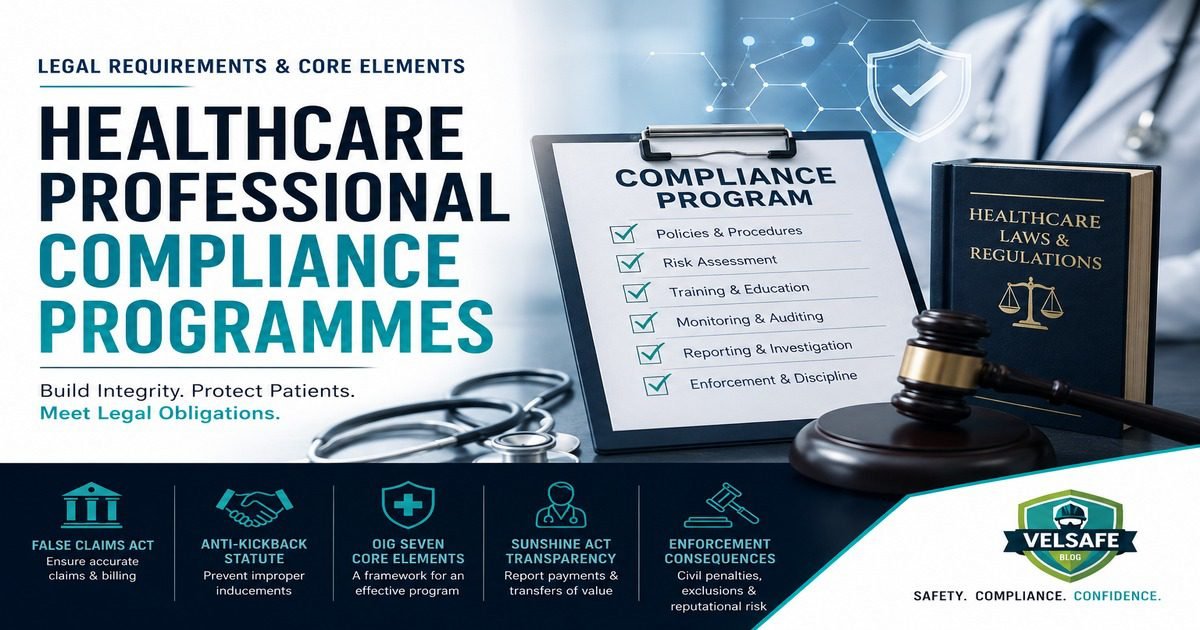
LAW: Healthcare Compliance Programme
Healthcare Professional Compliance Programmes: Legal Requirements and Core Elements
Healthcare organisations, pharmaceutical manufacturers, medical device companies, and their commercial teams operate in a legal environment governed by the False Claims Act, the Anti-Kickback Statute, the Physician Payments Sunshine Act, and a body of OIG guidance that defines what a functional compliance programme looks like. This article explains what the law requires, what constitutes an effective compliance programme under current enforcement standards, and what happens to organisations that treat compliance as paperwork rather than practice.
Legal Disclaimer
This article provides educational information about healthcare compliance programme requirements and applicable federal law. It does not constitute legal advice. Compliance requirements are complex, subject to change through agency guidance and court decisions, and their application depends on the specific facts of each organisation’s situation. Consult qualified legal counsel for guidance specific to your organisation, products, and activities.
$13,946
Per-Claim FCA Penalty
The False Claims Act imposes civil penalties of up to $13,946 per false claim, plus treble damages. In healthcare, where millions of claims may be submitted over the life of a scheme, FCA exposure can reach hundreds of millions of dollars before treble damages are applied. A functioning compliance programme is among the factors that can mitigate this exposure.
Source: DOJ | DOJ False Claims Act
7
OIG Core Elements
The HHS Office of Inspector General’s compliance programme guidance identifies seven core elements that define an effective compliance programme. Organisations whose programmes address all seven elements are better positioned to detect and prevent violations, reduce penalty exposure, and demonstrate good faith to enforcement authorities. OIG has issued specific guidance for pharmaceutical manufacturers, medical device companies, hospitals, and physician practices.
Source: OIG | OIG Compliance Guidance
10 Yrs
Maximum AKS Prison Term
The Anti-Kickback Statute carries a maximum criminal penalty of 10 years imprisonment per violation, plus fines, for individuals who knowingly and wilfully offer, pay, solicit, or receive remuneration to induce or reward referrals of federal healthcare programme business. AKS violations also trigger mandatory exclusion from federal healthcare programmes, which for many healthcare organisations is a more consequential penalty than the monetary fine.
Source: OIG | OIG Anti-Kickback Statute
Healthcare compliance programmes exist in response to a specific body of federal law that criminalises fraud and abuse in federal healthcare programmes and rewards organisations that establish effective programmes to prevent and detect violations. Understanding the legal framework is the starting point for understanding why compliance programmes are structured the way they are.
False Claims Act (31 USC 3729-3733)
The primary civil fraud statute in federal healthcare enforcement. It imposes liability on any person or entity that knowingly submits or causes the submission of false or fraudulent claims to the federal government. In healthcare, this typically means false claims to Medicare, Medicaid, or other federal healthcare programmes. The FCA’s qui tam provisions allow private individuals to file suit on behalf of the government and receive a share of any recovery, making whistleblower-initiated enforcement a significant and ongoing risk for healthcare organisations.
Anti-Kickback Statute (42 USC 1320a-7b(b))
Prohibits offering, paying, soliciting, or receiving anything of value to induce or reward referrals of items or services covered by federal healthcare programmes. The AKS applies broadly to pharmaceutical manufacturers, medical device companies, hospitals, physicians, and any entity whose products or services are reimbursed by Medicare or Medicaid. Safe harbours exist for specific arrangements including certain employment relationships, personal services agreements, and group purchasing organisations, but safe harbour protection requires strict compliance with the safe harbour’s conditions.
Physician Payments Sunshine Act (42 USC 1320a-7h)
Requires pharmaceutical manufacturers, medical device companies, biologics manufacturers, and medical supply companies to report payments and transfers of value to physicians, other covered recipients, and teaching hospitals to CMS annually. Reported data is published on the Open Payments database. Failure to report, or inaccurate reporting, carries significant civil penalties. The Sunshine Act creates a transparency obligation that supports AKS enforcement by making industry-physician financial relationships publicly accessible.
OIG Compliance Programme Guidance
The HHS Office of Inspector General has issued compliance programme guidance for pharmaceutical manufacturers, medical device manufacturers, hospitals, physician practices, home health agencies, and other healthcare entities. This guidance is not law, but it defines what a functional compliance programme looks like in OIG’s view and is used by prosecutors and enforcement authorities to evaluate whether an organisation’s programme was genuine or cosmetic. Organisations that follow OIG guidance are better positioned in enforcement proceedings.
Organisation Type
Primary Legal Exposure
Compliance Programme Required?
Pharmaceutical manufacturers
FCA (off-label promotion, pricing fraud); AKS (speaker programmes, samples); Sunshine Act
Not legally mandated but effectively required under CIA terms and enforcement expectations
Medical device manufacturers
AKS (consulting arrangements, training, loaner instruments); FCA; Sunshine Act
Not legally mandated; required under many CIAs and expected by DOJ/OIG in resolution agreements
Hospitals and health systems
FCA (billing fraud, upcoding); AKS (physician relationships); Stark Law (physician self-referral)
Mandated for Medicare participation in some states; required under most CIA agreements
Commercial sales teams (pharmaceutical and device)
AKS (field sales activities, meals, speaker programmes); FCA (off-label promotion)
Subject to employer compliance programme; individual representatives personally liable under AKS
Source: OIG | OIG Compliance Programme Guidance by Industry Sector
Key Legal and Regulatory References
31 USC 3729-3733 (False Claims Act): Primary civil fraud statute. Provides for treble damages and per-claim civil penalties. Qui tam provisions allow whistleblowers (relators) to bring FCA suits on behalf of the government and receive 15-30% of the government’s recovery. The FCA’s knowledge standard covers actual knowledge, deliberate ignorance, and reckless disregard.
42 USC 1320a-7b(b) (Anti-Kickback Statute): Criminal prohibition on remuneration to induce federal healthcare programme referrals. Knowing and wilful violations carry criminal penalties of up to $100,000 per violation and up to 10 years imprisonment. The AKS also serves as a predicate for FCA liability: claims resulting from AKS violations are false claims for FCA purposes.
42 USC 1395nn (Stark Law / Physician Self-Referral Law): Prohibits physicians from referring Medicare and Medicaid patients for designated health services to entities with which the physician has a financial relationship unless a specific exception applies. Unlike the AKS, the Stark Law is a strict liability statute; intent is irrelevant to liability.
42 USC 1320a-7h (Physician Payments Sunshine Act): Requires manufacturers to report to CMS all payments and transfers of value to covered recipients, including meals, consulting fees, travel, research funding, and educational items. Reports are published annually in the Open Payments database.
OIG Compliance Programme Guidance (Pharmaceutical, Medical Device, Hospital): Non-binding guidance documents setting out OIG’s expectations for effective compliance programmes in specific healthcare sectors. These documents define the seven core elements and provide sector-specific guidance on high-risk areas and risk mitigation strategies.
Source: HHS OIG | OIG Compliance Guidance Documents
Remuneration (AKS)
Courts and enforcement authorities interpret “remuneration” broadly under the AKS to include anything of value: cash, gifts, meals, entertainment, speaking fees, consulting arrangements, educational grants, research funding, and free goods or services. The AKS does not require that a referral actually occur as a result of the remuneration; the intent to induce or reward a referral is sufficient. Even legitimate-seeming arrangements can constitute unlawful remuneration if they are structured or used to generate referrals.
Corporate Integrity Agreement (CIA)
A CIA is a compliance agreement entered into between OIG and a healthcare entity as part of a civil settlement of FCA or AKS violations. CIAs typically require the entity to implement or enhance its compliance programme, submit to independent review organisation (IRO) audits, report certain events to OIG, and certify compliance by senior officers. Breach of a CIA can result in exclusion from federal healthcare programmes, which for a pharmaceutical or device company means loss of Medicare and Medicaid revenue.
Safe Harbour (AKS)
Regulatory safe harbours under the AKS define specific business arrangements that are protected from AKS prosecution if all conditions of the safe harbour are met. Safe harbours exist for employment relationships, personal services and management contracts, group purchasing organisations, and certain price reductions. Falling within a safe harbour requires strict compliance with every condition of that safe harbour; partial compliance provides no protection. Many industry arrangements do not qualify for safe harbour protection and must be evaluated against the AKS’s intent-based standard.
Exclusion (OIG)
OIG has the authority to exclude individuals and entities from participation in Medicare, Medicaid, and other federal healthcare programmes. Mandatory exclusion applies to convictions for certain crimes; permissive exclusion applies to a broader range of conduct including AKS violations and submission of false claims. Excluded individuals may not be employed by or serve as a contractor to any entity that receives federal healthcare programme payments. Employing an excluded individual can result in Civil Monetary Penalty liability for the employing entity.
OIG’s compliance programme guidance identifies seven core elements that define an effective compliance programme. These elements reflect the compliance programme standards used by federal prosecutors and OIG to evaluate whether an organisation’s programme is genuine. A programme that addresses all seven elements in substance, not just on paper, is the standard that enforcement authorities apply.
1
Written Standards of Conduct and Policies
Written policies and procedures that articulate the organisation’s commitment to compliance, define prohibited conduct, and provide guidance on high-risk activities. For pharmaceutical and device companies, this includes policies on interactions with healthcare professionals, speaker programmes, medical education grants, meals and entertainment, consulting arrangements, and off-label promotion. Policies must be current, accurate, and accessible to the workforce members they govern.
2
Designated Compliance Officer and Committee
A senior-level compliance officer with direct access to the board and executive leadership, and a compliance committee with cross-functional representation. The compliance officer must have sufficient authority, independence, and resources to investigate concerns and recommend corrective action. A compliance officer who reports only to the general counsel or who lacks the independence to raise concerns with the board does not satisfy OIG’s functional requirements.
3
Effective Training and Education
Training must be role-specific, not generic. Sales representatives need training on AKS safe harbours, appropriate HCP interactions, and meal and entertainment limits. Medical science liaisons need training on off-label communication standards. Finance staff need training on accurate billing and grant management. General annual compliance awareness training does not substitute for role-specific training that teaches employees how the law applies to the specific decisions they make in their jobs.
4
Effective Lines of Communication
A confidential reporting mechanism, typically an anonymous hotline, that allows employees to report potential violations without fear of retaliation. Reporting channels must be genuinely accessible, actively promoted, and used. A hotline that exists but is never promoted and receives no reports is a red flag in an enforcement context. Reports received must be investigated and the investigation and its outcome documented regardless of whether the report is substantiated.
5
Auditing and Monitoring
Ongoing monitoring of business activities against compliance standards, and periodic risk-based auditing of higher-risk areas. For pharmaceutical and device companies, this includes review of HCP payment data against internal policies and Open Payments reports, monitoring of speaker programme activity, review of samples and promotional materials, and audit of field sales expenses. Monitoring results must be reviewed, anomalies investigated, and findings addressed through documented corrective action.
Written disciplinary standards that are applied consistently across the organisation when compliance violations occur. The standards must apply equally to senior executives and field employees. Enforcement authorities are particularly attentive to whether discipline for compliance failures is applied at the management level or only to individual contributors. A compliance programme that disciplines sales representatives but not their managers for the same conduct does not reflect a genuine compliance culture.
7
Responding to Detected Problems and Corrective Action
When compliance problems are identified, the organisation must investigate promptly, take appropriate corrective action, and, where required by law or CIA obligations, self-disclose to OIG or the relevant enforcement authority. The seventh element also encompasses proactive steps to prevent recurrence, including policy updates, additional training, and enhanced monitoring in areas where violations occurred. Organisations that identify problems and ignore them face substantially greater enforcement consequences than those that identify, address, and remediate.
Employees Have the Right To
Employers Cannot
Report suspected FCA or AKS violations to the government as a whistleblower under the FCA’s qui tam provisions, and receive a share of the government’s recovery
Retaliate against employees who report compliance concerns internally, file qui tam suits, or cooperate with government investigations; FCA whistleblower protection provisions provide remedies including reinstatement and double back pay
Refuse to participate in activities that would violate the AKS or FCA without retaliation, and report concerns through the compliance hotline or other designated channels
Direct employees to engage in activities that would violate the AKS or FCA, or condition employment on participation in activities that the employee reasonably believes to be unlawful
Receive compliance training that accurately describes the legal requirements applicable to their specific role and the specific activities they are expected to perform
Provide compliance training that omits or misrepresents the legal requirements applicable to specific business activities, or that creates the impression that non-compliant activities are acceptable
Source: DOJ | DOJ False Claims Act Whistleblower Protections
High-Risk Areas in Pharmaceutical and Device Commercial Operations
Improper HCP speaker programme payments
Highest Risk
Speaker programmes where HCPs are paid as speakers but the programmes serve primarily to generate prescriptions rather than to educate. Red flags include programmes with no attendees, programmes at restaurants with no educational content, HCPs who are paid as speakers for products they have never prescribed, and payment rates that exceed fair market value. DOJ and OIG have resolved numerous FCA and AKS matters involving speaker programme abuse.
Off-label promotion
High Risk
Promoting products for unapproved uses creates FCA exposure when the promoted use is not covered by federal healthcare programmes. Off-label promotion also creates product liability risk independent of the FCA exposure. Commercial representatives and medical science liaisons must understand the distinction between permissible scientific exchange and unlawful off-label promotion, and the specific standards that apply to each role.
Consulting arrangements at above fair market value
Common
Consulting fees paid to HCPs that exceed the fair market value of the services actually rendered, or arrangements where the volume of consulting services is not commensurate with a legitimate business purpose. FMV determinations must be documented, defensible, and independent of the HCP’s prescribing volume or referral patterns.
Sunshine Act reporting failures
Ongoing Risk
Failure to report payments and transfers of value to covered recipients, or inaccurate reporting of the nature, amount, or recipient of payments. CMS imposes civil monetary penalties for reporting failures, and unreported payments also create Open Payments reconciliation risks when HCPs or journalists review published data and identify discrepancies.
Source: DOJ | DOJ FCA Settlements and Enforcement Actions
Statute
Civil/Criminal Consequences
Additional Consequences
False Claims Act
Treble damages plus $13,946 per false claim (civil); up to 5 years imprisonment (criminal healthcare fraud)
Qui tam suits; relator shares of 15-30%; reputational harm; product approval implications
Anti-Kickback Statute
Up to $100,000 per violation and 10 years imprisonment (criminal); Civil Monetary Penalties up to $100,000 per act
Mandatory exclusion from federal healthcare programmes upon criminal conviction
Sunshine Act
$1,000-$10,000 per payment not reported; $10,000-$100,000 per payment not reported with intent to avoid
Maximum $1.15 million per annual report; public disclosure of violations
CIA Breach
Stipulated penalties per breach type specified in CIA; potential exclusion from federal healthcare programmes
Exclusion has existential consequences for entities dependent on Medicare and Medicaid revenue
Source: OIG | OIG Civil Monetary Penalties and Exclusion Authority
Programme Structure
Compliance officer designated with appropriate seniority and independence
Written policies current and accessible covering all high-risk activities
Compliance committee active with cross-functional representation
Board-level compliance reporting in place and documented
Training and Monitoring
Role-specific training completed and documented for all affected employees
HCP payment monitoring and FMV review process operational
Open Payments reporting process verified annually before submission
OIG Exclusion List checked at hire and periodically for all personnel
Response and Reporting
Confidential reporting hotline operational and actively promoted
All hotline reports investigated and outcomes documented
Non-retaliation policy communicated and enforced
Self-disclosure protocol in place for potential FCA or AKS violations
A compliance programme that exists only on paper provides no meaningful protection
DOJ’s Justice Manual and OIG guidance are explicit: prosecutors and investigators evaluate whether a compliance programme was genuinely implemented and effectively enforced, not merely whether one existed. Policies that were never read, training that was completed as a checkbox exercise, a hotline that was never promoted, and disciplinary standards that were applied inconsistently are the hallmarks of a compliance programme that will not withstand scrutiny. The seven core elements must be operational in practice, not just documented in a binder.
Individual employees face personal liability under the AKS
The AKS imposes criminal liability on individuals, not just entities. Sales representatives, medical science liaisons, market access staff, and commercial leadership who knowingly participate in arrangements that violate the AKS face personal criminal exposure. The fact that the conduct was sanctioned by management or consistent with industry practice does not provide a defence. Role-specific training that teaches employees how the AKS applies to their specific activities is both a compliance obligation and a genuine protection for individual employees.
Whistleblowers are the primary source of FCA enforcement cases
The majority of FCA cases brought by DOJ originate as qui tam suits filed by former employees with knowledge of the company’s practices. These relators typically spent years observing the conduct they are reporting and have access to internal communications, sales data, and management directives that are difficult to refute. A compliance culture that encourages internal reporting and addresses concerns promptly and genuinely is the most effective mechanism for ensuring that compliance issues are resolved internally rather than becoming the basis for a qui tam suit filed after the employee decides they have no internal option.
Is a compliance programme legally required for pharmaceutical and medical device companies?
Not as a matter of statute for most organisations. The AKS, FCA, and Sunshine Act impose substantive prohibitions and reporting obligations, but they do not specifically mandate a compliance programme structure. However, an effective compliance programme is a practical necessity: it is required under virtually every CIA, is a factor DOJ and OIG consider in prosecution and resolution decisions, and is the primary evidence of good faith in an investigation. Organisations without functional programmes typically fare substantially worse in enforcement negotiations.
What is the difference between a compliance programme element being “in place” and being “effective”?
An element is in place when the structural requirement is satisfied: the policy is written, the hotline exists, training is assigned. An element is effective when it is actually changing behaviour and preventing violations. DOJ’s Evaluation of Corporate Compliance Programs guidance instructs prosecutors to evaluate whether the programme was effective in practice, not simply whether it existed on paper. A hotline employees are afraid to use because of a culture of retaliation is in place but not effective.
How does the OIG exclusion list screening requirement work?
OIG maintains the LEIE (List of Excluded Individuals and Entities). Employing or contracting with an excluded individual for Medicare or Medicaid-covered services can result in Civil Monetary Penalties of $20,000 per service plus up to treble the amount claimed. Effective compliance programmes screen new hires before employment and conduct periodic, typically monthly, screening of all employees and contractors. SAM.gov screening is also advisable for federal contractors.
When should a healthcare organisation self-disclose a potential FCA or AKS violation?
Self-disclosure through OIG’s Self-Disclosure Protocol or DOJ’s Voluntary Self-Disclosure policy can significantly reduce exposure, but the decision requires careful legal analysis. Benefits include reduced damage multipliers and potential avoidance of a CIA. Risks include initiating an investigation that might not have otherwise occurred. The decision should be made with experienced healthcare regulatory counsel who can evaluate the strength of the potential case and the specific disclosure frameworks available.
What triggers a Corporate Integrity Agreement, and what does it require?
A CIA is typically imposed as part of a settlement resolving FCA or AKS allegations where OIG agrees to exclude the organisation from federal healthcare programmes in exchange for the organisation entering into binding compliance obligations. CIAs commonly require an independent review organisation (IRO) to conduct annual assessments, mandatory reporting of certain events to OIG, enhanced training programmes, and written certifications from senior management and the Board. Failure to comply with CIA terms can result in stipulated penalties and exclusion.
How should a compliance programme address conflicts of interest in relationships with healthcare professionals?
Pharmaceutical and medical device companies must comply with the Physician Payments Sunshine Act (Open Payments), which requires reporting all payments and transfers of value to covered recipients to CMS annually. Beyond reporting, effective compliance programmes establish written policies governing speaker bureau programmes, advisory board payments, meals and entertainment, educational grants, and research funding. All payments must reflect fair market value for legitimate services, be documented with written agreements, and be reviewed by compliance before execution.
What records should a compliance programme maintain, and for how long?
Compliance programmes should maintain records of all training completions, hotline reports and investigations, monitoring and auditing results, disciplinary actions, government disclosures, and CIA reporting submissions. Retention periods vary by record type and applicable law: FCA claims have a six-year limitations period with a potential ten-year discovery rule, so records relevant to billing and payment arrangements should generally be retained for at least ten years. CIA terms frequently impose specific retention requirements that override standard organisational policies.
VelSafe
Build a Compliance Programme That Works
The seven core elements of an effective healthcare compliance programme are the minimum structure OIG and DOJ expect. Structure alone is not enough: the policies must be followed, training must be understood, and the hotline must be taken seriously. Find more healthcare compliance resources at VelSafe.
Explore VelSafe Resources