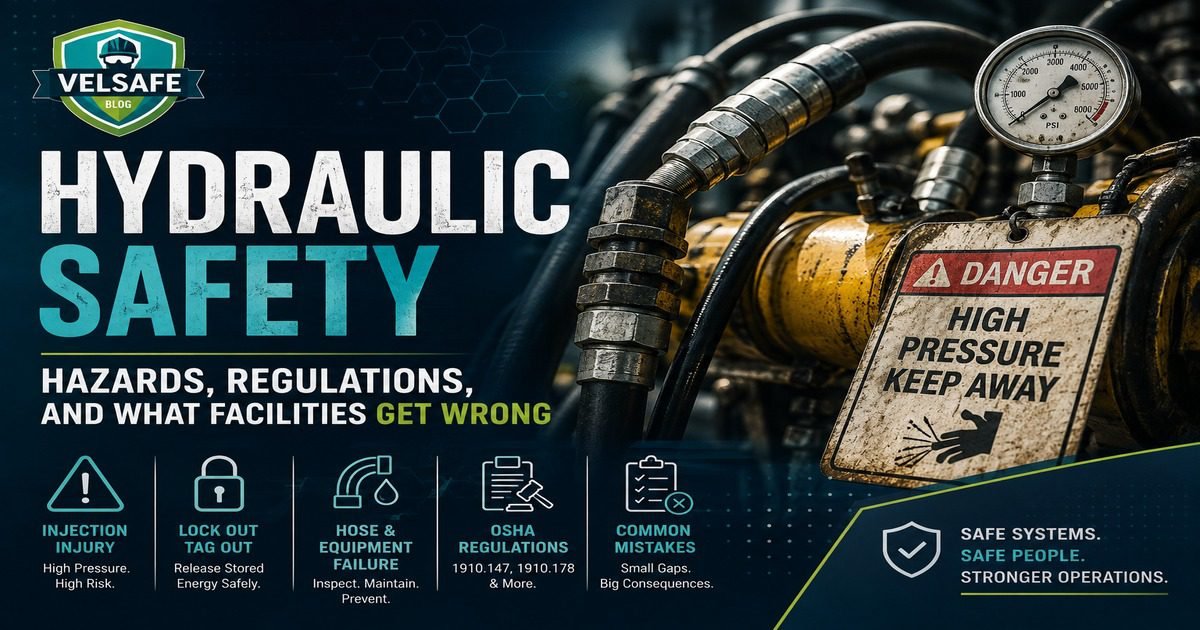
Hydraulic systems power some of the heaviest and most complex equipment in manufacturing, construction, agriculture, and aviation. They also generate some of the most severe occupational injuries: fluid injection wounds that result in amputation, crush injuries from unexpected actuator movement, and fires from high-pressure leaks reaching ignition sources. This analysis examines the hydraulic safety landscape, the regulatory framework that governs it, where the persistent gaps are, and what facilities with strong safety records do differently from those that appear repeatedly in incident reports.
Executive Summary
Hydraulic systems present hazards that are fundamentally different from most mechanical equipment: the energy stored in a pressurised hydraulic system is invisible, can be released without warning through component failure or pinhole leaks, and produces injuries of a severity that is often not immediately apparent. Hydraulic injection injuries, in which high-pressure fluid penetrates skin with little external evidence of the wound, cause permanent disability and amputation in a significant proportion of cases. OSHA’s general industry and construction standards address hydraulic hazards through lockout/tagout, machine guarding, and pressure vessel requirements, but hydraulic-specific guidance remains less standardised than many other hazard categories. This analysis covers the injury profile, regulatory framework, common failure modes, and the practices that distinguish facilities with strong hydraulic safety records.
PSI Operating Pressure
Modern industrial hydraulic systems commonly operate at pressures between 1,500 and 7,000 PSI, with some specialised systems exceeding 10,000 PSI. At these pressures, a pinhole leak produces a jet capable of penetrating skin and injecting fluid into tissue before the worker is aware of the contact. The invisibility of the hazard at the point of exposure is the defining characteristic of hydraulic injection injury risk.
Lockout/tagout (29 CFR 1910.147) is the most frequently cited OSHA standard in incidents involving hydraulic system maintenance and servicing. Stored hydraulic energy, maintained in actuators and accumulators even after power is disconnected, is a primary cause of serious injuries during maintenance operations. OSHA’s control of hazardous energy standard is one of the agency’s most cited standards across all industries.
Medical literature estimates that a significant proportion of hydraulic injection injuries result in partial or complete amputation of the affected digit or limb if treatment is delayed or inadequate. The primary risk factor is delayed presentation to specialised surgical care; workers and first responders frequently underestimate the severity of what appears to be a small puncture wound, delaying the aggressive surgical debridement required to prevent systemic toxicity.
Expert Insight: Why Hydraulic Injuries Are Systematically Underestimated
The defining characteristic of hydraulic injection injury risk is that it does not look serious at the point of contact. A worker who checks a hydraulic line for leaks by running their hand along it, or who uses their fingers to locate a pinhole, typically feels a sting and sees a small discoloration at the entry point. The hydraulic fluid injected under the skin at 2,000 PSI has already begun tracking along tissue planes, and will cause progressive tissue necrosis over the following hours. By the time pain and swelling become prominent, the window for effective surgical intervention is narrowing. Emergency departments that do not specialise in occupational medicine have a documented history of discharging these patients with a diagnosis of puncture wound, with catastrophic consequences. Every hydraulic maintenance programme must include explicit first aid guidance on the symptoms and emergency treatment of injection injury, because the generic first aid response to a small puncture is insufficient.
The Hydraulic Hazard Profile: Four Distinct Risk Categories
Hydraulic systems in industrial and construction settings generate hazards across four distinct categories, each with different mechanisms, injury types, and required controls. Understanding the hazard profile of a specific system requires understanding which categories are present and how they interact.
High-Pressure Fluid Injection
Hydraulic fluid ejected from pinhole leaks, fitting failures, or hose ruptures can penetrate skin at pressures as low as 100 PSI, well below the operating pressure of most systems. The wound entry point is typically small (1-3mm), and the injected fluid tracks along fascial planes to create a much larger area of contamination than the external wound suggests. Fluid types affect toxicity: water-based fluids cause less tissue damage than petroleum-based hydraulic oil, and certain synthetic fluids cause rapid and severe necrosis. Treatment requires immediate surgical debridement; delay of more than a few hours substantially worsens outcomes.
Stored Energy Release During Maintenance
Hydraulic actuators, cylinders, and accumulators retain energy after the hydraulic power unit is shut down. A cylinder supporting a load remains pressurised until the load is physically supported by another means. Accumulators, which store pressurised fluid to maintain system pressure during demand peaks, can hold substantial stored energy for extended periods after power is removed. Workers who open hydraulic connections or remove components without first releasing stored pressure and supporting suspended loads are at risk of sudden actuator movement, component ejection, and pressurised fluid release.
Hydraulic Fire and Environmental Hazard
Petroleum-based hydraulic fluid is flammable. A high-pressure leak near a hot surface, electrical arc, or open flame produces a fine mist that can ignite instantly. Hydraulic fires are characterised by rapid development and intense heat, and are a significant cause of fatality in mobile equipment incidents including agricultural, forestry, and mining equipment. Fire-resistant hydraulic fluids exist and are used in mining and other fire-risk environments; facilities in high-temperature environments should evaluate fluid selection against fire risk, not only performance characteristics.
Hydraulic actuators generate high forces through controlled movement of loads. Unexpected actuator activation, whether through control failure, inadvertent contact with controls, or incomplete energy isolation during maintenance, can produce crush injuries between the moving actuator and a fixed structure. In mobile equipment, hydraulic system failures can cause uncontrolled load drops or vehicle movement. The force generated by a hydraulic actuator typically far exceeds what the human body can withstand, making prevention of unexpected movement the critical control, not mitigation of the consequences of movement.
Regulatory Framework: What OSHA and Other Authorities Require
Hydraulic safety does not have a dedicated OSHA standard. Instead, hydraulic hazards are addressed through a framework of standards that apply to the specific hazard mechanisms: stored energy, pressure vessels, fire, and machine guarding. Understanding which standards apply to a given hydraulic system requires analysing the system’s function and location.
Standard
Hydraulic Application
Key Requirement
29 CFR 1910.147 (LOTO)
Maintenance and servicing of hydraulic equipment in general industry
Isolate all energy sources including hydraulic pressure and stored energy in accumulators; verify zero energy state before work begins
29 CFR 1910.217 (Mechanical Power Presses)
Hydraulically powered presses in general industry
Guarding, brake monitoring, and control reliability requirements for hydraulic press systems
29 CFR 1910.106 (Flammable Liquids)
Storage and use of petroleum-based hydraulic fluids
Storage limits, container requirements, and ignition source controls for flammable hydraulic fluids
29 CFR 1926.600-602 (Construction Equipment)
Hydraulically powered construction equipment and earthmoving machinery
Equipment inspection, maintenance requirements, and operator qualification for hydraulic construction machinery
ASME B31.3 / B31.1 (Pressure Piping)
High-pressure hydraulic piping systems in industrial facilities
Design, materials, testing, and inspection requirements for pressure piping including hydraulic lines
LOTO compliance for hydraulic systems is more complex than for electrical systems because hydraulic energy is not eliminated by opening a disconnect switch. Hydraulic stored energy exists in multiple locations simultaneously: in the pressurised fluid throughout the system, in actuators supporting loads, in accumulators, and in any component that is spring-loaded or gravity-loaded by the hydraulic cylinder. A complete LOTO procedure for a hydraulic system must address each of these energy sources independently.
The most common LOTO failure mode in hydraulic systems is the assumption that shutting off the hydraulic pump eliminates system pressure. It does not. Directional control valves that fail in their last position can trap pressure in actuator circuits. Accumulators continue to hold pressure until they are intentionally bled down. Cylinders supporting loads maintain the load through hydraulic pressure in the rod or blind end of the cylinder until the load is physically supported by another means. OSHA incidents involving hydraulic LOTO failures frequently share this characteristic: the worker believed the system was de-energised based on pump status, and discovered it was not when a component activated unexpectedly.
What a Complete Hydraulic LOTO Procedure Must Address
Hydraulic power unit shutdown: Isolate electrical power to the pump motor using appropriate lockout devices. This eliminates the energy source but does not de-energise the system.
System pressure bleed-down: Operate the hydraulic control to cycle the actuator through its full range to release trapped pressure. Verify pressure gauge reads zero before proceeding.
Accumulator isolation and bleed-down: Close the accumulator isolation valve and bleed down the accumulator through its drain port. Verify accumulator pressure is zero. Do not rely on the system bleed-down alone to address accumulator pressure.
Load support: Physically block, prop, or mechanically support any load that is held in position by hydraulic pressure. A cylinder supporting a load does not hold it safely in position when system pressure is released.
Hydraulic Hose and Fitting Failure: The Overlooked Maintenance Risk
Hydraulic hose assemblies have defined service lives that are frequently exceeded in operational equipment. Hose degradation is internal as well as external: the inner lining of a hydraulic hose degrades from fluid exposure and pressure cycling even when the external cover appears intact. A hose that looks serviceable from the outside may have a compromised inner lining that fails without external warning.
Industry guidance recommends inspection-based replacement cycles rather than time-based cycles alone, because operating conditions vary significantly between systems. High-cycle applications, systems with hydraulic fluid that is frequently contaminated or allowed to degrade, and systems operating near maximum pressure ratings all accelerate hose degradation. Bend radius violations, hose abrasion against machine surfaces, and improper fitting installation are the most common preventable causes of premature hose failure in facilities that conduct post-incident root cause analysis.
Hydraulic Hose Failure Causes and Prevention
Abrasion from contact with machine surfacesMost Common
Hose outer cover worn through by contact with adjacent metal components, creating a failure point at the cover layer. Prevention: route hoses away from moving parts and sharp edges; use protective sleeve where contact is unavoidable.
Bend radius violationVery Common
Hose bent tighter than its minimum bend radius rating, collapsing the reinforcement and creating a stress concentration. Prevention: route hoses with sufficient length to achieve the rated bend radius; use elbows and adapters rather than forcing a sharp bend.
Fitting overtorque or undertorqueCommon
Fittings installed at incorrect torque develop leaks at the fitting connection. Prevention: use torque wrenches and fitting manufacturer torque specifications; do not estimate torque from feel or experience alone.
Fluid contamination and internal degradationOngoing Risk
Water ingress, particulate contamination, and fluid degradation attack the inner lining of the hose and accelerate internal wear on pumps and valves. Prevention: maintain fluid cleanliness to ISO 4406 targets; change fluid and filters at manufacturer-specified intervals; sample fluid regularly in critical systems.
Industry Trends: What Hydraulic Safety Programmes Are Missing
Analysis of hydraulic incident investigations across manufacturing, construction, and agriculture consistently identifies recurring programme gaps that distinguish facilities where hydraulic injuries occur from those with sustained safety records in this area.
Absence of hydraulic-specific LOTO procedures
Generic LOTO procedures that address electrical energy but do not specifically identify hydraulic energy sources, their locations, and the specific steps required to isolate and verify zero energy state in hydraulic circuits. Effective hydraulic LOTO procedures identify each accumulator, each load-bearing cylinder, and the specific sequence and method for isolating each energy source.
Injection injury not covered in first aid training
First aid training programmes that do not specifically address hydraulic injection injury. Workers who sustain a pinhole injection and are treated with the standard first aid response to a puncture wound (wash, dress, monitor) rather than being directed immediately to emergency surgical care have substantially worse outcomes. Every facility operating hydraulic equipment above a threshold pressure should include injection injury recognition and emergency response in first aid training.
Hose and fitting inspection not formalised
Hydraulic hose condition is assessed by operators informally, if at all, rather than through a formalised inspection programme with defined criteria for replacement. Formalised programmes define inspection frequency, the specific conditions that require immediate replacement (visible wire reinforcement, coupling movement, external swelling, weeping), and the documentation trail that allows tracking of hose service life.
Regulatory Perspective: Where OSHA Enforcement Focuses
OSHA enforcement activity related to hydraulic systems concentrates in four areas that reflect the most common serious injury scenarios identified in accident investigation reports. Understanding these focus areas is useful for both self-assessment and inspection preparation.
LOTO programme adequacy for hydraulic systems
OSHA inspectors reviewing a hydraulic-related incident will request the LOTO procedure for the specific equipment involved and assess whether it identifies hydraulic energy sources specifically, whether it includes accumulator bleed-down steps, and whether workers are trained on the hydraulic-specific elements. Generic LOTO procedures that do not address hydraulic energy are a consistent finding.
Machine guarding for hydraulic actuators and hose runs
OSHA’s machine guarding standards apply to the hazardous motion of hydraulic actuators as well as to hose runs in areas where workers could be struck by a hose whip in the event of fitting failure. Unguarded hydraulic hose runs in high-traffic areas, and unguarded actuator movement zones in equipment, are common citations following hydraulic incidents.
Hydraulic fluid storage and ignition source control
Where petroleum-based hydraulic fluids are used near ignition sources, OSHA’s flammable liquid requirements apply to storage and handling. Hydraulic fluid leaks in areas with hot surfaces, welding activity, or electrical equipment are fire hazards that OSHA inspectors assess against the flammable liquid standards and the general duty clause.
Training documentation for hydraulic maintenance personnel
Workers who perform maintenance on hydraulic systems must be trained on the hazards specific to those systems, including the stored energy hazards, the injection injury risk, and the proper LOTO procedures for the specific equipment they service. Training records documenting hydraulic-specific training content are requested following incidents and are frequently unavailable.
What Facilities With Strong Hydraulic Safety Records Do Differently
They write equipment-specific LOTO procedures, not generic ones
Generic LOTO procedures that reference “depressurise hydraulic systems” without specifying how, where, and in what sequence to do so for the specific piece of equipment provide inadequate guidance to maintenance workers. Facilities with strong hydraulic safety records maintain equipment-specific procedures that identify each energy source by location, specify the isolation method and device for each, define the verification method for zero energy state, and identify the specific load support requirements for each load-bearing actuator.
They treat hydraulic fluid leaks as safety events, not housekeeping events
Hydraulic leaks that are cleaned up rather than repaired represent ongoing injection injury risk at the leak point and ongoing fire risk if the fluid contacts a hot surface. Facilities that categorise any hydraulic leak as a maintenance work order with defined response time criteria, rather than treating small leaks as normal operating conditions to be managed with absorbent pads, substantially reduce their injection injury exposure. The cultural shift from “leaking is normal, manage it” to “leaking is a defect, fix it” is the defining difference.
They include injection injury in first aid and emergency response training
Workers and supervisors at facilities with hydraulic equipment are trained to recognise the signs of a potential injection injury, including any small wound sustained in proximity to a hydraulic system under pressure, and to direct the injured worker to emergency care with a specific notation that the wound may involve hydraulic injection. Pre-establishing a relationship with an emergency department or occupational medicine clinic experienced in treating these injuries, and providing them with the type of hydraulic fluid used, significantly improves outcomes.
Key Takeaways
Hydraulic injection injuries are a medical emergency, not a puncture wound
The single most consequential knowledge gap in hydraulic safety is the failure to recognise hydraulic injection injury as a surgical emergency. Workers, supervisors, and first aid responders who treat an injection wound as a minor puncture and do not immediately direct the worker to emergency surgical care allow the injury to progress through the window during which debridement can prevent tissue loss. This information must be in first aid training, in safety briefings for hydraulic maintenance personnel, and in the posted first aid guidance at facilities operating high-pressure hydraulic equipment.
Hydraulic LOTO requires more than electrical disconnection
The majority of hydraulic LOTO failures occur because workers correctly isolate the electrical power source and incorrectly assume the hydraulic system is de-energised. Accumulators, load-bearing cylinders, and trapped pressure in directional control valve circuits all maintain stored energy after pump shutdown. Equipment-specific LOTO procedures that identify and address every hydraulic energy source are the baseline requirement for safe hydraulic maintenance.
Hydraulic leaks are not acceptable operating conditions
The cultural normalisation of hydraulic leaks in industrial and mobile equipment environments, where absorbent pads under leaking fittings are accepted as normal operating practice, creates a persistent injection injury risk that is unrelated to whether workers follow correct maintenance procedures. Every hydraulic leak that is managed rather than repaired represents an ongoing injection hazard at the leak point. The only technically correct response to a hydraulic leak is to repair it. Facilities that establish this as a cultural standard, not merely a written policy, eliminate a significant portion of their injection injury exposure.
Frequently Asked Questions
What is the minimum pressure at which hydraulic fluid can penetrate skin and cause an injection injury?
As low as 100 PSI if the stream is concentrated. Most industrial hydraulic systems operate at 1,500 to 7,000 PSI, far above this threshold. Any pressurised hydraulic system can cause injection injuries. Never use any part of the body to locate leaks; use cardboard or a leak detection tool instead.
What should be done immediately after a suspected hydraulic injection injury?
Treat it as a surgical emergency and go to the emergency department immediately, regardless of how minor the wound appears. The worker or supervisor should inform the emergency department specifically that the injury may involve high-pressure hydraulic fluid injection, the type of fluid involved (petroleum-based, water-glycol, synthetic ester, etc.), and the approximate system pressure at the time of contact. This information affects the surgical approach and the urgency of intervention. Do not apply a tourniquet, do not attempt to express fluid from the wound, and do not wait to see whether symptoms develop. Every hour of delay between injection and surgical debridement worsens outcomes.
Does OSHA’s lockout/tagout standard specifically address hydraulic systems?
29 CFR 1910.147 addresses the control of hazardous energy broadly, including hydraulic energy, but does not provide hydraulic-specific procedures. The standard requires that employers identify all energy sources for each piece of equipment, including hydraulic energy, and develop equipment-specific procedures to isolate and verify zero energy state for each source. OSHA’s compliance guidance and enforcement history make clear that a LOTO programme that addresses electrical energy but not hydraulic stored energy is non-compliant for equipment where hydraulic energy is present. The standard’s Appendix A provides a template LOTO procedure that references “stored pressure in hydraulic lines” as an energy source to be included.
How often should hydraulic hoses be inspected and replaced?
The frequency depends on operating conditions, fluid type, pressure cycling frequency, temperature range, and environmental factors specific to the hose and system. Manufacturer recommendations typically call for visual inspection before each use or at defined maintenance intervals, with immediate replacement triggered by visible damage to the outer cover, fitting movement or looseness, external swelling that indicates inner liner failure, any weeping of fluid through the cover, or kinking that has compromised the reinforcement layers. Time-based replacement at the intervals specified by the hose manufacturer for the specific application is recommended regardless of visual condition, because inner liner degradation is not visible from the outside. ISO 17165-2 provides guidance on hydraulic hose assembly service life recommendations that many industrial facilities and equipment manufacturers adopt as the baseline for their replacement programmes.
Source: ISO | ISO 17165-2 Hydraulic Hose Assembly Service Life High-cycle applications, systems with frequently contaminated fluid, and systems operating consistently near maximum pressure ratings should use replacement intervals shorter than the manufacturer’s general guidance for standard-duty applications.
What PPE is required when working near hydraulic systems under pressure?
At minimum, workers near pressurised hydraulic systems should wear safety glasses or face shields to protect against fluid spray, and cut-resistant gloves when handling hoses and fittings. Where high-pressure injection risk exists, face shields with splash protection are required. Standard leather gloves do not protect against hydraulic injection injuries. PPE selection must be based on a hazard assessment of the specific system pressure, hose condition, and task being performed.
What causes hydraulic hose failure and how can it be prevented?
The primary causes of hydraulic hose failure are age and fatigue, abrasion from contact with surfaces or other hoses, operating above rated pressure, improper routing that creates tight bends, and fitting corrosion or damage. Prevention requires a documented hose inspection programme that checks for external damage, blistering, kinking, and fitting integrity at defined intervals. Many facilities also implement a time-based hose replacement programme independent of visual condition, because internal deterioration is not visible externally. Operating a hose at pressures or temperatures above its rated specification is the single most preventable cause of catastrophic failure.
Is hydraulic fluid a health hazard in addition to a physical hazard?
Yes. Hydraulic fluid presents both physical and health hazards. Skin contact with petroleum-based hydraulic fluid can cause dermatitis with repeated exposure. Inhalation of hydraulic fluid mist or vapour generated during leaks or high-pressure spray events can irritate the respiratory tract. Fire-resistant hydraulic fluids used in high-temperature applications may contain phosphate esters that require more careful handling. Workers should review the Safety Data Sheet for the specific hydraulic fluid in use and use appropriate skin and respiratory protection when handling or exposed to fluid spray.
Government and Regulatory Sources
Government and Regulatory Sources
OSHA. 29 CFR 1910.147: Control of Hazardous Energy (LOTO) : the primary OSHA standard governing lockout/tagout procedures applicable to hydraulic energy control in all general industry settings.
OSHA. Hydraulic Systems Safety : OSHA guidance on hydraulic system hazards, inspection requirements, and employer obligations for workers operating or maintaining hydraulic equipment.
CDC NIOSH. High-Pressure Injection Injuries : NIOSH documentation on hydraulic injection injury mechanisms, severity, and medical treatment requirements.
OSHA. 29 CFR 1910.217: Mechanical Power Presses : OSHA standard covering hydraulic and mechanical press safety requirements including guarding and energy control.
Hydraulic hazards are well understood but consistently underserved by generic safety programmes. Equipment-specific, hazard-specific content closes the gaps that generic training leaves open. Find more workplace safety resources at velsafe.com.
VelSafe Staff is the editorial team at VelSafe.com, a workplace safety and compliance content platform. Our team of safety professionals, regulatory specialists, and compliance writers produces guides, tips, and insights on OSHA regulations, pharmaceutical GMP, healthcare compliance, and occupational health across construction, manufacturing, oil and gas, and life sciences sectors..