What ionizing radiation is, where workers encounter it, what it does to the body, and how employers and workers manage exposure under OSHA and NRC requirements.
General Industry
Healthcare
Radiation Safety
~3.6M
US Workers Exposed
Occupationally exposed to ionizing radiation annually across healthcare, nuclear, and industrial sectors
Source: NRC
5 rem/yr
OSHA Annual Limit
The OSHA whole-body occupational dose limit for radiation workers under 29 CFR 1910.1096
Source: OSHA 1910.1096
100 mSv
Cancer Risk Threshold
Cumulative dose above which statistically significant increased cancer risk begins to be measurable
Source: WHO
What Ionizing Radiation Is and Why It Matters at Work
Ionizing radiation is energy that carries enough force to remove electrons from atoms, creating ions. This ionization process is what makes it biologically damaging. Unlike heat or visible light, ionizing radiation can penetrate tissue and disrupt the chemical bonds that hold DNA together. At sufficient doses, this causes cell death, genetic mutation, or cancer.
Workers encounter ionizing radiation in hospitals, nuclear power plants, industrial radiography operations, research laboratories, and manufacturing facilities. The vast majority of occupational exposures are well below regulatory limits and manageable with proper controls. The risk is not in the presence of radiation. The risk is in uncontrolled or unknown exposure.
This guide covers the types of ionizing radiation workers encounter, what each type does to the body, the regulatory framework that governs occupational exposure, and the practical controls employers and workers must apply.
Types of Ionizing Radiation: What Workers Encounter
Five types of ionizing radiation appear in occupational settings. Each penetrates tissue differently, which determines both the health risk and the shielding required.
α
Alpha Particles
Emitted by heavy radioactive elements such as uranium, plutonium, and radon. Alpha particles travel only a few centimetres in air and are stopped by a sheet of paper or the outer layer of skin. External alpha exposure poses minimal risk. Internal exposure from inhaling or ingesting alpha-emitting material is highly dangerous because the particles deposit all their energy directly in tissue.
High-speed electrons emitted during radioactive decay. Beta particles penetrate further than alpha particles and can reach the skin and superficial tissues. They are stopped by plastic, glass, or a few millimetres of aluminium. Common in nuclear medicine, research laboratories, and tritium-based equipment. Internal exposure creates the same concentrated tissue damage risk as alpha particles.
Key workplaces: Nuclear medicine, research labs, industrial gauges
γ
Gamma Rays
Electromagnetic radiation emitted during radioactive decay. Gamma rays penetrate deeply through tissue and require dense materials such as lead or thick concrete for shielding. They are the primary external exposure concern in most industrial and medical settings. Gamma-emitting isotopes include cobalt-60 and cesium-137, used in industrial radiography and radiation therapy.
Produced by X-ray machines rather than radioactive decay. Like gamma rays, X-rays penetrate tissue and require lead shielding. They are present only when the machine is energised. The most common occupational ionizing radiation exposure globally, found in every hospital, dental clinic, and veterinary practice, as well as industrial inspection settings.
Produced in nuclear reactors and particle accelerators. Neutrons penetrate deeply and can make materials radioactive through a process called activation. Shielding requires hydrogen-rich materials such as water, polyethylene, or concrete. Neutron exposure is primarily encountered in nuclear power generation and particle physics research.
Key workplaces: Nuclear reactors, particle accelerators, research facilities
Health Effects: What Ionizing Radiation Does to the Body
Ionizing radiation damages biological tissue by ionizing atoms within cells, breaking chemical bonds, and disrupting DNA. The severity of the effect depends on the dose received, the dose rate, the type of radiation, the organs exposed, and the age and health of the individual.
Deterministic Effects (Threshold Dose)
These occur only above a threshold dose and become more severe as dose increases. Symptoms include radiation sickness (nausea, vomiting, fatigue), skin burns, hair loss, and organ failure at very high doses. Acute radiation syndrome (ARS) begins above approximately 1 Sv whole-body dose. These effects are relevant in accident scenarios, not routine occupational exposure.
Stochastic Effects (No Safe Threshold)
These occur randomly and the probability increases with dose, but severity does not. Cancer is the primary stochastic effect of occupational radiation exposure. Any dose, however small, carries a theoretical risk. This is the basis for the ALARA principle: all radiation exposure should be kept As Low As Reasonably Achievable, even when below regulatory limits.
Radiation Dose Reference Table
Dose (mSv)
Source / Context
Health Significance
0.01
Single dental X-ray
Negligible individual risk
3.1
US average annual background
Baseline reference
50
OSHA annual limit (5 rem)
Regulatory ceiling for workers
100
Cumulative occupational
Measurable cancer risk increase begins
1,000+
Accident / emergency scenario
Acute radiation syndrome threshold
Regulatory Framework: OSHA, NRC, and the ALARA Principle
Occupational radiation exposure in the United States is governed by two primary regulatory bodies depending on the source of radiation and the industry sector.
OSHA: 29 CFR 1910.1096
Covers ionizing radiation in general industry. Sets the 5 rem/year whole-body limit, requires posting of radiation areas, mandates personnel monitoring, and sets requirements for surveys, caution signs, and records. Applies to facilities not covered by the NRC or Agreement States.
NRC: 10 CFR Part 20
Governs nuclear power plants, nuclear medicine, research reactors, and radioactive material licensees. Sets a 50 mSv (5 rem) annual effective dose limit for workers and 1 mSv (0.1 rem) for members of the public. Requires radiation protection programmes, ALARA planning, and dose records.
The ALARA Principle
ALARA stands for As Low As Reasonably Achievable. It is not a regulatory limit. It is an operating philosophy that requires employers and workers to reduce radiation exposure below legal limits using practical measures, even when the dose is already within acceptable bounds. The three tools of ALARA are time (minimise time in radiation fields), distance (maximise distance from sources), and shielding (interpose barriers between source and worker). Every radiation protection programme must document how ALARA is being implemented.
Step-by-Step: Building a Radiation Protection Programme
A compliant radiation protection programme follows a structured sequence. Each step builds on the last. Skipping steps creates gaps that inspection findings exploit.
1
Appoint a Radiation Safety Officer (RSO)
Objective: Assign qualified oversight before any radiation source is put into service.
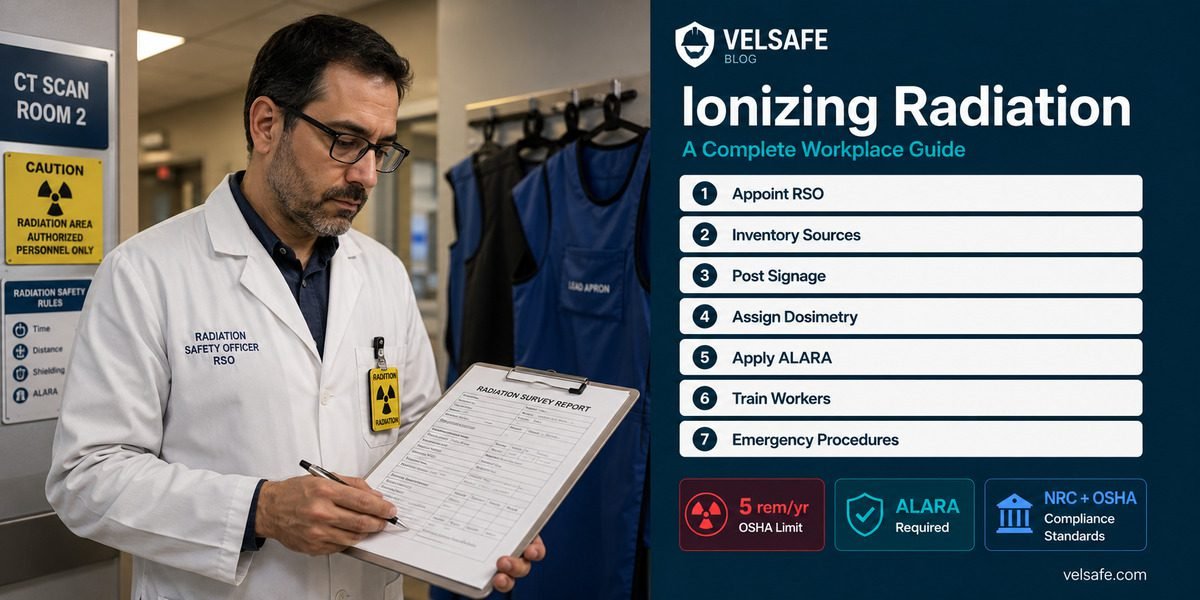
The RSO is responsible for implementing and overseeing all radiation protection activities. NRC-licensed facilities are required to have a named RSO on the licence. OSHA-regulated employers should designate a qualified person regardless of formal licence requirements. The RSO must understand applicable regulations, the specific radiation sources in the facility, and the controls required for each.
Expected Outcome
Named RSO with documented qualifications and written authority to stop unsafe practices.
2
Inventory All Radiation Sources
Objective: Know every source of ionizing radiation in the facility before designing controls.
List every radiation-producing machine, every radioactive material licence, every sealed source, and every location where radioactive material is used, stored, or generated as a byproduct. Include X-ray machines, CT scanners, fluoroscopy equipment, industrial gauges, irradiators, and any research sources. Each source requires its own shielding assessment and exposure evaluation.
Expected Outcome
Complete source inventory with location, type, activity or output, and applicable regulatory reference for each entry.
3
Classify Radiation Areas and Post Required Signage
Objective: Define controlled zones and ensure all entries are correctly marked.
Survey radiation fields around each source and classify areas according to OSHA 1910.1096 or NRC 10 CFR Part 20 criteria. Post Caution: Radiation Area signs where dose rates exceed 5 mrem/hr, Caution: High Radiation Area above 100 mrem/hr, and Danger: Very High Radiation Area above 500 rad/hr. Contamination area and airborne radioactivity postings are additional classifications that require separate surveys.
Expected Outcome
All controlled areas posted with correct signage. Survey records on file with date, instrument used, and dose rates measured.
4
Establish Personnel Dosimetry
Objective: Monitor individual worker dose to confirm exposures remain below limits and ALARA goals.
Assign dosimeters to all workers likely to receive 10 percent or more of the applicable annual dose limit. This threshold is set at 500 mrem/year under OSHA. Dosimeters must be exchanged and processed at regular intervals (typically monthly or quarterly depending on exposure levels) by an accredited dosimetry service. Results must be communicated to workers and records retained for the duration of employment plus 30 years.
Expected Outcome
Every occupationally exposed worker has an assigned dosimeter and receives dose reports on a defined schedule.
5
Implement Shielding, Time, and Distance Controls
Objective: Apply the three tools of ALARA to reduce dose below regulatory limits.
Time: rotate workers to limit individual dose accumulation. Minimise time in high-dose areas through procedure design and remote handling. Distance: exposure decreases with the square of the distance from a point source. Doubling the distance reduces exposure by 75 percent. Position workstations and rest areas accordingly. Shielding: select shielding materials matched to the radiation type. Lead for gamma and X-rays, polyethylene or water for neutrons, any solid material for alpha, plastic or glass for beta.
Expected Outcome
Documented ALARA analysis for each work task with time, distance, and shielding controls specified and verified through post-work dose comparison.
6
Train All Radiation Workers
Objective: Ensure every worker understands the hazards, the controls, and their own responsibilities.
OSHA 1910.1096 requires employers to inform workers of radiation hazards and their right to request dose information. NRC-licensed facilities must provide radiation safety training commensurate with the work performed. Training must cover: types of radiation and their hazards, facility-specific sources and controlled areas, ALARA principles, correct use of dosimetry, emergency response procedures, and reporting requirements for exposures and incidents.
Expected Outcome
All workers sign training completion records. Training is refreshed annually and whenever procedures or sources change.
7
Establish Emergency Response Procedures
Objective: Prepare workers to respond correctly to spills, equipment failures, lost sources, and overexposure events.
Emergency procedures must cover: how to evacuate a radiation area, how to respond to a radioactive spill, what to do if a sealed source cannot be retracted, how to report a suspected overexposure, and who to notify in each scenario. NRC regulations require prompt reporting of exposures exceeding certain thresholds. OSHA requires incident investigation and records. Drills are not mandated but are strongly recommended for facilities with sealed sources or contamination risk.
Expected Outcome
Written emergency procedures posted in all controlled areas. All workers can describe the correct response to the three most likely emergency scenarios in their work area.
PPE and Monitoring Equipment for Radiation Workers
PPE for radiation protection is different from other industrial PPE. Standard gloves and coveralls do not stop gamma or X-ray exposure. The function of PPE in radiation work is primarily to prevent contamination from radioactive particles, not to shield against penetrating radiation. Shielding is a structural or equipment control, not a wearable one for most applications.
Contamination Protection PPE
Nitrile or latex gloves (doubled for high contamination areas)
Tyvek or cotton lab coat
Boot covers and foot protection
Safety glasses or face shield for liquid work
Respiratory protection where airborne activity is possible
Monitoring and Detection Equipment
TLD or OSL dosimeter (personal, worn at collar or chest)
Electronic personal dosimeter for real-time feedback
Geiger-Mueller counter for contamination surveys
Ion chamber survey meter for dose rate measurement
Thyroid probe for iodine-131 uptake monitoring (nuclear medicine)
Lead Aprons in Healthcare Settings
Lead aprons are wearable shielding, not conventional PPE. In fluoroscopy and interventional radiology, lead aprons reduce scatter radiation to the torso. They do not protect the head, neck, eyes, or extremities. Wearing a lead apron does not eliminate the need for a dosimeter. Both are required. Lead aprons must be inspected annually for cracks using fluoroscopy or radiography, as a cracked apron provides no protection in the damaged area.
Radiation Safety Compliance Checklist
Employer Obligations
✓ RSO appointed with documented qualifications
✓ Complete source inventory on file
✓ Radiation surveys conducted and recorded
✓ All controlled areas posted with correct signs
✓ Dosimetry assigned to occupationally exposed workers
✓ Dose records retained for employment + 30 years
✓ ALARA programme documented
✓ Annual radiation safety training completed
✓ Emergency procedures written and posted
✓ Equipment inspected and calibrated on schedule
Worker Responsibilities
✓ Wear assigned dosimeter correctly at all times in controlled areas
✓ Read and follow all posted radiation area signs
✓ Apply ALARA: minimise time, maximise distance
✓ Report any dosimeter loss or suspected overexposure immediately
✓ Never eat, drink, or apply cosmetics in controlled areas
✓ Use contamination monitoring before leaving controlled areas
✓ Follow written emergency procedures for spills and alarms
✓ Request dose records from employer if needed
✓ Attend annual radiation safety training
✓ Report any unsafe practice or missing equipment to RSO
Key Takeaways
ALARA is the operating standard, not the regulatory limit
The 5 rem/year OSHA limit is a ceiling, not a target. A radiation protection programme that consistently approaches the limit is not compliant in spirit even if it is within the number. ALARA requires active work to keep doses as low as reasonably achievable through time, distance, and shielding controls documented for each work task.
Internal exposure is more dangerous than external for alpha and beta
Alpha particles stopped by skin are harmless externally but devastating if inhaled or ingested. Beta particles follow the same pattern. Contamination controls, respiratory protection in airborne areas, and prohibition of eating and drinking in controlled zones are the critical defences against internal exposure, not shielding.
Documentation is not optional: it is your legal defence and your safety record
Survey records, dosimetry results, training completions, ALARA analyses, and emergency procedure reviews are not administrative burdens. They are the evidence that demonstrates programme compliance during inspections, and they are the record that protects workers if a future health concern is linked to occupational exposure. Dose records must be retained for the duration of employment plus 30 years under both OSHA and NRC requirements.
Frequently Asked Questions
What is the difference between ionizing and non-ionizing radiation?
Ionizing radiation carries enough energy to remove electrons from atoms, creating ions that can damage DNA and tissue. It includes X-rays, gamma rays, alpha particles, beta particles, and neutrons. Non-ionizing radiation, such as radio waves, microwaves, visible light, and ultraviolet light, does not have sufficient energy to ionize atoms. The health risks and regulatory frameworks for the two categories are completely different.
Do I need a dosimeter if I work near an X-ray machine but I am not the operator?
It depends on your proximity and frequency of exposure. OSHA requires dosimetry for workers likely to receive 500 mrem or more per year. If you are regularly in or near the X-ray room during exposures, your employer should conduct an exposure assessment to determine whether dosimetry is required. Even if you are below the threshold, your employer may choose to monitor as a precaution and as a demonstration of ALARA compliance.
What does ALARA mean in practice for a radiation worker?
ALARA means actively reducing your radiation dose even when you are below regulatory limits. In practice this means: positioning yourself as far from the source as the work allows, completing tasks efficiently to minimise time in the radiation field, using all available shielding rather than bypassing it, and reporting any situation where your dose is higher than expected so the procedure can be reviewed. ALARA is a mindset, not a checklist item.
How often must radiation safety training be refreshed?
OSHA does not specify a frequency but requires that workers be informed of radiation hazards. NRC-licensed facilities are required to provide training commensurate with the work performed and to refresh it when procedures or sources change significantly. Industry best practice and most NRC licence conditions require annual refresher training. Training must always be updated when new radiation sources are introduced or when a worker moves to a different role.
Can pregnant workers be assigned to radiation work?
Pregnant workers may declare their pregnancy to receive additional dose limits under NRC regulations: 5 mSv (0.5 rem) for the entire gestation period, compared to 50 mSv annually for standard radiation workers. Declaration is voluntary. Once declared, the employer must ensure the foetal dose does not exceed the limit, which may require job reassignment or enhanced monitoring. Employers cannot require disclosure of pregnancy.
What should I do if I suspect I have received an overexposure?
Report it immediately to your RSO. Do not wait for dosimeter results. If you experienced a known high-dose event, seek a medical evaluation. NRC regulations require the facility to notify the NRC within 24 hours if a worker receives a dose exceeding specific thresholds. OSHA has similar notification requirements. Your employer is required to investigate overexposure events, determine the root cause, and take corrective action. You have the right to request your dose records at any time.
Is background radiation counted toward my occupational dose limit?
No. Occupational dose limits apply to dose received from work-related radiation sources only. Natural background radiation (from soil, cosmic rays, and food) and medical radiation received as a patient are not counted toward your occupational limit. However, the cumulative biological effect on your body includes all sources, which is why keeping occupational exposure ALARA matters even when the regulatory limit has not been approached.
Government and Regulatory Sources
Government and Regulatory Sources
OSHA. 29 CFR 1910.1096: Ionizing Radiation : the primary OSHA standard governing occupational ionizing radiation exposure in general industry.
NRC. 10 CFR Part 20: Standards for Protection Against Radiation : NRC dose limits, posting requirements, dosimetry standards, and ALARA requirements for licensed facilities.
OSHA. Ionizing Radiation Safety and Health Topics : OSHA guidance on health effects, exposure control, and employer obligations across sectors.
NRC. Radiation Health Effects : NRC overview of stochastic and deterministic health effects of ionizing radiation.
CDC NIOSH. Radiation Topics : NIOSH occupational radiation resources including exposure guidelines and workplace controls.
Build a Radiation Safety Programme That Holds Up to Inspection
The gap between regulatory compliance and genuine safety is filled by documentation, training, and ALARA thinking. Find more workplace safety resources at velsafe.com.
VelSafe Staff is the editorial team at VelSafe.com, a workplace safety and compliance content platform. Our team of safety professionals, regulatory specialists, and compliance writers produces guides, tips, and insights on OSHA regulations, pharmaceutical GMP, healthcare compliance, and occupational health across construction, manufacturing, oil and gas, and life sciences sectors..