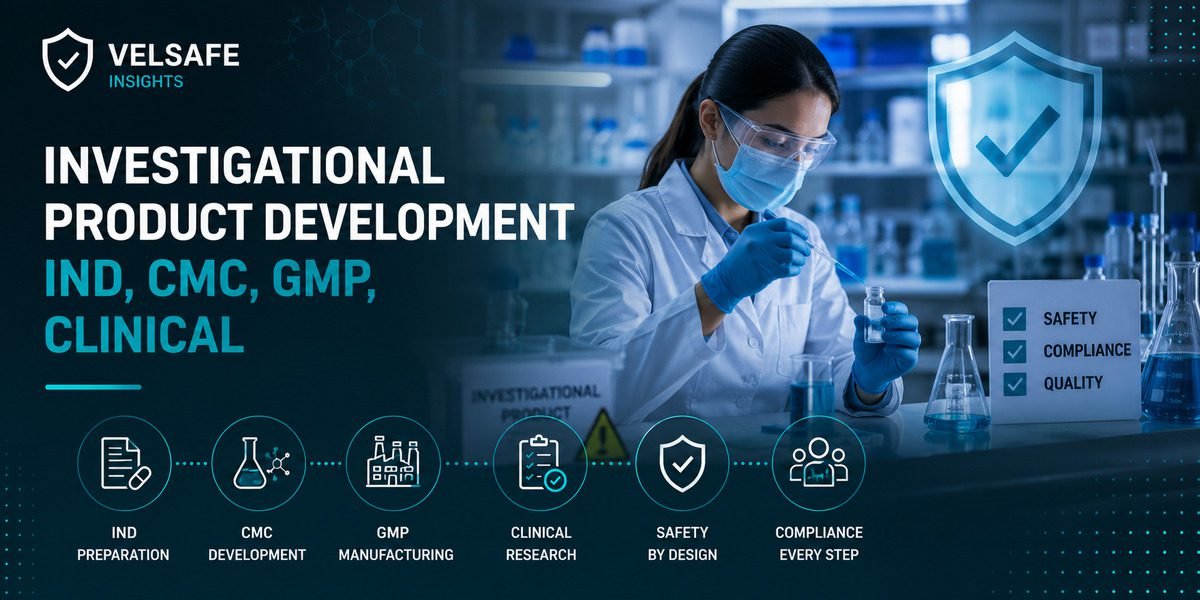
Why Most INDs Run Into Trouble Before Phase III and What the CMC Data Pattern Shows
FDA places approximately 30% of IND applications on clinical hold annually. The leading cause is not safety data: it is CMC deficiencies: inadequate characterisation, incomplete manufacturing controls, and process validation gaps that reviewers flag before a single subject is dosed. This article examines what the regulatory framework actually requires and where development programmes consistently fall short.
IND
The Gateway to Clinical Trial Supply
An Investigational New Drug application to FDA is the legal mechanism by which a sponsor obtains authority to ship investigational product across state lines and administer it to human subjects. No clinical trial in the US may begin without an active IND.
FDA, IND Application Overview
CMC
Chemistry, Manufacturing and Controls
CMC is the regulatory discipline covering the composition, manufacture, and quality control of an investigational drug. CMC development evolves across Phase I through Phase III and into the NDA/BLA, with increasing specificity at each stage as process knowledge accumulates.
FDA, Pharmaceutical Development Q8
21 CFR
312: The GMP Framework for Clinical Supply
21 CFR Part 312 governs IND applications and the obligations of sponsors and investigators. For manufacturing, investigational products must comply with GMP requirements appropriate to the phase of investigation, with Phase I allowing flexibility that later phases do not.
21 CFR Part 312, eCFR
Investigational product development occupies the space between early drug discovery and commercial manufacturing. It encompasses every activity required to produce a drug substance and drug product that is safe enough and characterised enough to administer to humans in a clinical trial, while simultaneously building the analytical, process, and quality knowledge that will eventually support regulatory approval.
This is one of the most technically demanding and regulatory-intensive disciplines in pharmaceutical development. A compound that fails CMC development never reaches patients. A compound that is manufactured without adequate GMP controls produces unreliable clinical data and creates patient safety risk. Understanding the structure of investigational product development, its regulatory framework, and the quality systems that govern it is foundational knowledge for everyone working in clinical-stage pharmaceutical and biotechnology organisations.
Key Intelligence: Investigational Product Development
CMC Is a Living Document
CMC information in the IND evolves as development progresses. Sponsors amend their IND as manufacturing processes change, specifications tighten, and analytical methods are validated. FDA expects CMC evolution; what it does not accept is change without notification.
Phase Defines GMP Expectations
Phase I manufacture has more GMP flexibility than Phase III. The expectation is that GMP compliance becomes increasingly rigorous as the product moves toward approval. A Phase I facility must demonstrate basic GMP controls; a Phase III facility must demonstrate commercial-equivalent practices.
Clinical Hold Is the Highest Risk
FDA may place an IND on clinical hold if it believes the product presents unreasonable risk to subjects. CMC deficiencies, inadequate safety data, or GMP failures at the manufacturing site are all grounds for clinical hold. Resolving a clinical hold can take months and cost a trial its timeline.
1. The IND Application: Structure and Purpose
An Investigational New Drug application is the submission to FDA that authorises a sponsor to begin clinical investigation of a drug in the United States. Without an active IND, no investigational drug may be shipped across state lines or administered to human subjects in a clinical trial. The IND is not an approval; it is a notification and authorisation that becomes effective 30 days after FDA receives it, unless FDA places the trial on clinical hold within that period.
IND Technical Sections
An IND contains three major technical sections: Animal Pharmacology and Toxicology (preclinical safety data supporting first-in-human administration); Chemistry, Manufacturing, and Controls (composition, manufacture, and quality control of the investigational product); and Clinical Protocols and Investigator Information (study design, subject selection, and investigator qualifications). Each section must be sufficient to support the proposed clinical investigation.
FDA, IND Application
IND Types
The most common IND type is the Commercial IND, filed by a pharmaceutical company developing a product for commercial sale. An Investigator IND is filed by an individual physician conducting research not intended for commercial application. An Emergency Use IND allows FDA to authorise a single use of an investigational drug before a formal IND can be filed. Expanded Access INDs cover use outside a clinical trial for patients with serious or life-threatening conditions.
21 CFR Part 312
IND Amendments
Once an IND is active, sponsors must submit amendments for any changes to the protocol, manufacturing process, safety information, or investigator roster. Protocol amendments are required before implementing any protocol change. Information amendments cover significant new safety, CMC, or preclinical information. Annual reports summarise the prior year’s clinical and manufacturing activity and update the IND status. IND maintenance is an ongoing obligation throughout the clinical development programme.
21 CFR 312.31, Information Amendments
2. CMC Development Across Clinical Phases
Chemistry, Manufacturing, and Controls development is not a single event but a progressive programme that builds product and process knowledge from the first synthesis of a drug substance through the final commercial process. The regulatory expectation is that CMC rigor scales with clinical phase: early-phase CMC may use simplified methods and fewer batches; late-phase CMC must demonstrate the commercial-equivalent process and analytical methods that will support the NDA or BLA.
CMC Maturity Requirements by Phase
Phase I: Safety, First-in-HumanFoundational
Limited batch data, simplified release testing, preliminary specifications. Process not required to be commercial-scale. Drug substance synthesis must be reproducible and drug product must meet basic identity, purity, and potency requirements.
Phase II: Proof of Concept, Dose FindingDeveloping
Process development advances, analytical methods begin formal development and qualification. Stability programme initiated. Comparability assessments conducted if manufacturing changes occur. Container-closure system qualified.
Commercial-scale process demonstrated on registration batches. Analytical methods fully validated. Specifications set based on clinical and stability data. Long-term stability data accumulated. Manufacturing site ready for pre-approval inspection.
NDA/BLA SubmissionFull Regulatory Package
Complete CMC section submitted: drug substance and drug product manufacturing descriptions, validated analytical methods, full specification justification, container-closure system data, stability data at commercial storage conditions, and pre-approval inspection-ready facilities.
FDA, ICH Q8 Pharmaceutical Development | FDA, CMC Information for IND Meetings
3. GMP for Investigational Products: What 21 CFR 312.23 Requires
Investigational products must be manufactured under GMP conditions appropriate to the phase of investigation. For Phase I products, FDA’s primary concern is that the product is safe for human administration: that it is what it is labelled to be, free from contamination, and at the potency and purity described in the IND. For Phase III products, manufacturing must reflect the commercial process because the registration batches produced during Phase III are the manufacturing evidence submitted in the NDA or BLA.
GMP Element
Phase I
Phase II/III
Commercial
Batch Records
Required; may be simplified
Full batch records required
Full batch records required, retained per 211.180
Analytical Methods
Qualified; validation not required
Validation in progress/complete
Full ICH Q2 validation required
Stability
Preliminary data; assigned expiry supported by data
Formal ICH Q1A programme ongoing
Long-term data at commercial conditions
Process Validation
Not required; process qualification acceptable
Ongoing process qualification; validation initiated
Full process validation per FDA 2011 guidance
QC Release
Required before administration to subjects
Required; Qualified Person release in EU
Full QC unit release per 211.22
FDA, Manufacturing Controls for Investigational Drug Products
4. Drug Substance and Drug Product Development
Investigational product development encompasses two distinct but interdependent workstreams: drug substance (API) development and drug product (finished dosage form) development. Each has its own CMC requirements, development milestones, and regulatory submissions.
Drug Substance (API) Development
The drug substance is the active pharmaceutical ingredient before it is formulated into a dosage form. Drug substance development encompasses: synthetic route development and optimisation; impurity identification and control; physical characterisation (polymorphism, particle size, solubility); analytical method development for identity, assay, and impurity profiling; reference standard qualification; and drug substance specifications development.
The ICH Q11 guideline governs the development and manufacture of drug substances. A key focus of drug substance CMC is impurity control: any impurity above qualification thresholds must be characterised and toxicologically qualified before administration to humans. Novel impurities emerging from process changes during development require reassessment.
ICH Q11, Drug Substance Development
Drug Product (Finished Dosage Form) Development
The drug product is the finished dosage form administered to clinical trial subjects: tablet, capsule, injectable solution, lyophilised powder, or other form. Drug product development encompasses: formulation development (excipient selection, compatibility, stability); dosage form design; manufacturing process development; container-closure system selection and qualification; and drug product specifications development.
ICH Q8 governs pharmaceutical development of drug products. The concept of pharmaceutical development is quality by design: understanding the link between formulation and process parameters and product quality attributes so that product quality is built in rather than tested in.
ICH Q8, Pharmaceutical Development
5. Clinical Supply Operations and Labelling
Clinical supply operations covers the manufacture, packaging, labelling, storage, distribution, and accountability of investigational product from the manufacturing site to the clinical trial site and, ultimately, to the patient. This is a complex, multi-party operation that must satisfy both GMP requirements and the specific protocol requirements of each clinical trial.
1
Investigational Product Labelling
Investigational products must bear labels that identify the product as investigational, state the protocol number, identify the sponsor and contact information, include storage conditions and expiry date, and carry the statement “Caution: New Drug : Limited by Federal Law to Investigational Use.” Blinded trial labels must maintain blinding while meeting all labelling requirements. Labels are defined in the protocol and approved by the IRB.
2
Randomisation and Blinding
Blinded trials require manufacturing and packaging procedures that maintain treatment blinding while allowing emergency unblinding. The randomisation code must be held by an independent party. Blinding procedures must be validated to confirm that blinded product is indistinguishable by appearance, weight, taste, and smell. Unblinding procedures must allow immediate access to treatment assignment when medically necessary.
3
Drug Accountability
Sponsors and investigators must maintain complete records of investigational product disposition: units shipped, received, dispensed, returned, and destroyed. Drug accountability records must reconcile every unit from the sponsor’s inventory to the investigational site to the subject to return or destruction. FDA inspectors review drug accountability records during site inspections and pre-approval inspections at the sponsor’s facility.
4
Cold Chain and Storage
Many investigational biologics and specialty products require controlled temperature storage and cold-chain transport. The sponsor must qualify the cold chain from manufacturing through site delivery, monitor temperature during transit, and define excursion management procedures. Temperature excursion events must be investigated and a disposition decision made before the product is used in a subject, based on stability data supporting the excursion conditions.
6. Pre-Approval Inspections and the Path to NDA/BLA
As a drug development programme approaches NDA or BLA submission, the manufacturing facilities that produced the pivotal trial batches and that will manufacture the commercial product become subject to FDA pre-approval inspection (PAI). The PAI evaluates whether the facility’s manufacturing processes, analytical methods, and quality systems are capable of consistently producing the product described in the application. A failed PAI is one of the most serious delays a development programme can encounter.
What FDA Reviews in a PAI
FDA inspectors compare the manufacturing information submitted in the NDA or BLA to the actual practice at the facility. They review batch records for the pivotal trial batches, validate that the process described in the application matches what was actually done, assess the quality system, review analytical method validation data, inspect equipment qualification records, and evaluate the facility’s CAPA system. Any significant discrepancy between the application and actual manufacturing practice is a finding that can prevent approval.
Common PAI Findings
The most common PAI findings include: data integrity deficiencies in laboratory records; process deviations during pivotal trial manufacture not described in the application; inadequate out-of-specification investigation procedures; inadequate process validation; and discrepancies between the analytical methods in the submission and the validated methods in use. Each of these can delay approval while the sponsor responds with corrective actions or a remediated re-inspection.
PAI Readiness Preparation
Sponsors should begin PAI readiness preparation at least 18 months before the planned NDA or BLA submission. This includes: a gap assessment of the facility’s quality systems against current expectations; reconciliation of all manufacturing and analytical methods against the submission draft; resolution of all open CAPAs related to the pivotal manufacturing campaign; data integrity assessment of all laboratory data associated with the submission; and a mock PAI conducted by qualified internal or external auditors.
Key Takeaways
The IND Is a Living Document, Not a One-Time Filing
An IND requires ongoing maintenance throughout the clinical development programme. Protocol amendments, information amendments, annual reports, and manufacturing change notifications must all be submitted on time. An IND that is not actively maintained reflects poorly on the sponsor’s regulatory management capability and can create compliance vulnerabilities.
GMP Expectations Scale With Clinical Phase
Phase I allows significant manufacturing flexibility compared to Phase III. This flexibility is not a licence to produce poorly controlled product; it reflects the reality that process knowledge is limited early in development. What it means practically is that Phase I GMP deficiencies that would be acceptable for a first-in-human study are not acceptable for a pivotal trial.
CMC Failures Are Clinical Failures
A clinical trial that uses out-of-specification product, product manufactured without adequate GMP controls, or product that does not match the IND description produces unreliable data that may not support an NDA or BLA. CMC failures are not manufacturing problems isolated from clinical results; they directly undermine the evidentiary value of the trial and may invalidate years of clinical investment.
PAI Readiness Is an 18-Month Programme
Pre-approval inspection preparation cannot begin at the time of submission. The quality systems, data integrity posture, process validation evidence, and analytical method validation package that FDA will inspect must all be in place before the application is filed. Starting PAI readiness 18 months before the planned submission date is the minimum preparation timeline for a facility without prior commercial approval experience.
Clinical Hold Is Preventable With Proactive CMC Management
The majority of clinical holds for CMC reasons are preventable. They typically result from inadequate impurity characterisation, insufficient stability data to support the proposed expiry, or manufacturing at a site that does not have adequate GMP systems. Proactive engagement with FDA through pre-IND meetings, IND amendments that anticipate rather than react to manufacturing changes, and rigorous internal CMC review significantly reduces clinical hold risk.
Drug Accountability Is a Regulatory and Ethical Obligation
Incomplete drug accountability records are both a regulatory finding and a signal that investigational product may have been used outside the protocol. Every unit must be accounted for from manufacture to disposition. Drug accountability failures identified during a PAI or site inspection are treated as GCP and GMP violations simultaneously and can jeopardise both the trial data and the approval application.
Frequently Asked Questions
What is the difference between an IND and an NDA?
An Investigational New Drug application authorises a sponsor to begin clinical investigation of an unapproved drug in the United States. It is a notification to FDA, not an approval, and becomes effective 30 days after filing if FDA does not place the study on clinical hold. A New Drug Application is submitted after clinical trials are complete and seeks FDA approval to market the drug for a specific indication. The NDA must demonstrate safety and efficacy based on substantial evidence from adequate and well-controlled clinical trials, and must include the complete CMC package for the commercial manufacturing process.
What triggers a clinical hold on an IND?
FDA may place an IND on clinical hold if it determines that human subjects would be exposed to unreasonable risk. Grounds for clinical hold include: inadequate information in the IND to assess risk; evidence of unreasonable or significant risk from preclinical or early clinical data; inadequate CMC information to assess the safety of the product proposed for human administration; investigations conducted by clinical investigators who are not qualified; or GMP failures at the manufacturing facility. Resolving a clinical hold requires a complete written response to FDA’s specific deficiency letter, and FDA has 30 days to review the response. A partial or inadequate response restarts the 30-day clock.
What is a pre-IND meeting and when should it be requested?
A pre-IND meeting is a formal meeting with FDA before an IND is submitted, in which the sponsor presents the proposed development programme and receives FDA feedback on study design, CMC requirements, preclinical data sufficiency, and clinical protocol. Pre-IND meetings are particularly valuable for first-in-class compounds, complex biologics, and programmes where the appropriate regulatory pathway is uncertain. They should be requested 3 to 6 months before the planned IND submission, using FDA’s formal meeting request process under the PDUFA meeting management procedures.
How does ICH Q8 Quality by Design apply to investigational products?
ICH Q8 introduced the concept of pharmaceutical development as a systematic approach to designing a product and manufacturing process to meet defined objectives, based on an understanding of the relationship between formulation and process variables and product quality. For investigational products, QbD means characterising the design space of the formulation and manufacturing process during development so that the acceptable ranges of key process parameters are understood before commercial-scale manufacture. This knowledge supports regulatory flexibility in the NDA or BLA, allowing post-approval manufacturing changes within the design space without supplemental submissions.
What are registration batches and why are they critical?
Registration batches are the batches of drug substance and drug product manufactured at commercial or representative scale using the commercial process and facilities, which are placed on stability and whose manufacturing data is included in the NDA or BLA. Registration batches serve two purposes: they demonstrate that the commercial process is capable of consistently producing the product at scale, and they provide the stability data at commercial storage conditions that establishes the approved shelf life. If registration batches fail specification during stability, the development programme may need to reformulate or remanufacture before submission, which can delay the NDA or BLA by one to two years.
What is the role of a Contract Manufacturing Organisation (CMO) in investigational product development?
Many clinical-stage companies rely on Contract Manufacturing Organisations for drug substance synthesis, drug product manufacture, analytical testing, or some combination of all three. When a CMO is used, the sponsor remains the IND holder and retains responsibility for the quality of the investigational product, regardless of which organisation physically produced it. The sponsor must qualify the CMO, audit its quality systems, maintain a quality agreement that defines responsibilities, and ensure that the CMO’s operations are reflected accurately in the IND. CMO involvement does not reduce the sponsor’s regulatory obligations; it requires the sponsor to manage those obligations through a supply chain.
What is the IMPD and how does it differ from the IND’s CMC section?
The Investigational Medicinal Product Dossier (IMPD) is the EU equivalent of the CMC section of a US IND. It is submitted to the competent authority of each EU member state where a clinical trial will take place, and it provides the quality information necessary to assess the safety of the investigational medicinal product. The IMPD must comply with the EU Clinical Trials Regulation (EU 536/2014) and EudraLex Volume 10 requirements. For global development programmes conducting trials in both the US and EU, sponsors typically maintain the quality data in a unified CMC document and translate it into both IND and IMPD format, as the content requirements are similar but the format and some specific requirements differ.
Government and Regulatory Sources
Government and Regulatory Sources
FDA. Investigational New Drug (IND) Application: IND structure, amendment requirements, annual reports, and clinical hold procedures.
21 CFR Part 312: Investigational New Drug Application : the complete federal regulation governing INDs, sponsor obligations, and investigator responsibilities.
FDA/ICH. Q8 Pharmaceutical Development: the ICH guideline governing the systematic development of drug products using quality by design principles.
FDA/ICH. Q11 Development and Manufacture of Drug Substances: guidance on drug substance CMC development and manufacturing description for regulatory submissions.
FDA. CMC Information for IND Meetings: guidance on what CMC information FDA expects at pre-IND and Phase I/II/III development meetings.
FDA. Manufacturing Controls for Investigational Drug Products for Human Use: GMP expectations for investigational products across clinical phases.
Related VelSafe Articles
Guides
Process Validation: A Complete Guide for GMP Manufacturers
FDA’s three-stage process validation lifecycle, IQ/OQ/PQ protocols, and continued process verification requirements for pharma and medical device GMP manufacturers.
Guides
Medical Device Adverse Event Reporting: 5 Regions
FDA MDR, EU MDR, Health Canada, PMDA, and TGA reporting obligations compared for medical device and pharmaceutical manufacturers across five jurisdictions.
Law
Cleanroom Compliance: FDA and EU GMP Requirements
ISO 14644, FDA 21 CFR Part 211, and EU GMP Annex 1 cleanroom requirements directly applicable to investigational product manufacturing environments.
PHARMACEUTICAL DEVELOPMENT
CMC Gaps Are the Leading Cause of Clinical Hold. Build the Programme Before the IND.
Find more pharmaceutical GMP, IND, and CMC compliance resources at VelSafe.
VelSafe Staff is the editorial team at VelSafe.com, a workplace safety and compliance content platform. Our team of safety professionals, regulatory specialists, and compliance writers produces guides, tips, and insights on OSHA regulations, pharmaceutical GMP, healthcare compliance, and occupational health across construction, manufacturing, oil and gas, and life sciences sectors..