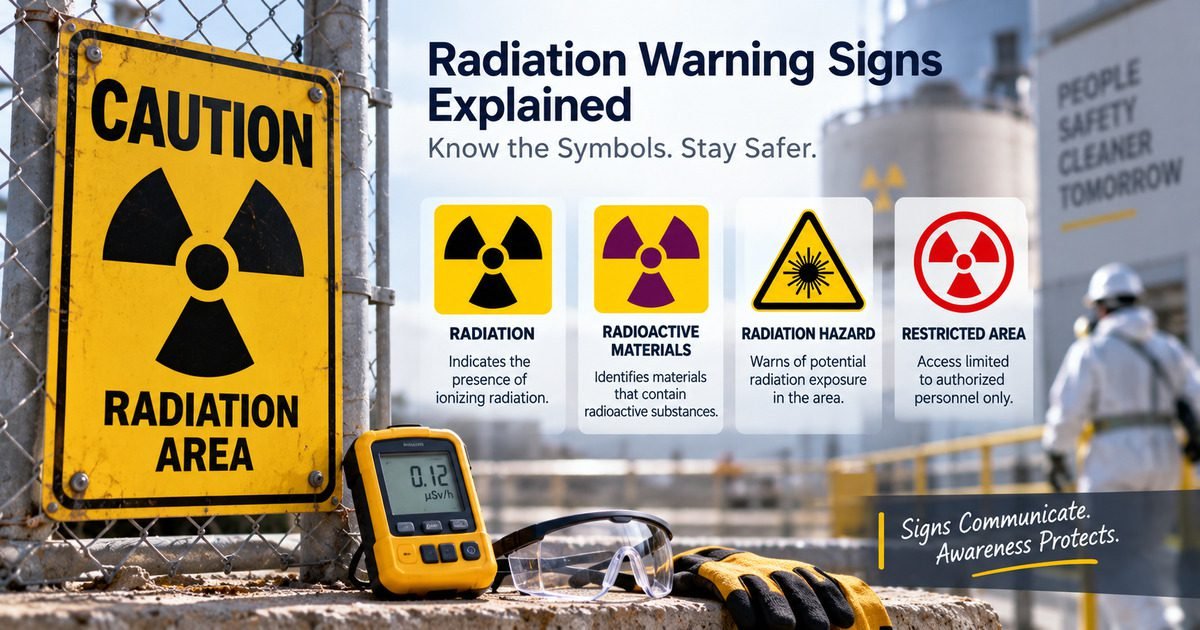
TIPS: Radiation Safety Awareness
Eight Signs, Eight Different Meanings:
Reading Radiation Warnings Correctly
Most workers encounter radiation warning signs without knowing the difference between them. Each symbol has a specific meaning and requires a specific response. Getting them wrong is not a procedural error, it is a life-safety failure.
1946
Trefoil Created
The trefoil radiation symbol was created at the University of California, Berkeley and became an international standard via ISO 361 in 1963.
2007
Red Triangle Added
ISO 21482 introduced the supplementary red triangle symbol for high-level ionising radiation sources, adopted by IAEA to reduce uninformed contact fatalities.
10 CFR
Part 20
NRC 10 CFR Part 20 governs US radiation area posting requirements, defining when each sign type is required based on dose rate thresholds.
NRC 10 CFR Part 20
Radiation is silent. The signs are not. In hospitals, laboratories, factories, nuclear facilities, and construction sites, radiation warning signs carry information that can protect your life if you know how to read them.
Most workers who encounter these signs have never been formally trained on what each one means, what the differences between them are, or what they are required to do when they see one. These tips close that gap.
Radiation Warning Sign Tips
Tip 1: Recognise the Classic Trefoil and Know What It Requires of You
The trefoil is the universal ionising radiation hazard symbol. Three blades arranged around a central dot, printed in black or magenta on a yellow background. It was created in 1946 at the University of California, Berkeley and became an international standard through ISO 361 in 1963.
When you see the trefoil, radiation from ionising sources is present. This includes X-ray machines, radioactive materials, linear accelerators, and particle accelerators. It does not apply to non-ionising radiation such as microwaves or lasers, which use different symbols.
Do not enter an area marked with the trefoil unless you are trained, authorised, and equipped. The sign is not a warning to be cautious. It is a barrier that requires qualification to cross.
Worker Tip
Yellow backgrounds on radiation signs are deliberate. Yellow grabs attention universally, is visible from a distance, and signals caution in every country where these standards apply. If you see yellow with the trefoil, stop and read the full sign before proceeding.
Tip 2: The New Red Triangle Symbol Means One Thing Only: Get Away
In 2007, the International Atomic Energy Agency (IAEA) and ISO introduced a supplementary radiation warning symbol: a red triangle containing a black trefoil, radiation waves, a skull and crossbones, and a running figure. This is ISO 21482.
Testing in 11 countries confirmed that people with no prior radiation training understood this symbol to mean: danger, run away, do not touch. That is exactly what it means.
This symbol is placed on the internal shielding or components of sealed radioactive sources in IAEA categories 1 to 3. It is hidden during normal use. If you can see this symbol, it means something has been opened or dismantled that should not have been. Leave the area immediately and notify safety personnel.
Do
Leave the area immediately if you encounter the red triangle ISO 21482 symbol. It is not a routine caution sign. It indicates exposure to a high-activity sealed source that requires immediate evacuation and emergency notification.
Avoid
Treating it like the standard trefoil. The red triangle is specifically designed for situations where untrained individuals may encounter a dangerous source. The correct response is immediate evacuation, not cautious entry.
Tip 3: Understand the Difference Between Radiation Area and High Radiation Area Signs
Not all trefoil signs carry the same level of urgency. The text accompanying the symbol tells you how serious the hazard is.
Caution: Radiation Area
A controlled zone where radiation levels are elevated but manageable with appropriate precautions. Dosimeters, time limits, and PPE requirements typically apply.
Caution: High Radiation Area
Radiation levels can cause harm after short exposure. Entry is typically restricted to authorised personnel only, and dosimetry and protective equipment are mandatory.
Danger: Very High Radiation Area
A brief exposure could cause injury or death. These areas have the strictest access controls and require specific authorisation even for trained radiation workers.
Quick Win
Before entering any area with a radiation sign, read the full text, not just the symbol. The words Caution, Warning, or Danger tell you the severity. A dosimeter, time restriction notice, or PPE requirement listed on the sign is a condition of entry, not optional guidance.
Tip 4: Radioactive Material Signs Apply to Containers and Storage, Not Just Areas
The trefoil appears not only on walls and doors but on containers, packages, medical devices, and industrial equipment. A sign reading Caution: Radioactive Material or Warning: Radioactive Material on a container means the contents are radioactive and subject to strict handling rules.
Most radioactive material is shielded during normal use, but improper handling, accidental drops, or attempted opening can release exposure. Do not open, move, or disturb any container marked with the trefoil unless you have been specifically trained and authorised to handle that material.
Supervisor Reminder
DOT radioactive transport labels use a three-category system: Category I White (minimal risk), Category II Yellow (moderate), Category III Yellow (high, strict controls required). Confirm that all staff who handle incoming radioactive shipments can identify these labels and know what each category requires.
Tip 5: Contamination Area Signs Require Different Precautions Than Radiation Area Signs
A contamination area sign does not indicate that radiation levels are high in the air. It indicates that radioactive particles, which may be invisible, are present on surfaces, tools, floors, or in the atmosphere as dust or droplets. These particles can stick to clothing, hands, and equipment and spread to other areas or people who were never in the original zone.
Before entering a contamination area, put on protective gear including gloves, boot covers, and a lab coat or protective suit. Do not touch walls, equipment, or surfaces unless necessary. Do not eat, drink, or use your phone inside the zone. Use a radiation monitor before exiting and decontaminate before returning to clean areas.
Do
Treat contamination area signs as exit-requiring as well as entry-requiring. Leaving a contamination zone requires confirming you have not carried particles out. Decontamination before exit is not optional.
Avoid
Assuming that because you feel no immediate effects, no exposure has occurred. Contamination can be present on your skin or clothing without any sensation. The monitor tells you whether you are clear, not how you feel.
Tip 6: Airborne Radioactivity Signs Mean Respiratory Protection Is Mandatory
An Airborne Radioactivity Area sign indicates that radioactive gases, dust, or particles may be suspended in the air. Inhaling these contaminants creates internal exposure, where radioactive material deposits inside the body, which can be more dangerous than external exposure and is not immediately detectable.
Entering an airborne radioactivity area requires respiratory protection: an N95 mask at minimum, and in many cases a Powered Air-Purifying Respirator (PAPR) or a supplied-air system depending on the concentration. Follow posted time restrictions for the zone. Air monitoring data is continuously tracked in these areas and determines how long workers may remain.
Worker Tip
Respiratory protection requirements for airborne radioactivity areas are determined by air monitoring data, not by how the air looks or smells. Radioactive particles are invisible and odourless. Never enter an airborne radioactivity zone without first confirming the current air monitoring readings and the required respiratory protection level.
Tip 7: X-Ray Area Signs Apply Only When Equipment Is Active
X-ray machines in hospitals, clinics, veterinary offices, and industrial inspection settings emit ionising radiation only when the machine is active. Stay out of X-ray areas when machines are active. Follow any light indicators or Radiation Active signs posted at the entrance. Use lead aprons, shields, or barriers as required for your role.
Quick Win
If you work near X-ray equipment and have not been assigned a personal dosimeter, ask your radiation safety officer. Workers with regular proximity to active X-ray equipment should have cumulative dose tracking. Under OSHA and NRC requirements, this is an employer obligation.
Tip 8: Do Not Confuse Laser Radiation Signs or Biohazard Signs with Radiation Signs
Laser signs are not radiation signs. A sign reading Caution: Laser Radiation indicates high-intensity light that can damage eyes or skin. Laser radiation has no connection to radioactivity.
Biohazard signs are not radiation signs. The biohazard symbol warns of biological agents such as viruses or bacteria. Some laboratory environments contain both biohazardous materials and radioactive materials. If you see both symbols in the same space, protocols for both hazards apply simultaneously and specialised training is required before entry.
Do
Read the full sign including its text label when you are uncertain which hazard a symbol represents. Text confirms whether a sign means radiation, laser, biological, or chemical hazard.
Avoid
Assuming that any triangular yellow sign with a symbol is a radiation sign. Laser, chemical, electrical, and biological hazards all use similar visual formats with different symbols and different required responses.
Quick Reference: Radiation Signs and Required Actions
Sign
What It Means
Required Action
Trefoil (ISO 361)
Ionising radiation present
Do not enter without authorisation and training
Red Triangle (ISO 21482)
High-activity sealed source exposed
Leave immediately. Notify safety personnel
High Radiation Area
Short exposure can cause harm
Authorised personnel only; dosimeter and PPE mandatory
Contamination Area
Radioactive particles on surfaces
Full protective gear; decontaminate before exit
Airborne Radioactivity
Radioactive particles in the air
Respiratory protection mandatory; follow air monitoring data
X-Ray Area
Ionising radiation when machine is active
Stay out when active; use shielding; dosimeter for regular proximity
Radiation Sign Awareness Checklist
Confirm These Before Entering Any Radiation-Controlled Area
✓ I can identify the trefoil and know it indicates ionising radiation
✓ I know the difference between the standard trefoil and the red triangle ISO 21482 symbol
✓ I have read the full text on the sign, including whether it says Caution, Warning, or Danger
✓ I understand the difference between a Radiation Area and a High Radiation Area
✓ I am wearing the PPE specified for this zone before I cross the threshold
✓ I have a dosimeter or monitoring device if required by the posted sign or site rules
✓ I know the decontamination procedure for this zone before I enter
✓ I know who to notify if I observe the red triangle symbol or any unexpected radiation reading
✓ I can distinguish laser warning signs and biohazard signs from radiation signs
Key Takeaways
The trefoil is a barrier, not a caution
The radiation trefoil does not mean proceed carefully. It means stop unless you are trained, authorised, and equipped. Every radiation area sign is a conditional barrier that requires qualification to cross, not a suggestion to be mindful.
The red triangle has exactly one correct response
ISO 21482 was designed so that untrained people would know to evacuate without reading text or receiving instruction. If you see it, leave immediately and notify safety personnel. There is no scenario in which investigating is the right response.
Reading the text is as important as recognising the symbol
The word Caution, Warning, or Danger changes the required response. Contamination area signs and airborne radioactivity signs require completely different controls than standard radiation area signs. Workers who only look at the trefoil and not the accompanying text are missing the information that determines what they must actually do.
Frequently Asked Questions
What does the radiation trefoil symbol actually mean?
The trefoil means ionising radiation is present in the area or in the container it is affixed to. It does not tell you the level of danger by itself. The text label (Caution, Warning, or Danger) and additional signage at the location tell you what controls apply and whether you are authorised to proceed.
Is the red triangle radiation symbol the same as the standard trefoil?
No. The ISO 21482 red triangle is a supplementary symbol designed specifically to communicate danger to untrained people who may encounter a compromised sealed radioactive source. It means evacuate immediately. The standard trefoil indicates the presence of radiation and requires trained, authorised personnel to assess the situation.
What is the difference between a Radiation Area and a High Radiation Area?
A Radiation Area has elevated radiation levels manageable with appropriate precautions and PPE. A High Radiation Area has levels that can cause harm after brief exposure and is typically restricted to authorised personnel with mandatory dosimetry. A Very High Radiation Area can cause injury or death from brief exposure and requires specific written authorisation even for trained workers.
Do I need a dosimeter in every area with a radiation sign?
Not necessarily in every controlled area, but dosimetry is required wherever posted and wherever NRC or OSHA regulations require monitoring. Workers who regularly work near X-ray equipment or spend time in radiation-controlled areas should discuss dosimeter assignment with their radiation safety officer. The posted sign may specify monitoring requirements for that zone.
Why is decontamination required before leaving a contamination area?
Radioactive particles can adhere to skin, clothing, and equipment and spread to clean areas when you leave. Decontamination prevents the spread of contamination to other workers, visitors, and parts of the facility. Radiation monitoring at the exit confirms whether decontamination is complete before you re-enter uncontrolled areas.
What respiratory protection is required in an Airborne Radioactivity Area?
The required level depends on air monitoring data for that specific area and time. An N95 respirator is the minimum for low concentrations of radioactive particles, but higher concentrations may require a PAPR (Powered Air-Purifying Respirator) or a supplied-air respirator. Never determine respiratory protection requirements by judgement alone. Check current air monitoring readings and posted requirements before entry.
Is a laser radiation sign the same as a radiation warning sign?
No. A laser radiation warning sign indicates high-intensity light hazards, not ionising radiation or radioactivity. The hazards and required controls are completely different. Laser areas require eye protection and specific training for the laser class involved. Ionising radiation areas require dosimetry, time controls, shielding, and authorisation. Always read the full sign text to identify which hazard type applies.
Government and Regulatory Sources
Government and Regulatory Sources
- OSHA. Ionizing Radiation Safety and Health Topics : OSHA requirements, PELs, and employer obligations for ionising radiation in general industry.
- NRC. 10 CFR Part 20: Standards for Protection Against Radiation : the primary US federal standard governing radiation exposure limits, posting requirements, and area classifications.
- IAEA. Supplementary Radiation Warning Symbol (ISO 21482) : IAEA documentation on the red triangle symbol, its development, and correct application.
- DOT PHMSA. Transporting Radioactive Materials : DOT requirements for radioactive transport labelling, category classifications, and carrier obligations.
- ISO 21482. Ionising Radiation Warning Supplementary Symbol : the international standard defining the red triangle symbol and its required placement on sealed radioactive sources.
- ISO 7010. Graphical Symbols, Safety Colours and Safety Signs : the international standard governing safety sign design, colours, and symbol requirements including radiation signs.
Related VelSafe Articles
Guides
Hydrogen Sulfide (H2S) Awareness: A Complete Safety Guide
Detection, exposure limits, warning signs, and emergency response for H2S in industrial and confined space environments.
Tips
FDA Inspection Interview Techniques for GMP Teams
How to respond accurately under pressure during FDA facility inspections in regulated pharmaceutical and medical device environments.
Worker Safety
ICH Q7 Resources and Materials Management
Material classification, handling requirements, and worker obligations under ICH Q7 for API and pharmaceutical manufacturing.
WORKPLACE SAFETY
Know Every Sign Before You Enter the Area
Radiation signs are life-critical information. Workers who can read them accurately make better decisions in the field. Find more workplace safety resources at VelSafe.
Explore More Tips