

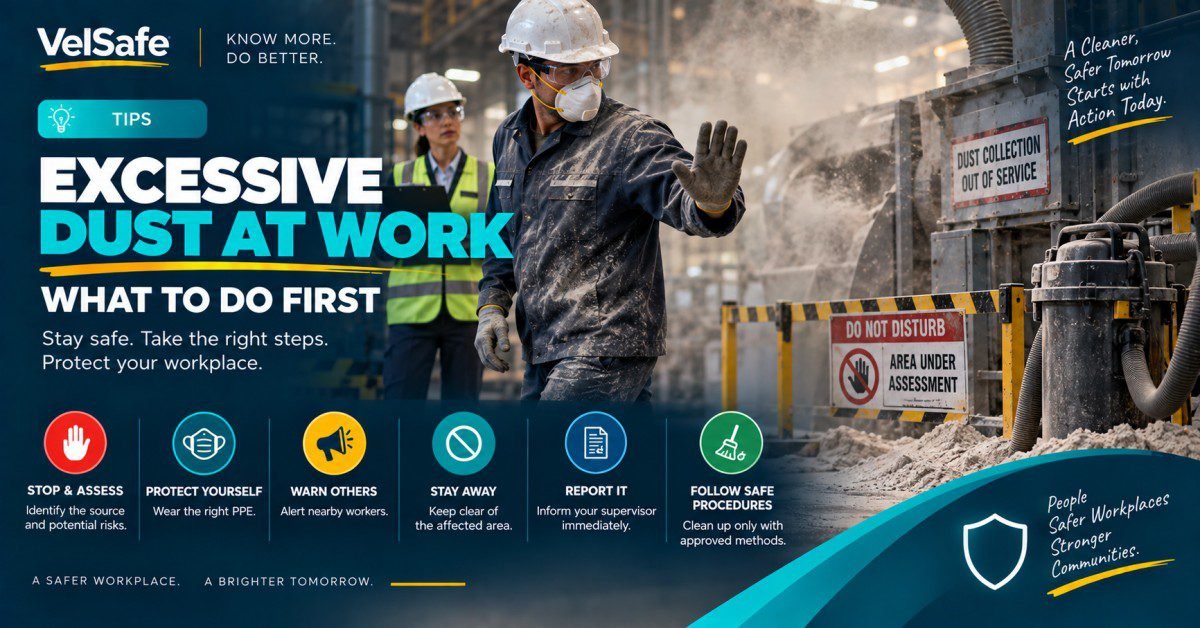
Tips: Excessive Dust Workplace Safety
Excessive dust in your work area is not a housekeeping problem. It is a fire, explosion, and respiratory hazard that requires an immediate, structured response from every worker who spots it.
Excessive dust workplace safety failures kill workers and destroy facilities. Combustible dust explosions have caused some of the most catastrophic industrial incidents in US history. Silica and wood dust exposures cause irreversible lung disease. And yet the most common response when a worker notices heavy dust in their work area is to sweep it up, keep working, or assume someone else will deal with it. These seven tips cover exactly what to do when you spot excessive dust: how to protect yourself immediately, what to report and how, how to identify the hazard type, and how to help prevent the next buildup before it becomes a fire, explosion, or health incident.
NFPA 652
The Standard on Combustible Dust: Facilities Must Conduct a Dust Hazard Analysis for Any Dust That Can Ignite
NFPA 652 requires facilities that handle combustible dust to conduct a Dust Hazard Analysis (DHA) identifying where dust can accumulate, ignite, or deflagrate. Metal, wood, grain, coal, plastic, and sugar dusts are all classified as combustible. A visible layer of dust 1/32 inch thick across a surface area the size of a room is enough to fuel a secondary explosion that can destroy a building. Source: NFPA 652
50 mcg/m³
OSHA PEL for Respirable Crystalline Silica: Exceeded by Routine Dry Grinding, Cutting, and Drilling in Many Workplaces
OSHA’s permissible exposure limit for respirable crystalline silica is 50 micrograms per cubic metre as an 8-hour time-weighted average under 29 CFR 1926.1153 (construction) and 29 CFR 1910.1053 (general industry). Silicosis caused by silica dust exposure is irreversible and can be fatal. Workers who do not know they are in a silica dust environment cannot protect themselves. Source: OSHA: Silica
Never Sweep
Dry Sweeping or Compressed Air Blowdown Turns Settled Combustible Dust Into an Explosive Cloud
Dry sweeping or using compressed air to blow down settled dust suspends it in air at concentrations that can reach the explosive range within seconds. OSHA and NFPA both prohibit using compressed air for dust housekeeping in facilities where combustible dust is present. The correct method is HEPA-filtered industrial vacuum equipment. Source: OSHA: Combustible Dust
7 Excessive Dust Workplace Safety Tips: Quick Summary
What to do when you spot excessive dust
1
Stop work and assess: never disturb settled dust before you know what type it is
2
Put on the correct respirator before entering any dusty area
3
Report immediately and specifically: location, source, dust type, and accumulation depth
4
Eliminate all ignition sources from the area before any cleanup begins
5
Use only HEPA-filtered vacuum equipment to remove settled dust: never dry sweep or use compressed air
6
Warn co-workers in the affected area and isolate the space until the hazard is assessed
7
Identify the root cause and fix it before restarting the equipment or process that produced the dust
Excessive Dust Workplace Safety Tips in Full
Tip 1: Stop Work and Assess Before You Touch or Disturb Anything
Why It Matters
The single most dangerous thing a worker can do when they spot heavy dust is disturb it. Sweeping, blowing, or walking through accumulated combustible dust can suspend it in air at concentrations that reach the explosive range in seconds. Before you do anything, you need to know: how much dust is present, where it came from, whether any ignition sources are nearby, and whether the area is still accumulating dust. That assessment takes 60 seconds and can prevent the conditions that cause secondary explosions. Source: OSHA: Combustible Dust Hazards
What To Do
Stop the task you are doing. Do not disturb the dust. Look without touching: how deep is the accumulation? Is it on horizontal surfaces (ledges, beam tops, ductwork) as well as the floor? Is it actively settling from a source, or has it built up over time? Is it one type or mixed? Identify whether there are any ignition sources in the area: open flames, grinding sparks, running motors with hot surfaces, or electrical panels with exposed contacts. Note the time, your location, and the approximate area covered. This is the information your supervisor needs to respond correctly.
Common Mistake
Grabbing a broom and starting to clean before anyone has assessed what the dust is. This is the most common first response and one of the most dangerous. Dry sweeping combustible dust raises it into the air. If there is any ignition source in the room, including a running motor, a light switch being flipped, or static electricity from clothing, the result can be a flash fire or dust explosion before anyone has time to react.
Pro Tip
Use the 1/32-inch rule as your threshold: if the dust layer is roughly the thickness of a paperclip wire (1/32 inch, about 0.8 mm) across a significant surface area, it is enough to fuel a secondary explosion if dispersed. NFPA 652 uses this as a reference threshold for when a combustible dust housekeeping response is required. Do not wait for the layer to get deeper before reporting it.
Tip 2: Put On the Correct Respirator Before Entering Any Area With Airborne Dust
Why It Matters
Not all dust protection is equal, and not all dust is the same hazard. A paper dust mask (surgical mask) provides almost no protection against respirable dust particles smaller than 10 microns, which are the particles that penetrate deepest into the lungs. Silica dust, fine metal dust, and fine wood dust all contain particles in this range. OSHA’s respiratory protection standard at 29 CFR 1910.134 requires that workers use the correct NIOSH-approved respirator for the dust type present and that they have been fit-tested for that respirator. Source: 29 CFR 1910.134
What To Do
Know which respirator your facility requires for dust work before you ever need it. For most nuisance and particulate dusts in general industry, a NIOSH-approved N95 filtering facepiece is the minimum. For silica dust, an N95 is required as a minimum; higher protection (P100 or supplied-air) may be required depending on the task and exposure duration. For metal fumes and fine metal dust, an N100 or P100 filter is typically required. If you do not have the correct respirator or have not been fit-tested, do not enter the dusty area. Report the observation from outside the area and wait for someone equipped to assess and address it.
Common Mistake
Pulling up a cloth neck gaiter or putting on a single-use surgical mask and walking into a silica or metal dust environment thinking it is protected. Cloth masks and surgical masks do not filter respirable-sized particles and are not NIOSH-approved for dust protection. Wearing them creates a false sense of protection that can lead to sustained exposures over months and years that cause irreversible lung disease.
Pro Tip
If you are unsure what type of dust is present, treat it as the most hazardous type that could plausibly be in that environment until your safety team identifies it. In a mixed-material manufacturing facility where metal grinding and wood cutting both occur, wear a P100 respirator until the dust type is confirmed. Overprotecting for 20 minutes costs nothing. Underprotecting for years causes silicosis, asbestosis, or occupational asthma that cannot be reversed.
Tip 3: Report Immediately With Specific Details: Location, Source, Type, and Accumulation Depth
Why It Matters
A report that says “there’s a lot of dust in the warehouse” is not actionable. A report that says “combustible metal dust has accumulated to approximately 1/16 inch depth on the horizontal beam tops and motor housings above stations 4 through 7 in the west bay, appearing to originate from the #3 grinder which has been running since 06:00” gives safety personnel everything they need to respond correctly. The quality of your report determines the speed and accuracy of the response. OSHA citations for combustible dust hazards frequently cite inadequate hazard reporting as a contributing factor.
What To Do
Report to your supervisor immediately. Do not wait until the end of your shift or until someone else notices it. When you report, include: the exact location (machine number, bay, floor area, elevation), the approximate depth and surface area of accumulation, what the dust appears to be (colour, texture, likely material source), whether the source is still active, whether there are ignition sources near the accumulation, and the time you first observed it. If your facility uses a safety reporting system or app, complete the report the same shift. Keep a personal note of what you reported, to whom, and at what time.
Common Mistake
Assuming someone else already reported it or that the supervisor must have seen it already. In post-incident investigations of dust explosion events, one of the most consistent findings is that multiple workers observed the dust accumulation but assumed someone with more authority was already handling it. The correct assumption is the opposite: if you are the first to report it, the response begins when you make the report. If you are the third person to report it, the response is now accelerated. There is no downside to being another person who reported the hazard.
Pro Tip
Take a photo on your phone if your facility permits personal devices in the area. A clear photo of the accumulation, including something for scale, is more informative than any written description. If devices are not permitted in the area, describe the accumulation in writing as soon as you reach an area where you can do so, while the detail is fresh. The photo or written record also protects you: it documents that you identified and reported the hazard on a specific date and time.
Tip 4: Eliminate All Ignition Sources From the Area Before Any Dust Cleanup Begins
Why It Matters
Combustible dust deflagrations and explosions require three elements: fuel (the dust), oxygen (air), and an ignition source. You cannot remove air from an occupied workspace. You can control the dust. But the fastest way to prevent an explosion during cleanup is to remove or control ignition sources before any dust is disturbed. Running motors, open electrical panels, hot work in adjacent areas, static electricity, and even metal-on-metal contact can all provide ignition energy. The energy required to ignite a combustible dust cloud is very small, often less than a static electricity discharge from a person touching a metal surface. Source: OSHA: Combustible Dust
What To Do
Before any cleanup of combustible dust begins, the following ignition control steps must be taken: shut down and lock out all electrical equipment in the affected area, suspend any hot work permits (grinding, welding, cutting, torching) in the area and in adjacent areas where dust could migrate, ensure no one is smoking or using open flame devices near the area, confirm that vacuum equipment to be used is rated for use in combustible dust environments (ordinary shop vacuums are not), and bond and ground all equipment and workers who will be handling the dust to prevent static discharge. Your facility’s hot work permit system should be the starting point: any active permits in the vicinity must be suspended before cleanup begins.
Common Mistake
Beginning dust cleanup while equipment in the area is still running. Grinding and cutting operations produce sparks continuously. A spark ejected while accumulated metal or wood dust is being swept or vacuumed nearby is an ignition source reaching a dust cloud at exactly the moment that cloud is most concentrated. The equipment must be shut down and locked out before any dust disturbance begins, even if the shutdown will delay production. No production schedule justifies the risk of a dust explosion.
Pro Tip
Do not forget overhead ignition sources. Fluorescent light fixtures with exposed bulbs can shatter and provide ignition energy if the fixture is impacted during cleanup. LED fixtures with sealed casings are safer in combustible dust environments. If your facility has older fluorescent fixtures in areas where combustible dust accumulates on beam tops and ledges near the fixtures, raise this with your safety officer as a separate hazard from the immediate cleanup situation.
Tip 5: Use Only HEPA-Filtered Industrial Vacuum Equipment to Remove Settled Dust
Why It Matters
How you remove dust matters as much as whether you remove it. Dry sweeping with brooms raises settled dust into the air. Compressed air blowdown disperses it at high velocity into clouds. Standard shop vacuums without HEPA filtration capture the larger particles but exhaust the fine respirable particles back into the air through the exhaust port, creating an airborne hazard from the very equipment being used to clean. HEPA-filtered industrial vacuums rated for combustible dust capture particles down to 0.3 microns at 99.97% efficiency and are designed to be used safely around combustible dust accumulations. Source: NFPA 652
What To Do
Confirm that your facility has HEPA-filtered industrial vacuum equipment rated for the type of dust present. If the dust is combustible (metal, wood, grain, coal, plastic), the vacuum must also be rated for combustible dust service: it must be bonded and grounded, have an explosion-proof motor, and use conductive hoses and attachments to prevent static buildup during vacuuming. Work from the highest surfaces down, starting with beam tops, ledges, and equipment housings before moving to floors. Dispose of collected dust in a sealed, labelled container designated for that dust type. Do not empty the vacuum canister indoors.
Common Mistake
Using the shop vac from the maintenance room to vacuum up metal dust. Standard shop vacuums are not rated for combustible dust, are not grounded or bonded, and exhaust fine particles back into the air. Using a standard shop vac on accumulated metal dust can create a dust cloud inside and around the vacuum while simultaneously providing a spark source from an ungrounded motor. This is a documented cause of facility fires. The correct equipment must be specified and available before a dust housekeeping event requires it.
Pro Tip
For dust accumulations at height (beam tops, above false ceilings, on ductwork), use vacuum equipment with extended wand attachments rated for reach. Do not use ladders and brooms in combination: the broom raises dust that the ladder-user then inhales at close range, and the movement of the ladder can create static discharge. Always reach the elevated surface with a grounded vacuum wand, not a brush or broom, before any person works at height near the accumulation.
Tip 6: Warn Co-Workers and Isolate the Area Until the Hazard Is Assessed
Why It Matters
A worker who is focused on their task may not notice the dust that has accumulated behind them or in an adjacent area. In large manufacturing facilities, dust accumulation in one zone can affect ignition risk in adjacent zones where workers have no line of sight to the source. A secondary explosion, which is the more destructive of the two events in most combustible dust incidents, occurs when the primary ignition disperses accumulated dust from surrounding surfaces into a large cloud that then ignites. Workers in adjacent areas who were not informed of the hazard are exposed to that secondary event with no warning and no time to evacuate.
What To Do
Alert every co-worker in the area immediately and verbally: tell them what you observed and where. Suggest they step away from the accumulation area and that they not disturb it. If you have the authority to do so, place physical barriers or caution tape to limit access to the affected zone. If you do not have that authority, communicate your observation to the person who does and ask them to act on it immediately. Do not wait for the person to come and see for themselves before barriers are placed. Every minute of continued access to an uncontrolled combustible dust accumulation is additional risk.
Common Mistake
Telling only your immediate co-worker and not the person responsible for the whole area or shift. In team environments, information stops at the edge of the immediate group. The worker at the far end of the bay, the forklift operator routing through the area, or the maintenance technician about to fire up a grinder 10 metres away are all at risk and all need to know about the accumulation. Dust hazard warnings need to reach everyone in the area, not just the person standing nearest to you.
Pro Tip
If your facility has a site-wide PA system or radio channel, use it. Dust hazards are area-wide hazards, not point hazards. A face-to-face warning to three nearby colleagues protects three people. A PA announcement or radio call that covers the whole shift protects everyone. Escalate the communication to match the scale of the hazard. A visible accumulation across multiple machine bays is a facility-wide event, not a local one.
Tip 7: Find and Fix the Root Cause Before Restarting the Equipment or Process
Why It Matters
Cleaning up the dust and restarting the equipment that produced it is not a fix. It is a restart of the same failure. Excessive dust accumulation almost always indicates that a dust control system has failed or been bypassed: a dust collector filter is clogged or damaged, a capture hood is misaligned, a conveyor enclosure is open, or a grinding operation is running without extraction. If the root cause is not identified and corrected, the dust will return to the same accumulation level within hours or days, and the next shift or next worker to encounter it may not respond as carefully. OSHA NESHAP regulations for certain materials and NFPA 652 both require that dust control systems be maintained and that failures be corrected before operations resume.
What To Do
After the area is cleaned and safe, investigate before restarting: inspect the dust collector or extraction system serving the area that produced the dust, check filter differential pressure readings, inspect capture hoods, duct connections, and blast gates for damage or blockage, and review the maintenance log for the equipment to see when the extraction system was last serviced. If your role does not include equipment inspection, communicate to your supervisor that the dust cleanup is complete but the root cause has not been identified or corrected, and that you need engineering or maintenance to assess the extraction system before the equipment is restarted. Document this communication and the response.
Common Mistake
Cleaning the dust, restarting the machine, and logging the event as resolved. This is the maintenance equivalent of clearing a check engine light without finding what triggered it. Within 48 hours the same accumulation will return, often at a faster rate because the underlying failure has been unaddressed longer. Each recurrence is also an OSHA recordable if anyone is exposed to a concentration that exceeds the applicable PEL, and it is evidence in an investigation that the facility knew about a recurring dust hazard and did not correct it.
Pro Tip
Ask for a copy of your facility’s Dust Hazard Analysis (DHA) for the area in question. Under NFPA 652, facilities handling combustible dust are required to conduct a DHA identifying dust accumulation zones, control measures, and inspection frequencies. If the area you cleaned is in the DHA, the DHA should identify the specific control that failed and what the corrective action should be. If the area is not in the DHA, raise this: it may indicate that the dust hazard analysis is incomplete and that a formal review is needed.
Excessive Dust Response Checklist
When You Spot the Dust
Before Cleanup Begins
Stop work immediately
Do not disturb the dust
Assess accumulation depth and surface area
Identify the probable source
Note whether ignition sources are present
Put on appropriate respirator
Warn all co-workers in the area
Report to supervisor with specific details
Do not disturb the dust
Assess accumulation depth and surface area
Identify the probable source
Note whether ignition sources are present
Put on appropriate respirator
Warn all co-workers in the area
Report to supervisor with specific details
All ignition sources locked out or removed
Hot work permits in adjacent areas suspended
HEPA industrial vacuum confirmed available and rated
Vacuum equipment bonded and grounded (if combustible)
Access to area restricted with barriers
Work top-to-bottom: ledges and beams first, floors last
Collected dust sealed, labelled, and disposed correctly
Root cause identified before equipment restart
Hot work permits in adjacent areas suspended
HEPA industrial vacuum confirmed available and rated
Vacuum equipment bonded and grounded (if combustible)
Access to area restricted with barriers
Work top-to-bottom: ledges and beams first, floors last
Collected dust sealed, labelled, and disposed correctly
Root cause identified before equipment restart
Sources: OSHA: Combustible Dust | NFPA 652
Key Takeaways
Dust that looks harmless has killed workers in facilities that also thought it was harmless
The facilities involved in major combustible dust explosions were not operating recklessly. Many had active safety programmes, trained workers, and maintenance schedules. What they consistently lacked was a structured, specific response to visible dust accumulation that treated it as the fire and explosion precursor it is, rather than a housekeeping task to be handled at convenience.
How you clean matters as much as whether you clean
A broom and a compressed air line are cleanup tools that can turn a manageable dust accumulation into a deflagration event in seconds. HEPA-filtered, grounded, explosion-rated industrial vacuum equipment is not optional for combustible dust environments. If your facility does not have it, that is a programme gap that needs to be raised before the next cleanup event, not during it.
Cleaning up without fixing the cause is not a resolution: it is a delay until the next incident
Every excessive dust accumulation event is evidence that a dust control measure has failed: a collector is clogged, a capture hood is damaged, an enclosure is open, or a process has been modified without updating the extraction design. Cleaning the dust and restarting the process restarts the failure. OSHA and NFPA require that dust control systems be maintained and failures corrected before operations resume. Documenting the cleanup as complete without documenting the root cause investigation creates a compliance gap that becomes an enforcement liability when the next accumulation event is inspected.
Frequently Asked Questions
What types of dust are considered combustible in a workplace?
Combustible dusts include metal dusts (aluminium, magnesium, iron, zinc, titanium), agricultural dusts (grain, flour, sugar, cornstarch, wood pellets), wood and paper dusts, coal dust, plastic and rubber dusts, certain chemical dusts, and textile fibres. NFPA 652 defines combustible dust as any finely divided solid material that presents a fire or deflagration hazard when suspended in air or another oxidising medium at atmospheric pressure and room temperature. If you are unsure whether the dust in your facility is combustible, your facility’s Safety Data Sheets (SDS) for the materials being processed are the starting point. Source: NFPA 652
Why is dry sweeping combustible dust so dangerous?
Dry sweeping picks up dust particles from the floor and suspends them in the air. When combustible dust is suspended in air at concentrations between its lower explosive limit (LEL) and upper explosive limit (UEL), it forms a cloud that can ignite and deflagrate if it encounters an ignition source. The energy required is very small, often no more than static electricity or a hot surface. Secondary explosions occur when the pressure wave from the initial deflagration disperses accumulated dust from surfaces throughout the facility into a much larger cloud that then ignites. This secondary event is typically far more destructive than the first. OSHA and NFPA both prohibit using dry sweeping or compressed air for combustible dust housekeeping. Source: OSHA: Combustible Dust
What respirator do I need for dust in the workplace?
The required respirator depends on the dust type and your exposure level. For nuisance particulate dusts in general industry below the applicable PEL, a NIOSH-approved N95 filtering facepiece is typically the minimum. For silica dust, an N95 is required at minimum under 29 CFR 1910.1053 and 1926.1153; higher protection may be required for higher-exposure tasks. For fine metal dusts including aluminium and magnesium, a P100 half-face or full-face respirator is typically required. For any toxic dust, consult the SDS and your facility’s respiratory protection programme. Under 29 CFR 1910.134, workers must be medically cleared, fit-tested, and trained before using any respirator. A cloth mask or surgical mask is not NIOSH-approved for dust protection. Source: 29 CFR 1910.134
What is a Dust Hazard Analysis and does my facility need one?
A Dust Hazard Analysis (DHA) is a systematic review of a facility’s processes and equipment to identify where combustible dust is present, where it can accumulate, what ignition sources are nearby, and what controls are in place to prevent fire and explosion. NFPA 652 requires facilities that handle combustible dust to complete a DHA and review it at least every five years or when processes change. The DHA is the foundational document for a combustible dust safety programme: it identifies the zones where dust housekeeping is critical, the frequency of cleanup required, and the equipment needed. If your facility handles any of the materials listed in the combustible dust question above and you do not know whether a DHA has been done, ask your safety manager. Source: NFPA 652
Can OSHA cite my employer for excessive dust accumulation even if no one was injured?
Yes. OSHA can cite for combustible dust hazards under the General Duty Clause (Section 5(a)(1) of the OSH Act), which requires employers to provide a workplace free from recognised hazards likely to cause death or serious physical harm, regardless of whether an injury has occurred. OSHA can also cite under specific standards where they apply: 29 CFR 1910.22 (general housekeeping), 29 CFR 1910.94 (ventilation), and material-specific standards for certain industries. OSHA’s combustible dust National Emphasis Programme (NEP) specifically targets facilities with combustible dust for inspection. Visible accumulations on ledges, beams, and equipment are among the first observations that trigger citation under the NEP. Source: OSHA: Combustible Dust NEP
What is the difference between a primary and secondary dust explosion?
A primary dust explosion is the initial ignition event, where a dust cloud at explosive concentration encounters an ignition source and deflagrates. This primary event is often relatively localised. The secondary explosion is what makes combustible dust incidents catastrophic: the pressure wave from the primary deflagration disperses accumulated dust from every surrounding surface into a much larger, facility-wide cloud, which then ignites in a second, far more powerful event. Most of the fatalities and structural destruction in documented combustible dust incidents result from the secondary explosion, not the primary. This is why accumulated dust on ledges, beam tops, and above suspended ceilings is so dangerous: it is the fuel for the secondary event.
How often should a facility clean up dust accumulations?
Housekeeping frequency for combustible dust must be based on the accumulation rate in the specific area, not on a calendar schedule. NFPA 652 requires that the DHA identify accumulation zones and that housekeeping be conducted at a frequency that prevents accumulation from reaching hazardous levels. In high-production grinding or cutting environments, this may mean daily or shift-by-shift vacuuming of horizontal surfaces. In lower-production environments, weekly may be sufficient. A visible accumulation layer at any time between scheduled cleanings indicates that the cleaning frequency is insufficient and must be increased. The 1/32-inch threshold across a significant surface area is a commonly cited indicator that an immediate cleanup event is needed regardless of schedule. Source: NFPA 652
Sources
Government and Regulatory Sources
- OSHA: Combustible Dust: OSHA’s primary resource on combustible dust hazards, the National Emphasis Programme for combustible dust inspections, General Duty Clause citation basis, and housekeeping and ignition control requirements.
- OSHA: Crystalline Silica: OSHA’s silica hazard page covering the 50 mcg/m3 PEL, the construction and general industry silica standards at 29 CFR 1926.1153 and 1910.1053, required exposure controls, and medical surveillance requirements.
- 29 CFR 1910.134: Respiratory Protection: OSHA’s respiratory protection standard governing medical clearance, fit testing, training, and NIOSH-approved respirator selection requirements for dust environments.
- 29 CFR 1910.22: General Housekeeping: the OSHA general industry housekeeping standard requiring workplaces to be maintained in clean and orderly condition, applied to dust accumulation citations.
Standards and Industry Sources
- NFPA 652: Standard on the Fundamentals of Combustible Dust: the primary standard governing Dust Hazard Analysis requirements, combustible dust classification, housekeeping frequency requirements, and the 1/32-inch accumulation threshold referenced throughout this article.
Related VelSafe Articles
Worker Safety
Housekeeping on the Job: Worker Safety Guide
Industrial housekeeping rules under 29 CFR 1910.22: how to clean up dust safely using approved methods, what OSHA requires for housekeeping frequency, and why correct technique prevents fire and slip hazards.
Tips
8 Hot Work Safety Tips for Construction Sites
8 actionable hot work safety tips for controlling ignition sources: permit requirements, fire watch obligations, and the pre-task checks that prevent fires and explosions near combustible dust environments.
Guides
Hot Work Safety: Permits, Controls and OSHA
The complete guide to hot work safety permits and OSHA compliance: what a permit must contain, who can authorise it, fire watch requirements, and how to manage hot work in areas with combustible dust risk.
Workplace Dust Safety Tips and Compliance Resources
More Actionable Safety Tips for General Industry Supervisors and Workers
VelSafe covers combustible dust, hot work, fire and explosion controls, respiratory protection, and OSHA compliance for frontline supervisors, safety coordinators, and EHS professionals in manufacturing, construction, and general industry.
Browse All Safety Tips