WORKER SAFETY: Commercial Driver Health and Alertness
Driver fatigue is the leading human factor in large truck crashes. Federal Hours of Service regulations set the legal framework, but compliance with HOS rules does not eliminate fatigue risk. Circadian rhythm disruption, sleep debt, medical conditions, and lifestyle factors all affect alertness independently of how many hours a driver has logged. This guide covers what every CDL driver needs to know about recognising fatigue, managing alertness across a long shift, and knowing when stopping is the only safe decision.
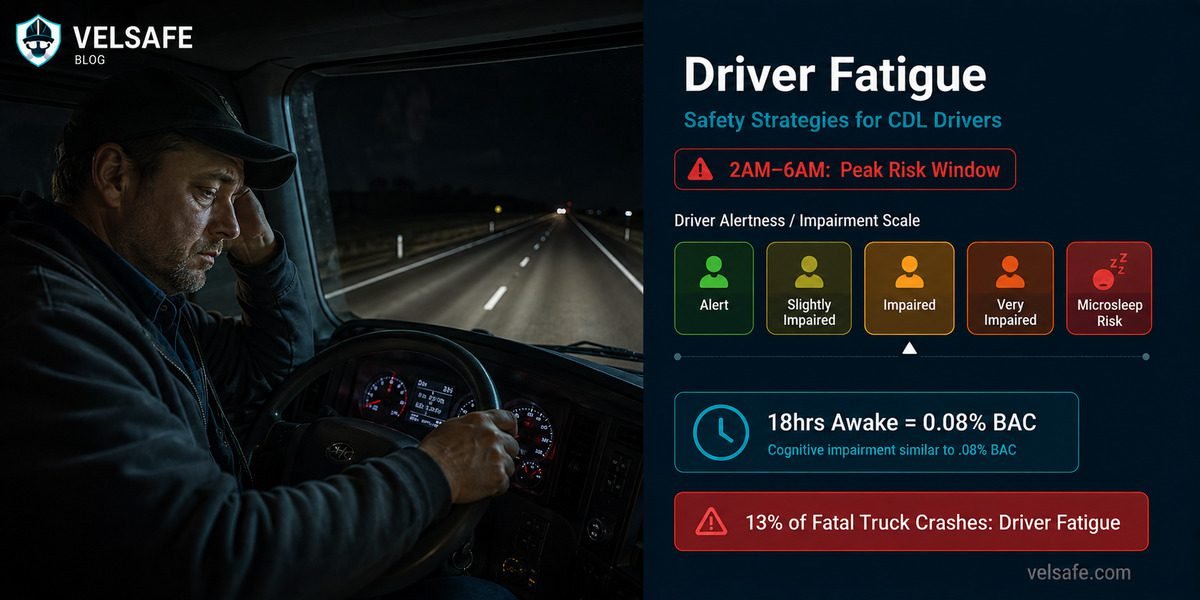
13%
Fatal Large Truck Crashes Involving Driver Fatigue
The FMCSA estimates that driver fatigue is a factor in approximately 13% of fatal large truck crashes. This figure is considered an undercount because fatigue is difficult to confirm post-crash and is underreported in crash investigations.
FMCSA, Driver Fatigue and Alertness, 2024
2AM-6AM
Peak Circadian Fatigue Window for Drivers
Human circadian rhythm creates a natural alertness trough between 2AM and 6AM regardless of how much sleep the driver has had. Crash risk for overnight drivers is highest during this window. A second, smaller trough occurs between 2PM and 4PM.
FMCSA, CMV Driver Fatigue Guide
18hrs
Wakefulness Equivalent to 0.08% BAC
Research consistently shows that 18 hours without sleep produces driving impairment equivalent to a blood alcohol content of 0.08%, the legal intoxication threshold. At 24 hours without sleep, impairment is equivalent to approximately 0.10% BAC.
NHTSA, Drowsy Driving Research, 2024
The Federal Motor Carrier Safety Administration’s Hours of Service (HOS) regulations set legal limits on driving time: 11 hours of driving within a 14-hour window, mandatory 10-hour off-duty periods, and a 70-hour limit over 8 consecutive days. These rules reduce exposure to fatigue-related risk by limiting cumulative driving time. They do not eliminate fatigue risk, and they do not account for the biological factors that determine how impaired a given driver is at a given moment.
A driver who spent their 10-hour mandatory rest period in a noisy truck stop unable to sleep is not rested simply because the clock ran. A driver fighting a sleep disorder, operating in their circadian low, or carrying weeks of accumulated sleep debt may be dangerously impaired before reaching the legal driving limit. Understanding the biology of fatigue, recognising its warning signs in yourself, and knowing when to stop are the practical skills that keep drivers and everyone else on the road safe.
Why Fatigue Is More Dangerous for CDL Drivers Than Other Workers
The vehicle weight multiplies consequences. A fatigued office worker makes a poor decision. A fatigued CDL driver operating an 80,000-pound combination vehicle at highway speed makes a poor decision with catastrophic potential consequences. Stopping distance at 65 mph for a fully loaded semi is approximately 525 feet. A fatigued driver’s reaction time delay of 2 seconds adds another 190 feet to that stopping distance. At those combined distances, most crash scenarios are unavoidable once initiated.
Microsleep is undetectable from inside. A microsleep is an involuntary episode of sleep lasting between 1 and 30 seconds that the driver cannot feel happening. During a microsleep, the driver’s eyes may remain open, but the brain is not processing visual input or controlling the vehicle. At 65 mph, a 4-second microsleep covers 381 feet with no driver control. Drivers who experience microsleep cannot self-report it reliably because they are unconscious during the event.
Caffeine has a ceiling effect. Caffeine temporarily blocks adenosine receptors and delays the sensation of sleepiness. It does not reduce sleep debt or restore impaired cognitive function. A driver who uses caffeine to extend driving time beyond their body’s safe operating window is suppressing the warning system without addressing the underlying impairment. When the caffeine wears off, the accumulated sleep pressure can produce rapid and severe drowsiness.
FMCSA, Driver Fatigue Research and Guidance
Fatigue Risk Factor Severity for Long-Haul CDL Drivers
Obstructive sleep apnoea (undiagnosed or untreated)Highest risk
Untreated OSA causes repeated oxygen desaturation and arousal during sleep, preventing restorative sleep regardless of time in bed. CDL drivers have significantly higher OSA prevalence than the general population. FMCSA has guidance on OSA and commercial drivers but no mandatory screening requirement for all drivers.
Circadian misalignment (overnight and rotating shift driving)Very high risk
Driving during the circadian trough (2AM to 6AM) impairs alertness regardless of prior sleep. Drivers whose schedules rotate between day and overnight runs cannot fully adapt their circadian rhythm to either schedule, compounding impairment.
Accumulated sleep debtHigh risk
Sleep debt accumulates when a driver consistently sleeps less than their individual sleep requirement (most adults: 7-9 hours). A driver who sleeps 6 hours per night accumulates a 7-14 hour sleep debt across a week of driving, significantly impairing cognitive function and reaction time regardless of HOS compliance.
Time-on-task fatigue (extended monotonous driving)Moderate-high risk
Long stretches of monotonous highway driving reduce alertness through attentional fatigue, independent of sleep status. Research shows that driver alertness on straight, featureless highway sections degrades measurably after 2 hours of continuous driving regardless of total duty time.
Medications with sedating effectsModerate risk (variable)
Many over-the-counter and prescription medications produce drowsiness as a side effect. Antihistamines, some blood pressure medications, muscle relaxants, and certain antidepressants can significantly impair driving alertness. CDL drivers must review all medications with their physician before driving.
FMCSA, CMV Driver Fatigue Guide
HOS Rule
Requirement
Safety Implication
11-Hour Driving Limit
May drive a maximum of 11 hours after 10 consecutive hours off duty
The 11-hour limit is a legal ceiling, not a recommended target. Most drivers should stop earlier if fatigue warning signs are present
14-Hour Window
May not drive after the 14th hour following the start of the shift, regardless of breaks taken
Once the 14-hour window closes, the driver may not drive. On-duty non-driving time counts toward this window
30-Minute Break
A 30-minute break is required after 8 cumulative hours of driving time
The break may be spent off duty or in the sleeper berth. A brief nap during this break provides more fatigue benefit than passive rest
10-Hour Off Duty
Must take 10 consecutive hours off duty before driving again (or a split sleeper berth option)
10 hours off duty does not guarantee adequate sleep. Truck stop noise, poor sleep environment, and sleep disorders can prevent full recovery even within a compliant off-duty period
70-Hour/8-Day Limit
May not drive after accumulating 70 hours on duty in 8 consecutive days
A 34-hour restart (including two periods from 1AM to 5AM) resets the 70-hour clock. This provision allows extended driving schedules that can maintain high cumulative fatigue levels
FMCSA, Summary of Hours of Service Regulations
Warning Signs That You Are Too Fatigued to Drive Safely
Drifting from your lane without intending to, or catching yourself drifting repeatedly. Lane drift is one of the earliest observable signs of fatigue-induced impairment and a primary fatigue detection signal used by in-cab monitoring systems.
Difficulty keeping your eyes open, heavy eyelids, or eyes that keep closing briefly. This is a direct indicator of sleep pressure overcoming wakefulness. When eyes are closing involuntarily, microsleep episodes are already occurring.
Missing exits, signs, or turns you were watching for, or finding yourself unable to account for the last several miles. Memory gaps during driving are a reliable indicator of prior microsleep episodes.
Excessive yawning or head nodding. Frequent yawning is the body’s attempt to increase oxygen intake as alertness drops. Head nodding indicates intermittent sleep episodes have already begun.
Aggressive or irritable feelings without a clear reason, or difficulty concentrating on the road environment. Fatigue degrades emotional regulation and attentional control before it degrades physical driving ability.
Tailgating without awareness or late-braking events you did not anticipate. Reduced following distance is a behavioural indicator of slowed reaction time and impaired hazard perception.
FMCSA, Recognising Driver Fatigue
If You Are Too Fatigued to Drive Safely: Step-by-Step Response
1
Signal and move to the right immediately. As soon as you identify a fatigue warning sign while driving, activate your right turn signal and begin moving toward the right lane. Do not wait for an exit. Any safe area to pull off is acceptable: a rest area, truck stop, wide shoulder, parking lot, or weigh station.
2
Park, turn off the engine, and activate hazard lights. If stopping on a shoulder, deploy triangles or flares at the required distances (10, 100, and 200 feet behind the vehicle). Notify dispatch of your location and the reason for the stop.
3
Take a minimum 20-minute nap. Set an alarm. Recline the seat or move to the sleeper berth. A 20-minute nap at this point provides meaningful recovery. Longer is better if time permits. Do not attempt to return to driving until you feel alert, not just technically rested from the nap.
4
After the nap, walk for 5 minutes before returning to driving. Do not move the vehicle immediately upon waking. Sleep inertia following a nap creates a brief period of grogginess that resolves within 10 to 15 minutes with movement and light exposure. Walking to and from the truck during a safety check accomplishes both.
5
If fatigue returns within 2 hours of resuming driving, stop again. A second fatigue episode within a short time indicates that the nap was insufficient to address the underlying sleep debt. Extended rest is needed. Contact dispatch and arrange a full off-duty period before continuing. Under 49 CFR 392.3, you have the regulatory right to stop driving if you are impaired.
49 CFR 392.3: Ill or Fatigued Operator
Schedule Loads to Align With Circadian Biology
Where possible, schedule departure times that allow drivers to drive during daylight hours or to complete overnight legs during the less-impaired part of the night. Avoid scheduling load pickups that require a driver to leave between midnight and 4AM with their highest-risk driving during the circadian trough hours of 2AM to 6AM.
Never Pressure a Driver Who Reports Fatigue
Under FMCSA regulations and the OSH Act’s General Duty Clause, pressuring a driver to continue operating after they report being too fatigued to drive safely creates direct liability for the carrier and may constitute a regulatory violation. A driver who reports fatigue before departure or during a run must be allowed to rest without threat of discipline or load reassignment penalty.
Implement a Fatigue Reporting Culture
Drivers who fear dispatch consequences for reporting fatigue will not report it. They will drive impaired. A carrier that creates a non-punitive fatigue reporting process and tracks fatigue reports as a safety performance metric will identify systemic scheduling problems that produce driver fatigue before they result in a crash.
Support OSA Screening and Treatment
Untreated obstructive sleep apnoea is the most significant medical fatigue risk factor in commercial drivers. Carriers that include OSA awareness in driver safety training, encourage self-referral for evaluation, and support CPAP compliance for diagnosed drivers have materially lower crash rates than those that do not address OSA systematically.
HOS Compliance Does Not Equal Fatigue Safety
Hours of Service rules set legal limits. They do not account for sleep quality, sleep disorders, circadian position, or accumulated sleep debt. A driver who is HOS-compliant but sleep-deprived, fighting a circadian low, or suffering from untreated sleep apnoea can be dangerously impaired within legal driving limits.
Microsleep Cannot Be Felt From Inside
Microsleep episodes are involuntary and undetectable by the driver experiencing them. A driver who has had a microsleep will not know it happened unless they notice a consequence (lane drift, missing miles). This is why waiting until you “feel tired enough to stop” is dangerous: fatigue warning signs appear before or alongside microsleep, not reliably before it.
A 20-Minute Nap Is the Most Effective Mid-Shift Fatigue Countermeasure
Coffee, fresh air, and music are temporary countermeasures that mask fatigue without reducing impairment. A 20-minute nap taken before the onset of severe fatigue provides 2 to 3 hours of improved alertness and is the only countermeasure that directly addresses the underlying sleep pressure. The caffeine-nap combination amplifies the benefit of both.
You Have the Regulatory Right to Stop When Fatigued
49 CFR 392.3 prohibits a driver from operating a commercial motor vehicle when their ability or alertness is impaired to the degree that it is unsafe to begin or continue driving. This regulation gives drivers the legal basis to stop driving and rest when fatigued, regardless of dispatch pressure or delivery schedule. Knowing this regulation and citing it protects drivers and carriers both.
Untreated Sleep Apnoea Is the Top Medical Fatigue Risk
CDL drivers have higher rates of obstructive sleep apnoea than the general population due to occupational factors including irregular schedules, sedentary driving time, and weight gain. Untreated OSA prevents restorative sleep regardless of hours in bed, creating persistent fatigue impairment. Screening and treatment is the highest-impact medical intervention available for driver fatigue.
Dispatch Culture Determines Whether Drivers Report Fatigue
A driver who fears dispatch consequences for reporting fatigue will drive impaired. A carrier’s crash rate is partly a function of its fatigue reporting culture. Non-punitive reporting, visible management response to fatigue concerns, and scheduling that respects circadian biology are the operational characteristics of carriers with the lowest fatigue-related crash rates.
What are the FMCSA Hours of Service rules for property-carrying drivers?
Property-carrying CDL drivers may drive a maximum of 11 hours after 10 consecutive hours off duty. They may not drive after the 14th hour following the start of the shift, regardless of breaks taken. A 30-minute break is required after 8 cumulative hours of driving. The 70-hour/8-day limit caps on-duty time across 8 consecutive days. A 34-hour restart resets this limit and must include two periods from 1AM to 5AM. Electronic logging devices (ELDs) are required for most drivers subject to HOS rules and automatically track driving time, duty status, and HOS violations.
Can a dispatcher legally require a driver to continue driving when the driver reports being too tired?
No. Under 49 CFR 392.3, a driver is prohibited from operating a commercial motor vehicle while fatigued to the point that safe operation is impaired. Carriers that coerce or pressure drivers to continue driving in violation of this regulation are subject to FMCSA enforcement action including civil penalties. FMCSA’s coercion rule (49 CFR Part 386) provides additional protections for drivers who refuse to drive in unsafe conditions. A driver who documents a dispatcher’s pressure to drive while impaired has regulatory and potentially legal recourse.
How does obstructive sleep apnoea affect CDL eligibility?
FMCSA does not have a mandatory OSA screening requirement for all CDL drivers, but medical examiners who conduct DOT physical examinations are expected to evaluate drivers for OSA risk. A driver with severe, untreated OSA may be found not medically qualified to operate a commercial motor vehicle. However, a driver who is diagnosed with OSA and successfully treated (typically with CPAP therapy) can generally maintain medical qualification. FMCSA guidance recommends that carriers include OSA awareness in their fatigue management programmes and encourage drivers at risk to seek evaluation.
Is it legal to sleep in a truck stop parking lot during the 10-hour off-duty period?
Yes. Drivers may spend their off-duty period in a truck stop parking lot, rest area, or any other location where they are legally parked. The 10-hour off-duty requirement does not specify where the driver must rest, only that they must be off duty for the required period. However, sleeping in a truck stop environment with significant noise, light, and activity from other vehicles may reduce sleep quality. Drivers should park in quieter areas of the lot, use blackout curtains and earplugs, and avoid areas near idling refrigerator units or busy loading docks.
Do energy drinks or caffeine tablets work as well as coffee for alertness?
The caffeine in energy drinks and caffeine tablets provides the same physiological mechanism as coffee: blocking adenosine receptors to delay the sensation of sleepiness. The dose matters more than the delivery format. Most energy drinks contain 80 to 300mg of caffeine; a standard cup of coffee contains approximately 95mg. However, many energy drinks also contain added sugars that may create an energy spike and subsequent crash. The additional ingredients in energy drinks (B vitamins, taurine, guarana) have limited research supporting enhanced alertness beyond the caffeine content. Plain coffee or caffeine tablets provide the same benefit with more predictable dosing and without the added sugar.
What is the split sleeper berth provision and how does it work?
The split sleeper berth provision allows drivers with a sleeper berth to split their required 10-hour off-duty period into two periods, as long as one period is at least 7 hours in the sleeper berth and the other is at least 2 hours (either off duty or in the sleeper berth). The two periods must add up to at least 10 hours. When a driver uses the split sleeper berth option, neither period counts against the 14-hour driving window. The provision gives drivers more flexibility to manage their rest during long-haul runs without losing their full 14-hour window.
What fatigue monitoring technology is available for commercial trucks?
Several commercial driver monitoring systems are available that detect fatigue indicators from inside the cab. Camera-based systems monitor eyelid closure rate (PERCLOS), blink frequency, and head position to detect drowsiness. Steering pattern analysis systems detect the irregular micro-corrections and lane drift associated with fatigue. Some systems combine multiple inputs including lane departure, following distance, and driver facial monitoring. FMCSA has not mandated fatigue monitoring technology beyond ELDs, but several large carriers have adopted these systems voluntarily. Drivers should be aware that such systems generate alerts to both the driver and the fleet manager and may trigger a mandatory stop requirement under carrier policy.
VelSafe Driver Safety Resources
The Log Shows Hours. The Body Keeps Its Own Record.
HOS compliance is the floor, not the ceiling of fatigue safety. Every CDL driver needs to understand the biology of fatigue, recognise its warning signs before they become dangerous, and know the regulatory framework that gives them the right to stop. VelSafe covers commercial driver safety, FMCSA regulations, and fleet safety management for drivers and carriers.
Browse Driver Safety Resources