GUIDES: Occupational Safety and Health
The Occupational Safety and Health Administration (OSHA) establishes and enforces workplace safety and health standards across most private sector employers in the United States. Understanding what OSHA requires, how enforcement works, and what employers must do to achieve and maintain compliance is foundational knowledge for anyone responsible for workplace safety, operations, or risk management. This guide covers the OSHA framework from authority and standards through inspection, enforcement, and compliance programme design.
2.3M
Nonfatal Workplace Injuries (2024)
The Bureau of Labor Statistics recorded approximately 2.3 million nonfatal occupational injuries and illnesses among private sector employers in 2024, a rate of 2.3 per 100 full-time equivalent workers.
BLS, Injuries, Illnesses and Fatalities, 2024
30,000+
OSHA Inspections Per Year
OSHA and its state plan partners conduct over 30,000 workplace inspections annually, prioritising sites with fatalities, imminent danger, formal complaints, referrals, and programmed inspection schedules for high-hazard industries.
OSHA, Enforcement Data, 2024
$16,131
Max Penalty Per Serious Violation
As of 2024, OSHA’s maximum penalty for a serious violation is $16,131 per violation. Willful and repeated violations carry penalties up to $161,323 each. Penalties are adjusted annually for inflation.
OSHA, Penalties, 2024
OSHA was created by the Occupational Safety and Health Act of 1970 (OSH Act) and operates within the U.S. Department of Labor. Its mission is to ensure safe and healthful working conditions by setting and enforcing standards and by providing training, outreach, education, and assistance. OSHA’s jurisdiction covers most private sector employers and their workers in all 50 states and U.S. territories. Federal, state, and local government workers are covered by separate federal agency safety programmes or by state plans.
Twenty-two states and two territories operate their own OSHA-approved state plans that cover both private and public sector workers. These state plans must be at least as effective as federal OSHA. Some states adopt federal standards directly; others add state-specific requirements. Employers in state plan states are subject to state enforcement, not federal OSHA inspections, for the covered workers.
Why OSHA Compliance Is Not Optional
Fatal injury consequences: Under the OSH Act, an employer whose wilful violation causes a worker’s death faces criminal penalties up to $10,000 and up to six months imprisonment for a first conviction. A second conviction doubles those penalties. Several landmark prosecutions have resulted in prison sentences for executives and managers.
Cumulative citation costs: OSHA citations accumulate per violation per day in some cases. A single inspection that identifies five serious violations can generate $80,000 in penalties before any repeat or willful classification. Facilities in high-hazard industries can face seven-figure citations from a single severe injury investigation.
Reputational and contractual impact: OSHA citation data is publicly available through the OSHA enforcement database. Many customers, particularly in government contracting, healthcare, and Fortune 500 supply chains, review OSHA compliance records as part of vendor qualification. A pattern of citations can disqualify a facility from preferred supplier status or government contracts.
OSHA, Worker Rights and Protections
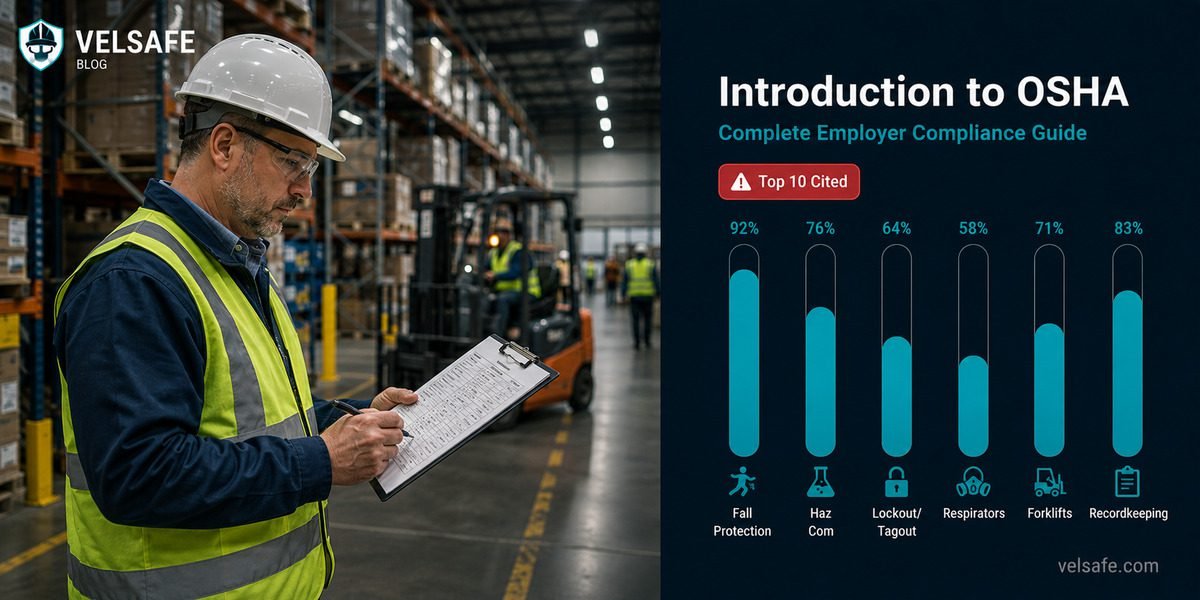
Most Frequently Cited OSHA Standards (FY2024, Construction and General Industry)
Fall Protection (1926.501)#1: 6,307 citations
Falls account for the largest share of construction fatalities. Guardrails, personal fall arrest systems, and safety nets are the primary controls required under 1926.501.
Hazard Communication (1910.1200)#2: 3,213 citations
Requires written Hazard Communication programme, Safety Data Sheets for all hazardous chemicals, and employee training on chemical hazards and protective measures.
Ladders (1926.1053)#3: 2,978 citations
Improper ladder selection, use, and inspection. Three-point contact, proper angle, and weight rating compliance are the most common deficiencies.
Respiratory Protection (1910.134)#4: 2,874 citations
Written programme, medical evaluation, fit testing, and training requirements. Frequently cited in manufacturing, construction, and healthcare settings.
Powered Industrial Trucks (1910.178)#5: 2,561 citations
Forklift operator training and certification, daily pre-shift inspections, and load capacity compliance. A leading cause of warehouse and distribution centre fatalities.
Lockout/Tagout (1910.147)#6: 2,554 citations
Control of hazardous energy during equipment servicing and maintenance. Requires written programme, equipment-specific procedures, training, and annual inspections.
OSHA, Top 10 Most Frequently Cited Standards, FY2024
29 CFR 1910: General Industry
Applies to manufacturing, warehousing, retail, healthcare, and service industries. Covers walking-working surfaces, emergency action plans, fire protection, electrical, machinery guarding, hazardous materials, personal protective equipment, and health standards including noise, ventilation, and bloodborne pathogens.
29 CFR Part 1910, eCFR.gov
29 CFR 1926: Construction
Applies to construction, alteration, repair, painting, decorating, and demolition. The most frequently cited standards in construction include fall protection (1926.501), scaffolding (1926.451), eye and face protection (1926.102), and excavations (1926.652). Construction has the highest fatal injury rate of any major industry sector.
29 CFR Part 1926, eCFR.gov
29 CFR 1928: Agriculture
Applies to agricultural operations including field sanitation, hazardous materials in agriculture, slow-moving vehicles, and temporary labour camp standards. Agriculture has historically high injury and fatality rates relative to its workforce size, and OSHA enforcement in agriculture has been an ongoing legislative and regulatory focus.
29 CFR Part 1928, eCFR.gov
General Duty Clause
Section 5(a)(1) of the OSH Act requires employers to provide a workplace free from recognised hazards likely to cause death or serious physical harm, even when no specific OSHA standard addresses the hazard. OSHA uses the General Duty Clause to cite hazards including workplace violence, heat illness, ergonomics, and novel hazards not yet covered by a specific standard.
OSH Act Section 5, General Duty Clause
What Triggers an OSHA Inspection: Priority Order
1. Imminent danger : A condition that could cause death or serious physical harm before normal enforcement procedures can be completed. OSHA inspectors can request immediate correction or seek a federal court injunction to shut down operations.
2. Fatality or catastrophe: Employers must report any work-related fatality to OSHA within 8 hours, and any in-patient hospitalisation, amputation, or loss of an eye within 24 hours. These always trigger an inspection.
3. Formal complaint: A written, signed complaint from a worker or union alleging a safety hazard. OSHA evaluates and may conduct an on-site inspection or require the employer to investigate and respond in writing.
4. Referral: Information from another agency, media report, or anonymous source indicating a potential hazard.
5. Follow-up: Verification that a previously cited violation has been corrected.
6. Planned/programmed: Routine inspections of high-hazard industries based on OSHA targeting lists, including Sites with high injury rates, National Emphasis Programmes (NEPs), and Local Emphasis Programmes (LEPs).
OSHA, Inspection Procedures
Problem: Written programmes exist but are not followed in practice
Root cause: Programmes were developed for compliance documentation, not operational use. Supervisors and workers are unaware of programme requirements or treat them as paperwork.
Fix: Convert programme requirements into job-level procedures and daily checklists. Build programme compliance into supervisor accountability metrics. Audit practice against the written programme quarterly, not just the programme against the standard.
Problem: Training records are incomplete or missing
Root cause: Training was delivered but not documented, or documentation was stored inconsistently and cannot be retrieved during an inspection.
Fix: Centralise all training records in a single system (LMS, spreadsheet, or paper binder per employee). Establish a verification step where the safety coordinator signs off on completion before any new hire is allowed to perform regulated tasks independently.
Problem: Injury recordability decisions are inconsistent
Root cause: Supervisors or HR make recordability determinations without training on OSHA’s criteria. First-aid cases and recordable cases are confused, and the 300 log does not reflect actual recordable incidents.
Fix: Designate one trained person to make all recordability determinations. Use OSHA’s recordkeeping online advisor as a decision tool. Document the determination and the reasoning for every incident, including those classified as first aid.
OSHA Covers Most Private Sector Employers
If you employ workers in the private sector in the US, OSHA almost certainly applies to your operations. Twenty-two states also operate state plans that cover both private and public workers and must be at least as effective as federal OSHA.
The General Duty Clause Fills Every Gap
If no specific standard addresses a recognised hazard, OSHA can cite under the General Duty Clause. There is no such thing as a hazard OSHA cannot regulate simply because a specific standard does not address it.
Fatalities and Severe Injuries Always Trigger Inspections
Work-related fatalities must be reported to OSHA within 8 hours. Hospitalisations, amputations, and eye loss must be reported within 24 hours. These events always result in an OSHA investigation and typically result in citations.
Written Programmes Must Reflect Actual Practice
An inspector who finds that workers are not following the written Lockout/Tagout or Respiratory Protection programme will cite both the procedural violation and the training failure. Written programmes that do not reflect what workers actually do are worse than useful: they document the gap.
OSHA’s Free Resources Are Genuinely Useful
The On-Site Consultation Program, recordkeeping online advisor, eTools, and OTI training courses are free, expert-developed resources. Facilities that use them consistently are better prepared for inspections and produce fewer recordable injuries than those that rely solely on third-party consultants.
Good Faith Reduces Penalties, Not Citations
OSHA considers good faith: evidence of a genuine safety programme: when calculating penalty amounts. However, good faith does not eliminate citations for violations OSHA finds. The citation is based on the violation; the penalty is where programme quality matters.
Does OSHA apply to small businesses?
Yes. OSHA applies to all private sector employers with at least one employee, regardless of size. However, exemptions exist for specific requirements: employers with 10 or fewer employees are exempt from OSHA’s injury and illness recordkeeping requirements (with some exceptions based on industry) and are not subject to programmed inspections, though they can still be inspected following a complaint, referral, or severe injury. Small employers also have access to OSHA’s free On-Site Consultation Program, which provides confidential compliance assistance without inspection risk.
What is the difference between a serious violation and a willful violation?
A serious violation exists where there is substantial probability that death or serious physical harm could result, and the employer knew or should have known of the hazard. Maximum penalty: $16,131 per violation. A willful violation exists where the employer intentionally and knowingly violated a standard, or acted with plain indifference to employee safety with awareness of the hazardous condition. Maximum penalty: $161,323 per violation. The distinction is knowledge and intent, not the severity of any resulting injury. A willful violation with no injury carries the same maximum penalty as one that caused a fatality.
Can an employer contest an OSHA citation?
Yes. Employers have 15 working days from receipt of a citation to file a Notice of Contest with the OSHA Area Office. Contesting a citation sends the case to the Occupational Safety and Health Review Commission (OSHRC), an independent adjudicatory body. Most contested citations are resolved through informal conference with OSHA or formal settlement before reaching an OSHRC hearing. Common grounds for contest include: the cited condition was not a violation of the standard, the violation was de minimis with no real safety impact, the proposed penalty is excessive, or the abatement timeline is unreasonable.
What is an OSHA National Emphasis Programme (NEP)?
OSHA National Emphasis Programmes are planned inspection initiatives that target specific hazards or industries identified as high-priority based on injury data, fatality rates, or enforcement history. Active NEPs have included programmes focused on heat illness, primary metals industries, combustible dust, and COVID-19 healthcare settings. Facilities in a targeted industry or hazard category face higher inspection probability during an NEP. Local Emphasis Programmes (LEPs) serve a similar function at the OSHA Area Office level based on regional hazard patterns.
What are OSHA’s whistleblower protections?
Section 11(c) of the OSH Act prohibits employers from retaliating against workers for reporting safety concerns, filing OSHA complaints, participating in OSHA inspections, or refusing to perform work they reasonably believe poses imminent danger. Workers have 30 days from the adverse action to file a whistleblower complaint with OSHA. OSHA investigates and can require reinstatement, back pay, and compensatory damages. OSHA also administers whistleblower protection programmes under 25 other federal statutes covering sectors including transportation, environmental protection, food safety, and financial services.
Is heat illness a citable OSHA hazard?
Yes. Although OSHA does not have a specific heat illness standard, it cites heat illness hazards under the General Duty Clause when employers fail to provide water, rest, and shade for outdoor workers or fail to acclimatise new or returning workers to hot environments. OSHA has been developing a specific heat illness standard and has issued an Advance Notice of Proposed Rulemaking. In the interim, OSHA’s heat-related illness enforcement under the General Duty Clause has resulted in significant citations following heat-related worker deaths, particularly in agriculture, construction, and warehousing.
What is the OSHA 300 log and who must keep one?
The OSHA Form 300 (Log of Work-Related Injuries and Illnesses) must be maintained by most private sector employers with 11 or more employees, except those in certain low-hazard industries identified in Appendix A to Subpart B of 29 CFR 1904. The 300 log records all recordable work-related injuries and illnesses. The companion Form 300A (Annual Summary) must be completed at year end and posted from February 1 through April 30. The Form 301 (Incident Report) must be completed for each recordable case within seven calendar days. Certain employers must electronically submit 300A data to OSHA’s Injury Tracking Application (ITA) portal based on establishment size and industry.
VelSafe Safety Guides
OSHA Compliance Is a System, Not a Checklist
Standards, written programmes, training, recordkeeping, and audits work together to create a compliant and injury-reducing safety programme. VelSafe covers OSHA standards, general industry hazards, warehouse safety, and safety management systems for operations and safety professionals.
Browse Safety Guides