

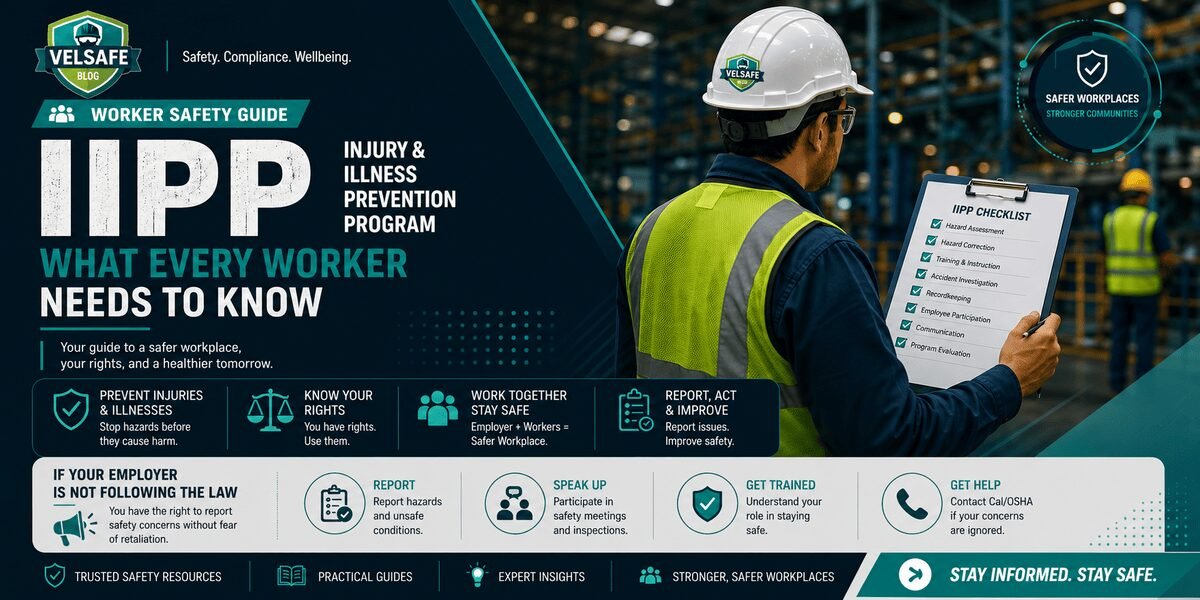
Worker in high-visibility vest and hard hat reviewing an IIPP checklist on a clipboard in a warehouse — VelSafe IIPP Worker Safety Guide

Injury and Illness Prevention Program (IIPP): What Every Worker Needs to Know

WORKER SAFETY: Injury and Illness Prevention
Injury and Illness Prevention Program (IIPP): What Every Worker Needs to Know
An Injury and Illness Prevention Program (IIPP) is your employer’s written plan for keeping you safe at work. In California, every employer must have one by law. In many other states and industries, it is a best-practice requirement or a condition of insurance. This guide explains what an IIPP is, what it must include, what your rights are under it, and what to do if something in your workplace is not safe.

Why This Matters to You

Your employer is required to have a safety plan, and you have the right to see it

Under California’s IIPP law (Title 8 CCR 3203), every employer in California must have a written Injury and Illness Prevention Program. It must cover how hazards are identified, how they are corrected, how workers are trained, and how injuries and illnesses are investigated. You have the right to ask your supervisor or employer to see the IIPP. Understanding what it contains, and whether it is actually being followed, is one of the most practical things you can do to protect yourself at work.

Hazard Overview: What an IIPP Is Designed to Prevent

An IIPP is a proactive safety management system. Rather than waiting for an injury to happen and then reacting, an IIPP requires employers to identify hazards before they cause harm, put controls in place, train workers, and check that controls are working. The eight required elements of a Cal/OSHA-compliant IIPP address every stage of this cycle.

Without an IIPP
Hazards go unidentified. Workers are not trained on risks. Injuries happen. There is no investigation to find out why or prevent the next one.
With an Effective IIPP
Hazards are found and fixed before injuries happen. Workers are trained. Injuries are investigated. The workplace gets safer over time.

The 8 Required Elements of a Cal/OSHA IIPP

California’s IIPP law requires that every written IIPP include all eight of the following elements. If your employer’s IIPP is missing any of these, it is not compliant with the law.

1
Responsibility
The IIPP must name a person who is responsible for implementing and maintaining it. This is usually a safety manager, supervisor, or the employer themselves in a small business. Knowing who is responsible means you know who to go to with safety concerns.
2
Compliance
The IIPP must describe how the employer ensures that workers follow safe practices. This includes a system for recognising workers who follow safety rules and for addressing workers who do not. It is not just about punishment; it is about making safe behaviour the norm on the job.
3
Communication
Workers must be able to raise safety concerns without fear of being fired, disciplined, or intimidated. The IIPP must include a system for workers to report hazards anonymously if they choose. If you see something unsafe and are afraid to report it, that is a sign this element of the IIPP is not working.
4
Hazard Assessment
The employer must conduct periodic inspections to identify unsafe conditions and unsafe work practices. This means a supervisor or safety person regularly walks through the workplace looking for hazards, not just after an injury happens. New hazards must also be assessed when new equipment, processes, or materials are introduced.
5
Accident Investigation
When an injury, illness, or near-miss occurs, the employer must investigate what caused it and take steps to prevent it from happening again. The purpose of an investigation is not to blame the worker; it is to find and fix the hazard or practice that allowed the incident to occur. Near-misses must also be investigated.
6
Hazard Correction
When a hazard is identified, it must be corrected. Serious hazards must be corrected immediately or workers must be protected until the correction is made (for example, barricading an area or removing workers from the zone). Less urgent hazards must be corrected within a reasonable timeframe. The IIPP must track which hazards have been identified and whether they have been fixed.
7
Training and Instruction
Workers must receive training on the hazards of their specific job when they are hired, when they are assigned to a new job, when new hazards are introduced, and whenever the employer becomes aware that a worker does not understand a safety procedure. Training must be in a language the worker understands.
8
Recordkeeping
The employer must keep records of hazard inspections, training provided, and any injuries and illnesses that occur. Cal/OSHA can inspect these records. Employers with fewer than 10 employees in low-hazard industries may use a simplified recordkeeping approach, but the IIPP itself is still required.

Signs Your Workplace’s IIPP Is Not Working

Workers are afraid to report hazards
If workers worry about retaliation when they raise a safety concern, the communication element of the IIPP is failing. Cal/OSHA prohibits retaliation against workers who report safety problems.
The same hazards keep appearing
If you see the same unsafe conditions being flagged repeatedly without being fixed, the hazard correction element is not working. Hazards identified must be corrected, not just noted.
No training when you start or change jobs
If you started a new job or task and were not told about the hazards involved, the training element is failing. You are legally entitled to training in a language you understand.
Injuries are not investigated
If a coworker gets hurt and nothing changes afterward, the accident investigation element is not working. Every injury should trigger a review of what caused it and what will be done differently.

Safe Work Practices: How to Use Your IIPP

1
Ask to see the IIPP
Your employer is required to make the IIPP available to you. Ask your supervisor or HR department where it is kept. Read the sections that apply to your job. If your employer refuses to show it to you, that is a violation you can report to Cal/OSHA.
2
Report hazards using the system in the IIPP
The IIPP must include a way for workers to report hazards (verbally, in writing, or anonymously). Use it. If there is no system or your reports are being ignored, document what you reported and when, and contact Cal/OSHA if the problem is serious.
3
Participate in safety training
Take training seriously. If training is conducted in a language you do not fully understand, tell your supervisor. You have the right to training in a language you can follow. Ask questions. If you leave a training session unsure of something, ask for clarification before you start the job.
4
Know your right to refuse unsafe work
In California, you have the right to refuse work that poses an imminent danger to your health or safety. This is a protected right; your employer cannot legally fire or discipline you for refusing work that any reasonable person would consider imminently dangerous.

PPE Requirements Under an IIPP

Your employer must provide required PPE at no cost to you

The IIPP must identify the PPE required for each job task where engineering or administrative controls cannot eliminate the hazard. Your employer is required to provide that PPE, ensure it fits correctly, train you on how to use it, and replace it when it is damaged or worn out. You should never have to pay for required safety equipment.

Hard Hats
Where overhead hazards exist
High-Vis Vests
Where vehicle traffic is present
Safety Footwear
Where foot injury hazards exist
Gloves
Type varies by hazard
Eye Protection
Where eye hazards exist
Respirators
Where airborne hazards exist

Do and Don’t

DO
DON’T
Ask to see the IIPP when you start a new job
Assume your employer has a working IIPP without checking
Report hazards as soon as you notice them
Wait for someone else to report a hazard you have seen
Wear all required PPE for your job task
Skip PPE because it is uncomfortable or inconvenient
Participate fully in safety training and ask questions
Stay quiet in training if you do not understand something
Refuse work that poses an imminent danger
Do a task you believe is seriously unsafe because you were told to
Report near-misses as well as actual injuries
Ignore a near-miss because nobody got hurt

Emergency Response: What to Do If You Are Injured at Work

Step 1: Get medical help immediately if needed
For serious injuries, call 911. For less serious injuries, notify your supervisor immediately. Your employer must direct you to medical care. Do not delay seeking treatment because you are worried about paperwork or being seen as a problem.
Step 2: Report the injury to your employer
Report your injury to your supervisor as soon as possible. In California, you must report a work injury within 30 days to preserve your workers’ compensation rights. Report it in writing if possible and keep a copy.
Step 3: Cooperate with the investigation
Your employer is required to investigate what caused the injury. Be honest about what happened. The goal is to prevent the next injury, not to punish you. If you feel the investigation is being done unfairly, you can contact Cal/OSHA.
Step 4: Know your workers’ compensation rights
In California, you are entitled to workers’ compensation benefits for work-related injuries and illnesses regardless of fault. Your employer cannot discriminate against you for filing a workers’ compensation claim. If you believe you are being retaliated against, contact the California Division of Workers’ Compensation.

Supervisor Tips: Making the IIPP Work on Your Team

Walk the IIPP, don’t just sign it. The most common IIPP failure is a document that exists on paper but is not implemented in practice. Supervisors are the link between the written programme and daily work. Conduct your own periodic walk-throughs. Ask workers if they know who to report hazards to.
Take every hazard report seriously. When a worker reports a hazard, document it and escalate it for correction. If workers learn that their reports lead to action, they will keep reporting. If they learn that nothing happens, they will stop.
Investigate near-misses, not just injuries. A near-miss is a warning that a hazard exists before someone gets hurt. Treating near-misses with the same seriousness as injuries is one of the highest-value things a supervisor can do under an IIPP.

Worker Checklist: IIPP Basics

I know where to find my employer’s IIPP
I know how to report a hazard at my workplace
I know who is responsible for safety at my workplace
I have received safety training for my specific job
I know what PPE is required for my tasks
I understand my right to refuse imminently dangerous work
I know what to do if I am injured at work
I feel safe reporting hazards without fear of retaliation

Key Takeaways

The IIPP is a legal requirement and a worker right
Every California employer must have a written IIPP. You have the right to see it, to report hazards under it, and to receive training through it. If your employer does not have one or refuses to follow it, that is a Cal/OSHA violation you can report.
The IIPP only works if it is actually followed
A written IIPP sitting in a binder that nobody reads does not protect anyone. The value of an IIPP comes from the daily practices it creates: regular hazard inspections, prompt corrections, meaningful training, and a culture where reporting is encouraged and taken seriously.
You are part of the IIPP
An IIPP is not just an employer document; it depends on workers actively participating: reporting hazards, attending training, following safe practices, and refusing work that is imminently dangerous. The programme works when workers and employers are both doing their part.

Frequently Asked Questions

Does every employer in California have to have an IIPP?
Yes. Title 8 CCR Section 3203 requires every California employer, regardless of size or industry, to have a written IIPP. There is no size exemption; even a business with one employee must have an IIPP. The level of detail required scales with the complexity of the workplace hazards, but the written programme is mandatory for all employers.
What happens if my employer does not have an IIPP?
Cal/OSHA can cite and fine employers who do not have a written IIPP or whose programme does not meet Title 8 CCR 3203 requirements. Workers can file an anonymous complaint with Cal/OSHA to trigger a workplace inspection.
Can my employer fire me for reporting a safety hazard?
No. California law prohibits employers from retaliating against workers who report safety hazards, file workers’ compensation claims, or contact Cal/OSHA. Retaliation includes firing, demotion, reduced hours, or any adverse action taken because you exercised a safety right. If you believe you have been retaliated against, you can file a retaliation complaint with the California Labor Commissioner’s office.

Government and Regulatory Sources

  • Cal/OSHA – Title 8 CCR Section 3203: Injury and Illness Prevention Program
  • Cal/OSHA – IIPP Requirements Guide
  • Cal/OSHA – Filing a Worker Safety Complaint
  • California DWC – Workers’ Compensation Information for Workers

VelSafe Worker Safety
An IIPP Is Only as Strong as the Culture Behind It
California’s IIPP requirement sets the minimum. The companies with the lowest injury rates build beyond it: strong reporting culture, supervisory accountability, and worker involvement at every stage. Explore VelSafe’s worker safety library to go further.
Browse Worker Safety Articles

Add a Comment

Your email address will not be published. Required fields are marked *