

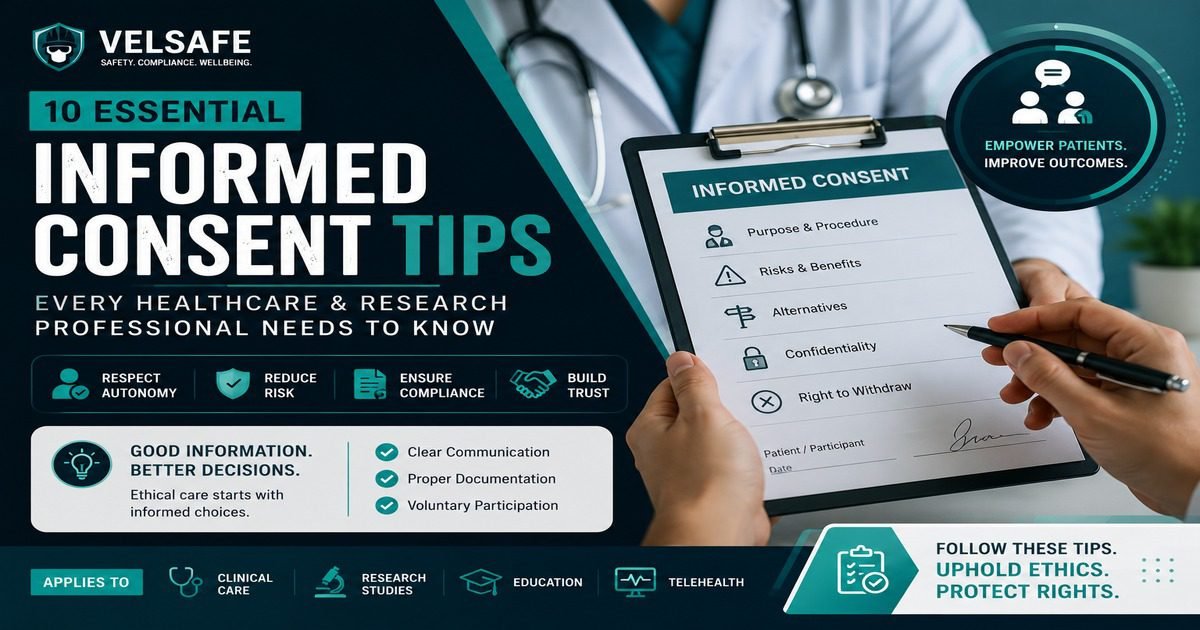
TIPS: Informed Consent
Informed consent is not a signature on a form. It is an ongoing process of communication that ensures the person giving consent genuinely understands what they are agreeing to, has the capacity to decide, and is making their decision freely. These ten tips address the specific points where informed consent processes most commonly break down: from inadequate disclosure to documentation failures that create legal and ethical exposure.
Quick Tips
1. Treat consent as a conversation, not a form
2. Always assess decision-making capacity before proceeding
3. Disclose all material risks, not just the common ones
4. Use plain language: never assume literacy or health literacy
5. Confirm understanding before obtaining the signature
6. Give adequate time: never rush consent
7. Document the process, not just the outcome
8. Reconfirm consent when circumstances change
9. Know who can consent for patients who cannot
10. Protect consent from coercion, even unintentional
What You Will Learn
The legal and ethical elements of valid informed consent
How to assess decision-making capacity reliably
What “material risk” means and why it matters legally
When substitute decision-makers can consent and what their limits are
How to document consent in a way that protects both patient and provider
10 Actionable Tips for Better Informed Consent Practice
1
Treat Consent as a Conversation, Not a Form
Why It Matters
A signed form without a genuine conversation documents a process that did not occur. Courts assess whether informed consent was actually obtained, not whether a signature is present.
What To Do
Before presenting any form, explain the procedure in your own words. Invite questions, address concerns, allow silence. Only then present the written form as a summary of what was discussed.
Common Mistake
Presenting the consent form first, asking the patient to read it, and then asking “Any questions?” This reverses the process and shifts the burden of understanding onto the patient rather than the professional.
Pro Tip
Use the teach-back method after your explanation: “I want to make sure I explained this clearly. Can you tell me in your own words what we will be doing and what the main risks are?” This identifies gaps in understanding before the signature, not after a complication.
2
Always Assess Decision-Making Capacity Before Proceeding
Why It Matters
Consent from a person who lacks decision-making capacity is not valid regardless of what they sign. Capacity is a clinical assessment of the person’s current ability to understand information, appreciate its relevance, reason about their options, and express a consistent choice. It differs from legal competence (determined by courts) and from age-based legal thresholds.
What To Do
Before any consent discussion, assess whether the person can: understand the information provided; appreciate its relevance to their situation; reason about the decision using their own values; and communicate a stable choice. If any of these four elements is impaired, capacity may be lacking and a substitute decision-maker may be required.
Common Mistake
Assuming capacity because the patient is conscious, without verifying they can understand and process the specific information being provided.
Pro Tip
Capacity is decision-specific and can fluctuate. A patient may have capacity to consent to a simple blood draw but not to a complex surgical procedure. Assess capacity for the specific decision at hand, and reassess if the patient’s condition changes or if they seem inconsistent.
3
Disclose All Material Risks, Not Just Common Ones
Why It Matters
Most jurisdictions now apply the “reasonable patient” standard: what a reasonable person in the patient’s position would want to know. Under this standard, a rare but serious risk (such as a one-in-a-thousand chance of permanent paralysis) is material and must be disclosed regardless of frequency.
What To Do
Disclose: all common risks; all serious risks regardless of frequency; risks specific to this patient; and alternatives including non-treatment. Document what was disclosed.
Common Mistake
Disclosing only common side effects and omitting rare but catastrophic outcomes because “it almost never happens.” Courts assess disclosure based on what the patient would have wanted to know, not on how often a risk occurs.
Pro Tip
Ask yourself: “If this patient later experiences this outcome, would they say they were not told it was possible?” If yes, it should have been disclosed. The test is not how likely the risk is; it is whether a reasonable person would consider it relevant to their decision.
4
Use Plain Language and Never Assume Health Literacy
Why It Matters
A substantial proportion of adults have limited health literacy. Patients regularly sign forms they do not understand, particularly in institutional environments where they feel pressure to appear cooperative. Consent without understanding is not legally or ethically valid.
What To Do
Aim for a Grade 6-8 reading level. Use everyday words: “heart attack” instead of “myocardial infarction”; “bleeding” instead of “haemorrhage.” Use visual aids where available. Offer professional interpreter services and document the offer.
Common Mistake
Using consent forms written for compliance or legal protection (dense, technical, passive voice) rather than for patient comprehension. These forms demonstrate legal awareness but fail at their primary purpose of informing the patient.
Pro Tip
Never use a family member (other than a professional interpreter) to translate for a patient during the consent process. Family members may omit or rephrase information to protect the patient from distressing content, which compromises the validity of the consent.
5
Give Adequate Time: Never Rush Consent
Why It Matters
Consent obtained under time pressure or immediately before a procedure is legally vulnerable. Voluntariness is a core element of valid consent; time pressure undermines it. Courts are sceptical of consents obtained in rushed circumstances even when the form is signed.
What To Do
Obtain consent well before the procedure, never in the pre-operative area or procedure room when the patient has already been prepared. Provide written information in advance where possible. Allow time for the patient to consult family members or advisors. Offer to reschedule the consent discussion if the patient is in significant distress.
Common Mistake
Obtaining consent in the anaesthetic room immediately before surgery when the patient is already in a surgical gown, surrounded by staff, and has limited realistic ability to refuse. This setting creates powerful implicit coercion.
Pro Tip
If a patient asks for more time before deciding, give it to them. Document that additional time was offered and provided. A patient who feels they had adequate time to decide is far less likely to later claim the consent was invalid.
6
Document the Process, Not Just the Outcome
Why It Matters
A signed consent form documents that the patient signed something. It does not document that a proper consent process occurred. When a consent dispute arises, the question is usually not “did the patient sign?” but “were they properly informed?” Clinical notes documenting the consent conversation: what was explained, what questions were asked, what the patient said they understood, are far more valuable than the form alone.
What To Do
Write a brief clinical note documenting: key information disclosed; specific risks discussed; alternatives covered; questions asked; and the patient’s expressed understanding. Note the time and setting.
Common Mistake
Relying entirely on the signed form as the only documentation of consent, with no contemporaneous note in the clinical record describing what was actually discussed.
Pro Tip
If a consent dispute arises years later, the contemporaneous clinical note carries more evidentiary weight than the form. Judges and juries understand that forms are presented to patients to sign; they give more credit to detailed, specific notes written immediately after the conversation.
7
Reconfirm Consent When Circumstances Change
Why It Matters
Consent is specific to the circumstances disclosed. If those change (different surgeon, additional procedure, new risk information), the original consent may not cover the new situation. Consent applies to what was disclosed at the time it was given.
What To Do
Before any procedure, confirm: the procedure has not changed, the same provider will perform it, and no new significant risks have emerged. In research, recontact participants when the protocol changes materially.
Common Mistake
Assuming that consent given six months ago for a planned procedure is still valid on the day of surgery without reconfirmation, particularly when the patient’s condition or the planned procedure has changed in the interim.
Pro Tip
A brief pre-procedure reconfirmation takes 60 seconds: “Mrs Smith, just to confirm before we proceed: this is still the procedure we discussed, you understand what we’ll be doing, and you’re still happy to go ahead?” Document this reconfirmation in the clinical note.
8
Know Who Can Consent When the Patient Cannot
Why It Matters
When a patient lacks capacity, a substitute decision-maker must be identified. The hierarchy and the standard they apply (“substituted judgement” or “best interests”) varies by jurisdiction. Acting on consent from an unauthorised substitute is legally equivalent to acting without consent.
What To Do
Know your jurisdiction’s SDM hierarchy: typically healthcare proxy first, then next of kin in a defined order. Ask the SDM to apply the patient’s known values, not their own. Document who the SDM is and on what basis they are authorised.
Common Mistake
Accepting consent from the first available family member without verifying who has legal authority to consent, or asking the substitute decision-maker what they want for the patient rather than what the patient would have wanted.
Pro Tip
Advance directives, healthcare proxies, and powers of attorney for personal care should be requested and documented on admission to any facility, not searched for in a crisis. Knowing who can consent before capacity is lost is far better than resolving it in an acute situation.
9
Protect Consent From Coercion, Including Unintentional Coercion
Why It Matters
Voluntariness is fundamental to valid consent. Coercion in healthcare is often unintentional: professional authority, patient dependency on care, or excessive research incentives can all compromise voluntariness without anyone intending it.
What To Do
Tell patients explicitly they can refuse or withdraw without affecting the quality of their care. In research, ensure incentives are proportionate and not “undue inducement.” Keep research consent separate from clinical care so patients do not feel participation is required.
Common Mistake
Describing refusal as a mistake: “Are you sure you want to refuse? This is the best treatment available.” This is pressure, not information.
Pro Tip
When a patient declines a recommended intervention, your role is to ensure their decision is informed: that they understand the risks of declining, not to change their mind. Document that the risks of non-treatment were explained and that the patient confirmed their decision after that discussion.
10
Apply Extra Care With Vulnerable Populations
Why It Matters
Certain populations face heightened vulnerability: minors, persons with cognitive impairment, those in custodial settings, and patients in acute distress. Vulnerability does not eliminate the right to consent or refuse; it requires additional procedural care to ensure consent is genuine.
What To Do
For minors, obtain assent alongside parental consent and give increasing weight to the adolescent’s view as they approach majority. For cognitive impairment, use simplified explanations and involve a trusted person. In custodial settings, ensure participation is genuinely voluntary.
Common Mistake
Treating a vulnerability as a reason to bypass the person’s views entirely and consent only through a substitute, when in fact many vulnerable people retain significant capacity to participate in and contribute to decisions about their own care.
Pro Tip
For patients with fluctuating capacity (delirium, intermittent psychiatric episodes), attempt consent during periods of higher capacity when possible, and document the timing and the patient’s state at the time of the discussion.
Quick Checklist: Informed Consent Process
Before the Discussion
Decision-making capacity assessed
Appropriate time and setting arranged
Interpreter arranged if needed
Written materials prepared in plain language
During the Discussion
Procedure explained in plain language
All material risks disclosed
Alternatives including non-treatment discussed
Teach-back used to confirm understanding
After Obtaining Consent
Clinical note written documenting the process
Form signed and filed
Right to withdraw consent confirmed
Reconfirmation planned for before procedure
Common Mistakes in Informed Consent
Mistake
Why It Is a Problem
Treating consent as a one-time administrative task
Consent is an ongoing process. A single signature cannot cover changed circumstances or partial understanding. Treat every material change as a trigger for renewed consent.
Delegating consent discussion to staff without the knowledge to conduct it
The person obtaining consent must be able to answer clinical questions. Delegating to staff who cannot results in a form-signing exercise, not informed consent.
Confusing a patient’s signature with their understanding
Patients regularly sign forms they do not understand in environments where refusing feels confrontational. Signature confirms the form was presented; understanding must be assessed, not inferred.
Real-World Application
What a Well-Conducted Consent Discussion Looks Like
A surgeon meets a patient three weeks before a planned cholecystectomy. She explains the procedure with a simple diagram, covers common and serious risks including the rare risk of major vascular injury, and discusses alternatives. Using teach-back, she asks the patient to summarise their understanding. The patient asks to delay the decision; the surgeon provides a written information sheet and arranges a follow-up call. At the second appointment, the patient signs the form and the surgeon writes a detailed note in the record.
Note: This example illustrates best practice and is illustrative rather than based on a specific case.
Downloadable Resource: Informed Consent Process Checklist
Use the three-phase checklist above as the standard process for every consent discussion. Add your organisation’s SDM hierarchy to the Before phase and review against your facility’s consent policy annually.
Use checklist above
Key Takeaways
The signature is the last step, not the only step
Valid informed consent requires disclosure of material information, capacity assessment, adequate time, freedom from coercion, and confirmation of understanding. The signature is evidence of this process; without it, the signature is documentation of a form-signing exercise.
Documentation must capture the conversation, not just confirm the signature
In a consent dispute, the contemporaneous clinical note carries more evidentiary weight than the form alone. It should describe what was disclosed, how understanding was assessed, and what the patient said they understood.
Consent protects the patient, not just the provider
Consent is primarily an ethical obligation to the patient, not a risk management exercise. Patients who are genuinely informed make better decisions, are more prepared for adverse outcomes, and trust their providers more when things do not go as planned.
Frequently Asked Questions
Can a patient withdraw consent after a procedure has started?
Yes. A patient who retains decision-making capacity can withdraw consent at any point, including during a procedure. If withdrawal mid-procedure would create a serious risk (stopping a surgical procedure at a dangerous point), the clinical team must use their judgement about whether it is safer to complete the immediate step or stop. The patient’s right to withdraw consent is not negated by inconvenience to the provider or the fact that the procedure has already begun. Document any withdrawal of consent immediately in the clinical record.
What is the difference between informed consent and assent?
Consent is the legally authoritative decision by someone with legal authority (the patient or a recognised substitute). Assent is the agreement of someone without full legal authority, typically a child or person with cognitive impairment. Assent is ethically important and required by many IRBs for research involving minors. A child’s dissent should be respected where possible even when parental consent has been obtained.
In an emergency where a patient cannot consent, can treatment proceed?
Yes, under narrow conditions: the patient lacks capacity, faces a serious threat to life or health, no substitute is immediately available, and delay would cause significant harm. Document the circumstances that justified proceeding without consent as thoroughly as you would document a consent process. Attempt to reach a substitute decision-maker if time permits.
Government and Regulatory Sources
- HHS – 45 CFR Part 46: Protection of Human Subjects (Common Rule)
- HHS – HIPAA and Research
- FDA – Informed Consent in Clinical Trials
- CMS – Patient Rights and Informed Consent
Related VelSafe Articles
- PRACTICE TEST: Infection Control and Hand Hygiene Knowledge Review
- 10 Incident Investigation Tips Every Safety Manager Needs to Know
- Industrial Hygiene Awareness: Understanding Workplace Health Hazards
VelSafe Compliance Training
Every clinical interaction involving participant decision-making requires properly documented informed consent. VelSafe covers FDA BIMO compliance, clinical research ethics, and pharmaceutical GMP requirements across tips, guides, and insights.
Browse Compliance Tips