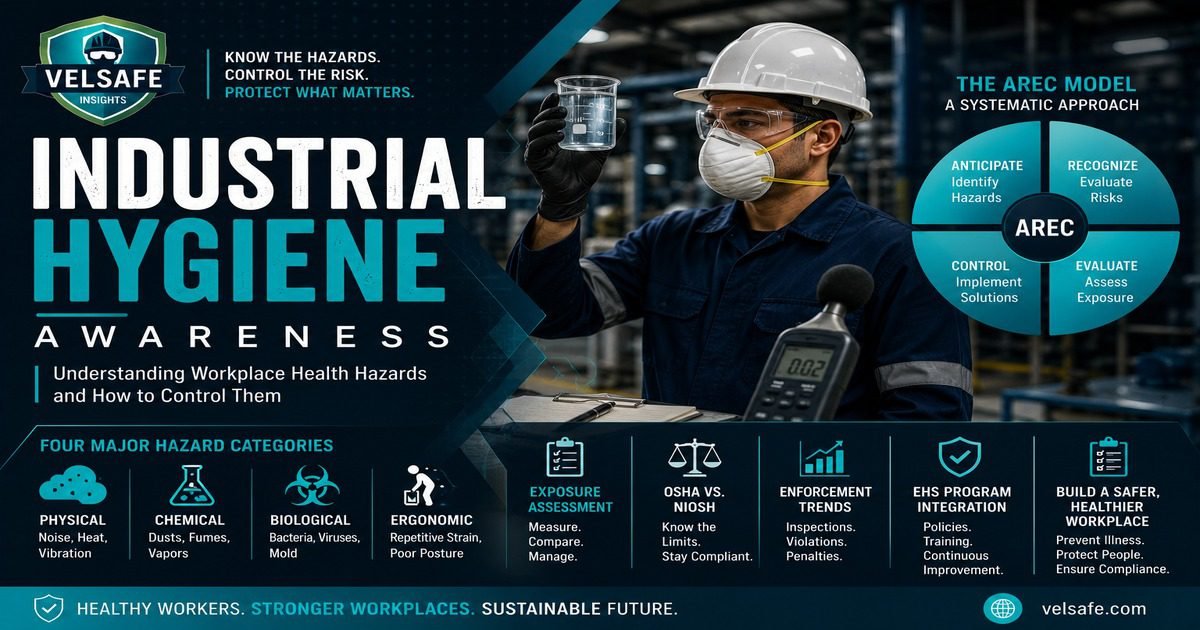
Industrial hygiene is the science and art of anticipating, recognising, evaluating, and controlling workplace conditions that cause illness or injury. Where safety focuses on preventing acute injuries, industrial hygiene focuses on preventing occupational illness from chemical, physical, biological, and ergonomic hazards that may not be immediately visible or obvious. This executive overview explains what industrial hygiene covers, why it matters, and what organisations need to know to build effective occupational health protection into their safety programmes.
Executive Summary
Industrial hygiene addresses the occupational health hazards that injure and sicken workers through chronic, cumulative, or immediate exposure rather than through discrete physical accidents. The four primary hazard categories are chemical, physical, biological, and ergonomic. Effective industrial hygiene programmes follow the Anticipate-Recognize-Evaluate-Control (AREC) model and apply the hierarchy of controls to eliminate or reduce exposures to levels below established occupational exposure limits. OSHA, NIOSH, and the American Conference of Governmental Industrial Hygienists (ACGIH) provide the primary regulatory and guidance framework. As occupational illness continues to carry costs that dwarf those of acute injury, industrial hygiene has become a strategic priority for safety-mature organisations.
Key Statistics
50,000+
US Workers Die From Occupational Disease Annually
NIOSH estimates more than 50,000 Americans die each year from occupational diseases, compared to approximately 5,000 from traumatic workplace injuries
An estimated 190,000 new cases of occupational illness are diagnosed in the US each year, with significant under-reporting in industries with high chemical or physical exposure
The total economic burden of occupational illness including medical costs, lost productivity, and disability exceeds $250 billion annually in the United States
“The fundamental problem with occupational illness is that the connection between exposure and disease is often invisible and delayed. A worker exposed to silica dust for ten years may not develop silicosis for another decade. By the time the disease appears, the exposure has been occurring for twenty years under conditions that could have been controlled. Industrial hygiene’s value is that it does not wait for illness to appear; it identifies and controls exposures before they accumulate into disease.”
Concept: Industrial Hygiene Practice | AIHA (American Industrial Hygiene Association)
1. What Is Industrial Hygiene?
Industrial hygiene is the discipline concerned with the anticipation, recognition, evaluation, and control of workplace conditions that may cause workers to experience illness, impaired health, or significant discomfort. The field emerged in the early twentieth century alongside the growth of industrial manufacturing, mining, and chemical production, as occupational physicians and engineers began to document the relationships between specific workplace exposures and specific diseases.
The AREC model (Anticipate-Recognize-Evaluate-Control) is the foundational framework of the discipline. Anticipation involves identifying potential hazards before they are introduced into the workplace. Recognition involves identifying existing hazards through observation, measurement, and review of occupational health and illness data. Evaluation involves quantifying exposure levels and comparing them to established occupational exposure limits (OELs) to determine whether control is needed and to what degree. Control involves implementing measures that reduce exposures to acceptable levels using the hierarchy of controls.
A
Anticipate
Identify hazards before they are introduced into the workplace through new processes, chemicals, or equipment
R
Recognize
Identify existing hazards through walkthrough surveys, air monitoring, biological monitoring, and review of illness records
E
Evaluate
Quantify exposure levels and compare to occupational exposure limits (OELs) to determine the need for and degree of control
C
Control
Implement engineering, administrative, and PPE controls to reduce exposures to acceptable levels following the hierarchy of controls
2. The Four Primary Hazard Categories
Industrial hygiene addresses four primary categories of occupational health hazard. Understanding each category is essential for effective hazard anticipation and recognition.
1
Chemical Hazards
Chemical hazards encompass the gases, vapours, dusts, fumes, mists, and liquids that workers may inhale, absorb through the skin, or ingest in the course of their work. They represent the most studied and most regulated category of industrial hygiene hazard. Exposure routes include inhalation (most common), dermal absorption, and ingestion. Health effects range from acute toxicity (immediate poisoning, chemical burns) to chronic disease (cancer, respiratory disease, reproductive effects, neurological damage) depending on the substance, the route of exposure, and the duration and intensity of contact.
Substitution: Replace hazardous substances with less hazardous alternatives where technically feasible. Substitution is the most effective chemical control when available.
Ventilation: Local exhaust ventilation (LEV) captures contaminants at the source before they reach the worker’s breathing zone. General dilution ventilation reduces concentrations by introducing large volumes of clean air.
Respiratory protection: The last line of defence when engineering controls cannot achieve acceptable exposure levels. Respirators must be matched to the specific hazard and properly fitted.
2
Physical Hazards
Physical hazards include noise, heat stress, cold stress, non-ionising radiation (ultraviolet, infrared, laser, radiofrequency), ionising radiation, vibration, and illumination. Many physical hazards are invisible and their health effects cumulative. Noise-induced hearing loss is the most prevalent occupational physical hazard in the United States, affecting millions of workers; it is also irreversible. Heat illness and heat stroke are leading causes of occupational fatalities during high-temperature seasons and in hot indoor environments.
Key Examples
Noise-induced hearing loss (NIHL), heat stroke, cold stress and frostbite, UV radiation-induced skin cancer and cataracts, ionising radiation from radioactive materials and X-ray equipment, whole-body vibration from vehicles, hand-arm vibration syndrome from power tools.
Primary Control Approaches
Engineering controls: Quieter equipment, acoustic enclosures and barriers, engineering out excessive heat sources, shielding for radiation sources. Engineering controls are preferred because they reduce exposure at the source.
Administrative controls: Work-rest regimens for heat and cold stress, job rotation to reduce vibration exposure time, scheduling outdoor work to avoid peak UV hours.
PPE: Hearing protection (earplugs, earmuffs), cooling vests for heat stress, UV-protective clothing and eyewear, vibration-dampening gloves.
3
Biological Hazards
Biological hazards include bacteria, viruses, fungi, parasites, and biological toxins that workers may be exposed to through their work. They are of particular concern in healthcare, agriculture, waste management, laboratory settings, and animal handling. Bloodborne pathogen exposure (HIV, hepatitis B, hepatitis C) under OSHA’s Bloodborne Pathogens Standard (29 CFR 1910.1030) is among the most regulated biological hazards. Mould exposure in building maintenance and remediation, Legionella in water systems, and zoonotic diseases in agricultural settings are other significant biological hazard categories.
Key Examples
HIV, hepatitis B and C (healthcare and emergency response workers), Legionella (building and water system maintenance), mould and fungal spores (remediation and agriculture), anthrax (animal handling), brucellosis (livestock workers), Q fever (veterinary and agricultural settings).
Primary Control Approaches
Vaccination: For vaccine-preventable occupational diseases (hepatitis B, influenza in healthcare), vaccination is the most effective protective measure.
PPE: Gloves, gowns, masks, face shields, and respirators appropriate to the specific biological hazard and transmission route. Must be used in conjunction with administrative controls and good hygiene practices.
4
Ergonomic Hazards
Ergonomic hazards are the physical demands of work that place excessive stress on the musculoskeletal system: repetitive motions, forceful exertions, awkward postures, contact stress, and vibration. They cause musculoskeletal disorders (MSDs) including back injuries, rotator cuff tears, carpal tunnel syndrome, and tendinitis. MSDs are the most costly category of workplace injury in the United States, accounting for roughly one-third of all injury and illness cases. Ergonomic hazards are addressed in detail in VelSafe’s Industrial Ergonomics series and California Ergonomics Law article; for the purposes of this overview, they are included as the fourth primary industrial hygiene hazard category alongside chemical, physical, and biological hazards.
3. Exposure Assessment: Measuring and Quantifying Risk
Exposure assessment is the evaluation phase of the AREC model. It involves measuring or estimating workers’ exposure to hazardous agents and comparing those exposures to established occupational exposure limits (OELs). The outcome of exposure assessment determines whether controls are needed and how rigorous those controls must be.
Occupational Exposure Limits (OELs)
OELs are the regulatory and guidance values that define acceptable exposure concentrations for chemical and physical agents. The key sets of OELs in the US are: OSHA Permissible Exposure Limits (PELs), which are legally enforceable but many are outdated; NIOSH Recommended Exposure Limits (RELs), which are more current and health-based; and ACGIH Threshold Limit Values (TLVs), which are annually updated guidance values used by many industrial hygienists as the most current benchmarks.
Air Monitoring
Personal air monitoring involves attaching sampling equipment to a worker to measure the airborne concentration of a contaminant in their breathing zone over a defined period (typically a full shift). Area monitoring uses stationary samplers to measure concentrations in a work area. Both methods are used to characterise exposure levels. Industrial hygienists use statistical analysis of monitoring data to determine the probability of overexposure across the exposure group.
Biological Monitoring
Biological monitoring measures the amount of a chemical or its metabolite in blood, urine, exhaled breath, or other biological specimens. It provides a direct measure of the absorbed dose regardless of the exposure route, capturing dermal absorption and ingestion in addition to inhalation. ACGIH Biological Exposure Indices (BEIs) provide guidance values for biological monitoring. It is used for substances with significant dermal absorption (lead, organic solvents, pesticides).
4. Regulatory Framework: OSHA, NIOSH, and ACGIH
Organisation
Role
Key Standards/Values
Legal Status
OSHA
Sets and enforces legally binding occupational health and safety standards for most US employers
Research agency within CDC; conducts occupational health research and makes recommendations to OSHA for new or updated standards
Recommended Exposure Limits (RELs); occupational health research; workplace health hazard evaluations (WHHEs) on request
ADVISORY
ACGIH
Professional organisation that publishes annually updated occupational exposure guidance values; widely used by industrial hygienists as the most current benchmarks
Threshold Limit Values (TLVs) for chemical substances and physical agents; Biological Exposure Indices (BEIs)
GUIDANCE
AIHA
Professional body for industrial hygienists; sets professional standards, credentials (CIH), and publishes occupational exposure bands and practice guidance
Occupational Exposure Banding (OEB); IH practice guidance; Certified Industrial Hygienist (CIH) credential
PROFESSIONAL
Important note on OSHA PELs: Many of OSHA’s Permissible Exposure Limits were established in 1971 and have not been updated to reflect current toxicological evidence. The NIOSH RELs and ACGIH TLVs are generally more protective than the corresponding OSHA PELs. Industrial hygienists routinely use the most protective applicable limit when evaluating exposures, which is often the NIOSH REL or ACGIH TLV rather than the OSHA PEL. Compliance with OSHA PELs is legally required but does not guarantee that exposures are without health risk.
5. Industry Trends Shaping Industrial Hygiene
Silica and Respirable Dust Enforcement
OSHA’s Respirable Crystalline Silica standard (29 CFR 1910.1053 and 1926.1153) continues to drive significant enforcement activity. The standard, fully implemented since 2018-2020 depending on industry sector, reduced the PEL for silica by 50 percent and imposed engineering control requirements, medical surveillance obligations, and hazard communication duties. Silica enforcement remains among OSHA’s top priorities, particularly in construction, foundries, and ceramics manufacturing.
Per- and polyfluoroalkyl substances (PFAS) represent a growing industrial hygiene challenge. Used in fire-fighting foams, industrial coatings, and numerous manufacturing processes, PFAS compounds are persistent, bioaccumulate in human tissue, and are associated with a range of adverse health effects including certain cancers, thyroid disease, and immune system disruption. Regulatory frameworks for workplace PFAS exposure are still developing. NIOSH and EPA are actively working on occupational exposure guidance for this class of compounds.
Welding Fumes and Hexavalent Chromium
The International Agency for Research on Cancer (IARC) classified welding fumes as a Group 1 carcinogen in 2017, recognising sufficient evidence of lung cancer risk in welders. OSHA’s hexavalent chromium standard (29 CFR 1910.1026) covers workers exposed to Cr(VI) in stainless steel welding, chromate coating operations, and related processes. These two overlapping hazards in welding operations continue to drive demand for improved ventilation and exposure monitoring in fabrication and manufacturing industries.
The availability and affordability of real-time air quality and noise monitoring sensors is changing industrial hygiene practice. Where traditional exposure monitoring required laboratory analysis and multi-week turnaround, new sensor technologies allow continuous exposure tracking, immediate feedback to workers and supervisors, and data-driven identification of exposure peaks. The challenge is sensor accuracy and calibration; real-time sensors supplement but do not replace validated industrial hygiene sampling methods for regulatory compliance purposes.
6. Regulatory Perspective: Where OSHA Is Focusing
OSHA’s enforcement priorities in industrial hygiene shift over time as new research identifies hazards, new standards are promulgated, and targeting criteria are updated. The current areas of concentrated OSHA industrial hygiene enforcement activity include:
Silica in Construction and General Industry
Silica citations remain among OSHA’s most-issued chemical exposure citations. The Engineering Control Requirements (Table 1 in construction) are frequently cited for non-compliance. OSHA NEP (National Emphasis Programme) inspections target silica-generating operations including masonry cutting, sandblasting, and foundry operations.
Heat Illness Prevention
OSHA has been developing a heat illness prevention standard under the regulatory agenda. In the interim, OSHA uses the General Duty Clause to cite heat illness hazards. Enforcement has intensified in agricultural, construction, and warehousing sectors. A formal rulemaking would impose specific temperature thresholds, rest requirements, and acclimatisation protocols.
Noise and Hearing Conservation
The Hearing Conservation Amendment (29 CFR 1910.95) continues to generate citations for missing audiometric testing programmes, inadequate hearing protector selection, and missing annual training. Noise exposures at or above the 85 dB(A) action level trigger programme requirements; exposures at or above the 90 dB(A) PEL trigger engineering control obligations.
The Hazard Communication Standard (29 CFR 1910.1200), aligned with GHS since 2012, consistently ranks as one of OSHA’s most frequently cited standards. Violations typically involve missing or outdated Safety Data Sheets, inadequate labelling, and incomplete training records. The standard covers virtually every employer that uses chemicals.
Occupational illness kills and disables far more workers than traumatic injury
The 50,000-plus annual occupational disease deaths in the US exceed the approximately 5,000 traumatic workplace fatalities by a factor of ten. The invisibility of occupational illness (its delayed onset, its gradual progression, its separation in time from the exposures that caused it) makes it easy to underestimate and underinvest in preventing. Industrial hygiene exists precisely to make the invisible visible before it produces irreversible harm.
The AREC model and hierarchy of controls are the practical tools
Industrial hygiene does not require a detailed understanding of toxicology to be applied effectively at the programme management level. The AREC framework (Anticipate, Recognize, Evaluate, Control) and the hierarchy of controls (Elimination, Substitution, Engineering Controls, Administrative Controls, PPE) provide a practical structure that any safety professional can use to identify whether an industrial hygiene hazard exists, assess its significance, and select appropriate controls.
OSHA PELs are a legal floor, not a health guarantee
Many of OSHA’s Permissible Exposure Limits were set in 1971 and have not been updated to reflect five decades of additional toxicological research. An employer who operates at the OSHA PEL is in legal compliance, but may not be providing adequate health protection. Safety professionals and industrial hygienists routinely use the NIOSH RELs and ACGIH TLVs as the more health-protective benchmarks, even though they are not legally enforceable. The goal is worker health, not just legal compliance.
Frequently Asked Questions
What is the difference between industrial hygiene and occupational health?
Industrial hygiene anticipates, recognises, evaluates, and controls workplace environmental hazards that may cause illness. Occupational health diagnoses and manages work-related illness and injury in individual workers, and implements medical surveillance programmes. Industrial hygienists identify and control exposures; occupational health providers treat the health effects of inadequately controlled exposures.
When does an employer need a Certified Industrial Hygienist (CIH)?
OSHA does not mandate CIH credentials for all industrial hygiene activities, but several standards require tasks be performed by qualified persons. For complex exposure assessment, control design, and medical surveillance programme design, engaging a CIH provides technical quality and regulatory defensibility. Many organisations retain CIHs as consultants for periodic audits, supplemented by in-house EHS staff.
How does industrial hygiene fit into an existing EHS programme?
Industrial hygiene is a component of a comprehensive EHS programme rather than a separate programme. In practice, most EHS programmes integrate industrial hygiene through the Injury and Illness Prevention Programme (IIPP or similar), hazard communication programme, hearing conservation programme, respiratory protection programme, and chemical management programme. The industrial hygiene perspective adds the exposure assessment and occupational exposure limit framework to the general hazard identification and control activities that an EHS programme already performs. Organisations that have not explicitly incorporated industrial hygiene principles often find that adding an AREC-based exposure assessment approach to their existing hazard identification process is the most straightforward integration path.
Government and Regulatory Sources
OSHA – Industrial Hygiene
NIOSH – Industrial Hygiene
OSHA – Air Contaminants Standard (29 CFR 1910.1000)
Chemical exposure, noise, heat, and biological hazards affect millions of workers before a single symptom appears. VelSafe’s insights library covers industrial hygiene, occupational health data, and OSHA enforcement trends for safety and EHS professionals.
VelSafe Staff is the editorial team at VelSafe.com, a workplace safety and compliance content platform. Our team of safety professionals, regulatory specialists, and compliance writers produces guides, tips, and insights on OSHA regulations, pharmaceutical GMP, healthcare compliance, and occupational health across construction, manufacturing, oil and gas, and life sciences sectors..