

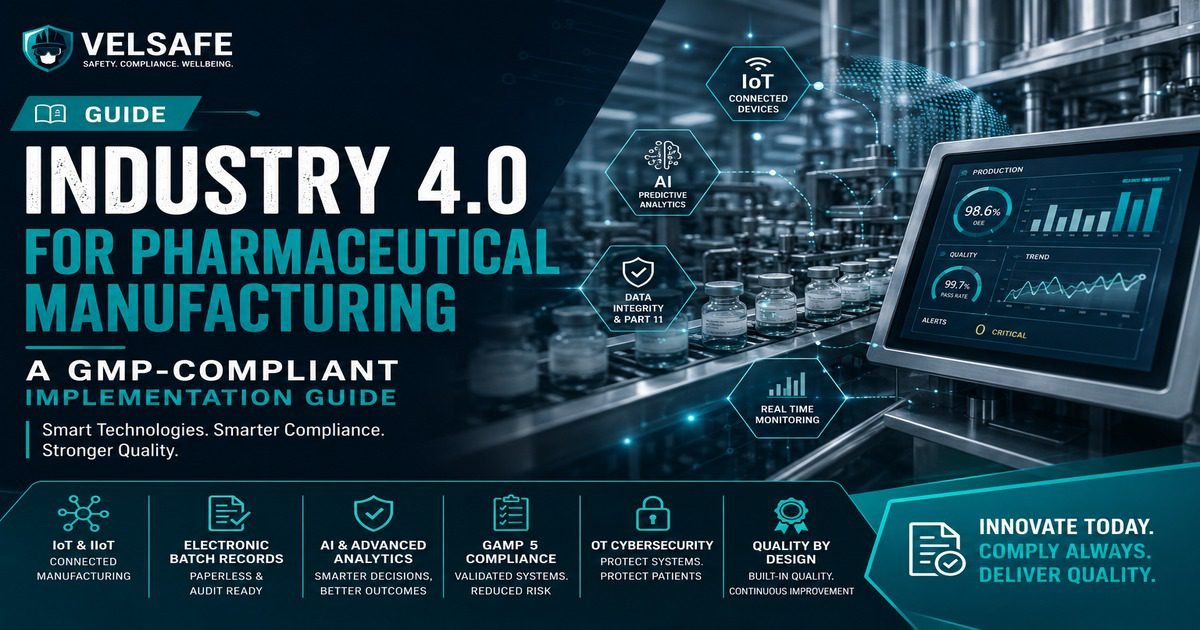
GUIDE: Industry 4.0
Industry 4.0 technologies (Internet of Things sensors, artificial intelligence, digital twins, cloud-based batch records, and automated process control) are transforming pharmaceutical manufacturing. They also introduce new compliance complexity: every connected device is a potential data integrity risk, every automated system requires computer system validation, and every cloud-based record must satisfy 21 CFR Part 11 or equivalent electronic records requirements. This guide walks pharmaceutical quality, manufacturing, and IT professionals through a structured approach to Industry 4.0 implementation that delivers the promised efficiency gains while maintaining GMP compliance.
Quick Overview
What This Guide Covers
A structured eight-step process for implementing Industry 4.0 technologies in pharmaceutical manufacturing facilities while maintaining compliance with cGMP regulations, FDA 21 CFR Part 11 electronic records requirements, data integrity principles (ALCOA+), and computer system validation (CSV) obligations under GAMP 5.
Who Should Use This Guide
Quality Assurance managers, manufacturing operations leaders, IT and OT (operational technology) teams, validation specialists, and EHS professionals at pharmaceutical manufacturers who are evaluating, planning, or implementing Industry 4.0 technologies in GMP-regulated environments.
Core Regulatory Requirement
Every computerised system used in a GMP environment must be validated. FDA Guidance for Industry on Process Validation (2011), 21 CFR Part 11, and GAMP 5 (Good Automated Manufacturing Practice) provide the primary framework. EU GMP Annex 11 applies to EU-facing manufacturers.
Central Compliance Risk
Data integrity. Every Industry 4.0 system that generates, modifies, or stores GMP-relevant data must satisfy the ALCOA+ principles (Attributable, Legible, Contemporaneous, Original, Accurate, plus Complete, Consistent, Enduring, and Available). Data integrity failures are among the most common and most serious findings in FDA and MHRA inspections.
What You Will Learn
How to conduct a GMP risk assessment before any Industry 4.0 technology is selected
How to classify systems under GAMP 5 and determine the appropriate validation approach
How IoT sensor networks can replace manual data collection while maintaining data integrity
What 21 CFR Part 11 requires for cloud-based batch records and electronic signatures
How to validate AI and machine learning systems used in process monitoring or quality decisions
How to design cybersecurity controls that satisfy both IT security and GMP requirements
How to manage change control for continuously updated software and connected systems
How to build an operational technology (OT) infrastructure that supports real-time release testing
Prerequisites
Established GMP quality management system
Industry 4.0 technologies amplify and automate existing processes; they do not fix broken ones. A facility implementing connected systems without a functioning QMS will embed existing compliance weaknesses into automated systems that are harder to correct after implementation.
Computer system validation (CSV) capability
Every GMP-relevant system introduced through Industry 4.0 requires validation. The facility needs either internal CSV expertise or reliable access to qualified validation specialists. Attempting Industry 4.0 implementation without CSV capability is a compliance risk that will surface during inspections.
IT and OT cross-functional collaboration
Industry 4.0 in pharma requires IT teams (who manage enterprise systems, cybersecurity, and cloud infrastructure) and OT teams (who manage manufacturing equipment, SCADA systems, and process control) to work together under a shared governance framework. Siloed IT-OT relationships are a primary implementation failure point.
Required Documents and Tools
Document / Framework
Purpose
Regulatory Source
GAMP 5 (Good Automated Manufacturing Practice)
Primary framework for pharmaceutical computer system validation; categorises systems by risk and defines appropriate validation depth
ISPE; recognised by FDA and EU regulatory authorities
21 CFR Part 11 (FDA)
Sets requirements for electronic records and electronic signatures in FDA-regulated industries; applies to all GMP-relevant electronic records
21 CFR Part 11; FDA Guidance on Scope and Application
EU GMP Annex 11
EU equivalent of 21 CFR Part 11; governs computerised systems in EU GMP-regulated manufacturing
EudraLex Volume 4, Annex 11
FDA Process Validation Guidance (2011)
Three-stage process validation lifecycle model (PPQ, PPQ, CPV); directly applicable to Industry 4.0 continued process verification systems
FDA Guidance for Industry: Process Validation (Jan 2011)
NIST Cybersecurity Framework
Provides the cybersecurity risk management structure for OT/IT convergence in pharmaceutical environments
NIST SP 800-82 (ICS Security)
Step-by-Step: Industry 4.0 Implementation in Pharmaceutical Manufacturing
1
Conduct a GMP Risk Assessment and Technology Mapping
Objective: Identify which processes will be affected, classify GMP impact, and prioritise implementation sequence
Why It Matters
Industry 4.0 implementations that are not preceded by a systematic GMP risk assessment frequently discover compliance issues after deployment, when correction is expensive and may require retrospective validation. The risk assessment determines which systems will generate, modify, or store GMP-relevant data, and therefore which require formal validation under GAMP 5.
Actions
Map all manufacturing processes and identify where Industry 4.0 technologies are being considered. For each technology, assess: Does it generate, modify, transmit, or store GMP-relevant data? Does it make or influence GMP decisions? Does it interface with systems that do? Classify each proposed system using the GAMP 5 category system (Category 1: Infrastructure; Category 3: Non-configured software; Category 4: Configured software; Category 5: Custom software). Higher GAMP categories require more rigorous validation.
Expected Outcome
A written risk assessment document that maps each proposed technology to its GMP impact classification, GAMP 5 category, applicable regulatory requirements (21 CFR Part 11, Annex 11), and preliminary validation scope. This document becomes the foundation for the validation master plan and implementation roadmap.
Tip
Involve QA, manufacturing, IT, and OT in the risk assessment. Each function sees different risks: QA sees data integrity risks; manufacturing sees process risks; IT sees cybersecurity risks; OT sees equipment integration risks. Missing any perspective at this stage creates blind spots that surface during inspection.
2
Design the Data Architecture for ALCOA+ Compliance
Objective: Ensure all GMP-relevant data generated by Industry 4.0 systems satisfies data integrity requirements from the point of creation
Why It Matters
Data integrity is the most frequent serious finding in pharmaceutical regulatory inspections globally. Industry 4.0 systems generate enormous volumes of data through automated sensors, process historians, and connected equipment. If the data architecture is not designed to satisfy ALCOA+ from the beginning, retroactively addressing data integrity gaps in deployed connected systems is extremely difficult and costly.
Actions
For each data type generated by Industry 4.0 systems, document: who or what creates the record (Attributable); how the record will be stored to prevent alteration (Original); what metadata is captured with each record (Contemporaneous, Legible); and how the record will be retained and made accessible for the required retention period (Enduring, Available). Configure audit trails for all GMP-relevant data that capture what changed, who changed it, when it was changed, and the reason for the change.
Expected Outcome
A data architecture specification that maps each data type to its ALCOA+ compliance controls, audit trail configuration, and retention mechanism. This document supports the 21 CFR Part 11 / Annex 11 assessment and becomes a key reference in the validation dossier.
Warning
IoT sensor data streams that overwrite historical readings (common in standard industrial IoT platforms) violate the “Original” and “Enduring” requirements of ALCOA+. All GMP-relevant sensor data must be stored in a form that preserves the original reading and the complete audit trail. Evaluate every vendor’s data retention architecture against ALCOA+ before procurement.
3
Validate IoT Sensor Networks and Process Monitoring Systems
Objective: Demonstrate that sensor networks produce accurate, reliable GMP-relevant data through formal validation
Why It Matters
IoT sensors that monitor temperature, humidity, pressure, pH, and other critical process parameters in GMP environments are subject to the same qualification and calibration requirements as traditional instruments. The fact that a sensor is networked and software-managed does not reduce the validation obligation; it typically increases it, because the data pathway from physical measurement to stored record includes multiple software layers that must each be validated.
Actions
Qualify sensors using IQ/OQ/PQ protocols. IQ verifies the sensor is installed correctly according to specification. OQ verifies it operates within specified performance parameters across the full range. PQ verifies it consistently produces accurate readings under actual process conditions. For IoT sensor networks, additionally validate the data transmission pathway (that readings are not altered, lost, or duplicated in transmission) and the data storage system.
Expected Outcome
Completed IQ/OQ/PQ qualification dossiers for all GMP-relevant sensors. A calibration programme that includes IoT sensors in the site’s periodic recalibration schedule. A data transmission validation report demonstrating that sensor readings are accurately and completely transmitted and stored.
Tip
Wireless IoT sensors in GMP environments require additional validation to demonstrate signal reliability in the specific facility environment. RF interference from equipment, building construction materials, and other wireless systems can cause intermittent data loss that is difficult to detect and may not trigger obvious alarms.
4
Implement 21 CFR Part 11-Compliant Electronic Batch Records
Objective: Replace paper batch records with electronic systems that fully satisfy FDA and EU GMP electronic records requirements
Why It Matters
Electronic batch records (EBR) are among the highest-value Industry 4.0 implementations in pharmaceutical manufacturing. They eliminate transcription errors, automate data capture from connected equipment, enable real-time exception management, and dramatically reduce batch record review time. They also carry significant compliance risk if the system is not properly validated and if electronic signature controls do not meet 21 CFR Part 11 requirements.
Actions
Select an EBR system with documented 21 CFR Part 11 compliance features: unique user IDs and passwords, electronic signature linking signatories to their actions, complete audit trails, restricted access by role, and a validated system that has been assessed against the FDA Part 11 requirements. Validate the EBR system using GAMP 5 protocols appropriate to its category. Conduct a Part 11 gap assessment comparing the system’s features against each Part 11 requirement. Define and validate the interface between the EBR and all connected manufacturing equipment.
Expected Outcome
A validated EBR system with a documented Part 11 assessment. Electronic batch records that satisfy all GMP documentation requirements and are accepted by QA for batch release. A training programme for all EBR users covering electronic signature requirements, audit trail awareness, and error correction procedures.
Warning
Hybrid systems (part paper, part electronic) create data integrity risks because the two record types must be reconciled and neither is the definitive record. When transitioning from paper to EBR, define a clear cutover point and a procedure for handling batches that span the transition. Do not run paper and EBR systems in parallel for the same batch.
5
Validate AI and Advanced Analytics Systems
Objective: Establish a validated approach to AI-driven process monitoring, anomaly detection, and quality predictions
Why It Matters
AI systems in pharmaceutical manufacturing can monitor hundreds of process parameters simultaneously and detect subtle patterns that indicate developing quality issues before they become batch failures. However, AI and machine learning models are not self-validating. If an AI system makes or influences a GMP decision (out-of-specification detection, process adjustment, release recommendation), that system must be validated. The validation approach for AI differs from traditional software validation because the model’s behaviour depends on training data and may change as the model is updated.
Actions
Define the intended use of the AI system precisely: is it advisory (recommendations reviewed by a person before action) or autonomous (takes action without human review)? Advisory systems carry lower GMP risk and require less rigorous validation. Autonomous systems require full validation including model performance verification, accuracy testing against a holdout dataset, and documented acceptance criteria. Establish a process for monitoring model performance over time and for revalidating the model when it is retrained on new data.
Expected Outcome
A validated AI system with documented intended use, acceptance criteria, and model performance records. A model governance procedure that defines how model updates are managed under change control and when revalidation is required. A monitoring programme that tracks model accuracy and generates an alert when performance falls below defined thresholds.
Tip
Start with advisory AI systems before implementing autonomous ones. An advisory AI that recommends process adjustments and has those recommendations reviewed and approved by a qualified operator before implementation allows the organisation to build confidence in the model’s performance and refine it based on operational experience before removing the human checkpoint.
6
Implement OT/IT Cybersecurity Controls
Objective: Protect GMP data, manufacturing systems, and connected equipment from cybersecurity threats while maintaining operational reliability
Why It Matters
Industry 4.0 connectivity that improves visibility also creates new attack surfaces. Ransomware attacks on pharmaceutical manufacturers have disrupted production, compromised batch records, and in some cases threatened product safety. FDA has issued cybersecurity guidance for medical device manufacturers and is increasingly focused on cybersecurity in pharmaceutical manufacturing. A cybersecurity incident that compromises GMP data integrity may require a full data integrity investigation and could affect batch release decisions.
Actions
Implement network segmentation between OT and IT networks using a demilitarised zone (DMZ) architecture. Establish access controls based on the principle of least privilege for all manufacturing systems. Implement patch management procedures that balance security updates with OT system stability (GMP-validated systems require change control before applying patches). Deploy monitoring for anomalous network traffic in the OT environment. Establish an incident response procedure that addresses both cybersecurity response and GMP data integrity assessment.
Expected Outcome
A documented OT cybersecurity programme aligned with NIST SP 800-82 (ICS Security) or IEC 62443. Network architecture documentation demonstrating OT/IT segmentation. A patch management procedure that satisfies both IT security timelines and GMP change control requirements. An incident response procedure with a GMP data integrity assessment component.
Warning
Security patches for validated GMP systems require change control review before implementation. The standard IT practice of automated patch deployment cannot be applied to GMP-validated systems without assessing whether the patch affects the validated state of the system. Establish a formal patch review and impact assessment procedure before any connected system enters production.
7
Manage Change Control for Continuously Updated Systems
Objective: Apply GMP change control to software updates, model retraining, and configuration changes in connected systems
Industry 4.0 systems (particularly cloud-based platforms, AI models, and software-as-a-service (SaaS) applications) update far more frequently than traditional validated systems. A cloud EBR system may receive software updates monthly. An AI model may be retrained quarterly as new process data accumulates. Each update that could affect GMP functionality must go through change control, and if the change is significant, may require revalidation or regression testing before deployment in the production environment.
Minor Changes
Bug fixes, cosmetic UI changes, or performance improvements with no impact on GMP functionality. Require impact assessment and documentation but typically do not require revalidation. Deploy to production after impact assessment approval.
Moderate Changes
New features, workflow changes, or integrations that add functionality but do not fundamentally alter validated processes. Require regression testing of affected GMP functions before deployment. May require updated validation documentation.
Major Changes
Changes that significantly alter validated GMP functionality, data structures, or system architecture. Require full revalidation of affected areas. Deploy to production only after validation is complete and approved by QA.
8
Establish Continued Process Verification (CPV) Using Real-Time Data
Objective: Use Industry 4.0 data streams to implement Stage 3 Process Validation (Continued Process Verification) as required by FDA’s 2011 Process Validation Guidance
Why It Matters
FDA’s 2011 Process Validation Guidance requires manufacturers to implement a CPV programme (Stage 3) that provides ongoing assurance that a process remains in a validated state. Industry 4.0 sensor networks and process historians provide the continuous data streams that make a rigorous CPV programme practically achievable. Without connected data systems, CPV programmes are typically limited to statistical sampling of batch records; with them, every batch can contribute to the statistical process control analysis.
Actions
Define the critical quality attributes (CQAs) and critical process parameters (CPPs) for each validated process. Configure the process historian or data management system to capture relevant parameters for each batch. Establish statistical process control (SPC) charts and control limits for each CPP and CQA. Define alert and action limits that trigger investigation when process parameters trend toward limits. Conduct periodic CPV reviews (at minimum annually) to assess process performance and trend data.
Expected Outcome
A functioning CPV programme with documented CQAs, CPPs, SPC charts, and periodic review reports. Real-time visibility into process performance that allows early detection of process drift before it affects product quality. Demonstrated ongoing process performance that supports real-time release testing where applicable.
Tip
A CPV programme that generates automated alerts to the manufacturing team when a parameter approaches its alert limit provides the early warning mechanism that prevents controllable process drift from becoming a batch failure or an OOS result. The alert must trigger investigation and documentation, not just be acknowledged and dismissed.
Best Practices
Pilot in a non-GMP environment before GMP deployment
Run each Industry 4.0 technology in a laboratory or development environment for a sufficient period to identify technical issues, integration problems, and data quality concerns before deploying in the GMP manufacturing environment. Issues discovered in a non-GMP environment cost significantly less to resolve than those found after GMP deployment.
Engage regulatory authorities early for novel implementations
For Industry 4.0 implementations that are genuinely novel (such as autonomous AI decision-making in batch release, real-time release testing based on continuous process verification, digital twin-based process development), consider engaging FDA through pre-submission meetings or participating in the FDA’s Emerging Technology Program before full implementation. Early dialogue prevents surprises during inspection.
Document everything: the implementation, the decisions, and the rationale
During an FDA inspection, the inspector will not simply assess whether your Industry 4.0 systems work. They will assess whether you understood the GMP implications of your choices, documented your risk assessment rationale, and implemented appropriate controls. Thorough documentation of the why behind every implementation decision is as important as the technical implementation itself.
Common Mistakes
Mistake
Consequence and Correction
Treating vendor validation documentation as sufficient for GMP compliance
Vendor documentation demonstrates that the vendor has validated the system in their environment. The user is responsible for validating that the system performs correctly in their specific GMP environment, with their specific data, configurations, and integrations. Vendor documentation supports but does not replace user validation.
Deploying cloud systems without a data residency and backup assessment
GMP records stored in cloud systems must be retrievable for the full regulatory retention period (typically 1 year after expiry for finished product records, 3 years for distribution records). Assess where the cloud provider stores data, the provider’s backup and disaster recovery capabilities, and what happens to your data if the provider ceases operations or terminates your contract.
Connecting manufacturing equipment to the enterprise network without OT security assessment
Manufacturing equipment PLCs and SCADA systems were typically not designed with enterprise network security in mind. Direct connection to an enterprise network without proper segmentation and access control exposes these systems to cybersecurity risks that can compromise both data integrity and equipment safety. Always assess and implement OT security controls before connecting manufacturing equipment.
Compliance Notes
Key Regulatory References for Industry 4.0 in Pharma
21 CFR Part 11: Electronic records and electronic signatures. Applies to all GMP-relevant records maintained in electronic form. Requires audit trails, access controls, and validated systems.
FDA Process Validation Guidance (2011): Three-stage lifecycle model. Stage 3 (CPV) is directly enabled by Industry 4.0 continuous data collection.
FDA Data Integrity Guidance (2018): Addresses ALCOA+ requirements, hybrid systems, remote access, and audit trail review. Required reading for any Industry 4.0 data architecture project.
GAMP 5: ISPE’s Good Automated Manufacturing Practice guide. The primary industry framework for pharmaceutical computer system validation. GAMP 5 Appendices address specific Industry 4.0 technology categories.
EU GMP Annex 11: EU equivalent of 21 CFR Part 11. If products are marketed in the EU, Annex 11 requirements apply in addition to Part 11.
Troubleshooting
Sensor data gaps appear in the process historian
Investigate the cause immediately: network connectivity issues, power interruptions, sensor failures, or data overwrite events. Any gap in GMP-relevant sensor data must be investigated, documented, and assessed for impact on the affected batch. Implement redundant data paths and automated gap-detection alerts for critical parameters.
AI model performance degrades over time
Model drift is a normal characteristic of machine learning systems as production conditions evolve. Establish performance monitoring metrics and thresholds that trigger a model review. Determine whether retraining on recent data restores performance or whether a more fundamental model redesign is needed. All retraining must go through change control and revalidation.
FDA inspector questions the validation of a connected system
Respond with the validation dossier: the risk assessment, GAMP 5 classification rationale, validation protocols, test results, and QA approval. If there are gaps in the dossier, acknowledge them factually and commit to a timeline for remediation. Do not offer explanations that are not supported by documentation.
Quick Checklist: Industry 4.0 GMP Compliance
Before Implementation
GMP risk assessment and GAMP 5 classification completed
Data architecture ALCOA+ assessment documented
21 CFR Part 11 / Annex 11 gap assessment completed
Validation master plan and protocol developed
During Implementation
IQ/OQ/PQ protocols executed and approved
Audit trails verified and functioning
OT cybersecurity controls implemented
Change control procedure established for software updates
After Go-Live
CPV programme operational and generating periodic reports
AI model performance monitoring active
Periodic system reviews scheduled
Validation documentation maintained and accessible
Key Takeaways
GMP compliance is not optional for Industry 4.0 in pharma
Every system that generates, modifies, or stores GMP-relevant data in a pharmaceutical manufacturing environment must be validated, regardless of whether the technology is novel or the implementation is otherwise elegant. Regulatory agencies are not impressed by sophistication; they are satisfied by compliance. Validation, data integrity controls, and change management are not bureaucratic obstacles to Industry 4.0; they are the framework within which it must be implemented.
Data integrity architecture must be built in, not added on
Pharmaceutical manufacturers who deploy Industry 4.0 technologies using standard commercial or industrial configurations and then attempt to add data integrity controls afterwards consistently encounter problems that are expensive and disruptive to remediate. ALCOA+ compliance must be built into the data architecture specification before vendor selection, before deployment, and before any GMP data is generated by the new system. The architecture review at Step 2 is not optional and cannot be abbreviated.
Industry 4.0 enables better GMP compliance, not just efficiency
Continuous process monitoring, automated data capture, real-time exception alerts, and CPV programmes built on Industry 4.0 infrastructure give pharmaceutical manufacturers a level of process visibility and control that was practically impossible with manual systems. Done correctly, Industry 4.0 implementation does not simply automate what was previously done manually; it enables a fundamentally better approach to process understanding and quality assurance that regulators recognise and, increasingly, expect.
Frequently Asked Questions
Does FDA require pharmaceutical manufacturers to implement Industry 4.0 technologies?
No. FDA does not require specific technologies. However, FDA’s Process Validation Guidance (2011) requires a Stage 3 CPV programme that is difficult to implement rigorously without continuous data collection. All electronic GMP systems must satisfy 21 CFR Part 11 and data integrity requirements regardless of technology type.
How does GAMP 5 categorise IoT sensors and AI systems?
IoT sensors with limited configurability typically fall into GAMP Category 3. Configurable IoT platforms fall into Category 4. Custom AI models developed for a specific manufacturer’s processes fall into Category 5, requiring the most rigorous validation. SaaS AI platforms may be Category 4 for the platform, with custom model training treated as user configuration.
Can a pharmaceutical manufacturer use a cloud-based system for GMP batch records?
Yes, provided the system satisfies 21 CFR Part 11 requirements (for US-regulated products) or EU GMP Annex 11 requirements (for EU-regulated products), is properly validated, and the data residency, retention, and accessibility requirements are assessed and addressed. The manufacturer must ensure that GMP records stored in cloud systems remain accessible for the required retention period, that the cloud provider’s infrastructure is assessed for data security, and that the supplier qualification programme includes the cloud provider as a critical GxP supplier. FDA has not prohibited cloud-based GMP records; it has consistently stated that the requirements apply regardless of where the system is hosted.
Government and Regulatory Sources
- FDA – Guidance for Industry: Process Validation (2011)
- FDA – Data Integrity and Compliance With Drug cGMP (2018)
- FDA – 21 CFR Part 11: Electronic Records and Electronic Signatures
- EMA – EU GMP Annex 11: Computerised Systems
- FDA – Technical Considerations for Pen, Hybrid, and Biosimilar Products (emerging technology reference)
Related VelSafe Articles
VelSafe Compliance Guides
Industry 4.0 changes how pharmaceutical manufacturing works. It does not change what regulators expect. VelSafe covers GMP compliance, FDA inspection readiness, and quality system implementation with in-depth guides for pharmaceutical and life sciences teams.
Browse Compliance Guides