

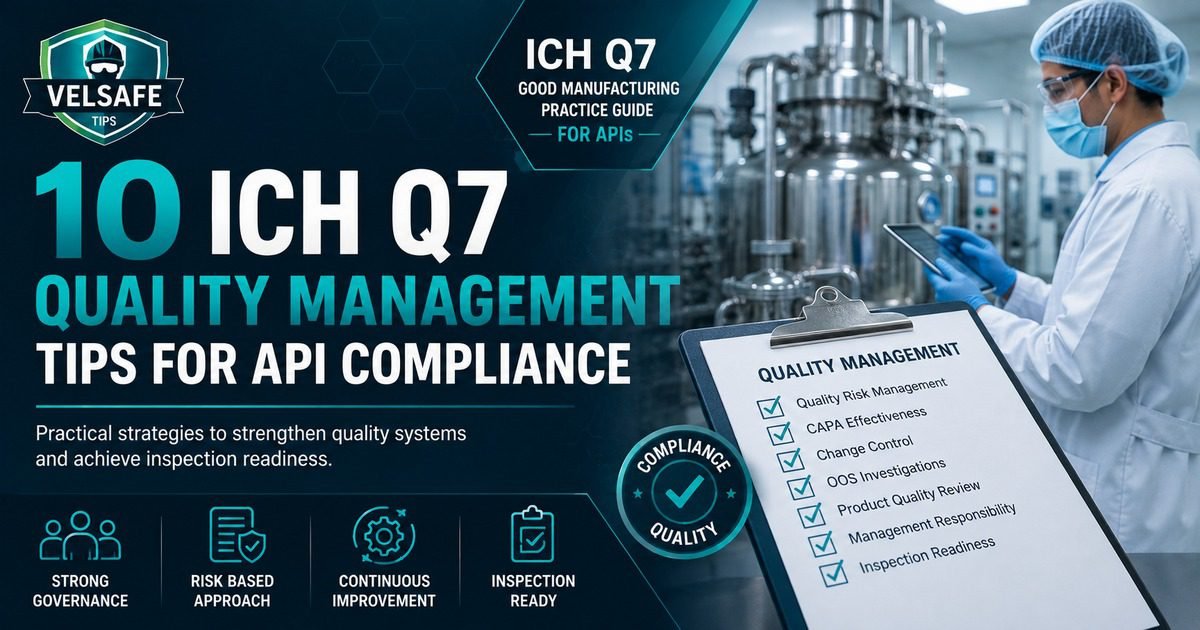
TIPS: ICH Q7 GMP Compliance
ICH Q7 establishes GMP requirements for active pharmaceutical ingredient manufacturing. Its opening chapters on quality management are where most API manufacturers either build a solid compliance foundation or create gaps that compound throughout the rest of the system. These ten tips cover what actually separates API facilities with robust Q7 quality management from those that generate repeat observations at every inspection.
Quick Tip Summary
1. Document the quality philosophy, not just the policy
2. Close CAPAs on evidence, not on due dates
3. Align QU independence with actual authority
4. Make annual product reviews drive actions
5. Keep the quality manual current with operations
6. Validate change control with impact assessments
7. Apply risk management across all quality processes
8. Link audit findings to CAPA actions
9. Set OOS investigation depth by risk, not habit
10. Maintain regulatory intelligence in the QS
What You Will Learn
Q7 quality management requirements vs. common implementation gaps
How to structure genuine QU independence under Q7 Section 2.2
Why CAPA systems close findings without addressing root causes
How to make annual product reviews drive corrective actions
Change control and OOS patterns that generate inspection observations
How risk management integrates into all Q7 quality system decisions
10 Actionable Tips for ICH Q7 Quality Management
1
Document the Quality Philosophy, Not Just the Quality Policy
Why It Matters
ICH Q7 Section 2.1 requires a quality policy but inspectors assess whether quality culture matches the documented commitment. A one-page policy statement that no one reads does not demonstrate the quality philosophy the guideline envisions. The policy must translate into observable practices across the organisation.
What To Do
Link the policy to SOP expectations and train personnel on what it means for their role. At management review, verify that the quality policy drives operational decisions.
Common Mistake
Treating the quality policy as a document management exercise. A policy signed by senior management and filed, but never referenced in training, management review, or operational decisions, is a documentation artefact that will not survive inspector scrutiny.
Pro Tip
Ask three people from different departments to describe the quality policy in their own words. If the descriptions diverge significantly or workers draw a blank, the policy is not operationalised.
2
Make CAPA Closure Evidence-Based, Not Date-Based
Why It Matters
ICH Q7 Section 2.5 requires root cause identification for deviations. Closing CAPAs on their due date regardless of demonstrated effectiveness is one of the most common quality management failures in API manufacturing. Inspectors routinely check closed CAPAs for recurrence of the same issue.
What To Do
Define closure criteria at CAPA initiation, not at the end. The criteria should specify what evidence is required to demonstrate effectiveness. For training CAPAs, this means assessment results, not training records. For process CAPAs, it means monitoring data from the corrected process, not a completed action item.
Common Mistake
Defining effectiveness checks as “retrain affected personnel” and closing the CAPA once training records are signed. Training completion is an action, not evidence of effectiveness. The effectiveness check must verify that the root cause condition has been eliminated.
Pro Tip
Run a quarterly CAPA recurrence report. If any root cause category (procedural gap, training deficiency, equipment failure) appears repeatedly in new CAPAs, prior CAPAs in that category did not achieve effectiveness.
3
Align Quality Unit Independence With Actual Authority
Why It Matters
ICH Q7 Section 2.2 requires the QU to have authority to approve or reject materials and APIs, and to review critical SOPs. Independence means production pressure cannot override quality decisions. Inspectors assess whether QU rejection decisions can be overruled by the same management line that controls production.
What To Do
Document QU authority in the organisational description and quality manual. Ensure the QU reporting line is independent of production at a level appropriate to the organisation’s size. Record QU decisions and the basis for those decisions, including batch rejections, so the decision record demonstrates independence in practice.
Common Mistake
Documenting QU independence in the org chart while the QU manager reports to the same VP as production, with no formal escalation process for QU-production disagreements. The structure on paper must match the actual decision-making authority.
Pro Tip
Include a documented escalation procedure for QU-production disputes. The existence of a formal escalation path signals that the organisation takes QU independence seriously, not just structurally but operationally.
4
Build Product Quality Reviews That Drive Action
Why It Matters
ICH Q7 Section 2.5 requires periodic quality reviews to verify process consistency. Many annual product reviews are comprehensive documents that are filed and not acted on. The review has regulatory value only when its findings generate actions.
What To Do
Build the annual product review template to include a mandatory conclusions and actions section that requires the reviewer to either state that no trend was identified and provide data support, or initiate an action to address identified trends. Review completion should trigger a QU approval step confirming that all identified actions are entered into the CAPA or change control system.
Common Mistake
Approving an annual product review that identifies a trend with no associated CAPA because limits were not exceeded. Any identified trend requires documented disposition.
Pro Tip
Present annual product review findings at management review. This connects product quality trends to management visibility and creates a record that senior management is informed of and engaged with quality data.
5
Treat the Quality Manual as a Living System Document
Why It Matters
ICH Q7 requires a documented quality system describing the system structure and responsibilities. Many API manufacturers have a quality manual that was written at system implementation and has not been updated as the organisation has changed. When the manual describes an organisational structure, key responsibilities, or process flows that no longer match current operations, it creates gaps that inspectors identify during document review.
What To Do
Include the quality manual in the document review cycle. Trigger unscheduled reviews whenever significant organisational or process changes occur. The manual must describe current operations.
Common Mistake
Approving a no-change review of a manual that pre-dates significant operational changes. A no-change approval on a stale manual is itself a gap.
Pro Tip
Use the quality manual as an inspection preparation tool. Walk through the manual with the QU before each major inspection and verify that every structural claim matches current practice. Gaps found in this exercise are much better corrected before an inspection than explained during one.
6
Validate Change Control Decisions With Impact Assessment Evidence
Why It Matters
ICH Q7 requires formal change control for evaluating changes that may affect API quality. The most common failure is approving changes based on opinion rather than documented impact assessment. Undocumented minor-change classifications and missed affected documents create inspection risk.
What To Do
Require written impact assessments for all changes. The assessment must identify affected processes and documents, validation requirements, and regulatory notification needs. Minor versus major classifications must be justified in writing.
Common Mistake
Approving a process change without updating the relevant batch records, SOPs, or validation documentation simultaneously. The change control record may be complete while related documents remain at the pre-change version, creating a discrepancy that inspectors find quickly.
Pro Tip
Close change control records only after confirming that all affected documents have been updated and approved. Use a document update checklist within the change control record to track each required update to completion.
7
Apply Risk Management Proportionally Across All Quality Processes
Why It Matters
ICH Q7 and companion guideline ICH Q9 require risk-based thinking across quality management decisions. Many facilities apply formal risk assessment to product steps only, leaving supplier qualification tiers, deviation investigation depth, and change control classification without documented risk rationale.
What To Do
Document the risk rationale behind key quality system decisions: supplier classification tiers, deviation investigation depth, and audit frequency. This creates a defensible, auditable basis that inspectors expect under ICH Q9 integration.
Common Mistake
Having a formal product risk register but no documented risk basis for supplier qualification tiers or audit frequency. Risk management must integrate across the whole quality system.
Pro Tip
When writing or revising a quality procedure, add a brief risk rationale section explaining why the requirements are set at the level they are. This documents the risk-based decision-making that ICH Q7 and Q9 expect.
8
Link Internal Audit Findings Directly to CAPA Actions
Why It Matters
ICH Q7 requires self-inspection with corrective action for identified gaps. Audit findings not entered into the CAPA system, or entered and closed without effectiveness verification, do not demonstrate the corrective response ICH Q7 expects.
What To Do
Require every internal audit finding above observation level to generate a CAPA record. The audit report and CAPA record should cross-reference each other. Track CAPA closure for audit findings through the same management review process as other CAPAs, with the same closure criteria and effectiveness verification requirements.
Common Mistake
Tracking audit findings in a spreadsheet outside the CAPA system, applying looser closure criteria. Two parallel systems produce one system that is held to a lower standard.
Pro Tip
Include audit finding CAPA status as a standing agenda item in management review. This ensures that management is aware of and accountable for the resolution of gaps identified in self-inspection.
9
Define OOS Investigation Depth by Risk, Not by Habit
Why It Matters
ICH Q7 requires OOS results to be investigated to root cause. The common failure modes are stopping at Phase I without confirmed laboratory cause, and applying a standard template regardless of severity or recurrence. Both satisfy procedural requirements without necessarily finding the actual cause.
What To Do
Define investigation scope and depth requirements in your OOS procedure based on the type and severity of the result. A first-occurrence OOS with a confirmed laboratory cause requires a different investigation depth than a repeat OOS in a critical quality attribute. Require supervisor and QU sign-off on the determination to close Phase I before Phase II is conducted.
Common Mistake
Attributing OOS results to analyst error without documented evidence that an error occurred, then retesting to obtain a passing result. This pattern, which FDA calls “testing into compliance,” is one of the most serious data integrity concerns in analytical laboratory operations.
Pro Tip
Track OOS rate by product, test method, and analyst. Patterns in this data often reveal systematic issues that individual OOS investigations miss, and the tracking data itself demonstrates a proactive quality posture to inspectors.
10
Maintain Regulatory Intelligence as Part of the Quality System
Why It Matters
ICH Q7 dates from 2000, but FDA guidance on data integrity, ICH Q9 and Q10 integration, and regional regulatory expectations have evolved substantially since. Facilities that interpret Q7 in isolation from current regulatory thinking operate against a compliance baseline that no longer reflects inspector expectations.
What To Do
Assign regulatory intelligence responsibility to regulatory affairs or the QU. Track FDA guidance and ICH updates relevant to API manufacturing and present findings at management review.
Common Mistake
Treating Q7 compliance as a static target set in 2000. Regulatory expectations evolve through guidance and enforcement actions even when guideline text does not change.
Pro Tip
Subscribe to FDA’s MedWatch and industry publications for API GMP. Review Warning Letters to API manufacturers quarterly; they reveal current inspection priorities more accurately than the guideline text alone.
Quick Checklist: ICH Q7 Quality Management
Quality Unit
QU independence documented and structurally supported
QU authority to reject documented and exercised
QU approval required for critical SOPs and batch dispositions
Escalation procedure for QU-production disputes in place
CAPA and Deviations
Root cause analysis required for all significant deviations
CAPA closure criteria defined at initiation
Effectiveness verification documented with objective evidence
Recurrence monitoring in place for closed CAPAs
Reviews and Audits
Annual product quality reviews completed with action tracking
Management review agenda covers all Q7 required inputs
Internal audit programme covers all Q7 processes annually
Audit findings enter CAPA system with effectiveness checks
Common Mistakes in ICH Q7 Quality Management
Tracking metrics without acting on them
Every unfavourable trend requires a documented disposition and, where warranted, a corrective action.
Equating document approval with SOP effectiveness
An approved SOP that no one follows is a compliance gap. Internal audits and direct observation are the only way to confirm effectiveness.
Treating Q7 as independent of ICH Q9 and Q10
Inspectors assess Q7 compliance within the ICH Q9 and Q10 integrated framework. Q7 in isolation does not reflect current regulatory expectations.
Real-World Application
What an Inspection-Ready Q7 Quality Management System Looks Like
An API site reviewing its quality management system before an FDA inspection identified three gaps: an annual product review yield trend with no associated CAPA; audit findings managed in a spreadsheet rather than the CAPA system; and a quality manual referencing a superseded org structure. All three were addressed before the inspection, which resulted in no quality management observations.
Note: This example illustrates a composite of common gap-finding patterns, not a specific company or inspection event.
Downloadable Resource: ICH Q7 Quality Management Self-Assessment Checklist
Work through the checklist above before your next internal audit or inspection preparation. For a full clause-by-clause assessment, refer to your Q7 compliance programme documentation.
Use checklist above
Key Takeaways
The quality system must drive behaviour, not just document it
ICH Q7 quality management requirements are assessed by whether the system produces consistent, controlled outcomes, not by whether policies exist. Every element of the quality system from the quality policy to the CAPA closure procedure must connect to observable operational behaviour.
Root cause identification is non-negotiable in deviations and OOS
Investigations that close without a confirmed root cause create both recurrence risk and inspection risk. Thoroughness in investigation is the foundation of CAPA effectiveness.
Q7 compliance is a continuous state, not a point-in-time achievement
Facilities that maintain compliance daily consistently outperform those that prepare for inspections. These tips are maintenance practices. Apply them continuously and inspection preparation largely takes care of itself.
Frequently Asked Questions
Does ICH Q7 apply to contract API manufacturers as well as in-house production?
Yes. ICH Q7 applies to any organisation involved in GMP manufacturing of APIs, including contract manufacturers. Contract API manufacturers must have a fully Q7-compliant quality system, and the sponsoring pharmaceutical manufacturer is independently responsible for qualifying the contract site and conducting periodic re-qualification audits.
What is the relationship between ICH Q7 and FDA 21 CFR Part 211 for API manufacturing?
FDA 21 CFR Part 211 applies to finished dosage form manufacturing. FDA’s compliance policy for API manufacturing is based on ICH Q7, adopted as guidance in 2001. In practice, FDA inspectors assess API sites against Q7 expectations. The quality management principles are comparable, though specific language differs.
How frequently should management review be conducted under ICH Q7?
ICH Q7 does not specify a frequency; annual is the industry standard minimum. Sites with rapid growth, frequent regulatory activity, or significant quality system changes should conduct reviews more often. Each review must cover quality performance data, CAPA status, audit findings, and regulatory compliance status.
What is the role of the Quality Unit under ICH Q7?
The Quality Unit (QU) under ICH Q7 must be independent from production and must have authority to approve or reject all materials, intermediates, and APIs. The QU is responsible for approving procedures, reviewing batch records, investigating deviations, and releasing or rejecting finished APIs. QU independence is a primary inspection focus for FDA auditors.
How does ICH Q7 address out-of-specification results?
ICH Q7 requires a documented OOS investigation procedure. When an OOS result occurs, the laboratory must conduct an initial phase 1 investigation to rule out assignable laboratory error before expanding to a phase 2 production investigation. Invalidating an OOS result requires documented scientific justification; results cannot be invalidated simply because a retest passes.
What are the key change control requirements under ICH Q7?
All changes to established manufacturing processes, equipment, analytical methods, or facilities must pass through a formal change control system before implementation. ICH Q7 requires evaluation of potential impact on product quality, regulatory notifications where applicable, and documentation of the rationale for each change. Post-change verification data must be retained.
Can a CAPA be closed without verifying that the corrective action worked?
No. ICH Q7 requires that corrective and preventive actions be verified for effectiveness before the CAPA is formally closed. Closing a CAPA without effectiveness verification is a common audit finding. Verification must include specific criteria defined before implementation, data collected after implementation, and a documented conclusion signed by the Quality Unit.
Government and Regulatory Sources
Government and Regulatory Sources
- FDA. (2016). ICH Q7 Good Manufacturing Practice Guidance for Active Pharmaceutical Ingredients — primary regulatory reference for API GMP compliance.
- FDA. (2023). ICH Q9(R1) Quality Risk Management — framework for risk-based decision making in pharmaceutical quality systems.
- FDA. (2009). ICH Q10 Pharmaceutical Quality System — overarching quality system guidance integrating with Q7 for API manufacturers.
- FDA. Warning Letters Database (API GMP enforcement actions) — searchable enforcement actions for real-world Q7 violation examples.
Related VelSafe Articles
Related VelSafe Articles
CONTINUE LEARNING
Apply These Tips to Your Q7 Quality System
ICH Q7 compliance is demonstrated through controlled outcomes and thorough root cause investigation. Find more pharmaceutical compliance resources at velsafe.com.
Explore Related Content