

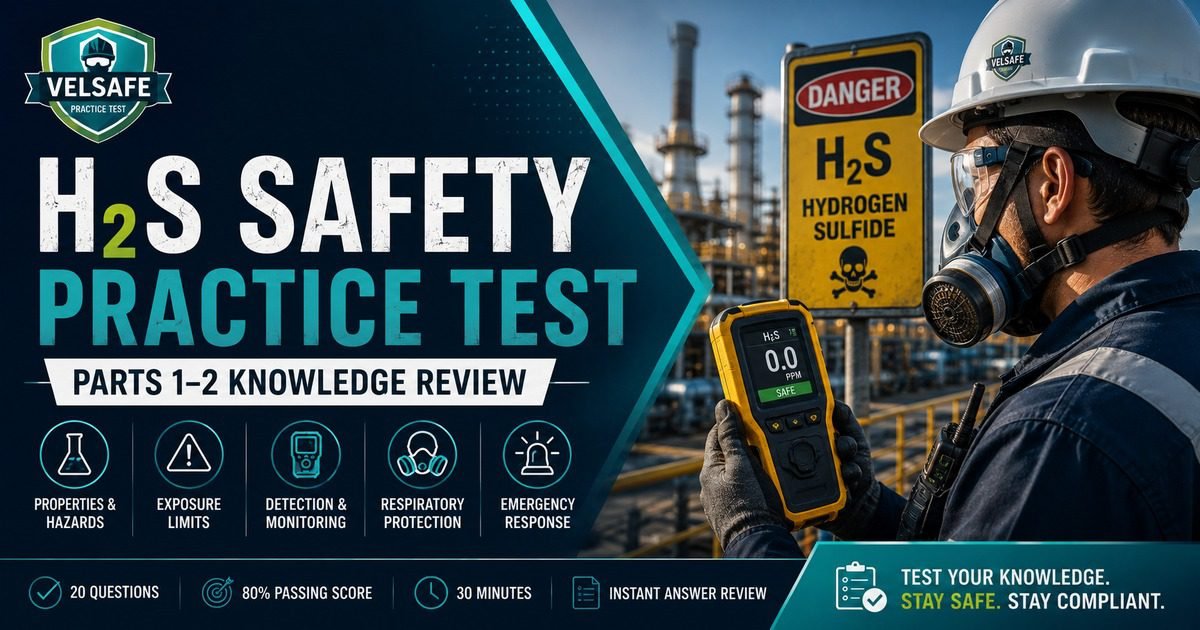
PRACTICE TEST: H2S Safety
This practice test covers the core knowledge areas from Hydrogen Sulfide Safety Parts 1 and 2, including H2S properties and health effects, exposure limits and concentration thresholds, detection and monitoring, respiratory protection selection, and emergency response procedures. Use this test to identify knowledge gaps before working in H2S-risk environments.
How to Use This Practice Test
Read each question and all four options before selecting your answer. Cover the answer section while working each question, then check the Correct Answer and Explanation. Use the Answer Key Summary to score your results, then review the Score Interpretation section to identify topic areas needing further study.
Section 1: H2S Properties and Health Effects
Hydrogen sulfide is a colourless, flammable gas produced by organic decomposition and encountered in oil and gas, wastewater, agriculture, and mining. It inhibits cellular respiration by binding to cytochrome c oxidase, similar to cyanide poisoning. Above approximately 100 ppm, it paralyses the olfactory nerve, eliminating the only sensory warning available to workers.
Question 1
At what approximate concentration does hydrogen sulfide paralyse the olfactory nerve, causing the gas to become odourless?
A. 10 ppm
B. 50 ppm
C. 100 ppm
D. 500 ppm
Correct Answer: C (100 ppm)
The olfactory nerve is paralysed at concentrations above approximately 100 ppm. This is why NIOSH has set the IDLH (immediately dangerous to life or health) level at 100 ppm. At this concentration, the only sensory warning workers have (odour) is eliminated, and the concentration is sufficient to cause rapid health effects. Workers who report not smelling H2S in an area with known H2S risk may be experiencing olfactory paralysis, not the absence of the gas.
Source: NIOSH | NIOSH IDLH Documentation for Hydrogen Sulfide
Question 2
A worker enters a confined space and reports that it smells fine and does not detect any hydrogen sulfide by odour. Which of the following is the most appropriate conclusion?
A. The space is safe to work in without respiratory protection
B. No further monitoring is needed since the worker did not detect any gas
C. The absence of odour does not confirm the absence of H2S; instrumented monitoring is required
D. H2S is only present when there is an odour
Correct Answer: C (The absence of odour does not confirm the absence of H2S)
Relying on smell to detect H2S in a confined space is a documented cause of fatalities. The olfactory nerve can be paralysed at concentrations above 100 ppm, and individuals vary in their odour sensitivity even at lower concentrations. Instrumented air monitoring using calibrated gas detection equipment is required before entry and must be maintained during entry. A clean odour report from a worker is not a substitute for a clean instrument reading.
Source: OSHA | OSHA Hydrogen Sulfide Safety and Health Topics
Question 3
What mechanism makes hydrogen sulfide acutely toxic at high concentrations?
A. It displaces oxygen in the lungs, causing asphyxiation by dilution
B. It irritates the respiratory tract and causes pulmonary oedema
C. It inhibits cellular respiration by binding to cytochrome c oxidase, preventing cells from using oxygen
D. It reacts with haemoglobin to form carboxyhaemoglobin, reducing oxygen transport
Correct Answer: C (Inhibits cellular respiration by binding to cytochrome c oxidase)
H2S poisons cells by inhibiting cytochrome c oxidase in the mitochondria, preventing cellular respiration, a mechanism similar to cyanide poisoning. Option A describes simple asphyxiants like nitrogen; option B describes lower-concentration irritant effects; option D describes carbon monoxide toxicity.
Source: CDC NIOSH | NIOSH Hydrogen Sulfide IDLH Documentation
Section 2: Exposure Limits and Concentration Thresholds
OSHA’s PEL is 20 ppm ceiling and 50 ppm peak for up to 10 minutes. NIOSH sets the IDLH at 100 ppm, where SCBA becomes mandatory. NIOSH’s REL is a 10-minute ceiling of 10 ppm. Oil and gas and other sectors commonly apply internal alarm thresholds of 10 ppm (low) and 20-25 ppm (high).
Question 4
What is OSHA’s permissible exposure limit (PEL) for hydrogen sulfide as a ceiling concentration?
A. 1 ppm
B. 10 ppm
C. 20 ppm
D. 100 ppm
Correct Answer: C (20 ppm)
OSHA’s PEL for H2S under 29 CFR 1910.1000 Table Z-2 is 20 ppm as a ceiling concentration, meaning workers must not be exposed above this level at any time during a shift. A 50 ppm peak is permitted for up to 10 minutes if no other exposure has occurred during the 8-hour shift. Option B (10 ppm) is NIOSH’s REL ceiling and a common industry low alarm setpoint. Option D (100 ppm) is the NIOSH IDLH level, which triggers SCBA requirements.
Source: OSHA | OSHA H2S Standards
Question 5
At which H2S concentration level does NIOSH classify the atmosphere as immediately dangerous to life or health (IDLH), requiring SCBA for entry?
A. 20 ppm
B. 50 ppm
C. 100 ppm
D. 500 ppm
Correct Answer: C (100 ppm)
NIOSH has established 100 ppm as the IDLH for hydrogen sulfide. At this concentration, SCBA (self-contained breathing apparatus) is mandatory for entry. The IDLH represents the maximum level from which one could escape within 30 minutes without experiencing any escape-impairing or irreversible health effects. At 100 ppm, olfactory paralysis also occurs, meaning workers lose their only sensory warning. 500 ppm (option D) causes rapid unconsciousness and can be fatal within minutes.
Source: NIOSH | NIOSH IDLH Documentation
Section 3: Detection Equipment and Respiratory Protection
Personal detectors must be bump tested before each day of use. APRs with H2S cartridges are only permitted when oxygen is adequate, concentration is known and stable below 50 ppm. SCBA is required at or approaching the IDLH (100 ppm) and for all rescue operations. Never enter an atmosphere of unknown H2S concentration using an APR.
Question 6
A maintenance worker is about to enter a confined space where the H2S concentration has been measured at 35 ppm and is confirmed stable. Oxygen level is 20.8%. Which respiratory protection is appropriate?
A. No respiratory protection is required below the OSHA PEL of 50 ppm
B. An APR with H2S-approved cartridges may be used given the known, stable concentration below 50 ppm and adequate oxygen
C. SCBA is required for any entry into a space with measurable H2S regardless of concentration
D. A surgical mask provides adequate protection for short-term exposures below 50 ppm
Correct Answer: B (APR with H2S-approved cartridges may be used)
When concentration is known, stable, and below 50 ppm and oxygen is adequate (at least 19.5%), an APR with H2S-approved cartridges is acceptable. As soon as concentration is unknown, unstable, or above 50 ppm, SCBA is required. Option A is wrong because the OSHA ceiling PEL is 20 ppm. Option D is wrong because surgical masks provide no gas protection.
Source: OSHA | 29 CFR 1910.134 Respiratory Protection
Question 7
How frequently must a personal H2S gas detector be bump tested when used in H2S-risk environments?
A. Monthly, at the same time as full calibration
B. Annually, as part of the equipment maintenance programme
C. Before each day of use in H2S environments
D. Only after the detector has alarmed to verify sensor function
Correct Answer: C (Before each day of use
Bump testing (functional testing with calibration gas to verify sensor response) must be performed before each day of use in H2S environments. A detector that appears operational but has a failed sensor will not alarm when H2S is present. Bump testing takes less than 60 seconds and is the only way to confirm the sensor will respond correctly before a worker enters a hazardous area. Full calibration using known-concentration gas standards is a separate procedure performed at manufacturer-specified intervals, typically every 30-90 days.
Source: OSHA | OSHA H2S Safety and Health Topics
Section 4: Emergency Response Procedures
Never attempt to rescue an incapacitated worker in an H2S atmosphere without SCBA. Multiple-fatality incidents regularly involve would-be rescuers entering without protection. When an H2S detector alarms: stop work, activate the area alarm, evacuate upwind to the muster point, and account for all personnel. Do not re-enter until a competent person authorises it.
Question 8
A worker collapses in a confined space where H2S has been detected at 600 ppm. A bystander without respiratory protection is standing nearby. What is the correct immediate action?
A. Hold your breath, enter the space quickly, and drag the worker out before the concentration affects you
B. Wait for the H2S to dissipate before entering
C. Do not enter without SCBA; activate the emergency alarm and call emergency services immediately
D. Enter with a wet cloth over the face as a filter
Correct Answer: C (Do not enter without SCBA; activate emergency alarm and call emergency services
At 600 ppm, collapse and respiratory arrest can occur within seconds of exposure. Entering without SCBA, even briefly or while holding your breath, is extremely likely to result in a second fatality. Options A and D are both fatal errors that account for many multi-victim H2S incidents. Option B is also wrong; the victim requires immediate medical attention. The correct response is to activate the alarm, call emergency services immediately with information about the H2S concentration and victim location, and initiate trained rescue procedures using personnel equipped with SCBA.
Source: OSHA | OSHA H2S Emergency Response Guidance
Question 9
When a personal H2S detector alarms, which of the following is the correct sequence of actions?
A. Silence the alarm; continue work while monitoring for increasing concentration
B. Stop work; activate area alarm; evacuate upwind to muster point; account for all personnel; await authorisation before re-entry
C. Stop work; retrieve tools and documents; then evacuate
D. Evacuate, then re-enter after 5 minutes to check if the alarm was a false reading
Correct Answer: B (Stop work, activate alarm, evacuate upwind, account for personnel, await authorisation
Every H2S alarm must be treated as real until proven otherwise. The documented pattern of workers silencing alarms and continuing work is a consistent finding in fatality investigations. Option A is the most dangerous incorrect answer. Option C is wrong because retrieving tools wastes critical evacuation time. Option D is wrong because re-entry without authorisation from a competent person who has confirmed safe conditions is prohibited. The full sequence in option B must be drilled until it is automatic.
Source: OSHA | OSHA H2S Standards
Answer Key Summary
Section 1: Properties
Q1
C
Q2
C
Q3
C
Section 2: Exposure Limits
Q4
C
Q5
C
Section 3: Detection/PPE
Q6
B
Q7
C
Section 4: Emergency Response
Q8
C
Q9
B
Score Interpretation
8-9 Correct
Strong H2S Knowledge Base
Strong grasp of H2S hazard properties, exposure limits, respiratory protection, and emergency response. Review any missed questions and confirm your site-specific alarm setpoints and evacuation routes before working in H2S environments.
5-7 Correct
Review Recommended
Partial understanding with gaps in one or more areas. Review the sections corresponding to missed questions. Pay particular attention to concentration thresholds and emergency response, as errors here carry the highest consequences.
0-4 Correct
Retrain Before Working in H2S Areas
Your score indicates significant gaps in H2S safety knowledge. Do not work in H2S-risk environments until you have completed H2S awareness training covering hazard properties, exposure limits, detection equipment, respiratory protection, and emergency response, and can demonstrate competency in each area.
Frequently Asked Questions
Can this practice test be used as a substitute for formal H2S training?
No. This practice test is a knowledge review tool that helps workers identify gaps before or after formal H2S training. It does not substitute for site-specific orientation, hands-on equipment training, or SCBA donning practice required for rescue-qualified personnel.
Which questions cover the most safety-critical knowledge for H2S workers?
Questions covering olfactory paralysis, bump testing, and emergency response without SCBA address the knowledge gaps most consistently linked to H2S fatalities. If you missed any of these, prioritise reviewing those sections before working in H2S areas.
How does this test relate to IACET CEU requirements for H2S Safety Parts 1-2?
H2S Safety Parts 1-2 carries 0.1 IACET CEU reflecting approximately one hour of qualified instruction. Successful completion of the full course, not this test alone, is required for CEU credit. Use this test as a pre-course assessment or post-course review.
What is olfactory fatigue and why does it matter for H2S safety?
Olfactory fatigue means the nose becomes desensitised to H2S odour within minutes of exposure, even at dangerous concentrations. A worker who can no longer smell H2S may believe the hazard has cleared when it has not. This is why continuous air monitoring and calibrated gas detectors are required, not smell-based assessment.
Why is rescue without SCBA prohibited in H2S environments?
Attempting rescue without supplied-air respiratory protection is one of the most common causes of multiple fatalities in a single H2S incident. A rescuer entering an H2S atmosphere without SCBA becomes a second victim within seconds at high concentrations. Emergency response plans must include SCBA as a prerequisite for any entry into an affected area.
How often must H2S gas detectors be bump tested?
OSHA and detector manufacturers require bump testing before each use in hazardous atmospheres. A bump test confirms the sensor responds to a known concentration of H2S gas. A detector that passes a bump test but fails to alarm during an actual exposure event is one of the most dangerous equipment failure modes in confined space and oil and gas work.
What are the OSHA permissible exposure limits for hydrogen sulfide?
OSHA’s general industry ceiling limit for H2S is 20 ppm with a peak of 50 ppm for up to 10 minutes if no other exposure has occurred. NIOSH recommends a much lower ceiling of 1 ppm. The IDLH (immediately dangerous to life or health) level is 100 ppm. Many employers adopt the more protective NIOSH or ACGIH limits as site standards.
Government and Regulatory Sources
Government and Regulatory Sources
- OSHA. Hydrogen Sulfide Safety and Health Topics — comprehensive OSHA guidance on H2S hazards, exposure limits, and employer requirements.
- OSHA. Hydrogen Sulfide Standards and Requirements — applicable regulatory standards including 29 CFR 1910.1000 and industry-specific requirements.
- CDC NIOSH. IDLH Documentation for Hydrogen Sulfide — documentation supporting the 100 ppm IDLH value and occupational exposure data.
- OSHA. 29 CFR 1910.134 Respiratory Protection Standard — the regulatory basis for SCBA requirements and respiratory protection programmes in H2S environments.
Related VelSafe Articles
Related VelSafe Articles
CONTINUE LEARNING
Continue Your H2S Safety Training
Pair this knowledge with site-specific training on your facility’s alarm systems, evacuation routes, and emergency procedures. Find more safety resources at velsafe.com.
Explore Related Content