

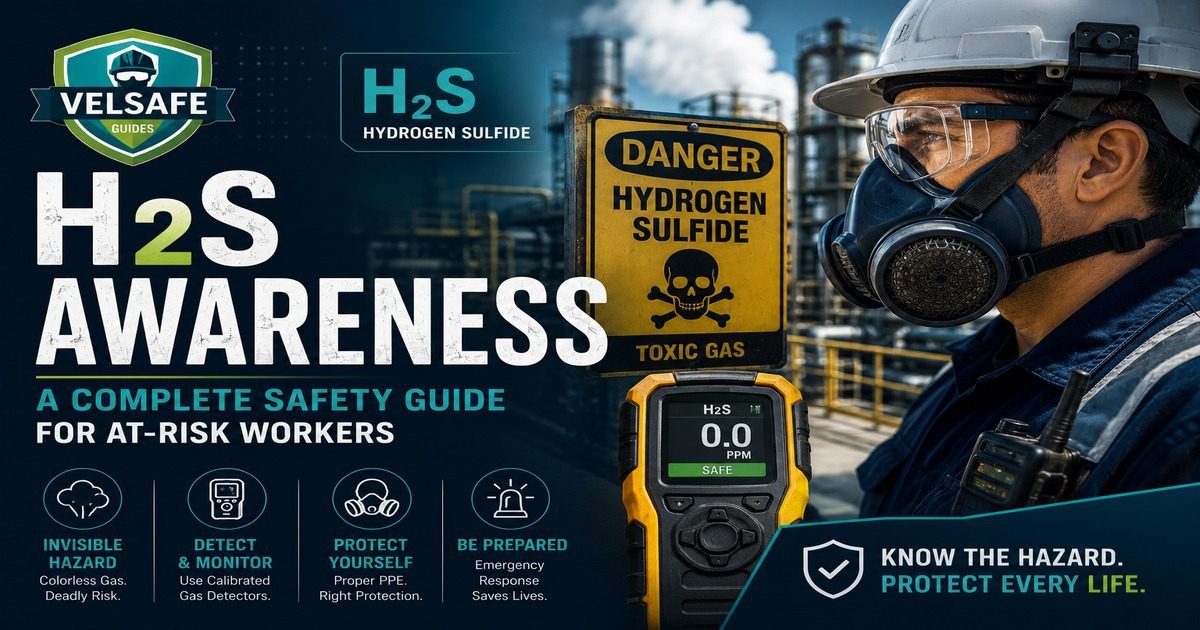
GUIDE: H2S Awareness and Safety
Hydrogen Sulfide (H2S) Awareness: A Complete Safety Guide for At-Risk Workers
Hydrogen sulfide is one of the most acutely dangerous gases encountered in occupational settings. It kills quickly at high concentrations, impairs olfactory detection at moderate concentrations, and is encountered across oil and gas, wastewater treatment, agriculture, mining, and confined space work. This guide explains what H2S is, why it behaves the way it does, what regulations require, and how to systematically protect workers who may encounter it.
Quick Overview
What H2S Is
A colourless, flammable gas with a characteristic rotten egg odour at low concentrations. H2S is produced by the decomposition of organic material containing sulphur and is a natural byproduct in oil and gas production, wastewater treatment, agriculture, and mining. At concentrations above approximately 100 ppm, it paralyses the olfactory nerve, eliminating the only sensory warning workers have.
Why It Is Dangerous
H2S inhibits cellular respiration by binding to cytochrome c oxidase in the mitochondria, preventing cells from using oxygen. The effect is comparable to cyanide poisoning. At 500-700 ppm, a single breath can cause rapid unconsciousness. At 1,000 ppm and above, collapse and respiratory arrest can occur within seconds. The speed of incapacitation means that workers who enter an H2S atmosphere without protection often cannot self-rescue.
Primary Industries
Oil and gas exploration and production, natural gas processing, petroleum refining, wastewater treatment, pulp and paper manufacturing, agricultural manure handling, mining, and confined space work in any industry where organic decomposition may occur. H2S is also encountered during hot work on sulphur-containing systems and in some chemical manufacturing processes.
Regulatory Authority
OSHA addresses H2S through multiple standards: general industry (29 CFR 1910), construction (29 CFR 1926), and maritime. OSHA’s permissible exposure limit (PEL) is 20 ppm as a ceiling and 50 ppm as a peak for up to 10 minutes. NIOSH recommends an immediately dangerous to life or health (IDLH) level of 100 ppm. Many states and industry sectors apply stricter limits.
What You Will Learn
The physical and chemical properties of H2S and why they create specific hazard patterns
OSHA exposure limits, regulatory requirements, and which standards apply to your industry
How to conduct a site hazard assessment for potential H2S exposure
How to select, use, and maintain H2S detection equipment
Respiratory protection selection and limitations for H2S environments
Emergency response procedures for H2S exposure incidents
The most common H2S training and programme failures that lead to fatalities
How to build and verify an effective site H2S safety programme
Prerequisites
Identify whether your workplace has H2S risk
H2S risk is not always obvious. It may be present in confined spaces even when the surrounding environment appears safe, in oil-bearing geological formations encountered unexpectedly during drilling, and in agricultural or wastewater environments that do not appear hazardous on the surface. Review your industry classification, any available site history, and your SDS library before assuming H2S is not a hazard at your site.
Understand confined space entry requirements
Many H2S fatalities occur in permit-required confined spaces. Workers who will enter or supervise entry into spaces where H2S may be present must be familiar with OSHA’s confined space entry standard (29 CFR 1910.146 for general industry; 29 CFR 1926.1200 for construction) in addition to H2S-specific hazard controls. H2S awareness training and confined space entry training address overlapping but distinct hazard sets.
Ensure supervisory authority and emergency response capacity
H2S programmes require designated competent persons with the authority to stop work when H2S hazards exceed safe thresholds. Supervisors must know the site’s emergency response procedures, the location of emergency equipment, and how to initiate emergency services response before any H2S-exposed work begins. These are programmatic prerequisites, not knowledge objectives for individual workers alone.
Required Equipment and Documents
Item
Purpose
When Required
Personal H2S gas detector (single-gas or multi-gas)
Continuous monitoring of personal exposure with audible and visual alarms
Any work in areas where H2S may be present
Self-contained breathing apparatus (SCBA)
Supplied-air respiratory protection for atmospheres at or approaching IDLH (100 ppm)
Rescue operations and entry into unknown or IDLH atmospheres
Escape respirator (SCBA or EEBD)
Emergency egress from H2S atmosphere; provides 10-15 minutes of protection
Workers in H2S-risk areas who are not wearing full SCBA
Fixed-point H2S detector system (where applicable)
Area monitoring for H2S with zone alarms and control room notification
Oil and gas facilities, wastewater plants, confined space entry programmes
Site H2S contingency plan
Documents alarm response levels, evacuation routes, muster points, and emergency contacts
Required before any work begins at H2S-risk sites
H2S Safety Data Sheet (SDS) for the site
Required hazard communication document; includes emergency response information
Required by 29 CFR 1910.1200 (Hazard Communication)
Step-by-Step: Building and Implementing an H2S Awareness Programme
1
Conduct a Site H2S Hazard Assessment
Objective: Identify where H2S may be present and at what concentrations
Why It Matters
H2S hazard assessment determines the scope of the programme required. A site with isolated confined space H2S risk needs a different programme than an oil and gas facility where H2S may be encountered across multiple work areas. The assessment also identifies which workers require training, what detection equipment is needed, and what alarm thresholds and response protocols are appropriate.
Actions
Review process chemistry, SDS documentation, industry classification, and any available historical monitoring data. Identify all confined spaces, low-lying areas, process vessels, and locations where organic decomposition or H2S-containing process streams may produce H2S. Conduct baseline air monitoring using calibrated detection equipment to establish whether H2S is present and at what concentrations under normal operating conditions. Document findings and use them to establish the scope of training, detection, and respiratory protection requirements.
Expected Outcome
A documented H2S hazard assessment identifying all potential exposure areas, estimated concentration ranges, and the populations of workers potentially exposed. This document is the foundation for all subsequent programme elements and should be reviewed when site operations change.
Warning
H2S concentrations can change rapidly with wind direction, temperature, barometric pressure, and process conditions. A site that tested below the action level on a previous assessment may have dangerous concentrations under different conditions. The assessment identifies the potential, not a static measurement of current conditions.
2
Understand the Concentration-Effect Relationship
Objective: Know what H2S does at each concentration level so alarm thresholds are set correctly
Setting appropriate alarm levels and response protocols requires understanding how H2S affects the human body at different concentrations. The relationship between concentration and effect is not linear: moderate concentrations impair the sensory warning, and high concentrations cause incapacitation faster than self-rescue is possible.
Concentration
Effects
Action Required
0.01-1.5 ppm
Detectable odour (rotten egg); no harmful effects at typical exposures
Monitor; investigate source
10 ppm
OSHA PEL action level; eye irritation on prolonged exposure; odour becomes less distinct
Alarm Level 1: increased monitoring; prepare to evacuate non-essential personnel
50-100 ppm
Olfactory paralysis begins; severe eye and respiratory irritation; headache, dizziness
Alarm Level 2: evacuate all non-essential personnel; SCBA required for entry
500-1,000 ppm
Rapid unconsciousness; respiratory paralysis; death within minutes
Full evacuation; no entry without SCBA; emergency services immediately
3
Select, Calibrate, and Maintain H2S Detection Equipment
Objective: Ensure detection equipment provides reliable warning before concentrations reach dangerous levels
Detection Equipment Selection
Personal H2S detectors must have audible and visual alarms and should be set to alarm at 10 ppm (low alarm) and 20 ppm (high alarm) as minimum thresholds for most industrial applications, with higher-risk applications using lower thresholds. Multi-gas detectors that also monitor for oxygen deficiency, LEL, and CO are preferred in confined space entry and complex industrial environments. Fixed-point detection systems provide area monitoring with zone-level alarms and are required or expected in many oil and gas facilities and wastewater plants.
Calibration and Bump Testing
Personal gas detectors must be bump tested (functionally tested with calibration gas) before each day of use in H2S environments. Full calibration using known-concentration gas standards must be performed at intervals specified by the manufacturer, typically every 30 to 90 days depending on use frequency and operating conditions. A detector that has not been bump tested is an unknown; treating it as reliable is not an acceptable risk management approach.
Expected Outcome
A written detection equipment programme specifying the equipment required for each work area, alarm setpoints, bump test and calibration procedures, maintenance intervals, and the record-keeping requirements for calibration records. Each worker who carries a personal H2S detector should be able to demonstrate how to use it, interpret its alarms, and respond to those alarms.
Tip
Never rely on smell to detect H2S. At concentrations above approximately 100 ppm, the olfactory nerve is paralysed and the gas becomes odourless. Workers who describe entering a confined space and not smelling anything after previous H2S alerts have described the mechanism of their own incapacitation without recognising it.
4
Select and Train Workers on Appropriate Respiratory Protection
Objective: Match the respiratory protection to the concentration and duration of H2S exposure
Why It Matters
Air-purifying respirators (APR) with H2S cartridges have a service life that is dramatically shortened at high H2S concentrations, and they provide no protection in oxygen-deficient atmospheres. At concentrations approaching or exceeding the IDLH (100 ppm), SCBA is required. Workers who are issued APR cartridge respirators and enter high-concentration areas are at risk even while wearing their assigned equipment.
Selection Criteria
Below 10 ppm: administrative controls and engineering controls; respirators may not be required. 10-50 ppm: APR with H2S-approved cartridges may be used if oxygen is adequate (above 19.5%) and concentrations are stable and known. Above 50 ppm or unknown concentration: SCBA (pressure-demand, full-face) is required. Rescue operations: SCBA mandatory regardless of known concentration. Escape: egress respirator (SCBA or approved EEBD).
Training Requirements
OSHA’s respiratory protection standard (29 CFR 1910.134) requires that workers be trained on how to use, maintain, and store their assigned respirator, how to perform a user seal check before each use, the limitations of the respirator, and when the respirator must be removed. SCBA training additionally requires hands-on donning practice under time pressure, because a worker who has not practised donning SCBA quickly is unlikely to do so effectively in an emergency.
Warning
Never enter a space with unknown H2S concentration using an air-purifying respirator. If the concentration exceeds the cartridge’s capacity rating, the respirator provides no protection. SCBA is the only appropriate respiratory protection for entry into unknown or IDLH atmospheres.
5
Develop and Drill the Emergency Response Plan
Objective: Ensure workers know exactly what to do when an H2S alarm activates
Why It Matters
At concentrations that cause incapacitation within seconds, workers who hesitate, attempt to rescue colleagues without SCBA, or do not know their evacuation route will become additional casualties. The emergency response plan converts a multi-fatality incident potential into a survivable event when it is trained, drilled, and executed automatically. Muscle memory from drills, not reading a procedure during an alarm, is what determines outcomes.
Plan Content Requirements
The H2S emergency response plan must specify alarm levels and the specific actions required at each level, evacuation routes and muster points for each work area, the location of emergency equipment including SCBA and rescue equipment, who is authorised to conduct rescue entry and under what conditions, how to contact emergency services and what information to provide, and how to account for all personnel after evacuation.
Drilling Requirements
Tabletop exercises identify plan gaps; physical evacuation drills verify that workers can locate exits and muster points and that the evacuation can be completed before critical concentrations are reached. Rescue drills specifically test whether trained rescuers can don SCBA, access the victim location, and remove the victim in the time available. Drills must be conducted for each shift, including night shifts and contractor crews.
Expected Outcome
A written emergency response plan specific to each H2S-risk work area, a documented drill schedule with completion records, and workers who can describe and demonstrate their alarm response without prompting. Rescue team members certified to SCBA entry standards appropriate for the site’s risk level.
Tip
The single most important rule in H2S emergency response: do not attempt to rescue an incapacitated worker in an H2S atmosphere without SCBA. More H2S fatalities involve would-be rescuers than any other category. This rule must be reinforced repeatedly because the instinct to help a fallen colleague is powerful and must be overridden by training.
6
Deliver Role-Specific H2S Training and Verify Competency
Objective: Ensure every worker who may encounter H2S can demonstrate competent hazard response
H2S training must be completed before workers enter areas where H2S exposure is possible. It must cover the properties and health effects of H2S, the specific hazards at the site, how to use and respond to detection equipment, the respiratory protection programme, and the emergency response plan. Generic online H2S awareness training satisfies a portion of this requirement; site-specific training covering the site’s hazard locations, alarm systems, and emergency procedures must supplement it.
All Workers
H2S properties and health effects, odour and odour failure, symptom recognition, personal detector use and alarm response, evacuation routes, muster points, and the prohibition on rescue entry without SCBA
Maintenance and Operations Personnel
All worker content plus: respiratory protection selection and use, confined space entry interaction with H2S hazards, work permit requirements for H2S-risk tasks, and first aid response for H2S exposure
Supervisors and Rescue Team
All previous content plus: SCBA donning and use to rescue competency standard, emergency response plan activation, worker accountability procedures, and authority to stop work for H2S hazards
Best Practices
Enforce the buddy system in all H2S-risk areas
No worker should enter an H2S-risk area alone. An incapacitated worker in an H2S atmosphere cannot self-rescue and cannot communicate distress. A buddy who remains outside the hazard zone can initiate emergency response and account for the worker’s location, enabling a trained rescue response rather than an improvised one.
Account for wind direction before positioning workers
H2S is heavier than air and accumulates in low-lying areas and downwind of sources. Worker positioning during H2S-risk tasks should account for wind direction so that muster points and escape routes are upwind of the hazard source. Wind direction should be monitored during extended operations because it can change.
Treat every alarm as real until proven otherwise
The documented pattern of workers silencing H2S alarms and continuing work because “it’s probably a false alarm” is a consistent finding in fatality investigations. Alarms must trigger the prescribed response every time. If false alarms are frequent, the correct response is to investigate and correct the cause, not to adjust worker behaviour toward ignoring alarms.
Common Mistakes
Mistake
Why It Is Dangerous and What to Do Instead
Relying on smell as the only H2S detection method
Smell fails above 100 ppm, precisely when the hazard is most acute. Personal detectors must be worn and functioning. Smell is a supplementary indicator at low concentrations, never a substitute for instrumented detection.
Attempting rescue without SCBA
The most common cause of multiple-fatality H2S incidents. A worker who enters an H2S atmosphere without SCBA to rescue a collapsed colleague will be incapacitated within seconds or minutes, depending on concentration. Rescue without SCBA is prohibited. Call emergency services; do not enter.
Using APR cartridges in unknown or high-concentration environments
APR cartridges have a finite service life that is dramatically reduced at high concentrations. In oxygen-deficient atmospheres, APRs provide no protection regardless of concentration. SCBA is required when concentration is unknown or above 50 ppm.
Skipping detector bump testing before entering H2S areas
A detector that appears to function but has a failed sensor will not alarm. Bump testing confirms sensor response before every entry. It takes less than 60 seconds and is the only way to verify that the detector will respond correctly to H2S.
Compliance Notes
Key Regulatory References
OSHA PEL (29 CFR 1910.1000 Table Z-2): 20 ppm ceiling; 50 ppm peak exposure for up to 10 minutes if no other exposure occurs. These are minimum standards; many industry sectors and states enforce stricter limits.
NIOSH IDLH: 100 ppm. At or above this concentration, supplied-air respiratory protection (SCBA) is mandatory for entry. NIOSH’s recommended exposure limit (REL) is a 10-minute ceiling of 10 ppm.
29 CFR 1910.134 (Respiratory Protection): Governs the respiratory protection programme, including selection, medical evaluation, fit testing, training, and maintenance requirements for all respirators including those used in H2S environments.
29 CFR 1910.146 (Permit-Required Confined Spaces): Applies when H2S risk is present in a confined space. Atmospheric testing for H2S before and during entry is a requirement, not a recommendation.
29 CFR 1910.1200 (Hazard Communication): Requires that H2S be included in the site’s hazard communication programme, with an SDS available and workers trained on the hazards.
Troubleshooting
Frequent false alarms from personal detectors
First confirm these are actually false by cross-referencing with fixed-point detectors or a second personal unit. If confirmed false, check calibration, sensor age, and whether the detector is being exposed to interferent gases (some sensors cross-react with certain organic compounds). Replace sensors past their service life. Do not adjust worker response behaviour as the solution to false alarms.
Workers removing personal detectors during work because they are inconvenient
This is a supervision and culture issue, not a training issue. Workers who have been trained know that the detector must be worn. If detectors are being removed, the immediate corrective action is supervisory enforcement. If the root cause is that detectors are truly impractical for the task, evaluate a different detector form factor rather than accepting non-use.
Worker is found unresponsive in an H2S area
Do not enter without SCBA. Activate emergency alarm. Call emergency services immediately and provide the nature of the hazard and the victim’s location. Initiate trained rescue procedures using personnel equipped with SCBA. After removal to fresh air: begin CPR if trained and if the victim is not breathing; do not perform mouth-to-mouth on a victim who may have H2S-saturated fluids. H2S can be transmitted from victim to rescuer through this route.
Quick Checklist: H2S Awareness Programme
Before Work Begins
Site H2S hazard assessment completed and documented
All workers trained and training records current
Personal detectors bump tested and calibration current
Escape respirators/SCBA accessible at work locations
Emergency response plan posted and briefed to all workers
During Work
Personal detectors worn continuously and not silenced without investigation
Buddy system enforced for H2S-risk areas
Wind direction known and muster point upwind of source
No entry into unknown concentration atmospheres without SCBA
Alarm response executed per plan, not improvised
Programme Maintenance
Detection equipment maintained and sensors replaced per manufacturer schedule
Emergency response drills conducted at least annually for each shift
Training refreshed when site conditions, equipment, or procedures change
Near-miss and alarm events investigated and corrective actions documented
Hazard assessment reviewed when operations change
Key Takeaways
Smell is not a reliable H2S warning above 100 ppm
The olfactory nerve is paralysed at concentrations above approximately 100 ppm. Workers in H2S environments who are relying on their sense of smell to warn them of dangerous concentrations are relying on a mechanism that fails precisely when the hazard is most acute. Personal gas detection equipment, worn correctly and maintained current, is the only reliable warning system in H2S-risk environments.
Rescue without SCBA creates additional fatalities
The pattern of multiple fatalities in H2S incidents almost always involves at least one would-be rescuer who entered the hazard zone without SCBA and was incapacitated alongside the original victim. This is the most important behavioural rule in H2S emergency response, and it is the most frequently violated in the heat of a real incident. Repeated drills that reinforce the rule under realistic conditions are the only effective countermeasure.
Site-specific training cannot be replaced by generic online courses
Generic H2S awareness courses cover the hazard properties, health effects, and regulatory framework. They cannot cover the specific locations where H2S may accumulate on a particular site, the alarm setpoints and response protocols of a specific detection system, the site’s evacuation routes and muster points, or the specific emergency contacts and procedures for that facility. Site-specific orientation covering these elements is a separate and non-negotiable component of every H2S training programme, and it must be completed before workers enter H2S-risk areas for the first time.
Frequently Asked Questions
What is the difference between the OSHA PEL and the NIOSH IDLH for H2S, and which applies in practice?
OSHA’s PEL establishes the legal exposure limit: a 20 ppm ceiling (not to be exceeded at any time) with a 50 ppm permissible peak for up to 10 minutes where no other exposure has occurred during the shift. NIOSH’s IDLH of 100 ppm defines the concentration at which supplied-air respiratory protection (SCBA) becomes mandatory. In practice, both apply: the PEL governs routine work and engineering control requirements, while the IDLH governs the respiratory protection selection threshold. Many industry sectors, particularly oil and gas, apply internal alarm thresholds (typically 10 ppm low alarm, 20-25 ppm high alarm) that are more conservative than both the OSHA PEL and the NIOSH IDLH, reflecting industry recognition that concentrations can rise rapidly from action level to IDLH in H2S-risk environments.
Can an air-purifying respirator (APR) with H2S cartridges be used in a confined space with H2S?
Only under specific conditions: the oxygen concentration must be adequate (at least 19.5%), the H2S concentration must be known and below 50 ppm, and the concentration must be stable. APR cartridges have a service life that is dramatically shortened at high concentrations and that cannot be reliably predicted in a dynamic environment. In practice, SCBA is the appropriate choice for most confined space H2S entries because unknown concentrations, oxygen deficiency, and rapidly changing conditions are common. Any confined space where H2S is present or suspected should be evaluated as a potential IDLH atmosphere, which mandates SCBA.
How should a worker respond if their personal H2S detector alarms while working?
Stop work immediately. Activate any area alarm system if one exists. Evacuate the area by the designated route, moving upwind and to the designated muster point. Do not re-enter the area to retrieve tools, documents, or other items. Account for all personnel at the muster point and report to the supervisor or emergency coordinator. The area must not be re-entered until the source of the H2S has been identified and controlled, air monitoring confirms concentrations are below action levels, and a competent person has authorised re-entry. This sequence must be drilled until it is automatic.
Is annual H2S training sufficient, or does it need to be more frequent?
Annual training is a regulatory minimum for many applications, not an optimal frequency. OSHA’s hazard communication and respiratory protection standards require retraining when there are changes in workplace conditions or equipment, when the worker demonstrates inadequate knowledge, or when there are indications that the training was not understood. Beyond regulatory minimums, effective H2S programmes typically supplement annual formal training with regular toolbox talks, pre-job safety briefings before H2S-risk tasks, and evacuation drills for each shift. The practical test is not whether training has occurred annually but whether workers can correctly execute the emergency response procedures when needed.
Government and Regulatory Sources
Related VelSafe Articles
H2S Safety Comes Down to Preparation and Discipline
Hydrogen sulfide kills quickly and without warning at high concentrations, and impairs the sensory system that workers most commonly rely on for warning at moderate concentrations. The hazard is well understood, the controls are available, and the regulatory framework is clear. Fatalities in H2S environments occur because programmes are incomplete, training does not address site-specific hazards, alarms are not taken seriously, and rescuers enter hazard zones without the equipment that would protect them. Addressing each of these gaps systematically, and maintaining that standard through supervision, drills, and programme review, is what separates sites with strong H2S records from those that appear in OSHA fatality reports. Find more workplace safety resources at velsafe.com.