

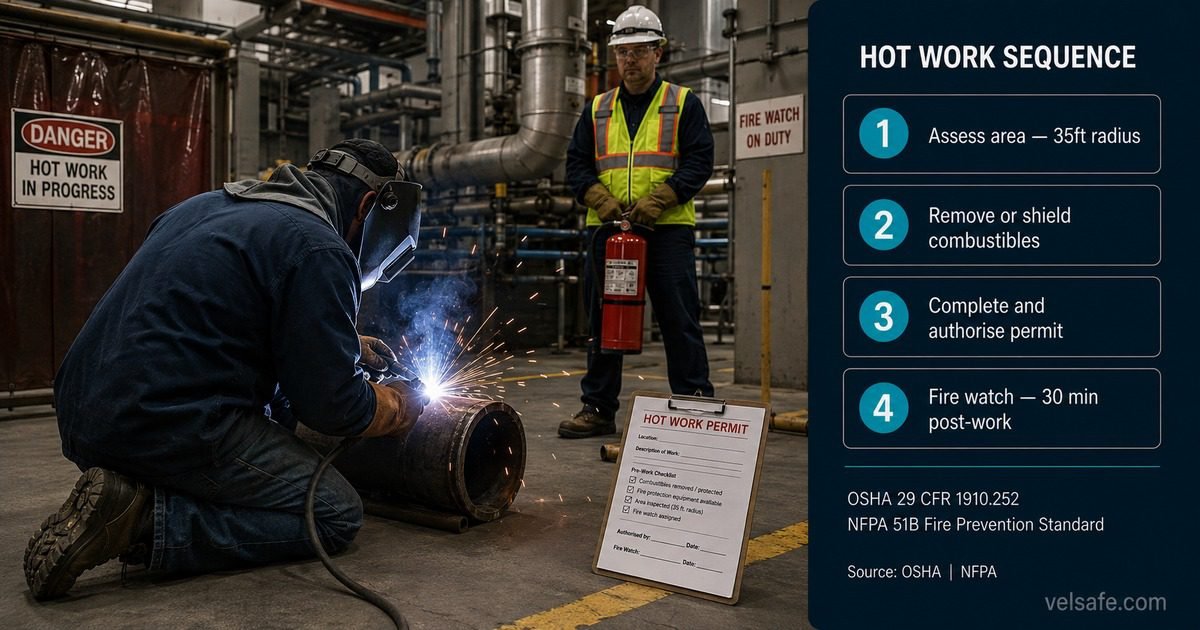
GUIDE: Hot Work Safety
Hot work, which includes welding, cutting, grinding, brazing, soldering, and any other operation that produces heat, sparks, or open flames, is one of the leading causes of industrial fires and explosions in the United States. OSHA’s hot work permit standard at 29 CFR 1910.252 and NFPA 51B establish the framework for controlling these hazards. This guide walks through every element of a compliant hot work programme from permit design to post-work inspection.
Quick Overview
What Hot Work Is
Any operation that involves open flames, electric arcs, or sparks capable of igniting combustible or flammable materials. Includes welding (MIG, TIG, stick, oxy-fuel), cutting, grinding, brazing, soldering, torch-applied roofing, and pipe thawing operations.
Why a Permit Is Required
Hot work permits provide a documented, systematic check that all hazard controls are in place before ignition sources are introduced. OSHA requires written permits for hot work in areas not specifically designated for it. The permit is both a planning tool and a safety control.
Regulatory Basis
OSHA 29 CFR 1910.252 (General Industry Welding), 29 CFR 1926.350-354 (Construction Welding), NFPA 51B (Standard for Fire Prevention During Welding, Cutting, and Other Hot Work), and 29 CFR 1910.119 (PSM) where hot work occurs in or near process areas.
Who This Guide Is For
Safety managers and EHS professionals designing or auditing hot work programmes. Supervisors who authorise hot work. Workers performing welding, cutting, or grinding operations in non-dedicated areas. Contractors performing hot work on facility premises.
What You Will Learn
How to identify hot work hazards and evaluate when a permit is required
How to design and implement a hot work permit system that satisfies OSHA and NFPA requirements
Pre-work site assessment: what to check and how to document it
Fire watch requirements: who qualifies, what they do, and how long they must remain
Atmospheric testing requirements for confined space and process area hot work
PPE selection for welding, cutting, and grinding operations
How to manage contractor hot work on your premises
Post-work inspection requirements and common causes of delayed ignition fires
Prerequisites
Hazard identification capability
The person authorising hot work must be able to identify the types of combustible and flammable materials present in and around the hot work area, including hidden materials inside walls, floors, and ceilings. This requires knowledge of the facility’s construction, the materials stored or processed in adjacent areas, and the behaviour of sparks and heat under the specific conditions of the operation.
Authority to stop work
The permit authoriser and the fire watch must each have clear authority to stop hot work immediately if conditions change. This authority must be established before work begins and communicated to all parties. A fire watch who lacks effective authority to halt an operation provides limited protection.
Knowledge of the facility’s hot work procedure
All parties involved in hot work operations including authorisers, operators, and fire watches must have been trained on the facility’s written hot work procedure before participating. Training should cover permit completion, pre-work checks, fire watch duties, and emergency response. Document training completion before assigning any of these roles.
Required Equipment and Documents
Item
Purpose
Required?
Hot work permit form
Documents the pre-work hazard assessment, authorisation, controls in place, and fire watch assignment
Mandatory
Appropriate fire extinguisher (charged and inspected)
Immediate suppression of ignition in the hot work area; fire watch must know its location and operation
Mandatory
Welding blankets or fire-resistant barriers
Shield combustible materials that cannot be removed from the hot work area; protect adjacent workers
Required where combustibles present
Combustible gas detector / atmospheric monitor
Verify that flammable vapour concentrations are below the Lower Explosive Limit before and during hot work
Mandatory where flammable vapours possible
PPE: welding helmet, gloves, flame-resistant clothing
Protects the hot work operator from arc flash, UV radiation, molten metal spatter, and burn
Mandatory
Written hot work procedure (facility-specific)
The programme document that governs all hot work activities; required to be available at the worksite
Mandatory
Source: OSHA | 29 CFR 1910.252 Welding, Cutting, and Brazing
Step-by-Step Instructions
1
Determine Whether Hot Work Can Be Avoided or Relocated
Objective: Eliminate the hazard before controlling it
Why It Matters
The safest hot work is hot work that does not happen near combustible materials. Before authorising any hot work, evaluate whether the component can be moved to a designated welding area, whether cutting can be done by mechanical means, or whether the operation can be deferred. Permits control residual risk; relocation eliminates it.
Actions
Ask whether the item to be welded or cut can be moved to a designated hot work area. If not, ask whether mechanical alternatives such as pipe cutters, hacksaws, or cold-cut saws can accomplish the task without spark generation. Document the decision and the reasoning in the permit.
Expected Outcome
A documented decision confirming that hot work in the proposed location is necessary and that alternatives have been evaluated. This documentation protects the authoriser and demonstrates due diligence if an incident occurs.
Tip
NFPA 51B requires that the decision to perform hot work in a non-designated area be made by someone with authority and knowledge of the hazards present. This is not a decision that should default to the lowest-level person available.
2
Conduct the Pre-Work Area Assessment
Objective: Identify all combustibles and ignition pathways within the hazard zone
Why It Matters
Sparks from grinding and welding travel up to 35 feet from the point of origin. Radiant heat and conducted heat through metal structures can ignite combustibles at a significant distance from the work point. Fires frequently start in adjacent areas or behind walls, not at the exact point of hot work. The assessment must account for the full hazard radius, not just the immediate work area.
Actions
Survey a minimum 35-foot radius around the proposed work location for combustible and flammable materials. Check the floor below for combustibles if work is on an elevated surface. Check the area behind walls and above ceilings if cutting or welding on structural members. Check for flammable liquid storage, dust accumulation, and floor drains that may contain flammable vapours from adjacent processes.
Expected Outcome
A complete written hazard assessment on the permit form identifying all combustible materials found, their location relative to the work point, and the control measures applied to each. No combustible material should be left unaddressed in the permit documentation.
Warning
Fires that start behind walls or in floor voids typically go undetected during the work period and ignite minutes to hours after hot work concludes. The post-work fire watch exists specifically to catch these delayed-ignition scenarios. The pre-work assessment must identify hidden combustibles, not just those that are visible.
3
Remove or Protect Combustible Materials
Objective: Eliminate or shield ignitable materials from the hazard zone
The preferred control is removal: relocate combustible and flammable materials to outside the hazard zone before hot work begins. Where removal is not practical, materials must be covered or shielded using fire-resistant materials rated for the application.
Remove (preferred)
Move combustible materials to outside the 35-foot radius. Drain flammable liquids from containers in the area. Relocate dust-laden equipment. Remove wood pallets, cardboard, paper, and similar materials from the floor area beneath elevated hot work.
Cover (if removal not practical)
Use welding blankets, fire-resistant curtains, or sheet metal to cover combustibles that cannot be removed. Welding blankets must be rated for the temperatures generated by the specific hot work operation. Standard fibreglass blankets are not appropriate for all applications.
Wet down (supplementary only)
Wetting down wooden floors or combustible surfaces with water can reduce ignition risk but is a supplementary measure, not a substitute for removal or covering. It does not protect against heat conducted through metal structures or vapour ignition from flammable liquids.
Source: NFPA | NFPA 51B Standard for Fire Prevention During Hot Work
4
Complete and Authorise the Hot Work Permit
Objective: Document all controls and obtain required authorisation before work begins
Required Permit Elements
Date and time of work. Location (building, floor, room, equipment ID). Type of hot work operation. Name of operator. Name of fire watch. Description of combustibles found and controls applied. Atmospheric testing results where required. Confirmation that fire extinguisher is in place and charged. Authoriser’s signature with time of authorisation. Permit expiration time.
Permit Validity
Permits should be issued for a specific time period, typically a single shift or a defined work window. If conditions change, such as a new chemical being introduced to an adjacent area, the permit must be re-evaluated. A permit authorised in the morning does not automatically remain valid for conditions that exist in the afternoon.
Expected Outcome
A fully completed, signed permit posted at the work location. The permit serves as both authorisation to proceed and a reference document for the fire watch and operator during the work period.
Tip
OSHA does not prescribe a specific permit form, but the permit must document the required elements. Many facilities use a checklist-format permit that guides the authoriser through each required element sequentially. Retain completed permits for the period specified in your programme, typically at least one year.
5
Perform Hot Work with Fire Watch in Position
Objective: Execute the work safely with active monitoring for ignition
Fire Watch Requirements
The fire watch must be present during the entire hot work operation. Their sole duty is fire watch: they must not be assigned other tasks simultaneously. They must have a charged fire extinguisher within reach, know how to use it, and have clear authority to stop work immediately if conditions become unsafe. The fire watch must monitor for sparks, smouldering materials, and smoke in the work area and all surrounding areas within the hazard zone.
When Two Fire Watches Are Required
If the hot work area has multiple faces, if work is on an elevated surface with the area below not visible to a single fire watch, or if combustible materials exist in locations that a single fire watch cannot simultaneously monitor, two fire watches are required.
Expected Outcome
Hot work completed within the authorised time window with continuous fire watch coverage. Any potential ignition identified and addressed immediately. No permit conditions violated during the work period.
Warning
The operator cannot serve as their own fire watch. The hot work operator’s attention is focused on the task; monitoring the surrounding area for ignition requires a dedicated, separate person who is not performing any other function during the operation.
6
Conduct the Post-Work Inspection and Extended Fire Watch
Objective: Detect delayed ignition before it becomes an uncontrolled fire
Why Post-Work Fire Watch Is Critical
NFPA 51B and OSHA both require a fire watch for at least 30 minutes after hot work concludes. This requirement exists because delayed ignition is common and predictable: smouldering materials in walls, ceilings, and floor voids may not produce visible flame for 30 minutes to several hours after hot work ends. The majority of hot work fires that occur after the crew has left would have been caught by an adequate post-work fire watch.
Post-Work Inspection Actions
Inspect all surfaces within the hot work area and the 35-foot hazard radius for smouldering, discolouration, or heat. Use the back of the hand to check wall surfaces for warmth indicating heat transfer. Check areas on the opposite side of any walls or floors where hot work occurred. Verify that the permit expiration time has not been reached before leaving the area. Close the permit only after the inspection is complete and no hazards are identified.
Expected Outcome
A documented post-work inspection with findings recorded on the permit. The permit closed with the time of inspection and the fire watch’s signature. Any anomaly found during the post-work inspection triggers immediate escalation and investigation before the area is released.
Tip
For hot work that occurs late in a shift or at the end of the workday, the 30-minute minimum fire watch may extend beyond normal working hours. Plan accordingly. Never terminate the post-work fire watch early because the shift is ending. The fire will not wait for a convenient time.
Best Practices
Pre-qualify contractor hot work programmes before they work on your site
Contractors performing hot work on your premises operate under their employer’s safety programme, but the host facility is responsible for informing contractors of site-specific hazards and for enforcing site hot work permit requirements. Before any contractor begins hot work, verify that they have a written hot work programme, that their workers are trained, and that they understand your site permit process. The most common gap in contractor hot work management is assuming the contractor’s programme meets your site requirements without verifying it.
Establish designated hot work areas where operations permit
A designated hot work area that is permanently cleared of combustibles, equipped with appropriate fire suppression, and equipped with proper ventilation eliminates the need for a permit for work conducted within that area. The investment in a proper welding shop or fabrication area pays back in reduced permit administration burden and reduced risk. Where a designated area is not practical, a permanent protocol for converting a specific area to a temporary hot work zone reduces the pre-work assessment burden for recurring operations.
Review all hot work incidents and near misses to update the programme
Every fire, near miss, or permit deficiency identified during an audit is programme feedback. Hot work incident investigations should specifically evaluate whether the permit process worked as designed, whether the fire watch was effective, and whether the pre-work assessment identified the hazard that contributed to the incident. Updating the permit form, the training programme, or the pre-work checklist based on incident findings is how the programme improves over time.
Common Mistakes
Common Mistake
What to Do Instead
Treating the permit as a formality rather than a genuine hazard assessment
The permit must be completed by someone physically present in the area who has assessed the actual conditions. A permit completed at a desk from memory or habit is not a hazard assessment. Walk the area, look for combustibles, check atmospheric conditions, and document what you actually found.
Assigning the hot work operator to serve as their own fire watch
The fire watch must be a separate, dedicated person whose only job during the hot work operation is watching for fire. The operator cannot simultaneously perform precision welding and scan the surrounding area for ignition. These are two different jobs requiring different attention.
Ending the fire watch immediately when hot work stops
NFPA 51B requires a minimum 30-minute post-work fire watch. Delayed ignition from smouldering materials behind walls is responsible for a significant share of hot work fires that occur after the crew has left the area. Do not leave the area without completing the post-work inspection and fire watch period.
Not checking below the work surface for combustibles when working at height
Sparks fall. Hot metal drops fall. Slag from overhead welding can travel significant distances after landing. When hot work is performed on elevated structures, grating, or overhead piping, the pre-work assessment must include the floor area and any equipment directly below the work. This area often gets missed because the authoriser’s attention is focused at the work elevation.
Issuing open-ended permits with no expiration time
A permit without an expiration time cannot be managed or audited. Conditions in industrial facilities change throughout the day. A permit authorised for morning conditions may not be valid for afternoon conditions if new materials have been introduced, shift personnel have changed, or adjacent operations have started that create new hazard sources.
Compliance Notes
OSHA and NFPA Requirements Summary
29 CFR 1910.252(a): Requires fire prevention measures for welding, cutting, and brazing in general industry. Specifies requirements for fire watch, relocation of combustibles, covering of combustibles that cannot be moved, and permit requirements for work in areas not designated for hot work.
29 CFR 1926.350-354: Construction hot work requirements covering welding, cutting, and heating in construction environments. Includes equipment requirements, fire prevention, and ventilation.
NFPA 51B: The National Fire Protection Association’s standard specifically for fire prevention during welding, cutting, and other hot work. While OSHA is the regulatory authority, NFPA 51B is the technical reference standard that defines requirements in more detail than the OSHA regulation, and OSHA inspectors frequently reference it.
29 CFR 1910.119 (PSM): Process Safety Management requires a hot work permit for work on or near covered processes. The PSM hot work permit requirement is separate from the general welding standard and applies whenever hot work occurs in or adjacent to a PSM-covered process unit.
Source: OSHA | 29 CFR 1910.252 Welding, Cutting, and Brazing
Troubleshooting
The gas detector is reading above the Lower Explosive Limit
Do not proceed with hot work. Identify and eliminate the source of the flammable vapour before re-testing. A reading above 10% of the LEL indicates a concentration significant enough to create an explosive atmosphere if an ignition source is introduced. Hot work must not proceed until the atmosphere has been tested and confirmed below 10% LEL throughout the hazard zone. If the source cannot be identified and controlled, the hot work must be deferred.
The fire watch identifies smoke or smouldering during the post-work inspection
Treat it as an active fire emergency. Alert others in the area immediately. Attempt suppression with the available extinguisher only if the fire is small and confined and you have a clear egress path. If suppression is not immediately successful, evacuate and call the fire department. Never leave a smouldering material in a wall or void space and assume it will self-extinguish.
Conditions change after the permit has been authorised
Stop work. Do not continue under a permit that no longer reflects actual conditions. A new chemical delivery to an adjacent area, a change in the work being performed by nearby crews, or a shift in wind direction that changes ventilation patterns may each require the permit to be re-evaluated. The permit authoriser must be notified and must re-assess conditions before work resumes. Mark the original permit as cancelled and issue a new one if conditions can be adequately controlled.
Quick Checklist
Before Authorising
Hot work evaluated for relocation or cold-work alternatives
35-foot radius surveyed for combustibles
All combustibles removed or shielded
Atmosphere tested where flammable vapours are possible
Fire extinguisher in place, charged, and inspected
During Hot Work
Permit posted at work location
Dedicated fire watch in position with no other duties
All parties know how to stop work immediately
Operator using correct PPE throughout
Work stays within the authorised area and time window
After Hot Work
30-minute post-work fire watch completed
Full inspection of work area and adjacent areas
No smouldering, smoke, or discolouration found
Permit closed with time and fire watch signature
Permit retained per the facility’s document retention requirement
Key Takeaways
The permit is only as good as the assessment behind it
A completed permit form provides legal documentation. What actually prevents fires is the physical hazard assessment that the permit is supposed to document. An authoriser who signs a permit without physically inspecting the area, checking for hidden combustibles, and verifying that controls are in place has created paperwork, not safety. The permit process should drive the assessment, not replace it.
Delayed ignition is predictable and preventable
The pattern is well documented in fire investigation literature: hot work concludes, crew leaves, fire starts 30 to 90 minutes later in a wall cavity or floor void. The post-work fire watch requirement in OSHA and NFPA 51B exists specifically to address this pattern. Every facility that has experienced a hot work fire after the crew departed should ask why the post-work fire watch did not catch it, and every facility that has not had such a fire should ask whether it would have been caught if it had occurred.
Contractor hot work is your site’s responsibility
When a contractor causes a hot work fire on your premises, the host facility bears consequences beyond the contractor’s own liability exposure. OSHA’s multi-employer citation policy allows citations to the controlling employer for hazards created by contractor operations. The facility’s own insurance, business continuity, and regulatory standing are all affected. Verifying contractor hot work qualifications before work begins and enforcing your permit requirements throughout is not optional oversight. It is how your facility’s hot work programme actually functions for the operations you did not directly control.
Frequently Asked Questions
Is a hot work permit required for all welding and cutting operations?
Not for all. Permits are required outside specifically designated hot work areas. A permanent welding shop designed and equipped for welding does not require a permit for routine operations within that space. Permits are required when hot work is performed in areas not specifically designated for that purpose, such as maintenance operations in production areas, repairs near flammable storage, or work in confined spaces.
How long must the fire watch remain after hot work is complete?
NFPA 51B and OSHA both specify a minimum 30-minute post-work fire watch. The 30-minute figure reflects the time required for smouldering materials to develop into a full fire. In areas with combustible wall or ceiling materials, insulation, or concealed spaces where sparks may have penetrated, the fire watch period should be extended and a follow-up inspection should be conducted several hours later.
Who can serve as a fire watch?
The fire watch must be a competent person who has been trained in fire prevention, knows how to use the fire extinguisher, and is stationed within the work area during hot work and for the required post-work period. The fire watch must have no other duties that would distract them from monitoring for fire conditions. Using the hot work operator as the fire watch while they are still performing work does not satisfy the requirement.
What atmospheric test result is required before hot work can begin in an area with potential flammable vapours?
OSHA and industry standards generally require that the atmosphere be tested and confirmed below 10% of the lower explosive limit (LEL) before hot work begins. Some employers and standards require testing below 5% LEL as a more conservative threshold. Testing must be performed with a calibrated gas detector by a qualified person immediately before hot work begins and periodically throughout the operation if conditions could change.
What training is required for employees who authorise hot work permits?
Hot work permit authorisers must understand the hazards of the specific work area, be able to assess whether combustible and flammable materials have been removed or protected, understand the fire watch requirements, and know when conditions require cancellation of the permit. Authorisers should be trained on the facility’s hot work programme, relevant OSHA standards, and NFPA 51B. The authoriser is responsible for the adequacy of precautions, not just signature of the form.
How should hot work be managed when performed by contractors?
Facility owners and controlling employers must ensure contractors understand the facility’s hot work programme before beginning work. This includes briefing contractors on permit requirements, area-specific hazards, fire watch requirements, emergency procedures, and the facility’s communication protocols. The permit must be issued before work begins regardless of whether the employer or a contractor is performing the work. Contractor compliance is the responsibility of the controlling employer under OSHA’s multi-employer citation policy.
What records must be kept for a hot work permit programme?
Completed permits should be retained for a period appropriate to the facility’s safety management system, typically at least one year or until the next inspection cycle. Records of hot work-related incidents, near misses, and equipment inspections should also be maintained. Documented training records for permit authorisers and fire watch personnel demonstrate programme compliance in the event of an OSHA inspection or insurance review.
Government and Regulatory Sources
Government and Regulatory Sources
- OSHA. 29 CFR 1910.252: Welding, Cutting, and Brazing: general industry hot work standard covering fire prevention requirements.
- OSHA. 29 CFR 1926.350: Gas Welding and Cutting (Construction): construction standard for gas welding and cutting operations.
- OSHA. 29 CFR 1910.119: Process Safety Management: PSM requirements applicable to hot work in facilities with highly hazardous chemicals.
Research and Industry Sources
- NFPA. 51B Standard for Fire Prevention During Welding, Cutting, and Other Hot Work: industry consensus standard for hot work fire prevention programmes.
Related VelSafe Articles
Related VelSafe Articles
VelSafe
Make Your Hot Work Programme Audit-Ready
Effective hot work safety requires permits, trained fire watch personnel, and proper post-work inspection. Find more workplace safety guidance and resources at VelSafe.
Explore VelSafe Resources