

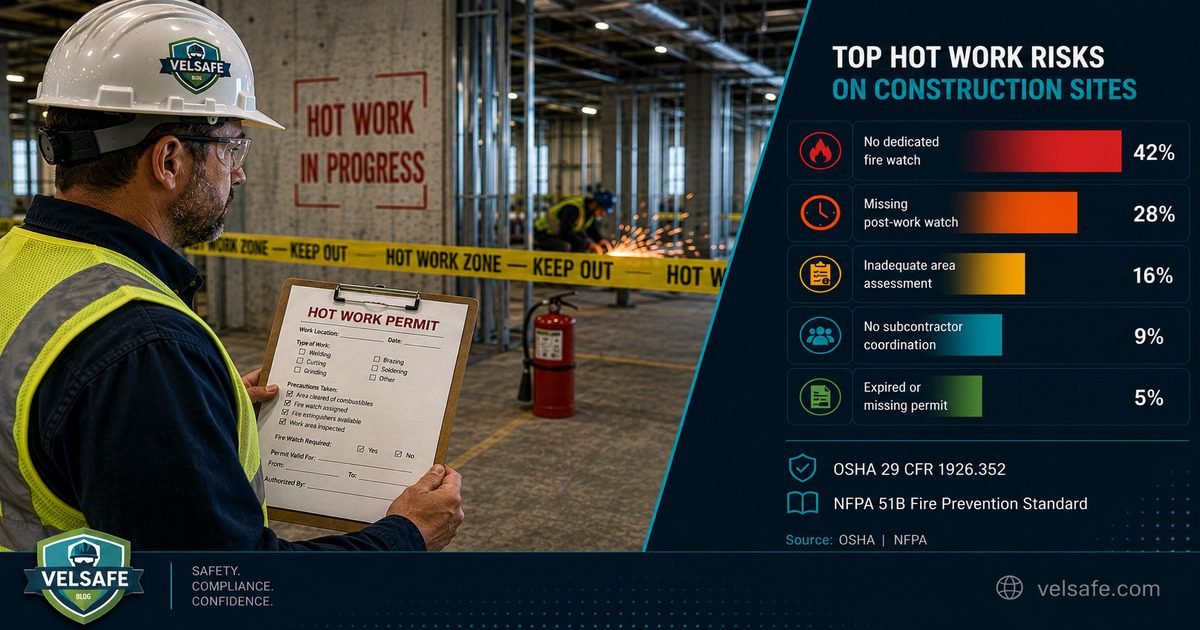
TIPS: Hot Work Safety in Construction
Hot work on construction sites carries additional hazards that differ from industrial facility settings. Combustible materials are often distributed across large, open areas. Permit systems may be less formalised. Workers from multiple subcontractors share the same space without coordinating their operations. These 10 tips address the specific conditions that make construction hot work high-risk and what supervisors and workers can do about them.
Quick Tip Summary
Assess the full 35-foot radius before every operation, every time
Never assign the hot work operator as their own fire watch
Check below and behind the work surface, not just in front of it
Verify contractor hot work programmes before they start on your site
Keep the post-work fire watch for the full 30 minutes, no exceptions
Use atmospheric testing before hot work near any enclosed or partially enclosed space
Coordinate hot work timing with adjacent subcontractors to avoid simultaneous hazards
Treat the permit as a genuine hazard assessment, not a signature exercise
Source: OSHA | 29 CFR 1926.350 Gas Welding and Cutting (Construction)
What You Will Learn
How to manage the specific hot work hazards unique to construction environments, including multi-employer coordination, combustible material distribution across open sites, atmospheric hazards in partially enclosed structures, and the permit and fire watch requirements under OSHA’s construction standard at 29 CFR 1926.350-354 and NFPA 51B.
Construction Hot Work Safety Tips
1
Conduct the 35-foot radius assessment on-site, not from memory
Why It Matters
Construction sites change daily. An assessment from memory does not reflect today’s conditions. A fire that starts in materials that arrived this morning is still a preventable fire.
What To Do
Walk the full 35-foot radius physically before every hot work operation. Look for wood framing, insulation, paper vapour barriers, cardboard, adhesives, paint or solvent containers, and any other combustible materials. Check what is on the opposite side of any wall or floor where you will be working. Document what you find on the permit form.
Common Mistake
Completing the permit in the site office or trailer without walking the area. The permit requires documenting actual conditions.
Pro Tip
On framed construction, check what is in the stud bays and above the ceiling before cutting or welding near walls. Heat conducts through metal fasteners into wood framing.
2
Coordinate with adjacent subcontractors before starting hot work
Why It Matters
A painter applying solvent 20 feet away creates a vapour environment that did not exist during the morning assessment. A lumber delivery adds combustibles to the hazard zone. These conditions change within minutes on a busy site.
What To Do
Before hot work begins, notify adjacent trades and ask whether their work involves flammable materials or will add combustibles to the area. If a conflict exists, schedule accordingly. Document the coordination.
Common Mistake
Assuming adjacent trades’ operations are the GC’s problem. On a multi-employer site, everyone shares exposure to a hot work fire.
Pro Tip
Raise hot work scheduling at the daily toolbox talk or subcontractor coordination meeting. Five minutes of planning eliminates hours of incident investigation.
3
Test the atmosphere before hot work in any enclosed or partially enclosed structure
Why It Matters
Partially enclosed structures accumulate vapours from adhesives, solvents, and fuel leaks. A welding arc in an atmosphere at or above 10% LEL creates an explosion hazard, not just a fire risk.
What To Do
Use a calibrated combustible gas detector before hot work in any partially enclosed space. Test at multiple elevations. If above 10% LEL, ventilate and retest. Keep the detector running during the operation where warranted.
Common Mistake
Assuming a space that smells fine is safe. Many flammable vapours have odour thresholds above their ignitable concentrations.
Pro Tip
Test low points separately from high points. Propane and other heavy vapours settle at floor level while lighter vapours accumulate above.
4
Assign a dedicated fire watch, not a shared one
Why It Matters
Assigning one person to fire watch while they do another task is common on busy sites. It does not work. Monitoring for ignition in the work area and full hazard zone requires undivided attention.
What To Do
Designate a named individual whose only job during hot work is monitoring for fire, extinguisher within reach, authority to stop work. If they must leave, hot work stops until they return or a replacement is in place.
Common Mistake
Listing “operator” as the fire watch on the permit. OSHA does not accept self-monitoring as a fire watch.
Pro Tip
Brief the fire watch before hot work starts. Confirm they know how to use the extinguisher, where to look, and what to do if they see smoke or smouldering.
5
Do not skip the 30-minute post-work fire watch because the shift is ending
Why It Matters
Many construction hot work fires ignite after the crew leaves. Smouldering in wood framing, insulation, and building paper may not produce visible flame for up to 90 minutes after welding stops. The post-work fire watch is the control that catches these delayed ignitions.
What To Do
Plan hot work to finish with enough time for a full 30-minute post-work watch before departure. If not operationally possible, finish the work earlier in the shift. Never cut the watch short to make a departure time.
Common Mistake
Leaving at 4:30 when hot work finished at 4:25. Five minutes of post-work observation is not a fire watch.
Pro Tip
Record the post-work inspection time and findings on the permit before closing it. This documents compliance and provides evidence if a fire occurs after the crew departs.
6
Verify contractor hot work programmes before they start on your site
Why It Matters
Under OSHA’s multi-employer citation policy, the GC can be cited for a subcontractor’s hot work fire if they did not exercise reasonable care to prevent or detect the violation. Assuming the sub knows what they are doing is not reasonable care.
What To Do
Before any subcontractor performs hot work on your site, verify that they have a written hot work programme, that their workers are trained, and that they understand and will follow your site’s permit process. Include this verification in the pre-construction or pre-task meeting. Require subcontractors to use your site permit form or an equivalent that meets the same minimum elements.
Common Mistake
Accepting a subcontractor’s verbal assurance that they follow hot work procedures without reviewing their written programme or training records.
Pro Tip
Include a hot work programme verification in your subcontractor pre-qualification checklist, alongside insurance certificates and safety plans.
7
Use welding blankets and screens to protect combustible building materials that cannot be moved
Why It Matters
Unlike industrial facilities where combustibles can often be removed to clear the hazard zone, construction sites frequently have combustible materials that are part of the structure being built. Wood framing, engineered lumber, temporary formwork, vapour barriers, and installed insulation cannot always be relocated before hot work in adjacent areas takes place.
What To Do
Cover exposed combustible structural materials with welding blankets or fire-resistant barriers rated for the operation type. Do not substitute standard fibreglass insulation batts for rated welding blankets.
Common Mistake
Covering only the visible face of a wood stud without covering the surrounding area where sparks can land.
Pro Tip
Secure welding blankets so they cannot shift or fall during the operation. A blanket that moves during welding leaves uncovered surfaces exposed exactly when sparks are most active.
8
Select and use the correct PPE for the specific hot work operation
Why It Matters
Different hot work operations generate different hazards. Oxy-fuel cutting produces UV radiation, infrared radiation, molten metal, and slag at high velocity. Arc welding generates intense UV that can cause arc eye (photokeratitis) from brief exposure. Grinding generates sparks and metal fragments. Wearing the wrong PPE, or PPE rated for a different operation, leaves workers exposed.
What To Do
Match PPE to the specific operation. Arc welding requires a helmet with correct lens shade, flame-resistant clothing, leather gloves, and leather boots. Grinding requires safety glasses under the face shield. Oxy-fuel requires filter lenses rated for the fuel gas. Verify PPE condition before every use.
Common Mistake
Wearing a face shield without safety glasses underneath during grinding. A fragment that comes around the shield’s edge strikes an unprotected eye.
Pro Tip
Post the PPE requirements for each hot work operation type at the tool storage area so workers check before they start, not after a near miss.
Frequently Asked Questions
Does OSHA’s construction welding standard require a hot work permit?
The construction welding standard at 29 CFR 1926.352 requires fire prevention measures but does not mandate a permit system by name. However, OSHA’s general duty clause and multi-employer worksite standards effectively require permit-equivalent controls on most commercial and industrial construction sites. Many general contractors and owners require hot work permits as a condition of contract, and NFPA 51B recommends permit systems for all hot work outside designated areas.
Who is responsible for hot work fire prevention when multiple subcontractors are on site?
All employers are responsible for their workers, but the controlling employer (GC or construction manager) bears responsibility for overall site hot work compliance under OSHA’s multi-employer citation policy. The controlling employer must implement a site-wide hot work programme, communicate requirements to all subcontractors, and ensure that permit requirements are followed before any hot work begins. Ignoring a subcontractor’s non-compliance does not shield the controlling employer from citation.
How should roofing torch operations be managed under hot work requirements?
Torch-applied roofing is hot work requiring the same permit, fire watch, and post-work inspection as welding. Roofing torches are a leading cause of construction fires. Fire watch must be maintained during the work and for at least 30 minutes after torch use ceases. Inspections should check concealed spaces, gaps in decking, and areas below the roof where heat transfer could ignite structural materials hours after the work is complete.
What is the minimum fire watch duration for construction hot work?
NFPA 51B requires a 30-minute minimum post-work fire watch. On construction sites with combustible framing, temporary materials, or open penetrations between floors, a 30-minute watch should be treated as a floor, not a ceiling. Sites with known ignition pathways such as open stud bays, penetrations through combustible assemblies, or proximity to stored materials should extend the fire watch and conduct follow-up inspections.
What PPE is required for hot work operators on construction sites?
At minimum, hot work operators require a welding helmet with appropriate shade lens, flame-resistant clothing covering arms and legs, leather or FR-rated gloves, safety boots, and hearing protection where noise levels require it. Operations generating significant fume exposure require respiratory protection selected based on an industrial hygiene assessment of the specific materials being welded. PPE selection must be documented and training records maintained.
How should combustible materials be managed before hot work begins?
Combustible materials within 35 feet of the hot work location should be removed, covered with fire-resistant blankets, or shielded with non-combustible barriers. Flammable liquids and gases must be removed from the area entirely. If combustible materials cannot be moved, the permit authoriser must determine that adequate shielding is in place and document that determination on the permit. Where adequate protection is not achievable, the work should be relocated.
What are the most common hot work fire causes on construction sites?
The leading causes are sparks and spatter landing in combustible materials including wall cavities, insulation, and temporary debris; torch flames contacting combustible roofing or framing; inadequate or no fire watch; and fires starting in concealed spaces after the fire watch period ends. Fires that begin after the fire watch is discontinued are particularly common in timber-framed construction where heat can transfer through framing members and smoulder for hours before igniting.
Government and Regulatory Sources
Government and Regulatory Sources
- OSHA. 29 CFR 1926.350: Gas Welding and Cutting (Construction): construction standard covering gas welding and fire prevention.
- OSHA. 29 CFR 1926.352: Fire Prevention (Construction): construction fire prevention requirements for welding and cutting.
- OSHA. 29 CFR 1910.252: Welding, Cutting, and Brazing: general industry standard applied by reference to many construction situations.
Research and Industry Sources
- NFPA. 51B Standard for Fire Prevention During Welding, Cutting, and Other Hot Work: consensus standard for hot work permit programmes and fire watch requirements.
Related VelSafe Articles
Related VelSafe Articles
VelSafe
Keep Construction Hot Work Safe and Compliant
Hot work fires are preventable with the right permit programme, trained personnel, and post-work inspection practices. Find more construction safety resources at VelSafe.
Explore VelSafe Resources
1
Conduct the 35-foot radius assessment on-site, not from memory
Why It Matters
Construction sites change daily. An assessment from memory does not reflect today’s conditions. A fire that starts in materials that arrived this morning is still a preventable fire.
What To Do
Walk the full 35-foot radius physically before every hot work operation. Look for wood framing, insulation, paper vapour barriers, cardboard, adhesives, paint or solvent containers, and any other combustible materials. Check what is on the opposite side of any wall or floor where you will be working. Document what you find on the permit form.
Common Mistake
Completing the permit in the site office or trailer without walking the area. The permit requires documenting actual conditions.
Pro Tip
On framed construction, check what is in the stud bays and above the ceiling before cutting or welding near walls. Heat conducts through metal fasteners into wood framing.
2
Coordinate with adjacent subcontractors before starting hot work
Why It Matters
A painter applying solvent 20 feet away creates a vapour environment that did not exist during the morning assessment. A lumber delivery adds combustibles to the hazard zone. These conditions change within minutes on a busy site.
What To Do
Before hot work begins, notify adjacent trades and ask whether their work involves flammable materials or will add combustibles to the area. If a conflict exists, schedule accordingly. Document the coordination.
Common Mistake
Assuming adjacent trades’ operations are the GC’s problem. On a multi-employer site, everyone shares exposure to a hot work fire.
Pro Tip
Raise hot work scheduling at the daily toolbox talk or subcontractor coordination meeting. Five minutes of planning eliminates hours of incident investigation.
3
Test the atmosphere before hot work in any enclosed or partially enclosed structure
Why It Matters
Partially enclosed structures accumulate vapours from adhesives, solvents, and fuel leaks. A welding arc in an atmosphere at or above 10% LEL creates an explosion hazard, not just a fire risk.
What To Do
Use a calibrated combustible gas detector before hot work in any partially enclosed space. Test at multiple elevations. If above 10% LEL, ventilate and retest. Keep the detector running during the operation where warranted.
Common Mistake
Assuming a space that smells fine is safe. Many flammable vapours have odour thresholds above their ignitable concentrations.
Pro Tip
Test low points separately from high points. Propane and other heavy vapours settle at floor level while lighter vapours accumulate above.
4
Assign a dedicated fire watch, not a shared one
Why It Matters
Assigning one person to fire watch while they do another task is common on busy sites. It does not work. Monitoring for ignition in the work area and full hazard zone requires undivided attention.
What To Do
Designate a named individual whose only job during hot work is monitoring for fire, extinguisher within reach, authority to stop work. If they must leave, hot work stops until they return or a replacement is in place.
Common Mistake
Listing “operator” as the fire watch on the permit. OSHA does not accept self-monitoring as a fire watch.
Pro Tip
Brief the fire watch before hot work starts. Confirm they know how to use the extinguisher, where to look, and what to do if they see smoke or smouldering.
5
Do not skip the 30-minute post-work fire watch because the shift is ending
Why It Matters
Many construction hot work fires ignite after the crew leaves. Smouldering in wood framing, insulation, and building paper may not produce visible flame for up to 90 minutes after welding stops. The post-work fire watch is the control that catches these delayed ignitions.
What To Do
Plan hot work to finish with enough time for a full 30-minute post-work watch before departure. If not operationally possible, finish the work earlier in the shift. Never cut the watch short to make a departure time.
Common Mistake
Leaving at 4:30 when hot work finished at 4:25. Five minutes of post-work observation is not a fire watch.
Pro Tip
Record the post-work inspection time and findings on the permit before closing it. This documents compliance and provides evidence if a fire occurs after the crew departs.
6
Verify contractor hot work programmes before they start on your site
Why It Matters
Under OSHA’s multi-employer citation policy, the GC can be cited for a subcontractor’s hot work fire if they did not exercise reasonable care to prevent or detect the violation. Assuming the sub knows what they are doing is not reasonable care.
What To Do
Before any subcontractor performs hot work on your site, verify that they have a written hot work programme, that their workers are trained, and that they understand and will follow your site’s permit process. Include this verification in the pre-construction or pre-task meeting. Require subcontractors to use your site permit form or an equivalent that meets the same minimum elements.
Common Mistake
Accepting a subcontractor’s verbal assurance that they follow hot work procedures without reviewing their written programme or training records.
Pro Tip
Include a hot work programme verification in your subcontractor pre-qualification checklist, alongside insurance certificates and safety plans.
7
Use welding blankets and screens to protect combustible building materials that cannot be moved
Why It Matters
Unlike industrial facilities where combustibles can often be removed to clear the hazard zone, construction sites frequently have combustible materials that are part of the structure being built. Wood framing, engineered lumber, temporary formwork, vapour barriers, and installed insulation cannot always be relocated before hot work in adjacent areas takes place.
What To Do
Cover exposed combustible structural materials with welding blankets or fire-resistant barriers rated for the operation type. Do not substitute standard fibreglass insulation batts for rated welding blankets.
Common Mistake
Covering only the visible face of a wood stud without covering the surrounding area where sparks can land.
Pro Tip
Secure welding blankets so they cannot shift or fall during the operation. A blanket that moves during welding leaves uncovered surfaces exposed exactly when sparks are most active.
8
Select and use the correct PPE for the specific hot work operation
Why It Matters
Different hot work operations generate different hazards. Oxy-fuel cutting produces UV radiation, infrared radiation, molten metal, and slag at high velocity. Arc welding generates intense UV that can cause arc eye (photokeratitis) from brief exposure. Grinding generates sparks and metal fragments. Wearing the wrong PPE, or PPE rated for a different operation, leaves workers exposed.
What To Do
Match PPE to the specific operation. Arc welding requires a helmet with correct lens shade, flame-resistant clothing, leather gloves, and leather boots. Grinding requires safety glasses under the face shield. Oxy-fuel requires filter lenses rated for the fuel gas. Verify PPE condition before every use.
Common Mistake
Wearing a face shield without safety glasses underneath during grinding. A fragment that comes around the shield’s edge strikes an unprotected eye.
Pro Tip
Post the PPE requirements for each hot work operation type at the tool storage area so workers check before they start, not after a near miss.
Does OSHA’s construction welding standard require a hot work permit?
The construction welding standard at 29 CFR 1926.352 requires fire prevention measures but does not mandate a permit system by name. However, OSHA’s general duty clause and multi-employer worksite standards effectively require permit-equivalent controls on most commercial and industrial construction sites. Many general contractors and owners require hot work permits as a condition of contract, and NFPA 51B recommends permit systems for all hot work outside designated areas.
Who is responsible for hot work fire prevention when multiple subcontractors are on site?
All employers are responsible for their workers, but the controlling employer (GC or construction manager) bears responsibility for overall site hot work compliance under OSHA’s multi-employer citation policy. The controlling employer must implement a site-wide hot work programme, communicate requirements to all subcontractors, and ensure that permit requirements are followed before any hot work begins. Ignoring a subcontractor’s non-compliance does not shield the controlling employer from citation.
How should roofing torch operations be managed under hot work requirements?
Torch-applied roofing is hot work requiring the same permit, fire watch, and post-work inspection as welding. Roofing torches are a leading cause of construction fires. Fire watch must be maintained during the work and for at least 30 minutes after torch use ceases. Inspections should check concealed spaces, gaps in decking, and areas below the roof where heat transfer could ignite structural materials hours after the work is complete.
What is the minimum fire watch duration for construction hot work?
NFPA 51B requires a 30-minute minimum post-work fire watch. On construction sites with combustible framing, temporary materials, or open penetrations between floors, a 30-minute watch should be treated as a floor, not a ceiling. Sites with known ignition pathways such as open stud bays, penetrations through combustible assemblies, or proximity to stored materials should extend the fire watch and conduct follow-up inspections.
What PPE is required for hot work operators on construction sites?
At minimum, hot work operators require a welding helmet with appropriate shade lens, flame-resistant clothing covering arms and legs, leather or FR-rated gloves, safety boots, and hearing protection where noise levels require it. Operations generating significant fume exposure require respiratory protection selected based on an industrial hygiene assessment of the specific materials being welded. PPE selection must be documented and training records maintained.
How should combustible materials be managed before hot work begins?
Combustible materials within 35 feet of the hot work location should be removed, covered with fire-resistant blankets, or shielded with non-combustible barriers. Flammable liquids and gases must be removed from the area entirely. If combustible materials cannot be moved, the permit authoriser must determine that adequate shielding is in place and document that determination on the permit. Where adequate protection is not achievable, the work should be relocated.
What are the most common hot work fire causes on construction sites?
The leading causes are sparks and spatter landing in combustible materials including wall cavities, insulation, and temporary debris; torch flames contacting combustible roofing or framing; inadequate or no fire watch; and fires starting in concealed spaces after the fire watch period ends. Fires that begin after the fire watch is discontinued are particularly common in timber-framed construction where heat can transfer through framing members and smoulder for hours before igniting.
Government and Regulatory Sources
- OSHA. 29 CFR 1926.350: Gas Welding and Cutting (Construction): construction standard covering gas welding and fire prevention.
- OSHA. 29 CFR 1926.352: Fire Prevention (Construction): construction fire prevention requirements for welding and cutting.
- OSHA. 29 CFR 1910.252: Welding, Cutting, and Brazing: general industry standard applied by reference to many construction situations.
Research and Industry Sources
- NFPA. 51B Standard for Fire Prevention During Welding, Cutting, and Other Hot Work: consensus standard for hot work permit programmes and fire watch requirements.
Related VelSafe Articles
VelSafe
Keep Construction Hot Work Safe and Compliant
Hot work fires are preventable with the right permit programme, trained personnel, and post-work inspection practices. Find more construction safety resources at VelSafe.
Explore VelSafe Resources