

A maintenance crew is cutting through a structural steel beam in a production area that was cleared for hot work this morning. The welder has been at it for two hours. The fire watch, assigned at the start of the job, has been watching the work area the whole time. The welder finishes and packs up. The fire watch is about to do the same.
This scenario works through what happens next, what the fire watch is required to do under OSHA 29 CFR 1910.252, and what the consequences are when fire watch is abandoned early.
The Scenario
Location: A general industry manufacturing facility. Paint storage is located in a room adjacent to the production area, separated by a standard drywall partition with an HVAC duct passing through. The morning shift cleared the work area and the hot work permit was issued at 07:00.
The work: A maintenance welder has been cutting and grinding a structural steel beam near the exterior wall. The job took approximately two hours. During the work, sparks were observed landing on the concrete floor and on a section of fiberglass pipe insulation that could not be fully removed from the area. A flame-resistant blanket was placed over most of the insulation but did not cover the full length of the run.
The people: – Marcus, the welder, who is packing up his equipment. – DeShawn, the designated fire watch, who has been on station for the full two-hour duration of the job. – The shift supervisor, who has radioed DeShawn asking him to move to another task now that the welding is done.
The condition of the area: The work area looks clear. The floor is warm near the cut point but there is no visible flame, no smoke, and no smell of burning. The fiberglass insulation under the blanket has not been visually checked since the blanket was placed 90 minutes ago.
Decision Point
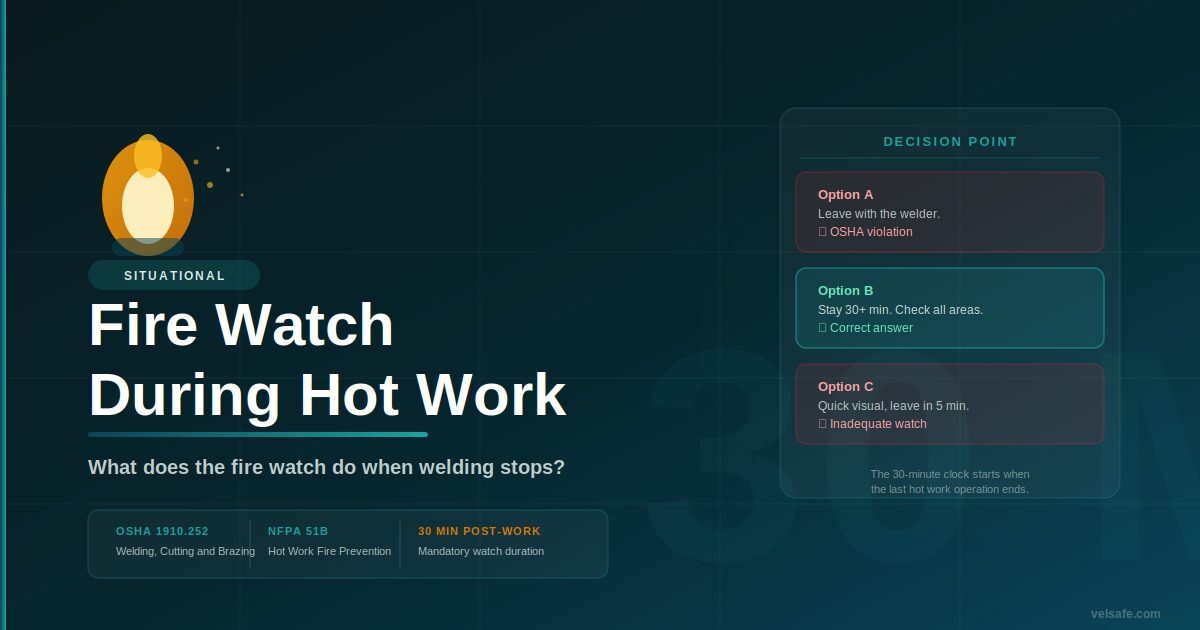
The welding is complete. The supervisor wants DeShawn on another task. Marcus is leaving. DeShawn has three options:
Option A: Leave with Marcus. The job is done, the area looks fine, and the supervisor needs him elsewhere.
Option B: Stay at the work area for at least 30 minutes after the welding stopped, monitor all exposed areas including the insulation under the blanket, and not leave until the post-work watch period is complete.
Option C: Do a quick visual of the area, confirm nothing is burning, and leave after five minutes.
What should DeShawn do?
Analysis: What the Fire Watch Must Do
OSHA 29 CFR 1910.252(a)(2)(iii)(A) states explicitly: a fire watch shall be maintained for at least a half hour after completion of welding or cutting operations to detect and extinguish possible smoldering fires.
The 30-minute post-work period is a minimum, not a guideline. NFPA 51B, which many authorities having jurisdiction adopt in addition to OSHA, sets the minimum at 60 minutes and permits the permit-authorizing individual to require extended monitoring of up to three hours for higher-risk conditions.
In this scenario, several factors would support extended monitoring beyond the 30-minute OSHA minimum: sparks were observed landing on incompletely covered fiberglass insulation, a flammable storage room is adjacent through a partition with an HVAC penetration, and the insulation under the blanket has not been visually confirmed clear since early in the job.
Why Options A and C are both wrong:
Option A abandons the fire watch entirely before the required period expires. If a smoldering fire ignites in the fiberglass insulation after DeShawn leaves, there is no one in the area to detect it until a smoke alarm activates, which may be several minutes after the fire has grown beyond extinguisher capacity.
Option C treats a quick visual check as equivalent to a maintained watch. Smoldering fires in fiberglass insulation, wall cavities, and behind equipment are not visible from a standing position. A fire watch means active, continuous monitoring of all exposed areas, including areas that are not directly visible without moving and checking, for the full required duration.
What DeShawn Must Do, Step by Step
What the Regulations Actually Require
When Fire Watch Is Triggered in the First Place
Under OSHA 1910.252, a fire watch is required when hot work is performed in locations where:
This scenario triggers fire watch on at least three counts: incompletely shielded combustible insulation within the area, an HVAC penetration through the adjacent partition to a paint storage room, and sparks observed on materials that could not be fully removed.
Learning Points
Most hot-work fires are discovered after the welder has left. Smoldering ignition in insulation, wall cavities, and behind equipment can take 20 to 40 minutes to produce visible flame. The post-work watch exists specifically for this window.
The most common real-world failure in fire watch programs is early termination because the work is done and the area “looks fine.” OSHA does not allow the watch to be terminated based on visual appearance before the minimum duration has elapsed.
The HVAC duct penetrating the wall to the paint storage room in this scenario is the most serious hazard, not the sparks on the floor. Sparks travel through ducts, crawl spaces, and wall cavities. Pre-job inspection must include the other side of any wall near the work area.