

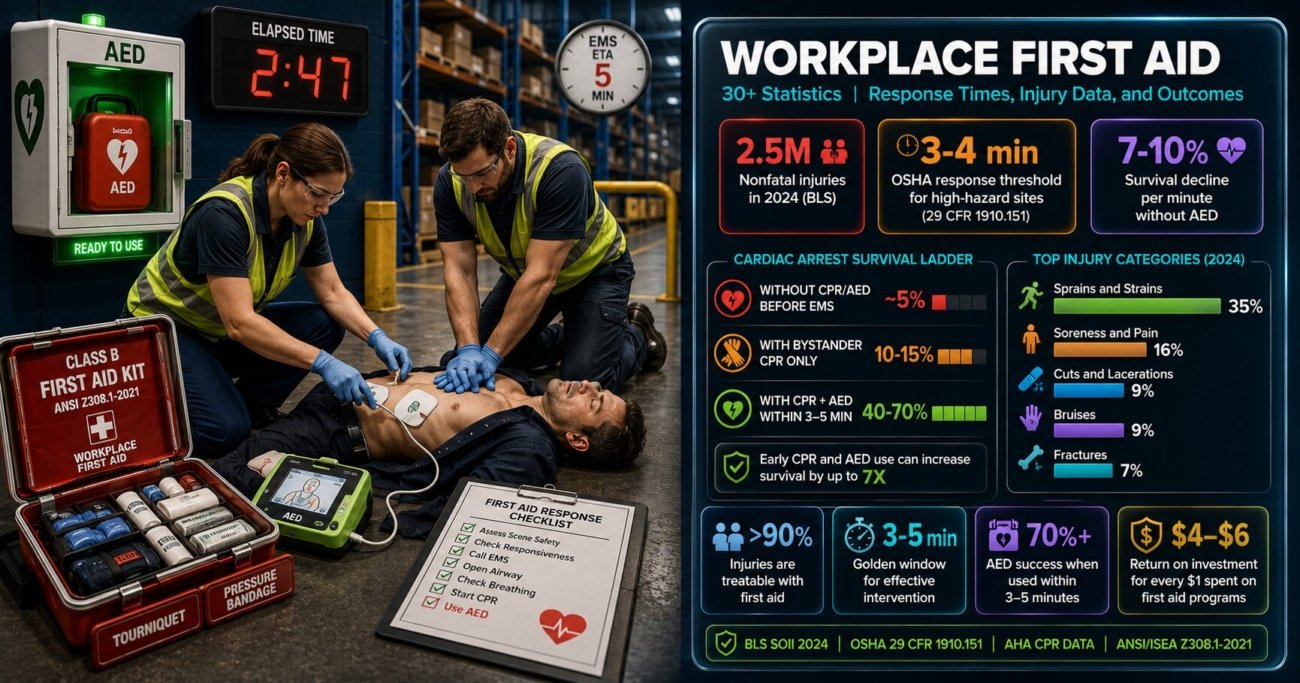
30+ Statistics on Response Times, Injury Data, and Outcomes
US employers reported 2.5 million nonfatal injury and illness cases in private industry in 2024, down 3.1% from 2023 but still representing an injury rate of 2.3 cases per 100 full-time equivalent workers. Behind each of those cases is a window of minutes during which the outcome is determined by whoever is closest – not whoever is most qualified.
That is what workplace first aid is about. OSHA’s regulatory framework under 29 CFR 1910.151 is built around one operational truth: for serious injuries involving cardiac arrest, stopped breathing, or uncontrolled bleeding, the difference between survival and permanent impairment is measured in minutes – not the time it takes an ambulance to arrive. EMS response times in most US metropolitan areas average 7-8 minutes. OSHA requires trained first aid response within 3-4 minutes at high-hazard worksites. That gap defines why workplace first aid programmes exist.
Below we have compiled 30+ statistics and data points on workplace first aid, covering injury incidence, OSHA requirements, cardiac arrest survival data, AED effectiveness, injury category breakdown, training standards, and the documented outcomes of workplace first aid programmes.
1. Workplace Injury and Illness Incidence: 2024 Data
- US private industry employers reported 2.5 million nonfatal workplace injury and illness cases in 2024, representing an injury and illness rate of 2.3 cases per 100 full-time equivalent workers – down 3.1% from 2023. (BLS SOII 2024)
- Fatal work injuries totalled 5,070 in 2024, down 4% from 5,283 in 2023, at a fatal injury rate of 3.3 per 100,000 full-time equivalent workers. Transportation incidents remained the leading cause of fatal occupational injuries, accounting for approximately 38% of all fatalities. (BLS CFOI 2024)
- The workplace injury rate has declined from approximately 8.4 recordable cases per 100 FTE workers in 1994 to 2.3 in 2024 – a 73% reduction over 30 years, reflecting the cumulative impact of OSHA standards including first aid and emergency response requirements. (BLS Historical SOII Data)
- Despite overall improvement, high-hazard industries maintain substantially higher rates. Agriculture, forestry, fishing and hunting recorded a fatal injury rate of 20.2 per 100,000 FTE workers in 2024 – more than 6 times the all-industry average. (BLS CFOI 2024)
- The most frequent nonfatal injury categories by nature are sprains, strains, and tears (approximately 35% of cases), followed by soreness and pain (16%), cuts and lacerations (9%), and bruises and contusions (9%). The leading event is overexertion and bodily reaction, accounting for approximately 30% of cases. (BLS SOII 2024)
2. OSHA First Aid Requirements: What the Law Specifies
- OSHA’s 29 CFR 1910.151 is deliberately performance-based rather than prescriptive. It does not specify how many first aid responders a workplace must have, what certifications they must hold, or what supplies must be stocked. It requires that adequate first aid be available within an adequate timeframe – leaving the employer to determine what that means for their specific hazards. (29 CFR 1910.151)
- OSHA’s 3-4 minute response threshold for high-hazard workplaces is derived from an OSHA Letter of Interpretation (Feb 14, 2007) addressing what constitutes near proximity in workplaces where suffocation, severe bleeding, or electrocution is possible. This interpretation has significant compliance implications for large facilities, multi-building campuses, and remote job sites. (OSHA LOI Feb 2007)
- For lower-hazard environments such as offices, OSHA has indicated that a response time of up to 15 minutes may be acceptable if a clinic or hospital can provide care within that timeframe. The 15-minute threshold applies only where serious emergencies are unlikely. (OSHA Interpretation)
- The ANSI/ISEA Z308.1-2021 standard for Minimum Requirements for Workplace First Aid Kits and Supplies provides the baseline supply content specification that OSHA compliance officers use when evaluating first aid supply adequacy. Kits are categorised by type (Class A for low-hazard environments, Class B for higher-hazard) with defined minimum contents for each. (ANSI/ISEA Z308.1-2021)
3. Cardiac Arrest: The Time-Critical Emergency That Defines First Aid Programmes
- Approximately 350,000 out-of-hospital cardiac arrests occur in the United States each year. Survival rates for workplace cardiac arrests specifically are influenced heavily by whether a first responder initiates CPR and deploys an AED before EMS arrives. (AHA; CDC)
- The average EMS response time in US metropolitan areas is 7-8 minutes from call to arrival. In rural areas, average response times exceed 14 minutes. At a survival decline rate of 7-10% per minute, a 7-minute EMS response time means the casualty has already lost 49-70% of their survival probability before the ambulance arrives. (NAEMSP; NHTSA EMS Data)
- OSHA specifically cites cardiac arrest as one of the emergencies that defines the 3-4 minute first aid response requirement for high-hazard workplaces. The alignment between this threshold and the cardiac arrest survival curve is not coincidental – OSHA’s threshold is calibrated to the window in which bystander action can change the outcome. (OSHA 1910.151; OSHA LOI 2007)
- AED accessibility is a critical determinant of workplace cardiac arrest outcomes. Studies show that AED use within the first 3-5 minutes of witnessed cardiac arrest produces survival rates of 40-70%, while AED use after 5 minutes produces dramatically lower survival rates. (AHA; OSHA AED Guidance)
- OSHA encourages AED programmes in the workplace through guidance and has noted that workplaces with AEDs and trained responders have documented survival outcomes that approach those of facilities with on-site medical staff. The cost of a workplace AED programme is typically less than $3,000 for equipment and initial training. (OSHA; AHA)
4. Injury Category Breakdown: What Workers Are Actually Getting Hurt By
- Sprains, strains, and tears account for approximately 35% of all nonfatal workplace injuries – making musculoskeletal injuries the largest single injury category. The leading first aid response for these injuries is RICE (Rest, Ice, Compression, Elevation), which requires trained responders and appropriate supplies at the worksite. (BLS SOII 2024)
- The leading event or exposure producing workplace injury is overexertion and bodily reaction, accounting for approximately 30% of nonfatal cases. This category includes lifting, pushing, pulling, and reaching – predominantly musculoskeletal in nature. (BLS SOII 2024)
- Falls, slips, and trips are the second most common event category and produce a higher proportion of serious injuries requiring first aid than overexertion events. Fall injuries include lacerations, fractures, and head trauma – all of which require trained first aid assessment and response. (BLS SOII 2024)
- Contact with objects and equipment – struck by, caught in, caught between – accounts for approximately 26% of fatal workplace injuries and a significant share of nonfatal serious injuries including crush injuries, amputations, and severe lacerations that require immediate first aid to control bleeding. (BLS CFOI 2024)
- Heat-related illness accounts for an estimated tens of thousands of nonfatal cases annually across agriculture, construction, and other outdoor industries. First aid for heat exhaustion – moving to shade, hydration, cooling – is time-critical and must be initiated before EMS arrival to prevent progression to heat stroke. (OSHA; NIOSH Heat Data)
5. First Aid Training Standards and Certification Data
- OSHA does not mandate a specific first aid training programme or certification. Employers in states with OSHA-approved State Plans may face more specific requirements – California’s Title 8 and Washington’s L&I rules specify training content more prescriptively than the federal standard. (29 CFR 1910.151; State Plan Variations)
- The American Heart Association updates its CPR guidelines every five years based on the International Liaison Committee on Resuscitation (ILCOR) evidence review. The 2020 guidelines (current as of 2024) confirm that for adult witnessed cardiac arrest, hands-only CPR by untrained bystanders is as effective as conventional CPR in the first few minutes. (AHA 2020 CPR Guidelines)
- Studies on CPR training retention show that knowledge and skill decay begins within weeks of initial training without reinforcement. Organisations that provide only initial CPR training without refreshers, skill practice, or manikin drills see measurable skill degradation within 6-12 months. (Resuscitation Journal; AHA)
- The ANSI/ISEA Z308.1-2021 standard updated first aid kit requirements significantly from prior editions, adding tourniquet and pressure bandage requirements for Class B kits and expanding the minimum contents for Class A kits. Workplaces still using kits stocked to pre-2021 standards may have supply gaps. (ANSI/ISEA Z308.1-2021)
- Tourniquet use for severe extremity bleeding has been validated by military combat data from Afghanistan and Iraq as the most effective intervention for uncontrolled extremity haemorrhage. Stop the Bleed, a DHS-funded public training programme, has trained over 2 million people in tourniquet and wound packing techniques as of 2024. (DHS Stop the Bleed; Journal of Trauma)
6. High-Hazard Industry First Aid Requirements
- Agriculture is the highest-fatality industry sector at 20.2 fatal injuries per 100,000 FTE workers – more than 6 times the all-industry average. Rural worksites with EMS response times exceeding 15 minutes make on-site first aid not just a regulatory requirement but an operational life-safety essential. (BLS CFOI 2024)
- Construction accounts for approximately 20% of all US workplace fatalities despite employing a smaller share of the workforce. The fatal four – falls, struck-by, caught-in/between, and electrocution – all produce injuries where immediate first aid can prevent death before EMS arrival. (OSHA; BLS CFOI 2024)
- Even in the lowest-hazard office environments, cardiac events remain a significant cause of on-site death. Age demographics in office workforces and the prevalence of cardiovascular disease in the working population make AED programmes relevant to every employer regardless of physical hazard level. (AHA; OSHA)
7. AED Programmes: Deployment Data and Effectiveness
- The number of AEDs deployed in US workplaces, public buildings, and community settings has grown significantly since the 1990s. Estimates suggest over 3 million AEDs are deployed in the United States as of the mid-2020s, though coverage remains uneven across geographic areas and industry sectors. (AHA; AED Industry Data)
- Public access defibrillation programmes in airports, casinos, and other high-traffic venues have documented survival rates of 40-74% for witnessed cardiac arrest when AED was applied within the first few minutes – among the highest reported survival rates for out-of-hospital cardiac arrest. (AHA; JACC)
- OSHA’s AED guidance encourages workplace AED programmes and notes that placing AEDs within a 3-5 minute round trip of all work areas satisfies the response time requirement for high-hazard sites where cardiac events are possible. This translates to one AED per floor in multi-story buildings and multiple AEDs in large single-floor facilities. (OSHA AED Guidance)
- AED programmes require trained users and regular maintenance. Monthly visual inspection and annual clinical review of electrode pads and battery status are minimum maintenance requirements. An AED that fails to activate when needed provides false assurance. (AHA AED Maintenance Guidelines)
- Some US states have enacted laws requiring AEDs in workplaces above certain sizes or in specific industry sectors. 24 states and DC have enacted AED laws that apply to workplaces, health clubs, schools, or public buildings. Requirements vary significantly by state. (AHA Legislative Data)
8. What Effective Workplace First Aid Programmes Have in Common
- Effective first aid programmes designate named, trained responders by shift and location – not a pool of generally trained employees. Named accountability means someone specific is responsible for responding within the 3-4 minute window. Diffuse responsibility produces slower responses than named accountability. (OSHA EAP Guidance; NFPA 1)
- First aid training that includes scenario-based practice on manikins and simulated equipment produces better skill retention than lecture-only training. The AHA hands-on skills component of CPR certification is specifically designed to build muscle memory that degrades more slowly than knowledge-based recall. (AHA; Resuscitation Journal)
- First aid kits that are regularly inspected and restocked after use are operationally different from kits that are stocked once and forgotten. Monthly visual inspection and immediate restocking after any use are the two practices most strongly associated with kit adequacy when it matters. (ANSI/ISEA Z308.1-2021; OSHA)
- Post-incident review following any first aid activation – including minor cases – provides the best available data on response time, responder availability, and supply adequacy. Organisations that systematically review first aid activations identify gaps before they affect serious outcomes. (OSHA; Safety Management Best Practices)
- Visitor and contractor awareness is a documented gap in first aid programmes. Visitors and contractors who do not know where the AED is, where the first aid kit is located, or who the designated first responder is cannot contribute to a first aid response – they can only wait. Site induction should include first aid orientation for anyone who spends significant time on site. (ASIS International; OSHA)
Key Takeaways for Safety Managers and Employers
Sources
Government and Regulatory
- OSHA 29 CFR 1910.151: Medical Services and First Aid
- BLS: Survey of Occupational Injuries and Illnesses 2024 (2.5M cases; 2.3 per 100 FTE)
- BLS: Census of Fatal Occupational Injuries 2024 (5,070 fatalities; industry fatal rates)
- OSHA: First Aid eTool (3-4 minute response threshold; AED guidance)
Clinical and Industry Sources
- American Heart Association: CPR Facts and Statistics (7-10% survival decline per minute; 2-3x bystander improvement)
- ANSI/ISEA Z308.1-2021: Minimum Requirements for Workplace First Aid Kits and Supplies
- DHS: Stop the Bleed Programme (2M+ trained; tourniquet and wound packing data)
- Liberty Mutual: Workplace Safety Index 2023