

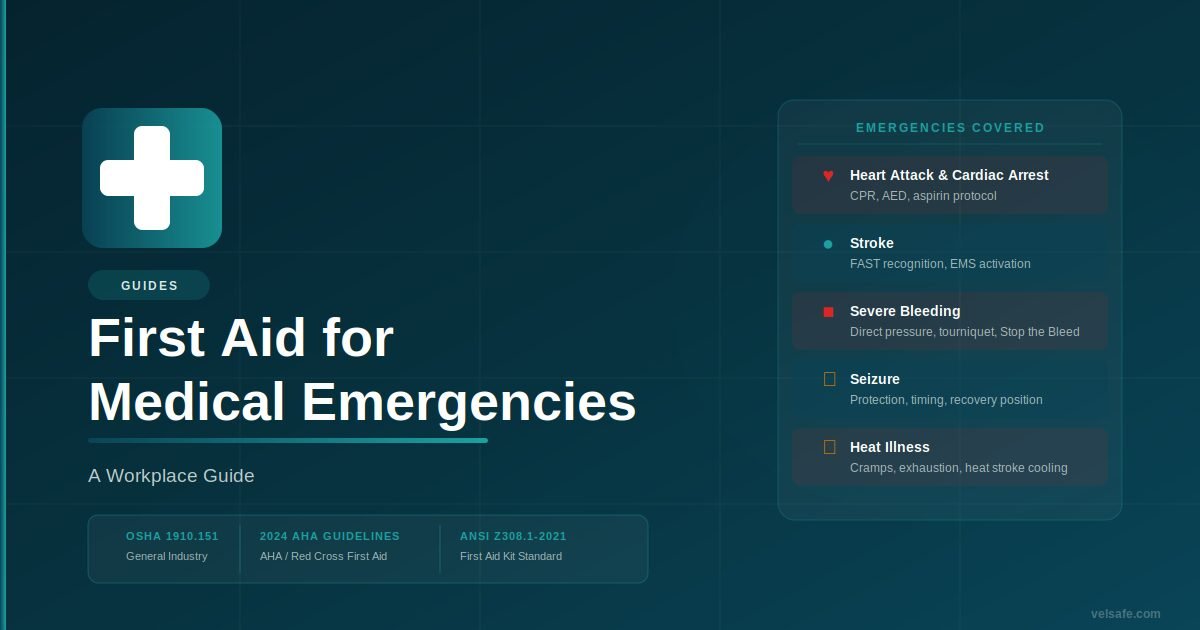
Medical emergencies do not announce themselves. A worker in a warehouse has chest pain. A colleague on a construction site becomes unresponsive. Someone in an office collapses during a meeting. In each case, the first few minutes of response by whoever is nearby determines the trajectory of what follows, not the paramedics who arrive several minutes later.
This guide covers recognition and first aid response for the medical emergencies most likely to occur in US workplaces, based on the 2024 American Heart Association and American Red Cross First Aid Guidelines and OSHA’s regulatory framework under 29 CFR 1910.151 and 1926.50.
Who This Guide Is For
This guide is written for any worker who may be the first person present when a medical emergency occurs, including designated first aid responders, supervisors, safety officers, remote workers, and construction site personnel. Formal first aid certification requires hands-on training with a qualified provider. This guide is a reference for recognition, initial response decisions, and what to do while waiting for EMS.
Fundamental Concepts
Scene Safety and Initial Assessment
Before approaching any person who appears to be injured or unwell, a first aid provider must assess scene safety. An unconscious worker in a trench, near live electrical equipment, or in a space with a suspected atmospheric hazard requires hazard control or rescue-trained personnel before entry.
Once the scene is safe, the first assessment covers three points:
When to Call 911
Call 911 immediately, or direct a specific person nearby to call, for any of the following: unresponsive person, chest pain or pressure, difficulty breathing, suspected stroke symptoms, severe bleeding, seizure in a person with no history of seizures, serious injury from fall or impact, suspected spinal injury, severe allergic reaction, and suspected heat stroke.
Do not delay calling 911 to gather more information or to try to manage the situation first. Call first, then act.
Heart Attack
Recognition
A heart attack occurs when blood flow to part of the heart muscle is blocked. Common signs include:
Chest pain, pressure, squeezing, or heaviness. Pain radiating to the jaw, left arm, or back. Shortness of breath. Sweating, nausea, or light-headedness.
Unusual fatigue, upper abdominal discomfort, pain or pressure in the upper back, or simply a sense that something is wrong with no obvious chest pain.
First Aid Response
Cardiac Arrest
Cardiac arrest is not a heart attack, although a heart attack can cause it. In cardiac arrest, the heart stops pumping effectively and the person is unresponsive and not breathing normally. Without CPR and defibrillation, brain damage begins within 4 to 6 minutes.
Stroke
Recognition: FAST
A stroke occurs when blood supply to part of the brain is interrupted. The 2024 AHA/Red Cross guidelines recommend using the following signs to recognize a possible stroke and activate EMS immediately when any are present:
Does the face droop on one side when the person tries to smile?
Is one arm lower or weaker when the person raises both arms?
Is speech slurred or difficult to understand? Can they repeat a simple sentence?
Call 911 immediately. Note the time symptoms started and report it to EMS.
First Aid Response for Stroke
Call 911 immediately when any FAST sign is present. Note the exact time symptoms started, because this determines which hospital treatments are available. Clot-dissolving medications can be given within 4.5 hours of symptom onset; the timing window makes EMS notification at the first sign of symptoms essential.
While waiting for EMS: keep the person still and in a position of comfort if they are conscious. If unconscious and breathing, place them in the recovery position (on their side) to protect the airway. If not breathing, begin CPR.
Severe Bleeding
Severe bleeding from a wound can become fatal within minutes. The 2024 AHA/Red Cross guidelines updated guidance on bleeding control, reflecting the increased adoption of tourniquet use and wound packing outside of clinical settings.
Seizure
Recognition
A seizure involves sudden, uncontrolled electrical activity in the brain. In a workplace, it may appear as sudden collapse, muscle stiffening followed by rhythmic jerking, staring, confusion, or brief unresponsiveness.
First Aid Response
Call 911 if: the seizure lasts longer than 5 minutes, the person does not regain consciousness after the seizure ends, a second seizure occurs, this is the person’s first known seizure, the person is pregnant, there is an injury, or the seizure occurred in water.
After the seizure ends, place the person on their side in the recovery position to protect the airway if they are unconscious or confused, and stay with them until they are fully alert.
Heat Illness
Heat emergencies range from heat cramps and heat exhaustion to heat stroke, which is a life-threatening emergency. On construction sites, in manufacturing facilities without climate control, and in any outdoor work environment during summer months, the progression from heat exhaustion to heat stroke can occur rapidly.
Common Mistakes to Avoid
For heart attack, stroke, cardiac arrest, and heat stroke, delay costs outcomes that cannot be recovered. Call first, then act.
Aspirin worsens hemorrhagic stroke. It is appropriate only for suspected heart attack and only when the person is alert and not allergic.
Every minute without CPR reduces survival probability. Start compressions immediately; the AED can be retrieved and used without stopping CPR for more than 10 seconds.
Restraint increases injury risk and does not stop the seizure. Clear the area, protect the head, and time it.
Removing a tourniquet can cause sudden blood loss and shock. Leave it in place; note the time it was applied, and let EMS make the removal decision.
Cooling and calling 911 should happen simultaneously. If you must choose an order, begin cooling first. Heat stroke is fatal if not treated immediately.
First Aid Kit Requirements
OSHA 1910.151 requires “adequate first aid supplies readily available” but does not specify kit contents. The reference standard is ANSI/ISEA Z308.1-2021:
FAQs
Does every employee need first aid training? No. OSHA requires that a person or persons be trained to render first aid when the workplace is not in near proximity to a medical facility. The number of trained responders must be sufficient to provide coverage on every shift and at every location where serious injuries are possible.
How often should first aid training be renewed? The American Red Cross recommends CPR renewal annually and first aid renewal every two years. There is no OSHA-mandated renewal interval, but certification that has lapsed significantly will be examined during an OSHA inspection following an incident.
Are AEDs required? OSHA 1910.151 does not explicitly require AEDs. However, OSHA has stated they are a recommended best practice, and some state OSHA plans and local codes do require them in specific occupancies. Given the 7 to 10% per minute decline in survival from cardiac arrest without defibrillation, AEDs are a practical necessity in any workplace where EMS response exceeds 3 to 4 minutes.
What about bloodborne pathogen protection during first aid? OSHA 1910.1030 requires employers to implement bloodborne pathogen protections for employees who have occupational exposure to blood. Employees designated as first aid responders are covered by this standard. First aid kits must include appropriate gloves, and first aid training must include the use of barrier devices.
Related Resources
- OSHA, “Medical Services and First Aid: 29 CFR 1910.151”
- OSHA, “First Aid Standards: 29 CFR 1926.50 (Construction)”
- AHA/Red Cross, “2024 First Aid Guidelines” (Circulation, 2024)
- OSHA, “Best Practices Guide: Fundamentals of a Workplace First-Aid Program” (Publication 3317)
- ANSI/ISEA Z308.1-2021, Minimum Requirements for Workplace First Aid Kits
- Stop the Bleed Campaign
- Mayo Clinic, “Stroke: First Aid”