

Mental wellness in the workplace is increasingly recognized as a safety issue, not only a benefit program concern. According to the 2024 NAMI Workplace Mental Health Poll, 33% of employees noticed their productivity suffer because of their mental health, and 62% of those who felt uncomfortable discussing mental health at work also reported burnout. Depression and anxiety cost the global economy an estimated 12 billion workdays per year in lost productivity (WHO, 2024).
This practice test covers recognition of mental health challenges in the workplace, the Mental Health First Aid (MHFA) ALGEE action plan, appropriate responses to colleagues in distress, and employer obligations. Questions range from beginner to advanced and include scenario-based learning exercises.
Introduction: Mental Health First Aid at Work
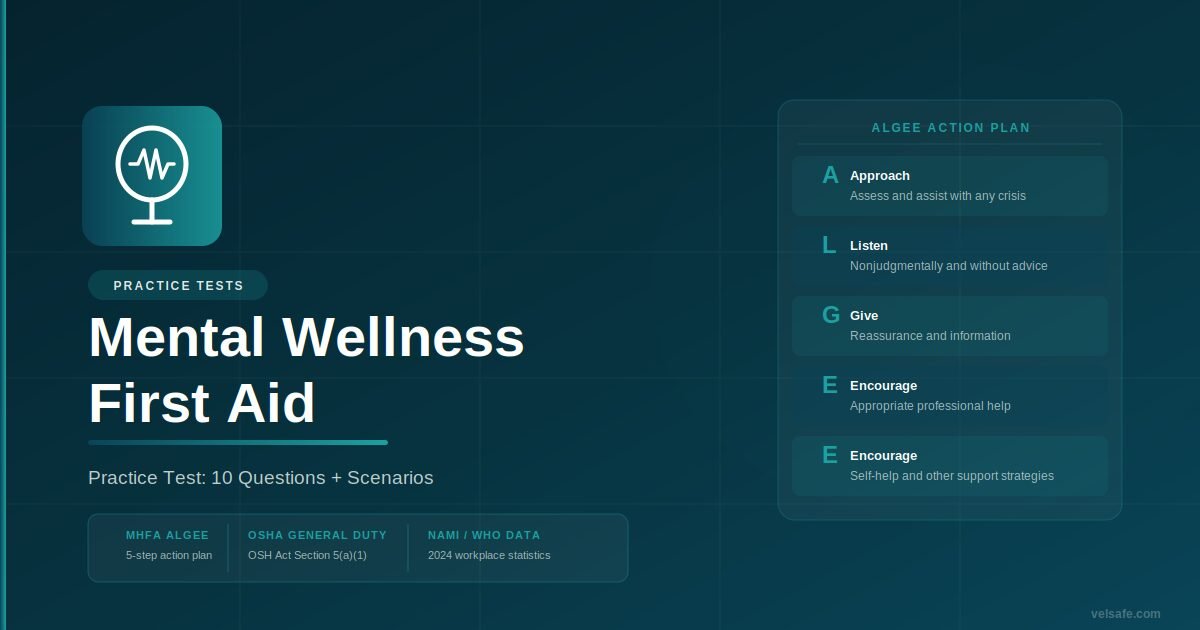
Mental Health First Aid (MHFA) is an evidence-based training program developed in Australia in 2001 and introduced in the United States in 2008. It is administered by the National Council for Mental Wellbeing and has trained more than 4.5 million people in the US. The program teaches a five-step action plan called ALGEE that guides a first aider through supporting a colleague who may be experiencing a mental health challenge or crisis.
MHFA does not train people to act as therapists. It trains them to recognize warning signs, offer initial support, and connect the person to appropriate professional help. In this way it parallels physical first aid: just as CPR does not replace emergency medicine, mental wellness first aid does not replace clinical treatment. It bridges the gap between the moment of distress and the moment of professional care.
Fundamentals
Question 1 | Beginner
A colleague mentions they have been feeling overwhelmed and anxious at work for several weeks. As a mental wellness first aider, what is the most appropriate first step?
- A) Refer them immediately to HR and let HR handle it
- B) Tell them everyone feels that way sometimes and they should try to push through
- C) Approach them privately, listen nonjudgmentally, and ask how they are doing
- D) Suggest they take a few days off and come back when they feel better
Why C is correct: The first step in ALGEE is to Approach, assess, and assist. A private, nonjudgmental approach opens the conversation and allows the person to feel safe discussing what they are experiencing. Asking “how are you doing” in a genuine, unhurried way is the appropriate entry point before any other action.
Why A is incorrect: Bypassing the person entirely and going straight to HR can feel like a breach of trust and may discourage the colleague from seeking help in the future. HR involvement may be appropriate later, but it is not the first step.
Why B is incorrect: Minimizing the person’s experience (“everyone feels that way”) is a direct counter to nonjudgmental listening and can make the person feel dismissed, misunderstood, or ashamed.
Why D is incorrect: Suggesting they “push through” or implying they should resolve the issue on their own before returning to work does not provide first aid support and may worsen isolation.
Question 2 | Beginner
What does the acronym ALGEE stand for in the Mental Health First Aid framework?
- A) Assess, Listen, Guide, Evaluate, Exit
- B) Approach, Listen, Give, Encourage, Encourage
- C) Alert, Link, Guide, Engage, Evaluate
- D) Approach, Analyze, Give, Escalate, Establish
Why B is correct: ALGEE stands for: Approach (assess, and assist with any crisis), Listen nonjudgmentally, Give reassurance and information, Encourage appropriate professional help, and Encourage self-help and other support strategies. The second E is intentionally repeated because both forms of encouragement are distinct action steps.
Why A is incorrect: “Evaluate” and “Exit” do not appear in the MHFA framework. The action plan does not conclude with exiting the situation; the first aider stays engaged until the person is connected with support.
Why C and D are incorrect: Neither “Alert,” “Analyze,” “Escalate,” nor “Establish” are components of the ALGEE framework. These options include plausible-sounding alternatives designed to test recall of the actual steps.
Warning Signs and Recognition
Question 3 | Beginner
Which of the following is NOT typically a warning sign that a colleague may be experiencing a mental health challenge?
- A) Withdrawal from social interactions and team activities
- B) Missing deadlines consistently after a history of reliable performance
- C) Taking a scheduled vacation after a completed project
- D) Increased irritability and difficulty concentrating
Why C is correct: Taking planned time off after completing a project is a normal, healthy behavior. It reflects good boundaries and rest, not distress. Recognizing the difference between expected workplace behaviors and meaningful deviations from a person’s baseline is a core skill in mental wellness first aid.
Why A, B, and D are incorrect (all are warning signs): Withdrawal from social interactions, a notable change in work performance compared to a person’s usual standard, and increased irritability or concentration difficulties are all established warning signs of potential mental health challenges including burnout, anxiety, or depression. The key diagnostic signal is change from baseline, not any single behavior in isolation.
Question 4 | Intermediate
A coworker on your remote team has stopped participating in team meetings, has not responded to messages for two days, and sent a message saying “I don’t think anyone would notice if I wasn’t here anymore.” What is the most appropriate immediate response?
- A) Forward the message to your manager and let them handle it
- B) Reply with a positive message reminding them of their contributions to the team
- C) Treat it as a potential crisis signal and contact the person directly to check on their safety
- D) Give them space and check in after a few days when they may feel better
Why C is correct: The statement “I don’t think anyone would notice if I wasn’t here anymore” is an indirect expression that may indicate thoughts of suicide or severe hopelessness. Combined with withdrawal and communication silence, this pattern warrants immediate, direct contact. The first step in ALGEE is to approach and assess for crisis. Asking directly “Are you okay? I’m worried about you, are you having thoughts of hurting yourself?” does not plant the idea of suicide; research consistently shows that asking the question directly is safe and allows the person to respond honestly.
Why A is incorrect: Escalating to management without making direct contact first can delay a response. The person may not speak to a manager if they do not trust the relationship. First contact should come from the person who noticed the signal.
Why B is incorrect: Sending a positive message without acknowledging the concerning statement bypasses the most important signal. Positive reinforcement does not substitute for a direct welfare check.
Why D is incorrect: Giving space is appropriate for mild burnout or temporary overwhelm. It is not appropriate when indirect expressions of hopelessness have been made alongside behavioral withdrawal. Acting quickly is essential.
Question 5 | Intermediate
According to the 2024 NAMI Workplace Mental Health Poll, which of the following best describes the relationship between mental health stigma and burnout?
- A) Employees who feel comfortable discussing mental health at work report higher burnout rates
- B) 62% of employees who felt uncomfortable discussing mental health at work also reported burnout
- C) Stigma has no measurable impact on burnout; burnout is driven primarily by workload
- D) Burnout affects only employees in frontline or physically demanding roles
Why B is correct: The 2024 NAMI Workplace Mental Health Poll found that 62% of employees who reported feeling uncomfortable sharing about their mental health at work also reported burnout from their job. This demonstrates a significant correlation between stigma, silence, and burnout outcomes. When employees cannot discuss mental health concerns without fear of judgment or career consequences, the challenges remain unaddressed and compound over time.
Why A is incorrect: Research consistently shows the opposite: employees who feel supported in discussing mental health report lower burnout, not higher. A supportive culture is a protective factor, not a risk factor.
Why C is incorrect: Multiple studies have demonstrated that stigma has measurable impact on help-seeking behavior, which in turn affects burnout outcomes. Attributing burnout entirely to workload ignores the documented role of workplace culture in mental health outcomes.
Why D is incorrect: Burnout affects workers across all sectors. The 2025 Mind Share Partners survey found that more than three-quarters of all US workers reported some level of burnout, spanning office, remote, and frontline roles.
Compliance Requirements
Question 6 | Intermediate
Under which OSHA provision can an employer be held responsible for failing to address a known mental health hazard in the workplace?
- A) 29 CFR 1910.151 (Medical Services and First Aid)
- B) 29 CFR 1910.132 (Personal Protective Equipment)
- C) Section 5(a)(1) of the OSH Act of 1970 (General Duty Clause)
- D) 29 CFR 1926.503 (Fall Protection Training)
Why C is correct: Section 5(a)(1) of the OSH Act, commonly known as the General Duty Clause, requires employers to provide a workplace free from recognized hazards that are causing or likely to cause death or serious physical harm. OSHA has increasingly applied this provision to workplace psychological hazards, including workplace violence, harassment, and conditions that cause significant mental harm. While OSHA does not have a specific standard for workplace mental health, the General Duty Clause creates an obligation to address recognized mental health hazards.
Why A is incorrect: 29 CFR 1910.151 governs physical first aid and medical services. It does not address psychological health directly, though it is relevant to the broader first aid framework.
Why B is incorrect: 1910.132 covers physical personal protective equipment, not mental health protections.
Why D is incorrect: 1926.503 is specific to fall protection training requirements in construction and has no application to mental health obligations.
Question 7 | Intermediate
An Employee Assistance Program (EAP) is best described as:
- A) A government-mandated benefit that all employers with 50 or more employees must provide
- B) A voluntary, confidential program that provides employees access to short-term counseling and referrals
- C) A formal disciplinary process for employees whose mental health affects their performance
- D) A replacement for health insurance that covers all mental health treatment costs
Why B is correct: An EAP is a voluntary, employer-sponsored benefit that provides employees confidential access to short-term assessment, counseling, and referral services for mental health, substance use, financial stress, and other personal concerns. EAPs are typically provided at no cost to the employee for a limited number of sessions and are designed to connect employees with support before issues escalate.
Why A is incorrect: EAPs are not government-mandated. They are offered voluntarily by employers and are particularly common in medium to large organizations, but there is no federal requirement to provide one.
Why C is incorrect: An EAP is a support resource, not a disciplinary mechanism. Using an EAP is voluntary and cannot be required by an employer as part of a performance management process without creating legal risk.
Why D is incorrect: EAPs provide short-term counseling (typically 3 to 8 sessions) and referrals. They supplement, but do not replace, health insurance coverage for ongoing mental health treatment.
Advanced Scenarios
Question 8 | Advanced
A supervisor notices that one of their remote team members, who has been high-performing for three years, has missed three consecutive check-in meetings, submitted incomplete work, and sent an email saying they “can’t keep doing this.” The supervisor’s initial instinct is to address the performance issue formally. What should the supervisor do first?
- A) Document the missed meetings and incomplete work in preparation for a performance improvement plan
- B) Contact the person with genuine concern for their wellbeing before initiating any performance conversation
- C) Notify HR immediately that the employee may need to be let go due to declining performance
- D) Send the team member MHFA resources and let them decide whether to use them
Why B is correct: A sudden, significant change in performance from a historically reliable employee is a warning sign that something is wrong beyond a skills or motivation issue. The email “I can’t keep doing this” is potentially an expression of crisis or severe distress. The ALGEE framework begins with Approach and Listen. Before any performance process, the supervisor should contact the team member as a human being to ask how they are doing. This approach is also better practice: addressing the underlying cause (a mental health challenge) produces better outcomes than addressing the symptom (missed meetings) through formal process.
Why A is incorrect: Jumping to documentation and performance management without first checking on the person treats the symptom rather than the cause, and may significantly worsen the person’s distress if they are already in crisis.
Why C is incorrect: Initiating separation proceedings based on a pattern that may reflect a health crisis exposes the employer to risk under the ADA and similar statutes, and is a premature response to what may be a temporary and addressable situation.
Why D is incorrect: Sending resources passively without making direct contact fails the Approach step. A person in distress is unlikely to self-initiate help from a document or link sent in an email, especially if they are already disengaged.
Question 9 | Advanced
Which of the following statements about asking someone directly if they are thinking about suicide is accurate, according to current mental health first aid guidance?
- A) Asking directly about suicide plants the idea and significantly increases risk
- B) Only licensed professionals should ask about suicide; a first aider should not raise the topic
- C) Asking directly is safe and allows the person to respond honestly about their level of distress
- D) You should only ask about suicide if the person has already mentioned it explicitly
Why C is correct: Current evidence, including research reviewed by MHFA’s program developers, consistently shows that asking a person directly about suicidal thoughts does not increase the risk of suicide and does not plant the idea. In fact, a direct question (“Are you having thoughts of hurting yourself?”) signals that the person’s wellbeing matters, opens the door to an honest answer, and allows the first aider to assess the level of crisis appropriately. Indirect expressions of hopelessness, such as “I don’t see the point anymore” or “everyone would be better off without me,” are recognized warning signs that warrant a direct question.
Why A is incorrect: The “suicide contagion” concern is specifically about media portrayals and detailed descriptions of methods, not about a private, direct welfare question from a concerned colleague. Research does not support the idea that a first aider’s direct question increases risk.
Why B is incorrect: MHFA explicitly trains non-clinical people to assess for crisis including suicide risk as the first step of ALGEE. Waiting for a licensed professional before raising the topic delays an assessment that may be urgent.
Why D is incorrect: Many people in crisis express distress indirectly. Waiting for an explicit statement means missing many of the most important opportunities to intervene.
Question 10 | Advanced
The WHO estimates that depression and anxiety cost the global economy approximately how many working days per year?
- A) 1.2 million
- B) 340 million
- C) 12 billion
- D) 1 trillion
Why C is correct: The World Health Organization (WHO) estimates that depression and anxiety disorders cost the global economy approximately 12 billion working days each year (WHO, 2024). The associated productivity loss is approximately $1 trillion USD annually. Option D ($1 trillion) refers to the dollar cost, not the number of days, making C the correct response to the specific question asked.
Why A and B are incorrect: These are significantly too low to reflect the WHO’s global estimate. 340 million refers to the approximate number of people globally who live with depression, not the working days lost.
Why D is incorrect: $1 trillion is the estimated productivity cost in US dollars, not the number of working days. Understanding the distinction matters in a professional context: citing “12 billion lost workdays” and “$1 trillion in productivity losses” are both accurate but refer to different metrics from the same WHO data source.
Scenario-Based Learning
Scenario 1
Raj works in a manufacturing facility. His supervisor has noticed that over the past six weeks, Raj has become increasingly short-tempered with colleagues, has made uncharacteristic errors on routine tasks, and has looked visibly exhausted every morning. When asked how he is doing in a group setting, Raj says “fine” and changes the subject.
Q1: What is the most likely explanation for these changes?
The pattern of behavioral changes, including irritability, cognitive errors, and visible exhaustion, combined with deflection in a group setting, is consistent with burnout or a mental health challenge such as anxiety or depression affecting work performance. These changes are significant because they represent a departure from Raj’s established baseline, not a temporary bad day.
Q2: How should the supervisor approach this situation?
The supervisor should find a private moment to speak with Raj one-on-one, away from the work floor and outside of any formal review context. The approach should open with genuine personal concern (“I’ve noticed you seem under a lot of pressure lately, and I wanted to check in. How are you really doing?”) rather than a performance-framed observation (“Your error rate has gone up and I need to address it”). The goal of the first conversation is to open the door, not to provide solutions or diagnose the problem.
Q3: What are appropriate next steps after the initial conversation?
If Raj discloses that he is struggling, the supervisor’s role is to Listen nonjudgmentally (L), Give reassurance that support is available (G), and Encourage use of the EAP or other professional resources (E). The supervisor does not need to know the specific nature of Raj’s challenges to be helpful. If Raj expresses anything that suggests risk of self-harm, the supervisor should directly ask about safety and, if risk is present, contact emergency services.
Scenario 2
Maria works remotely and manages a small team. During a one-on-one video call, a team member named Jordan mentions they have not slept properly in weeks, have stopped exercising, and feel like “nothing is working out.” Jordan then quickly laughs it off and says “anyway, let’s talk about the project.”
What should Maria do?
Maria should not let the comment pass unchallenged. The deflection (“anyway, let’s talk about the project”) is a common behavior when someone has shared more than they intended. An appropriate response acknowledges what was said before moving on: “Before we go to the project, I want to come back to what you said. Sleep problems for weeks and feeling like nothing is working out sounds really difficult. I have time for that conversation if you want it.”
This approach uses the ALGEE framework by Approaching (acknowledging the signal), inviting the person to Listen (being present), and keeping the door open for the rest of the conversation. If Jordan declines, Maria should note the pattern and check in again within a few days. If Jordan wants to talk, Maria should stay present, listen without problem-solving, and at the appropriate moment mention the EAP or other support resources available.
Knowledge Expansion
Mental Health and Remote Work
The expansion of remote and hybrid work has changed the landscape of mental wellness first aid in important ways. According to survey data, 75% of US workers reported experiencing mental health challenges including anxiety, depression, or grief at least sometimes during the year (Yomly, 2025). For remote workers, early warning signs that would be visible in a shared physical workspace, such as disheveled appearance, visible fatigue, or social withdrawal in common areas, are not directly observable.
Remote first aiders and managers need to pay attention to the signals that are visible digitally: participation patterns in meetings, response time to messages, quality and tone of written communication, and explicit or indirect disclosures during calls. The ALGEE framework applies identically in remote contexts; the delivery mechanism changes, not the steps.
The Difference Between Burnout and a Clinical Condition
Burnout is recognized by the World Health Organization as an occupational phenomenon characterized by exhaustion, increased mental distance from work, and reduced professional effectiveness. It is not classified as a medical condition in the ICD-11. Depression and anxiety disorder are clinical conditions that require professional diagnosis and treatment.
A mental wellness first aider is not qualified to distinguish between burnout and clinical depression. The appropriate response to either is the same: provide non-judgmental support, encourage professional help, and avoid minimizing or diagnosing. The distinction matters for treatment; it does not change the first aider’s role.
Supporting Resources
- Mental Health First Aid USA (MHFA.org)
- National Alliance on Mental Illness, “2024 NAMI Workplace Mental Health Poll”
- World Health Organization, “Mental Health at Work” (2024)
- OSHA, “Workplace Stress” (General Duty Clause context)
- National Council for Mental Wellbeing, MHFA Program Overview
- SAMHSA National Helpline: 1-800-662-4357 (free, confidential, 24/7)