

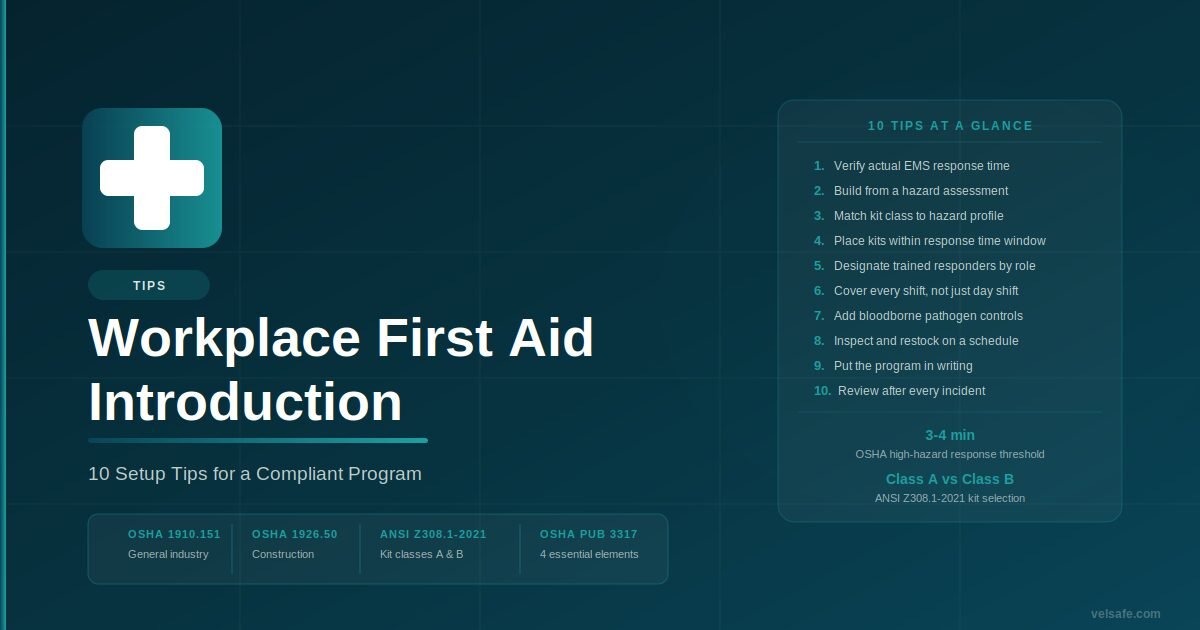
Most workplaces have a first aid kit somewhere. Fewer have a first aid program that would hold up to an OSHA inspection or, more importantly, to an actual emergency. OSHA’s framework under 29 CFR 1910.151 (general industry) and 1926.50 (construction) is a performance standard, meaning there is no single checklist that satisfies it. What satisfies it is a program designed around the actual hazards, locations, and response time constraints of the specific workplace.
These 10 tips cover the practical decisions that determine whether a first aid program actually works, based on OSHA Publication 3317’s four essential program elements and the most common gaps found during compliance assessments.
1. Start with the Actual EMS Response Time, Not Assumptions
The entire structure of OSHA’s first aid requirements hinges on one question: how long does it take EMS to reach your specific address? OSHA’s “near proximity” standard is interpreted as a 3 to 4 minute response time for high-hazard workplaces and up to 15 minutes for lower-hazard environments like offices. Metropolitan EMS services use an 8-minute standard, which means most workplaces in high-hazard industries do not meet the threshold by relying on 911 alone.
2. Build the Program from a Hazard Assessment, Not a Generic Template
OSHA Publication 3317 identifies worksite analysis as one of the four essential elements of a workplace first aid program. The hazard assessment determines what injuries are foreseeable, which drives every other decision: which kit class is appropriate, what training content is needed, and where supplies need to be placed.
Walk the facility and identify injury types that could realistically occur: lacerations from machinery, falls from elevation, chemical splash, crush injuries, electrical contact, heat exposure. Review the OSHA 300 log for the past three years to see what has actually happened.
Using a standard first aid kit and standard first aid training purchased from a vendor without reference to the specific hazards present. A construction site and an office need different programs; using the same one for both leaves real gaps in the construction environment.
In first aid program audits we conduct before OSHA inspections, the most common deficiency is not missing equipment. It is a mismatch between the supplies on hand and the injuries that have actually occurred at that site. The 300 log shows lacerations from a metal shear every quarter; the kit has no tourniquet and the trained responder has not covered wound packing. The log is the most accurate predictor of what the kit and training need to address.
3. Match the Kit Class to the Hazard Profile
ANSI/ISEA Z308.1-2021 defines two kit classes. Class A covers common, lower-risk environments; Class B covers higher-risk environments where more serious injuries are foreseeable. The class determines both the types of supplies and the quantities. Stocking a Class A kit in a manufacturing facility or on a construction site is an under-preparation that is visible to an OSHA inspector.
4. Place Kits Where They Will Be Reached Within the Response Time Window
A kit in a locked supply room or at the far end of a large facility does not satisfy the “readily available” requirement in practice. The test is whether a trained responder can retrieve supplies and reach the injured worker within the response time that applies to your workplace.
5. Designate Trained Responders, Not Just Whoever Volunteers
A common approach is to ask who is interested in first aid training and train whoever raises their hand. This produces responders on some shifts and gaps on others, and it means the training may not reflect the hazards at the actual work location.
6. Cover Every Shift, Not Just Day Shift
The most common first aid coverage gap found during OSHA inspections and incident investigations is the night shift. Day shift typically has trained responders present because training is usually scheduled during business hours. Night and weekend shifts often have no one current on first aid certification.
In program audits at facilities running two or three shifts, we rarely find night shift coverage in the written program. When we ask who is the designated first aid responder on the midnight shift, the answer is usually either the shift supervisor (who may or may not be currently certified) or “we call 911.” In manufacturing environments where amputation and severe lacerations are foreseeable, 911 alone does not satisfy the 3 to 4 minute threshold.
7. Add Bloodborne Pathogen Controls Alongside First Aid Equipment
OSHA’s bloodborne pathogen standard (29 CFR 1910.1030) applies to any employee who has occupational exposure to blood or other potentially infectious materials. Employees designated as first aid responders are covered. The standard requires an exposure control plan, appropriate PPE (gloves, face shield, CPR mask), hepatitis B vaccination offer, and post-exposure follow-up procedures.
8. Inspect and Restock Kits on a Written Schedule
Kits deplete over time from routine use. Supplies expire. Bandages get used for minor cuts and are not replaced. An inspection during an OSHA visit that reveals an empty or expired kit is a direct 1910.151 citation.
9. Put the Program in Writing and Make It Accessible
OSHA 1910.151 does not explicitly require a written first aid program. But an OSHA inspector following up on an incident will ask for documentation, and “we have first aid training and a kit” is not an answer that demonstrates an adequate program. Written documentation also makes the program consistent across supervisors, shifts, and locations.
10. Review the Program After Every Incident
A first aid incident, whether it results in a recordable injury or not, is information about where the program worked and where it did not. OSHA Publication 3317 identifies periodic evaluation and updating as a core element of an effective program. The OSHA 300 and 301 logs are the primary data source for identifying patterns.
Was a trained responder available within the response time window? Was the appropriate supply in the kit? Did the responder know what to do? Did the procedure for summoning help work as intended?
Update the written program to address gaps. Add supplies that were missing. Adjust responder designations if coverage was absent. Retrain if the responder was uncertain. Document the review and the changes made.
OSHA Publication 3317 identifies four essential elements of an effective workplace first aid program. What are they?
Show answer
Management leadership and employee involvement; worksite analysis; hazard prevention and control; and safety and health training. All four must be present for a program to be considered effective under OSHA’s guidance.
Common Mistakes
Metropolitan EMS targets 8 minutes; OSHA’s high-hazard threshold is 3 to 4. That gap means most high-hazard employers cannot rely on 911 alone. Call and ask for the actual figure.
A Class A kit is sized for minor injuries in low-risk settings. Construction and manufacturing sites need Class B, plus hazard-specific supplements such as tourniquets and hemostatic dressings.
Coverage must exist on every shift work is performed. Night and weekend shifts are the most common coverage gaps found during OSHA inspections.
The bloodborne pathogen standard requires barrier protection for designated first aid responders. Gloves and a CPR mask must be accessible with the kit, not stored separately.
A kit used to treat a laceration on Monday that is not restocked before Tuesday leaves the next shift with depleted supplies. Restock after every use, not at the next scheduled inspection.
A verbal description of training and kit locations is not documentation. An OSHA inspector will look for written hazard assessment, responder designation list, training records, and inspection logs.
Sources
- OSHA, “29 CFR 1910.151: Medical Services and First Aid”
- OSHA, “29 CFR 1926.50: Medical Services and First Aid (Construction)”
- OSHA Publication 3317, “Best Practices Guide: Fundamentals of a Workplace First-Aid Program” (2006)
- OSHA, “1910.151 Appendix A: First Aid Kits (Non-Mandatory)”
- ANSI/ISEA Z308.1-2021, Minimum Requirements for Workplace First Aid Kits and Supplies
- OSHA, “Standard Interpretation: First Aid Response Times” (2007)
- OSHA, “29 CFR 1910.1030: Bloodborne Pathogens”