


Legal Disclaimer: This article is general educational information about FDA field examination law and regulations. It is not legal advice. Manufacturers facing an active inspection, warning letter, or enforcement action should consult a qualified regulatory attorney familiar with their specific situation.
FDA Field Examinations: Legal Authority, Scope, and Compliance Requirements
An FDA field examination is not a surprise audit in the casual sense. It is a formal exercise of statutory authority, conducted by trained federal investigators, with real legal consequences for how a company responds. Understanding the legal framework is the first step to managing it correctly.
This guide covers the statutory basis for FDA field examinations, the types of inspections manufacturers encounter, the documents involved, inspection outcome classifications, and the legal obligations that attach during and after an inspection.
Overview: What Is a Field Examination?
A field examination, also called an establishment inspection, is the FDA’s primary tool for verifying that regulated facilities are operating in compliance with applicable law. The agency conducts these examinations across all product sectors it regulates: drugs, medical devices, biologics, food, cosmetics, and tobacco products.
The purpose of a field examination is to determine whether a facility, its processes, records, and products conform to the requirements of the Federal Food, Drug, and Cosmetic Act (FD&C Act) and its implementing regulations. Inspections may be routine or directed, domestic or foreign, and may be triggered by a range of factors including risk-based scheduling, pre-approval review, or a specific safety signal.
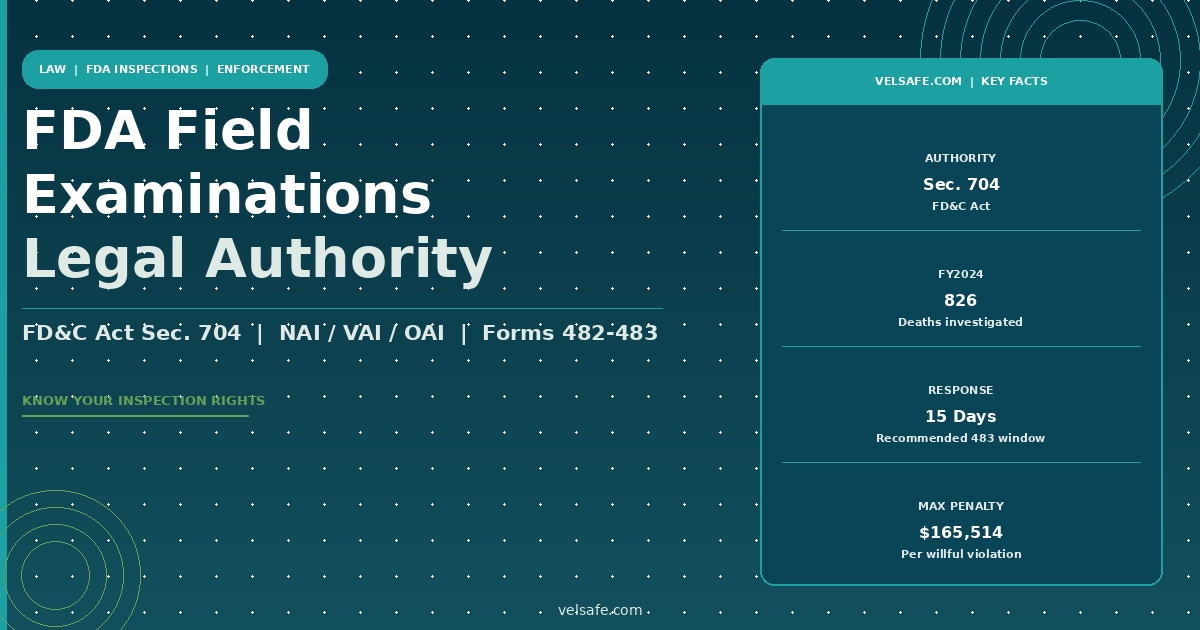
Section 702 of the FD&C Act authorizes the FDA to conduct examinations and investigations. Section 704 is the core inspection authority. It provides FDA investigators the right to enter, at reasonable times, any factory, warehouse, or establishment in which drugs, devices, food, or cosmetics are manufactured, processed, packed, or held for introduction into interstate commerce, and to inspect those facilities and their records.
Section 704(a)(1) requires FDA investigators to present their credentials and issue a written Notice of Inspection (Form FDA 482) to the owner, operator, or agent in charge before beginning an inspection. This issuance of Form FDA 482 is a legal trigger: it formally commences the inspection and places the facility on notice of the FDA’s authority to examine its operations.
The FDA’s authority under Section 704 extends to what is reasonably necessary to achieve the objective of the inspection. The agency has long maintained this interpretive position, meaning investigators may examine records, processes, equipment, materials, and facilities to the degree that bears on compliance with applicable regulations.
Key Legal Documents in a Field Examination
Understanding the forms used during an inspection matters because each document has distinct legal significance and triggers different obligations.
Types of Field Examinations
FDA field examinations are not all the same. The type of inspection, and the circumstances that triggered it, shape what investigators focus on and how the firm should respond.
Routine inspections are scheduled by the FDA’s Office of Regulatory Affairs using a risk-based workplan. Facilities are prioritized based on factors including product risk level, time since last inspection, inspection history, and complaint volume. For high-risk drug manufacturing facilities, the FDA aims to inspect on a biennial cycle. For medical device manufacturers, inspection frequency has historically varied by device class and risk profile.
Routine inspections are the baseline form of FDA oversight. They are not triggered by a specific problem at the facility, though findings from a routine inspection can escalate into directed follow-up activity.
For-cause inspections are initiated in response to a specific compliance signal: a product recall, a pattern of adverse event reports, a consumer or trade complaint, an import alert, a whistleblower complaint, or a deficiency identified in a regulatory submission. These inspections are more focused than routine surveillance and investigators typically arrive with a defined scope of review.
A for-cause inspection carries heightened significance. The FDA has specific information suggesting a potential problem, and the inspection is designed to investigate it. Companies facing a directed inspection should engage qualified regulatory counsel promptly and review the circumstances that may have triggered it before the inspection begins.
Pre-approval inspections are conducted at manufacturing sites linked to pending NDA, ANDA, BLA, or PMA submissions. The FDA inspects to verify that the facility can manufacture the product as described in the application, that the data in the submission are accurate and were generated under compliant conditions, and that the quality system is capable of supporting commercial production.
An OAI classification from a pre-approval inspection can delay or prevent product approval. Companies in late-stage submission should ensure their manufacturing sites are in a strong state of compliance before the PAI window opens.
Remote Regulatory Assessments, formalized through FDA final guidance published in 2025, are examinations of a regulated establishment or its records conducted entirely remotely. Critically, the FDA has clarified that RRAs are not inspections under Section 704(a)(1) or 704(a)(5) of the FD&C Act, which require physical entry to a facility by FDA personnel. RRAs serve as a separate compliance oversight mechanism.
Voluntary RRAs are conducted with facility cooperation; mandatory RRAs are conducted pursuant to FD&C Act authority and require records submission within a defined timeframe. No Form FDA 482 or 483 is issued for an RRA. The RRA does not replace or limit the FDA’s authority to conduct an in-person inspection.
Inspection Classification Outcomes
After an inspection, the FDA investigator prepares an Establishment Inspection Report (EIR) and makes a classification recommendation to the District Office. The final classification determines what enforcement action, if any, follows.
No objectionable conditions or practices found. No further regulatory action is required from the FDA or the firm.
Objectionable conditions found, but not significant enough for FDA to take regulatory action. The firm is expected to voluntarily correct the issues.
Major violations found. FDA will likely take further regulatory action: Warning Letter, Import Alert, Injunction, Seizure, or referral for prosecution.
An OAI classification can trigger a cascade of enforcement consequences. For drug facilities, OAI may result in an import alert restricting product from entering the US market. For device manufacturers, OAI may delay pre-market submissions. For any facility, OAI results in public disclosure through the FDA’s Inspections Data Dashboard, which is updated weekly and is reviewed by customers, partners, and investors.
Employer and Manufacturer Legal Obligations During an Inspection
Manufacturers have specific legal obligations that apply from the moment Form FDA 482 is presented.
Manufacturers must provide investigators with access to facilities, equipment, finished and unfinished materials, containers, and labeling. Records required to be maintained by regulation must be made readily available for review and copying. For medical device manufacturers under 21 CFR 820.180 (now incorporated into the QMSR), records must be available for FDA review during an inspection as a matter of regulatory requirement, not discretion.
Companies are not required to provide records that are not required by regulation, and should designate trained personnel to accompany investigators throughout the inspection. All discussions with investigators should be documented internally. Verbal commitments made during the inspection about corrective actions can be referenced against the company in subsequent enforcement proceedings.
If an investigator collects a sample, the company will receive Form FDA 484 as a receipt. Keep a retain sample of the same lot where feasible, as the FDA’s analytical results may be challenged if the firm can produce a counter-sample from the same batch.
Companies are not legally required to submit a written response to Form FDA 483, but failing to do so is broadly considered a missed opportunity and a compliance risk. A substantive, well-documented response submitted within 15 business days of the inspection close can demonstrate corrective intent and influence the final classification. The FDA reviews 483 responses when determining whether to escalate an inspection from VAI to OAI or when deciding whether to issue a Warning Letter.
Each observation in the 483 should be addressed individually. Responses that acknowledge the observation, describe the root cause analysis, identify the specific corrective and preventive actions taken or planned, and provide evidence of implementation are more persuasive than general assurances. Vague responses that promise future action without specifics are unlikely to move a classification favorably. OAI classifications may lead to regulatory meetings, Warning Letters, Import Alerts, Injunctions, or Seizures.
The 2026 Device Inspection Framework: CP 7382.850
For medical device manufacturers, the inspection landscape changed materially on February 2, 2026. The FDA replaced the Quality System Inspection Technique (QSIT) framework and Compliance Program 7382.845 with a new Compliance Program Manual, CP 7382.850. This update accompanies the QMSR and aligns the FDA’s device inspection methodology with ISO 13485:2016.
Under CP 7382.850, investigators evaluate manufacturers against the QMSR requirements and the incorporated provisions of ISO 13485. The new program places greater emphasis on risk management integration, post-market surveillance data, and evidence of a quality culture that extends beyond the quality department to organizational leadership. Investigators will specifically look for whether risk management activities are documented throughout the product realization process, and whether complaint and field data are analyzed and integrated into ongoing risk decisions.
Compliance Checklist: Inspection Readiness
FAQs
Can a company refuse entry to FDA investigators?
Refusing entry without a reasonable explanation can result in products being deemed adulterated under the FD&C Act and may constitute a prohibited act. Companies with concerns about the scope of an inspection should consult legal counsel immediately, but outright refusal is rarely defensible and typically makes the regulatory situation worse.
Is a Form FDA 483 a violation notice?
No. A Form FDA 483 lists inspectional observations the investigator believes may represent deviations from applicable requirements. It is not a final agency action and does not constitute a legal finding of violation. However, it must be taken seriously: unaddressed 483 observations are frequently cited in subsequent Warning Letters.
How long does the FDA have to issue a Warning Letter after an OAI inspection?
There is no fixed statutory deadline for Warning Letter issuance following an OAI classification. Warning Letters can be issued weeks to many months after inspection closure. Companies should not interpret a delay as an indication that no action is forthcoming.
What is the difference between an inspection and a Remote Regulatory Assessment?
An inspection under Section 704(a)(1) requires physical entry to the facility by FDA investigators and triggers the issuance of Form FDA 482 and potentially Form FDA 483. A Remote Regulatory Assessment (RRA) is conducted entirely remotely and no Form FDA 482 or 483 is issued. RRAs complement but do not replace physical inspections and do not substitute for the agency’s statutory inspectional authority.
Are foreign manufacturing facilities subject to FDA field examinations?
Yes. The FDA conducts inspections of foreign establishments that manufacture products for the US market. Foreign facilities subject to inspection include drug, device, biologic, and food manufacturers. FDA’s annual report to Congress on establishment inspections covers both domestic and foreign inspection activity. Products manufactured at facilities that refuse foreign inspections may be subject to import alerts.
References
- FD&C Act Section 704, Inspections, FDA
- Chapter 3: Establishment Inspections, FDA Investigations Operations Manual
- Inspection Classification Database, FDA
- Compliance Program 7382.850: New FDA Device Inspection Program, Complife Group
- Quality Management System Regulation (QMSR), FDA
- Understanding FDA EIR: Key Insights and Readiness, Atlas Compliance
- FDA Remote Regulatory Assessments Final Guidance, Sidley Austin
- How to Prepare for an FDA Inspection, Lachman Consultants

- VelSafe Editorial Team
-
VelSafe Staff is the editorial team at VelSafe.com, a workplace safety and compliance content platform. Our team of safety professionals, regulatory specialists, and compliance writers produces guides, tips, and insights on OSHA regulations, pharmaceutical GMP, healthcare compliance, and occupational health across construction, manufacturing, oil and gas, and life sciences sectors..
Comments are closed.