

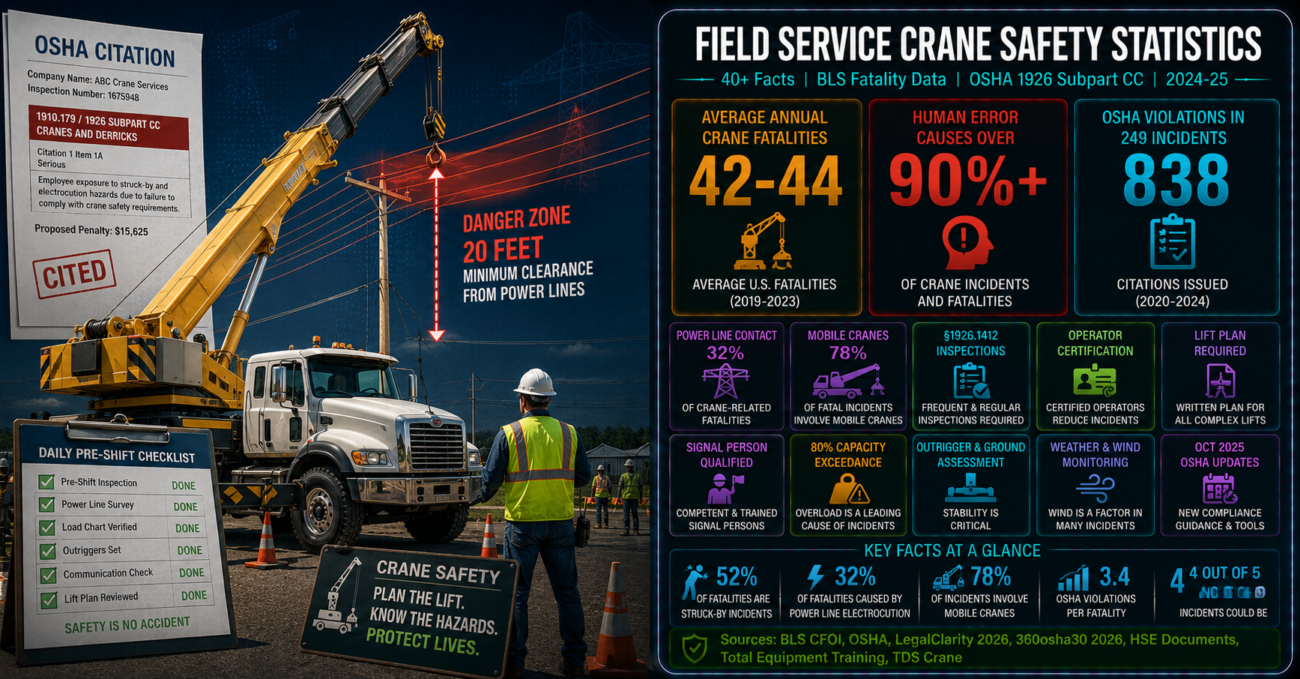
Crane safety has improved materially over the past three decades. The average of 78 annual fatalities from 1992 to 2010 fell to approximately 42 to 44 per year between 2011 and 2017, coinciding with major regulatory changes including OSHA’s Subpart CC (29 CFR 1926.1400), which took effect in 2010 and introduced comprehensive requirements for operator certification, inspection protocols, power line safety, and assembly/disassembly procedures. But the improvement has plateaued. Recent data shows no significant reduction in the annual fatality count from the 2011-2017 average, and OSHA reported 7 fatal overhead crane incidents in industrial settings in just the first seven months of 2024.
In field service environments – where mobile and truck-mounted cranes operate at different sites each day, ground conditions vary with every setup, lift plans are developed in the field rather than in engineering offices, and crew composition changes between jobs – the compounding of variable hazards makes compliance more demanding, not less. The violations found in crane fatality investigations are consistent: power line contact, inadequate pre-shift inspections, missing or incomplete lift plans, rigging failures, and uncertified operators are the recurring citations. This article compiles 40+ statistics on crane accident causes, the regulatory framework, inspection requirements, and what compliant field service crane programs do differently.
Editor's Choice: Key Crane Safety Statistics for 2024-25
1. Crane Fatality Trends: From 78 Per Year to 42-44 Per Year - and Where We Are Now
- From 1992 to 2010, crane-related workplace fatalities averaged 78 deaths per year in the U.S., per BLS Census of Fatal Occupational Injuries (CFOI) data. The historic peak was 97 deaths in 1997. This period preceded OSHA’s comprehensive Subpart CC standard, which was finalized in 2010. (BLS CFOI; LegalClarity, May 2026)
- Following OSHA’s Subpart CC implementation, crane-related fatalities dropped sharply to an average of approximately 42-44 per year between 2011 and 2017. The 2017 figure of 33 deaths was the lowest single-year total since BLS began systematic crane fatality tracking. The regulatory intervention produced a measurable and sustained safety improvement. (BLS CFOI; LegalClarity, May 2026)
- The improvement has not continued. More recent reporting suggests the annual crane fatality count has not improved significantly from the 2011-2017 average, with 2021 crane fatalities aligning with the 10-year average of 40-45 per year. OSHA reported 7 fatal overhead crane incidents in industrial settings in just the first seven months of 2024, projecting an annualized rate above the 2011-2017 industrial baseline. (360osha30.com, February 2026; HSE Documents, April 2026)
- By crane type, mobile or truck cranes are disproportionately deadly: of 375 identifiable fatal crane incidents in BLS/NIOSH data, 292 (78%) involved mobile or truck cranes. Overhead/gantry cranes accounted for 12% of fatal incidents, tower cranes 5%, and floating/barge cranes 3%. The field service environment – where mobile cranes dominate – carries the highest-proportion fatal risk. (NIOSH / eLCOSH crane analysis; BLS CFOI)
- By location, the majority of crane fatalities (27%) occurred on non-roadway construction sites, with factory and plant locations a close second at 24%. Road construction sites accounted for 8% and dockyards 7%. The distribution reflects where mobile cranes operate and where OSHA’s Subpart CC – which applies to construction – overlaps with general industry standards. (BLS CFOI; Koonz Law, 2024)
2. What Causes Crane Incidents: The Five Leading Killers
- Power line electrocution at approximately 32% of fatalities is not a random occurrence – it follows a consistent pattern: crane operators or signal persons who do not identify overhead lines before the lift, or who operate within the Table A restricted zone without implementing §1926.1408’s required mitigations. The 20-foot minimum clearance requirement under §1926.1408 is the first line of defense, but pre-lift power line surveys are what enable operators to identify whether the 20-foot threshold applies before operations begin. (OSHA §1926.1408; Total Equipment Training, May 2026)
- The 80% load capacity exceedance figure reflects a common field service failure mode: operators relying on visual estimates or rule-of-thumb calculations rather than verifiable load weights and crane capacity charts. A lift plan that specifies load weight, radius, boom angle, and configuration – and is verified against the crane’s load chart by a qualified person – is the engineering control that prevents overload events. (360osha30.com, 2026; OSHA lift plan requirements)
- The 838 OSHA violations found across 249 crane incidents averages to 3.4 violations per incident. Crane fatalities almost never occur in a single-violation environment – they occur in environments where multiple control failures coincide: no pre-shift inspection, no lift plan, no signal person, boom within power line clearance distance simultaneously. Addressing any one of these individually while allowing the others to persist does not meaningfully reduce risk. (Crane Training Universities; OSHA Outreach Courses, May 2026)
- Over 90% of crane accidents caused by human error (CICB) masks a more operationally useful finding: the specific human errors are predictable and preventable. Communication failures between operator and signal person, inadequate pre-lift planning, skipped pre-shift inspections, and rigging assembled by unqualified workers are the documented human error categories. Each has a specific regulatory requirement, training standard, and supervisory verification point. (CICB; HSE Documents, April 2026)
3. The OSHA Regulatory Framework: Subpart CC (1926.1400) and 1910.179
- OSHA’s Subpart CC (29 CFR 1926.1400) applies to power-operated equipment used in construction that can hoist, lower, and horizontally move a suspended load. Field service crane operations at construction sites fall within Subpart CC scope regardless of whether the primary work performed by the field service crew is installation, maintenance, or repair – if the work is at a construction site and the crane is expediting that work, Subpart CC governs. (OSHA scope interpretation, March 2012; 29 CFR 1926.1400)
- General industry crane operations follow 29 CFR 1910.179. OSHA standards 1926.1412 and 1910.179 were updated in October 2025, emphasizing stricter compliance and advanced inspection practices. Field service crews operating at non-construction industrial facilities must assess which standard applies before lifting begins. (TDS Crane, January 2026)
- OSHA’s $1926.1427 operator certification requirement is type-specific and employer-enforced: an operator with a mobile crane certification cannot legally operate a tower crane on a construction site, and vice versa. Employers must verify that certification type matches the specific crane being operated – not just that the operator holds any NCCCO certification. (TDS Crane, November 2025; NCCCO)
- For field service work specifically, the ground conditions requirement at §1926.1402 is the most frequently overlooked compliance element. At construction sites where the field service crew is not the primary contractor, the equipment user (the field service employer) must obtain ground condition information from the controlling entity before setting up the crane. Operating on assumed rather than verified ground conditions is a documented citation pattern in OSHA crane enforcement. (OSHA §1926.1402; crane compliance analysis)
- Signal person qualification under §1926.1428 must be method-specific. In multi-employer worksite environments – common in field service – employers cannot assume that another employer’s worker is qualified to serve as a signal person for their crane operation unless documented qualification for the specific signaling method (hand signals, voice/radio, or electronic) can be produced. (OSHA §1926.1428; multi-employer worksite compliance)
4. Crane Inspection Requirements: Three Tiers, One Compliance Gap
- OSHA’s three-tier inspection system (pre-shift, monthly, annual) under §1926.1412 is designed to catch different categories of failure: pre-shift inspection catches operational and environmental changes (ground conditions, weather, setup issues); monthly inspection catches developing mechanical deterioration; annual inspection catches cumulative structural wear and systems-level degradation. Field service operations that compress these three functions into only pre-shift checks are systematically missing two of the three detection layers. (OSHA §1926.1412; TDS Crane, January 2026)
- Wire rope inspection under §1926.1413 requires daily inspection by a qualified person – more frequent than the three-tier crane body inspection schedule. Wire rope is the life safety critical path for every suspended load: failure of a crane’s wire rope while a load is suspended is the mechanical precursor to the 27% of fatalities attributed to rigging failure and a substantial portion of the 37% attributed to crushed-by-load events. (OSHA §1926.1413; crane fatality cause analysis)
- Documentation is not optional. OSHA requires inspection logs that record: the date of inspection, the type of inspection (pre-shift, monthly, annual), the identity of the person performing the inspection, and any deficiencies identified and how they were addressed. Field service operations that inspect equipment but do not document the inspection are unable to demonstrate compliance during OSHA investigations of incidents. (OSHA §1926.1412; Cal/OSHA 48-month retention; TDS Crane, January 2026)
- The October 2025 updates to OSHA’s crane inspection standards emphasize advanced inspection practices and stricter compliance, particularly for mobile cranes in variable field environments. The practical implication for field service: pre-shift inspection checklists that were adequate for 2020 compliance may not satisfy the elevated documentation expectations in post-October 2025 enforcement. (TDS Crane, January 2026)
5. Power Line Safety: The 20-Foot Rule and the §1926.1408 Framework
- Power line contact is responsible for approximately 32% of crane-related fatalities – the leading single cause – despite being one of the most preventable failure categories. The preventive requirement is straightforward: identify whether overhead lines are present before lifting, determine the voltage and required clearance, and implement the appropriate mitigation before the boom is raised. The fatalities occur when this pre-lift survey step is skipped entirely. (OSHA §1926.1407-1411; Total Equipment Training, May 2026)
- OSHA’s Table A distances for power line clearance are specific to voltage: for lines up to 350 kV, the default minimum clearance is 20 feet. Operations closer than Table A distances are permitted only if the requirements of §1926.1410 are followed, which requires utility company coordination, capacity verification, and specific physical controls. Field service employers who operate within Table A distances without completing the §1926.1410 process are in direct violation regardless of how many prior lifts were completed without incident. (OSHA §1926.1408-1410; crane compliance analysis)
- The multi-employer worksite dimension: in field service environments where the host facility controls the power distribution infrastructure, the field service crane operator depends on the host facility to have identified and communicated the location and voltage of overhead lines. This information transfer must happen before the crane is set up, not during the lift. Pre-job coordination with the host facility’s facilities team or safety officer is the mechanism for obtaining the required ground and overhead hazard information. (OSHA §1926.1402; multi-employer worksite power line safety)
6. Operator Certification and Signal Person Qualification: The Human Factor Framework
- Under 29 CFR §1926.1427, every crane operator working in construction must hold certification by an accredited testing organization for the type of crane being operated. The National Commission for the Certification of Crane Operators (NCCCO) is the most widely recognized accredited certification body. NCCCO certification requires passing both written and practical examinations covering load charts, rigging techniques, and safe operating procedures. (OSHA §1926.1427; TDS Crane, November 2025)
- Certification is type-specific and cannot be transferred across crane categories. An operator with NCCCO mobile crane certification cannot legally operate a tower crane on a construction site without tower crane certification. In field service operations where the same crew may use different crane configurations at different jobs, each operator must hold certification for each crane type they will operate. (TDS Crane, November 2025; NCCCO)
- Beyond third-party certification, §1926.1427 also requires an employer-conducted evaluation on the specific machine the operator will use. This evaluation is separate from the NCCCO certification and assesses whether the operator can safely operate the specific crane (make, model, configuration) they will be assigned. For field service operations using rented or customer-site cranes, the employer evaluation must be completed before lifting begins on each new equipment configuration. (OSHA §1926.1427; Scarlet Tech, September 2025)
- Signal person qualification under §1926.1428 must be documented for each signaling method the signal person will use: hand signals, voice/radio communication, and electronic signaling are separate qualifications. The qualification must be documented – a signal person who cannot produce or whose employer cannot produce qualification documentation cannot legally perform signal person duties. For field service operations at multi-employer worksites, this documentation verification responsibility falls on the crane operator’s employer, not the site’s primary contractor. (OSHA §1926.1428; Scarlet Tech, September 2025)
7. Lift Planning and Field Service Compliance: What Every Lift Requires
- Lift plans are not bureaucratic documents – they are engineering calculations in a documented format. A compliant lift plan for field service operations must state: load weight (verified, not estimated), lift radius, boom angle and configuration, applicable load chart data confirming capacity, ground condition assessment, power line clearance status, rigging configuration with capacity verification, and the identity of the competent/qualified person who approved the plan. NCCCO provides a quick-reference lift plan format that mirrors OSHA’s requirements. (OSHA lift plan requirements; Scarlet Tech, September 2025)
- In field service environments, the critical lift plan discipline is treating each setup at each site as a new engineering problem, not a repeat of the previous setup. Ground conditions differ. Overhead hazards differ. Load weights may differ from the previous similar job. A lift plan developed for Monday’s site at Customer A does not transfer to Tuesday’s site at Customer B, even if the work is nominally the same. (field service crane safety principles)
- Rigging must be performed by qualified riggers. OSHA’s definition of a qualified rigger is a person who, by possession of a recognized degree, certificate, or professional standing, or by extensive knowledge, training, and experience, has demonstrated the ability to solve problems related to rigging. A worker who is assigned to rig a load without meeting this qualification is not a qualified rigger under OSHA definitions, and the lift is not in compliance regardless of how many times a similar lift has been performed without incident. (OSHA rigger qualification definition; 29 CFR 1926)
- Assembly and disassembly of cranes under §1926.1404 requires a competent and qualified Assembly/Disassembly (A/D) director to supervise the work. This requirement applies whenever a crane is assembled or disassembled – including setup at the beginning of a field service job and breakdown at the end. Field service employers who assign assembly to general crew members without an A/D director are in direct citation exposure. (OSHA §1926.1404; Scarlet Tech, September 2025)
Key Takeaways for Field Service Crane Operators, Employers, and Safety Managers
Sources
Government and Regulatory Sources
- OSHA 29 CFR 1926.1400 – Subpart CC Scope: construction crane applicability; power-operated equipment that hoists, lowers, and horizontally moves suspended loads
- OSHA 29 CFR 1926.1408 – Power Line Safety (Equipment Operations): 20-foot default clearance; Table A distances by voltage; §1926.1410 requirements for closer operations
- OSHA 29 CFR 1926.1412 – Inspections: pre-shift, monthly, and annual inspection requirements; what must be checked; documentation requirements
- OSHA 29 CFR 1926.1427 – Operator Certification and Qualification: NCCCO and equivalent accredited certification; type-specific requirements; employer evaluation requirement
- OSHA 29 CFR 1926.1428 – Signal Person Qualifications: method-specific qualification; documentation requirement; third-party qualification option
Statistics and Industry Sources
- LegalClarity (May 2026) – OSHA Crane Accident Statistics: 78/yr average 1992-2010; 42/yr average 2011-2017; 33 in 2017 (lowest); fatality mechanisms and locations; BLS CFOI sources
- 360osha30.com (February 2026) – Crane Safety Statistics 2026: 44/yr BLS average; 7 fatal overhead incidents Jan-Jul 2024; 37% crushed by load; 27% rigging failure; 12% falls; 80% capacity exceedance
- OSHA Outreach Courses (May 2026) – Crane Safety Statistics 2021-2025: 249 incidents / 838 violations / 133 fatalities / 133 injuries (Crane Training Universities study); human error 90%+; 2021-2024 trend
- HSE Documents (April 2026) – Crane Safety News 2024-2026: CICB 90%+ human error; 37% crushed by load; 27% rigging failures; “inspection and training failures dressed up as accidents”
- Total Equipment Training (May 2026) – Causes of Crane Accidents: 52% struck-by; 32% power line electrocution; 21% collapse; 18% struck by boom/jib; BLS/OSHA sources
- Koonz Law (March 2024) – Common Types of Crane Accidents: 27% non-roadway construction; 24% factory/plant; 8% road construction; 7% dockyards; overhead power line location statistics
- NIOSH / eLCOSH – Crane Deaths in Construction: 78% of fatal incidents involve mobile/truck cranes (292 of 375 identifiable); 12% overhead cranes; 5% tower cranes; 3% floating cranes
- Scarlet Tech (September 2025) – OSHA Crane Regulations Practical Guide: §1926.1427 operator certification; §1926.1402 ground conditions; §1926.1428 signal persons; lift plan elements; multi-employer worksites
- TDS Crane (January 2026) – OSHA Crane Inspection Requirements: §1926.1412 and §1910.179 October 2025 updates; three-tier inspection system; Cal/OSHA 48-month record retention; pre-shift checklist elements
- TDS Crane (November 2025) – OSHA Crane Operator Requirements: type-specific NCCCO certification; 5-year renewal; employer evaluation requirement; expired certification citation exposure