

When a sponsor submits a marketing application to the FDA, the agency does not evaluate the clinical data in isolation. It considers who conducted the studies and whether any financial relationships between those investigators and the sponsor could have influenced the results.
21 CFR Part 54 is the regulation that governs this evaluation. It requires sponsors and applicants to collect, maintain, and disclose specific financial information about clinical investigators involved in covered studies, and it gives the FDA authority to act on that information when it raises questions about data integrity.
What 21 CFR Part 54 Requires and Why It Exists
The financial disclosure regulation was established to ensure that clinical data submitted in marketing applications is reliable and free from the potential influence of financial conflicts of interest. A clinical investigator who stands to benefit financially from a favorable study outcome has an incentive, whether conscious or not, that the FDA considers relevant to how it evaluates their data.
21 CFR Part 54 is critical for maintaining the credibility of clinical trial data, which underpins regulatory decisions affecting public health. By mitigating conflicts of interest, it ensures that clinical study results are not skewed by financial incentives. Compliance with this regulation safeguards the legitimacy of research outcomes, protects patient safety, and fosters trust among healthcare providers, regulators, and the public.
The regulation applies to drug, biological product, and medical device applications. For device studies, it reaches IDE-regulated investigations. For drug and biologic studies, it applies to IND-regulated trials that generate data submitted in NDA, ANDA, BLA, and similar applications.
Who Is Subject to the Regulation
The Applicant is the party submitting the marketing application to the FDA. The applicant is responsible for submitting a complete list of all clinical investigators who conducted covered studies, and for providing either a certification of no disclosable financial interest (Form FDA 3454) or a disclosure of financial interests (Form FDA 3455) for each non-employee investigator.
The Sponsor under Part 54 has a broader definition than the IND or IDE sponsor. A sponsor under this regulation is any party that provides material support to a covered study, which can include the marketing application holder, a contract research organization, or any other entity whose financial arrangements with investigators must be disclosed. If both the parent company and its subsidiary provided material support to the study, then all investigators must report their financial arrangements with both entities.
The Clinical Investigator is any individual who is directly involved in the treatment or evaluation of research subjects in a covered study. Each clinical investigator who is not a full-time or part-time employee of the sponsor is required to provide the sponsor with sufficient accurate financial information to allow for complete disclosure or certification, and to update this information if any relevant changes occur during the study and for one year following its completion. The disclosure obligation extends to the investigator’s spouse and each dependent child.
What Is a Covered Clinical Study
Not every clinical study triggers Part 54 obligations. The regulation applies specifically to covered clinical studies.
A covered clinical study means any study of a drug or device in humans submitted in a marketing application that the applicant or FDA relies on to establish that the product is effective, or any study in which a single investigator makes a significant contribution to the demonstration of safety.
This would, in general, not include Phase I tolerance studies or pharmacokinetic studies, most clinical pharmacology studies (unless they are critical to an efficacy determination), large open safety studies conducted at multiple sites, treatment protocols, and parallel track protocols. Applicants uncertain about whether a particular study qualifies may consult with the FDA.
What Must Be Disclosed
Compensation affected by study outcome. Any financial arrangement where the investigator’s compensation could be higher for a favorable outcome than an unfavorable one. This includes compensation explicitly tied to a favorable result, equity interests linked to study success, and royalty interests tied to product sales. This type of arrangement must always be disclosed regardless of its value.
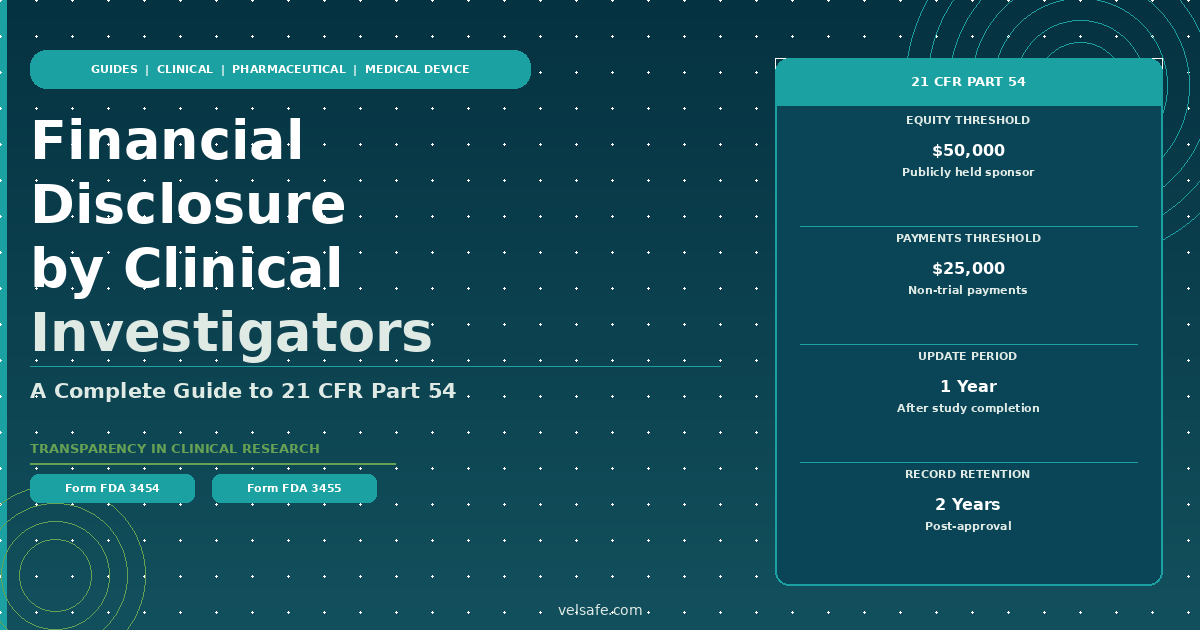
Significant equity interest in a publicly held sponsor. An equity interest, including stock or stock options, in a publicly held sponsor company that exceeds $50,000 in value during the period of the study and for one year following its completion. The threshold applies per investigator and includes interests held by the investigator’s spouse and dependent children.
Proprietary interest in the tested product. Any proprietary interest the investigator holds in the product being studied, including a patent, trademark, copyright, or licensing arrangement.
Significant payments of other sorts. Payments by the sponsor to the investigator or the investigator’s institution that exceed $25,000 during the study period and for one year after completion. This threshold specifically excludes the costs of conducting the clinical trial itself and covers consulting fees, speaker honoraria, retainers, and similar payments that go beyond trial support.
What Is Not Disclosable
A number of financial arrangements are specifically excluded from Part 54 disclosure requirements. Financial compensation that is not reportable includes any support used in execution of the clinical trial, and any payments to an investigator’s institution that are not specifically targeted to the investigator personally.
Payments for the direct costs of conducting the study, including site fees, subject compensation payments, and equipment purchased at cost, are not disclosable. The regulation targets financial arrangements that go beyond standard clinical trial compensation and create a potential conflict of interest.
Forms FDA 3454 and 3455
The two submission forms under Part 54 are the primary compliance vehicle at the marketing application stage.
The Form FDA 3454 must be dated and signed by the chief financial officer or other responsible corporate official. If the certification covers less than all covered clinical data in the application, the applicant must include a list of the studies covered by the certification.
When a Form FDA 3455 is submitted disclosing financial interests, the applicant must also describe the steps taken to minimize the potential for bias, including any statistical adjustments or audit procedures used to assess the impact of the financial interest on the study data.
Record Retention Requirements
Financial disclosure records must be retained for two years after approval of the application. This retention requirement applies to all financial arrangement records, compensation agreements, and the documentation supporting whether Form FDA 3454 or Form FDA 3455 was submitted for each investigator.
Sponsors must obtain clinical investigator financial information before allowing the clinical investigator to participate in a covered clinical study. This means that financial disclosure collection is a pre-enrollment obligation, not something assembled at the application stage.
What Happens When Disclosable Interests Are Found
A Form FDA 3455 disclosure does not automatically disqualify the investigator’s data. The FDA uses the disclosed financial information in conjunction with information about the design and purpose of the study to assess the reliability of the data.
If the FDA determines that the financial interests or arrangements raise a serious question about data integrity, the agency may initiate audits of the data derived from that investigator, request further analyses to evaluate the effect on overall study outcomes, or conduct a sensitivity analysis excluding the affected investigator’s data.
Step-by-Step Compliance Guide
Common Compliance Failures
Collecting disclosures too late. Many sponsors collect financial disclosure forms at the end of the study rather than before investigator enrollment. By that point, the investigator has already been involved in subject selection, treatment, and data interpretation. The regulation requires collection before participation begins.
Omitting sub-investigators. The definition of clinical investigator under Part 54 includes all individuals directly involved in the treatment or evaluation of research subjects. Sponsors that collect disclosures only from principal investigators have an incomplete Part 54 submission.
Failing to update disclosures. Financial relationships change during multi-year studies. An investigator who had no disclosable interests at enrollment may receive a consulting agreement or stock grant during the study period. Sponsors that do not actively remind investigators of their update obligations will often not learn of these changes until after the application is submitted.
Misapplying the $25,000 threshold. The significant payments threshold excludes the costs of conducting the clinical trial but applies to consulting fees, advisory board participation, speaker honoraria, and ongoing retainers. Sponsors who assume all payments made in connection with the study are excluded as trial support routinely underreport disclosable interests.
Financial Disclosure in Medical Device Studies
The Part 54 financial disclosure requirements apply to medical device studies submitted in PMA applications and, where applicable, de novo requests. For device studies conducted under an IDE, the sponsor must obtain financial disclosure information from clinical investigators before they participate in the covered study, per 21 CFR 812.43(c).
Device studies often involve a smaller number of investigational sites than drug trials, which makes the individual investigator’s data contribution proportionally larger. This increases the scrutiny the FDA applies to financial disclosures in device applications, because a single investigator with a disclosable financial interest may have contributed a material percentage of the total efficacy dataset.
“For device PMAs with few sites, the FDA pays particular attention to whether any investigator with a financial stake in the sponsor contributed disproportionately to the efficacy data. Sponsors should be prepared to show that the data is robust across all sites, not dependent on the output of any single investigator.”
Quick Reference
References
- 21 CFR Part 54: Financial Disclosure by Clinical Investigators, eCFR
- 21 CFR Part 54 Glossary and Requirements, Zamann Pharma
- 21 CFR Part 54 Financial Disclosure Obligations for Investigators and Sponsors, FDAGuidelines.com
- FDA’s Requirements for Financial Disclosure, Sharlin Consulting
- FDA Conflict of Interest Policies: Financial Disclosure Requirements, University of Kentucky Research
- A Guide to Financial Disclosures for Investigators, Duke University School of Medicine
- 21 CFR 54.4: Certification and Disclosure Requirements, Law.Cornell.edu