

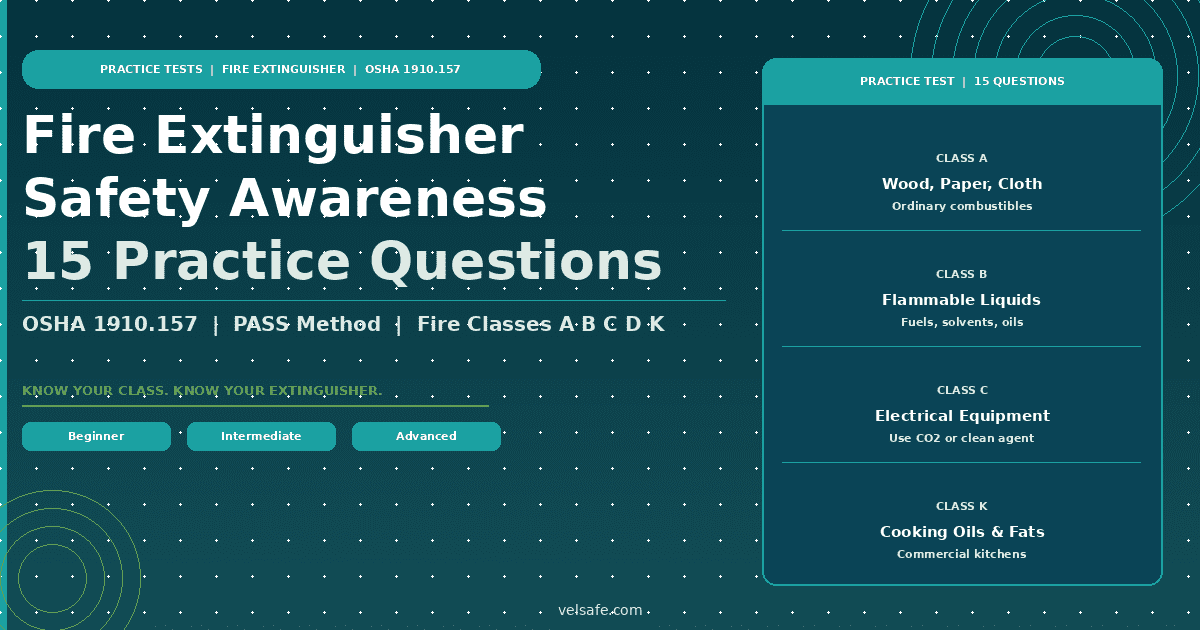
Fire extinguisher safety awareness training is required for all employees under OSHA 29 CFR 1910.157. Whether you work in an office, a warehouse, a manufacturing facility, or remotely, knowing when to fight a fire and when to evacuate is a core workplace safety competency.
These 15 practice questions cover fire classes, extinguisher types, the PASS method, OSHA placement requirements, inspection obligations, and realistic workplace scenarios. Each question includes a full explanation of the correct answer and why the other options are wrong.
Fire Extinguisher Fundamentals
Question 1 — Beginner
Which of the following is the correct sequence of steps when using a fire extinguisher?
A) Pull, Aim, Sweep, Squeeze B) Pull, Aim, Squeeze, Sweep C) Point, Activate, Sweep, Stop D) Prepare, Assess, Signal, Suppress
Show Answer
Correct Answer: B, Pull, Aim, Squeeze, Sweep (PASS)
The PASS method is the industry-standard technique taught in all OSHA-compliant fire extinguisher training: Pull the pin to unlock the extinguisher, Aim the nozzle at the base of the fire (not the flames), Squeeze the handle to discharge the agent, and Sweep from side to side across the base. Option A reverses Squeeze and Sweep, which would cause you to discharge the agent before you are properly aimed at the base. Options C and D are not recognized methods and do not appear in any OSHA or NFPA standard.
Question 2 — Beginner
Under OSHA 29 CFR 1910.157, who is required to receive fire extinguisher training?
A) Only employees designated as fire wardens B) Only employees who work near flammable materials C) All employees where extinguishers are provided for employee use D) Only employees in manufacturing or warehouse settings
Show Answer
Correct Answer: C, All employees where extinguishers are provided for employee use
Under 1910.157(g)(1), the employer must provide an educational program to familiarize employees with the general principles of fire extinguisher use and the hazards involved with incipient-stage firefighting. This applies wherever extinguishers are accessible for employee use. Option A is incorrect, awareness training is not limited to fire wardens; only hands-on operational training is limited to designated responders. Option B is incorrect because proximity to flammable materials is not the trigger. Option D is incorrect because the standard applies across all general industry settings, including offices and remote worksites.
Question 3 — Beginner
What does a Class A fire extinguisher protect against?
A) Flammable liquids and gases B) Electrical equipment fires C) Ordinary combustibles such as wood, paper, and cloth D) Combustible metals like magnesium and sodium
Show Answer
Correct Answer: C, Ordinary combustibles such as wood, paper, and cloth
Class A extinguishers are designed for ordinary combustible materials including wood, paper, cardboard, cloth, rubber, and most plastics. These are the most common fuels in offices, warehouses, and general workspaces. Option A describes Class B fires (flammable liquids and gases such as gasoline, solvents, and propane). Option B describes Class C fires (energized electrical equipment). Option D describes Class D fires, which require specialized extinguishing agents like dry powder and occur with metals such as magnesium, titanium, and sodium.
Fire Classes and Extinguisher Types
Question 4 — Intermediate
A worker in a commercial kitchen notices a grease fire in a deep fryer. Which extinguisher class is specifically designed for this hazard?
A) Class A B) Class B C) Class C D) Class K
Show Answer
Correct Answer: D, Class K
Class K extinguishers are specifically designed for fires involving combustible cooking media including vegetable oils, animal fats, and grease. They use a potassium-based wet chemical solution that cools the fire and reacts with burning oils to form a soapy, foam-like layer that smothers the flames. NFPA 10 recommends Class K units be placed no more than 30 feet from cooking operations. Class A would be ineffective and potentially dangerous on a grease fire. Class B covers flammable liquids but not cooking oils. Class C covers electrical fires. Using a water-based Class A extinguisher on a grease fire can cause a violent steam explosion and is a commonly cited training failure.
Question 5 — Intermediate
An ABC dry chemical extinguisher is considered multipurpose. Which fire class does it NOT effectively protect against?
A) Class A, paper and wood fires B) Class B, flammable liquid fires C) Class C, electrical fires D) Class D, combustible metal fires
Show Answer
Correct Answer: D, Class D, combustible metal fires
ABC dry chemical extinguishers are rated for Class A, B, and C fires only. They are ineffective against Class D fires involving combustible metals such as magnesium, titanium, sodium, or aluminum alloys. Class D fires require specialized dry powder agents (not dry chemical) that are formulated to form a crust over burning metals, cutting off oxygen. Using a standard ABC extinguisher on a Class D fire can intensify the reaction or spread burning material. Facilities handling combustible metals must stock dedicated Class D extinguishers in those specific areas.
Question 6 — Intermediate
A maintenance worker discovers a fire in a server room involving energized electrical equipment. What type of extinguisher should be used?
A) Class A water extinguisher B) Class K wet chemical extinguisher C) Class C CO2 or clean agent extinguisher D) Class B foam extinguisher
Show Answer
Correct Answer: C, Class C CO2 or clean agent extinguisher
Class C fires involve energized electrical equipment. CO2 and clean agent extinguishers are non-conductive and leave no residue, making them safe and appropriate for use on electrical fires and valuable electronic equipment. Using a Class A water extinguisher on an electrical fire creates an electrocution hazard, water conducts electricity. Class K is designed for cooking oils and is not appropriate here. Class B foam extinguishers can also conduct electricity and should not be used on energized equipment. Note: if the power can be safely de-energized, the fire may downgrade to Class A, but extinguisher selection should be made before de-energization if the fire is active.
OSHA Placement and Maintenance Requirements
Question 7 — Intermediate
Under OSHA 29 CFR 1910.157, what is the maximum travel distance to a Class A fire extinguisher in a general industry workplace?
A) 25 feet B) 50 feet C) 75 feet D) 100 feet
Show Answer
Correct Answer: C, 75 feet
OSHA 29 CFR 1910.157(d)(1) requires that portable fire extinguishers for Class A hazards be located so that the travel distance to any extinguisher from any point in the workplace does not exceed 75 feet. For Class B hazards, the maximum travel distance is 50 feet. For Class K extinguishers, NFPA 10 recommends a maximum travel distance of 30 feet from the cooking hazard. Extinguishers must also be placed along normal paths of travel, including near exits, and must be mounted in visible and accessible locations per 1910.157(c)(1).
Question 8 — Beginner
How frequently must portable fire extinguishers receive a documented maintenance inspection under OSHA 29 CFR 1910.157?
A) Monthly B) Quarterly C) Annually D) Every three years
Show Answer
Correct Answer: C, Annually
OSHA 29 CFR 1910.157(e)(3) requires that portable fire extinguishers be subjected to an annual maintenance check. Records of this annual maintenance check must be kept for at least one year. Additionally, visual inspections must be conducted monthly, but these visual checks do not need to be documented in the same way as the annual maintenance. Quarterly inspections are not an OSHA requirement but some facilities implement them voluntarily. A three-year cycle applies to hydrostatic testing for certain extinguisher types, not annual maintenance.
Question 9 — Intermediate
An employer decides that employees will evacuate rather than fight fires, and removes fire extinguishers from the workplace. Which OSHA statement is correct?
A) This is not permitted under any circumstances B) This is permitted if the employer has a written emergency action plan requiring evacuation C) This is permitted only in offices with fewer than 10 employees D) This is permitted only if the local fire department is notified
Show Answer
Correct Answer: B, This is permitted if the employer has a written emergency action plan requiring evacuation
OSHA 29 CFR 1910.157(a) states that the standard applies to the placement, use, maintenance, and testing of portable fire extinguishers provided for the use of employees. If an employer decides that employees will not use extinguishers and will instead evacuate, the employer is not required to provide them, but this decision must be reflected in a written emergency action plan under 1910.38 that clearly requires evacuation. OSHA’s position is that the decision to use extinguishers may not be left to individual employees and must be spelled out in the plan. Options C and D contain conditions that OSHA does not recognize as triggers for this exemption.
Inspection, Training, and Documentation
Question 10 — Intermediate
What information must be recorded and retained after the annual maintenance inspection of a portable fire extinguisher?
A) The name of the employee who last used the extinguisher B) The maintenance date and the identity of the person who performed the check, retained for one year C) The date of installation and the serial number only D) The brand and model, retained for the lifetime of the extinguisher
Show Answer
Correct Answer: B, The maintenance date and the identity of the person who performed the check, retained for one year
OSHA 29 CFR 1910.157(e)(4) requires that the employer retain a record of the annual maintenance check. The record must show the maintenance or recharge date and must be kept for at least one year after the last entry or until the next maintenance check. Retaining the installer’s name or the brand and model are not specific OSHA documentation requirements, though they may be recorded as part of good practice. The last user is not relevant to maintenance documentation.
Question 11 — Advanced
An employer provides fire extinguishers and designates certain employees as first responders who are expected to use them. What training requirement applies specifically to these employees under OSHA 1910.157?
A) The same general awareness training as all other employees B) Hands-on training that includes how to discharge the extinguishers appropriate for the anticipated fire types C) A written exam covering all five fire classes D) Certification through an accredited third-party program
Show Answer
Correct Answer: B, Hands-on training that includes how to discharge the extinguishers appropriate for the anticipated fire types
OSHA 1910.157(g)(2) requires that employees who are designated to use fire extinguishers must receive hands-on training, not just awareness training. The hands-on training must include how to discharge the specific types of extinguishers the employee would actually use in a fire emergency. Importantly, OSHA does not require live fire demonstrations, but employees must practice the discharge operation. A written exam is not an OSHA requirement. Third-party certification is not mandated by 1910.157, though some employers require it as a quality measure. General awareness alone is insufficient for designated responders.
Question 12 — Advanced
How often must hydrostatic testing be conducted on a CO2 fire extinguisher cylinder under NFPA 10 and OSHA standards?
A) Every year B) Every 3 years C) Every 5 years D) Every 12 years
Show Answer
Correct Answer: C, Every 5 years
Under NFPA 10 and referenced by OSHA 1910.157(f), CO2 extinguisher cylinders must undergo hydrostatic testing every 5 years. Hydrostatic testing involves pressurizing the cylinder to verify structural integrity and check for leaks or weaknesses. This differs from the annual maintenance check, which is a visual and functional inspection. Dry chemical extinguishers typically require hydrostatic testing every 12 years. Stored-pressure dry chemical with stainless steel shells require testing every 5 years. The 3-year interval applies to certain agent recharge cycles, not hydrostatic testing. Annual testing is not required for hydrostatics.
Emergency Response and Egress
Question 13 — Intermediate
Before attempting to use a fire extinguisher, which assessment should a worker complete first?
A) Confirm the extinguisher has been recently inspected B) Determine the class of fire, confirm the extinguisher is appropriate, ensure a clear escape route, and confirm the fire is small enough to fight C) Radio the fire warden for approval D) Ensure all coworkers have evacuated the area
Show Answer
Correct Answer: B, Determine the class of fire, confirm the extinguisher is appropriate, ensure a clear escape route, and confirm the fire is small enough to fight
Before engaging a fire with an extinguisher, workers should complete four rapid assessments: identify the fire class; confirm the extinguisher on hand is rated for that class; verify a clear path of egress behind them so they can retreat if the fire grows; and confirm the fire is still at an incipient stage (roughly wastebasket size or smaller). If any of these conditions are not met, the correct decision is to evacuate and call emergency services. Option A (checking inspection records) is not the right pre-engagement step, there is no time. Option C requires radioing for approval, which delays response. Option D (waiting for evacuation) is not a prerequisite to using an extinguisher, and waiting could allow the fire to grow beyond the incipient stage.
Question 14 — Advanced
A worker successfully uses an extinguisher to put out a small paper fire. The area appears safe. What should the worker do next?
A) Return the extinguisher to its mount and report the incident to a supervisor B) Remain in the area and monitor for re-ignition, then report to a supervisor C) Immediately evacuate, report the incident, and ensure the extinguisher is taken out of service for inspection and recharge D) Refill the extinguisher from the nearest recharge station and return it to service
Show Answer
Correct Answer: C, Immediately evacuate, report the incident, and ensure the extinguisher is taken out of service for inspection and recharge
After using an extinguisher, the worker should leave the area (even if the fire appears out, re-ignition is a real risk as some materials retain heat), report the incident to a supervisor and/or safety officer, and ensure the extinguisher is removed from service for inspection and recharge. A partially discharged extinguisher must never be returned to the mount for future use without being fully recharged and inspected first. Option A is incorrect because returning a used extinguisher to service is a safety violation. Option B is partially correct in noting re-ignition risk but keeping a worker in a post-fire environment without PPE is not appropriate. Option D is incorrect, employees are not authorized to self-recharge extinguishers; this must be done by a qualified service provider.
Scenario-Based Learning
Question 15 — Advanced
A hot work permit has been issued for welding in a manufacturing bay. The safety checklist requires a fire watch with a fire extinguisher posted for one hour after work completion. The welder finishes, and the assigned fire watch leaves after 20 minutes because the area looks safe. Thirty minutes later, a fire starts in insulation that was smoldering undetected. What violations occurred and what was the correct procedure?
A) No violation, leaving after 20 minutes is acceptable if no visible smoke is present B) The fire watch violated the hot work permit requirement; the watch must remain for the full one hour after completion regardless of visual assessment C) The welder is responsible for remaining on fire watch after their own work D) A violation occurred only if the fire causes injury or property damage
Show Answer
Correct Answer: B, The fire watch violated the hot work permit requirement; the watch must remain for the full one hour after completion regardless of visual assessment
This scenario illustrates one of the most common and dangerous fire watch failures in manufacturing environments. Smoldering fires in insulation, combustible dust, and structural materials can remain invisible for extended periods before igniting. OSHA 29 CFR 1910.252(a)(2)(iii) requires that a fire watch be maintained for at least 30 minutes after hot work is complete in most cases, but many facilities’ hot work permit programs extend this to 60 minutes or more, and permit requirements are legally binding for the work covered. Departing early because the area “looks safe” violates the permit and negates the entire purpose of the fire watch. Option A is incorrect, visual assessment alone does not satisfy the watch requirement. Option C is incorrect, the welder and fire watch are distinct roles, and the welder is not assigned fire watch duty after completing their work. Option D is incorrect, a violation exists at the moment the permit terms are breached, not at the moment harm occurs.
Supporting Resources
Understanding fire extinguisher safety awareness is one component of a broader hot work, fire prevention, and emergency egress compliance program. Related topics that complement this practice test include fire watch and welding safety protocols, hot work permit requirements under OSHA 1910.252, prevention and egress planning under 1910 Subpart E, and fire extinguisher classification standards under NFPA 10.
For teams preparing for OSHA inspections or refreshing their fire prevention training programs, the OSHA Outreach 10-hour and 30-hour General Industry courses cover fire protection requirements in depth. The National Fire Protection Association’s NFPA 10 standard is the primary technical reference for extinguisher selection, placement, and maintenance beyond what OSHA’s regulation specifies.
Sources
- OSHA 29 CFR 1910.157: Portable Fire Extinguishers, OSHA
- OSHA Fire Extinguisher Training Requirements, Enviro Safety Products
- Understanding OSHA Requirements for Fire Extinguishers, OSHA Education Center
- Fire Extinguisher Classes and Placement, TRADESAFE
- OSHA Fire Extinguisher Training Requirements 101, CPR1
- Mastering Fire Extinguisher Use, OSHA Safety Training
- Portable Fire Extinguisher Training Resources, OSHA Training
- Understanding OSHA Fire Extinguisher Requirements, Mid-South Safety Services